Variance in Machine Learning
By Sriram
Updated on Aug 18, 2026 | 15 min read | 7.04K+ views
Share:

All courses
Certifications
More
By Sriram
Updated on Aug 18, 2026 | 15 min read | 7.04K+ views
Share:
Table of Contents
Key Highlights
Want to build stronger machine learning skills and understand concepts like variance, bias, model selection, and overfitting? Explore Machine Learning Courses in India from upGrad and take your ML knowledge from concepts to practical applications.
Popular AI Programs
Variance in machine learning describes how much a model’s predictions change when it is trained on different samples of data.
A high-variance model is sensitive to small changes in training data, while a low-variance model gives more consistent predictions.
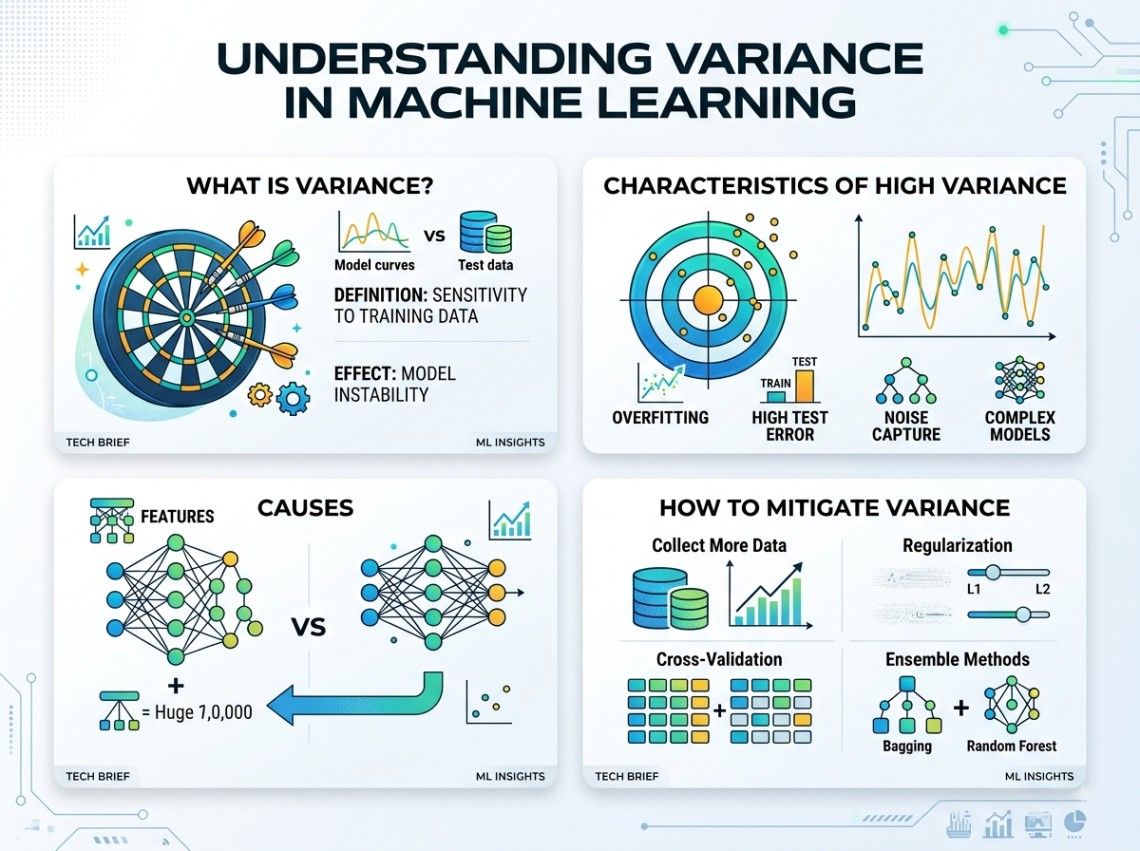
For example, a decision tree predicting house prices may produce very different results if a few training examples are removed. This sensitivity indicates high model variance.
It is important not to confuse model variance with statistical variance, which measures how much numerical values differ from their mean.
High variance is strongly connected to overfitting. An overfit model learns the training data too closely and captures details that don't represent broader patterns.
A model might achieve 98% training accuracy but only 72% validation accuracy. That gap doesn't automatically prove high variance, but it's a strong reason to investigate model complexity and data quality.
What is variance in machine learning becomes easier to understand when you look at this difference between training and unseen data. The model isn't necessarily learning nothing. It's learning too specifically.
A model shouldn't only perform well on training data. It should also make reliable predictions on new data. That's why variance matters.
A high-variance model may show very low training error but much higher validation error. This gap can signal overfitting and poor generalisation. Variance also affects model selection because complex models can become unstable when the dataset is small or noisy.
Generalisation means how well a model performs on unseen data. High variance can hurt it because the model relies too heavily on specific training examples.
For example, a fraud detection model may work well on past transactions but struggle with new ones. Validation testing helps reveal this problem before deployment.
Complex models can capture detailed patterns, but they can also learn random noise. What is variance in machine learning becomes clearer here because model complexity and dataset size directly affect stability.
A complex model may work well with enough quality data. With limited data, the same model can become too sensitive and overfit.
Also read: Supervised vs Unsupervised Learning: Key Differences
Free Courses
Imagine you're building a model to predict whether a customer will renew a subscription. The model uses factors such as age, usage, purchase history, and support interactions.
Now, create two slightly different training datasets from the same customer group. The models trained on them should produce fairly similar predictions if they're stable.
Suppose the first model predicts an 80% renewal rate, while the second predicts only 55%. The training data changed only slightly, yet the predictions changed significantly.That's a clear sign of high variance.
Model behaviour |
Low-variance model |
High-variance model |
| Small training-data change | Small prediction change | Large prediction change |
| Stability | More consistent | Less consistent |
| Overfitting risk | Lower | Higher |
| Generalisation | More stable | Less stable |
A deep decision tree is another simple example. As the tree grows, it can create very specific rules based on individual training examples.
This can lead to excellent training performance. But when the model receives new data, those rules may not work as well.
The issue is that the tree has learned the training data too closely instead of learning patterns that generalise.
In simple terms a low-variance model stays relatively stable when the training data changes, while a high-variance model can change its predictions significantly.
Ready to move from understanding machine learning concepts to leading AI-powered technology decisions? Explore the Chief Technology Officer Program - CTO & AI Course & Certification by upGrad and build the strategic, technical, and AI leadership skills needed to drive modern technology teams and initiatives.
AI Courses to upskill
Explore Artificial Intelligence Courses for Career Progression
High variance usually appears when a model becomes too sensitive to its training data. Model complexity is a common cause, but dataset size, noise, and feature selection can also contribute.
The cause matters because the best solution depends on why the model is unstable.
A highly flexible model can learn very detailed relationships from its training data. Deep decision trees are a familiar example because they can keep creating splits until very small groups of observations influence predictions.It becomes a problem when the model starts learning details that don't hold outside the training set.
Reducing tree depth, changing model parameters, or applying regularization can help control unnecessary complexity.
Small datasets give a model fewer examples from which to learn general patterns. When only a limited number of observations are available, individual records can have a larger influence on the final model.
This becomes more serious when the model itself is highly flexible.
Adding more representative training data can help. It won't magically solve every problem, though. Poor-quality or irrelevant data can still leave a model unstable.
Noise refers to random variation or irrelevant patterns that don't help predict the target. A flexible model can sometimes fit these fluctuations instead of focusing on useful relationships.
Imagine a house-price model that gives unusual importance to a feature because of a few exceptional properties in the training data.
Those observations might not represent the broader market.
A large number of features can give a model more opportunities to find accidental relationships. Some variables might carry little predictive information, while others could introduce noise.
Feature selection and regularization can help control this problem. You should still validate the final model because removing features isn't automatically beneficial.
Also read: Understanding Recurrent Neural Networks: Applications and Examples
Bias and variance describe different ways a model can make prediction errors. Bias comes from overly simple assumptions, while variance comes from excessive sensitivity to the training data.
The difference between bias and variance in machine learning becomes clearer when you compare underfitting and overfitting.
A high-bias model is usually too simple. A high-variance model is usually too sensitive.
Model behaviour |
Bias |
Variance |
Common outcome |
| Too simple | High | Low | Underfitting |
| Balanced | Moderate | Moderate | Better generalization |
| Too complex | Low | High | Overfitting |
The difference between bias and variance in machine learning doesn't mean that one should always be reduced as much as possible. A model needs enough complexity to capture useful relationships, but not so much that it memorises training-specific details.
Suppose you use a straight-line regression model for data that follows a complicated curve. The model could have high bias because its assumptions are too restrictive.
Now suppose you use an extremely flexible model that follows every small fluctuation in the same dataset. Its variance could become high.That's why model selection requires balance.
Underfitting happens when a model fails to capture important patterns. Training and validation performance can both be poor.Overfitting is different. The model learns the training data too closely, so training performance looks strong while performance on unseen data drops.
The difference between bias and variance in machine learning helps explain these two situations without treating them as identical problems.
Also read: Regularization in Machine Learning: How to Avoid Overfitting?
The bias-variance tradeoff describes the balance between making a model too simple and making it too sensitive to training data.
A simple model can have high bias because it makes strong assumptions about the relationship between inputs and outputs. A highly flexible model can have high variance because it reacts strongly to individual training observations.
Neither extreme is ideal.
A high-bias model doesn't have enough flexibility to capture important patterns. For example, a linear model might struggle with a strongly nonlinear relationship.
The model could perform poorly even on its training data.
A high-variance model has enough flexibility to fit detailed training patterns. If those patterns include noise or unusual observations, validation performance can fall sharply.
That's why a model with excellent training results isn't automatically the right model.
Model complexity should be evaluated against validation performance. Cross-validation can help because it shows how a model behaves across different portions of the dataset.
Also Read: Ensemble Methods in Machine Learning: Types, Applications, and Best Practices
High and low variance describe how strongly a model's predictions respond to changes in training data.A high-variance model can produce noticeably different predictions when the training sample changes. A low-variance model is more stable.
Factor |
High variance |
Low variance |
| Sensitivity to training data | High | Low |
| Training performance | Often very high | More moderate |
| Prediction stability | Lower | Higher |
| Overfitting risk | Higher | Lower |
| Flexibility | Usually higher | Usually lower |
Low variance isn't automatically better.A model can have very low variance because it's too simple. If it fails to capture important relationships, its bias can become high.
The better goal is appropriate variance for the problem. What is variance in machine learning should therefore always be considered alongside model complexity, bias, and generalisation.
Variance doesn't look exactly the same across every algorithm. The model's flexibility, training data, features, and configuration all affect how sensitive its predictions become.
Understanding these differences helps when you're choosing and tuning models.
Supervised learning models learn from labelled examples. Regression and classification both involve variance because their predictions can change when the training sample changes.
For example, a classification model trained on a small dataset might produce different decision boundaries when a few observations are replaced.The same principle applies to regression.
Flexible regression models can fit detailed patterns in the training data. Polynomial regression is a useful example. A low-degree polynomial might be too simple, while a very high-degree polynomial can follow training observations too closely.
You should compare training and validation performance before deciding that additional complexity is useful.
Decision trees can become high-variance models as their depth increases. A deep tree can create very specific rules based on individual observations.That can produce strong training performance.The problem appears when those rules don't generalise.
Limiting tree depth, pruning, and ensemble methods can help. Random forests are especially useful because they combine predictions from many decision trees rather than relying on one highly sensitive tree.
Identifying high variance requires more than looking at one accuracy score. You need to compare how the model performs across training data, validation data, and, where appropriate, multiple validation splits. Start with the training-validation gap.
Suppose a classification model achieves 97% training accuracy but only 74% validation accuracy. It suggests that the model has learned the training data much better than it generalises to unseen examples. High variance could be one explanation, although you should also check for data leakage, sampling issues, and differences between training and validation data.
Cross-validation trains and evaluates the model across several data splits. This gives you a broader picture of performance than relying on one validation split.
If the model's results change considerably from one fold to another, investigate its sensitivity to the training sample.
Cross-validation won't diagnose every cause by itself.It gives you better evidence.
Another practical approach is to train the same model using different samples and compare its predictions. If small changes to training data produce large prediction changes, the model may have high variance.
This is particularly useful when you're working with limited datasets where one train-test split might give a misleading picture.] make this short and reduce AI %
A practical diagnostic flow looks like this.
Training performance → Validation performance → Cross-validation → Model stability → Investigate variance
Reducing variance helps a model generalise better instead of fitting noise in the training data. Common approaches include:
Imagine a company wants to predict whether customers will renew a subscription.
The team trains a deep decision tree. Training accuracy reaches 100%, but validation accuracy is only 72%.That's a clear reason to investigate.The team checks the model and finds that the tree has many levels. The dataset is also relatively small.
Instead of immediately abandoning the model, the team tests several controlled changes.
The team then compares validation performance.If a simpler tree produces slightly lower training accuracy but substantially better validation accuracy, the model has likely improved its generalisation.
That's a much more useful result than chasing perfect training accuracy.
Handling model variance requires more than simply making a model less complex. Poor evaluation, low-quality data, or excessive simplification can create new problems and affect how well the model performs on unseen data.
1. Looking Only at Training Accuracy
High training accuracy does not mean the model will perform well on unseen data. Always compare training results with validation or test performance.
2. Assuming Lower Variance Is Always Better
A model with very low variance may still have high bias. If it is too simple to capture important patterns, reducing variance further may hurt performance.
3. Confusing Model Variance With Statistical Variance
Statistical variance measures how data values spread around their mean. Model variance refers to how much predictions change when the model is trained on different datasets.
4. Ignoring Data Quality
Adding more data does not automatically reduce variance. Poorly labelled, biased, or irrelevant data can still lead to unreliable predictions.
5. Making the Model Too Simple
Reducing complexity can control variance, but too much simplification can increase bias. Use validation results to find the right balance.
Variance in machine learning shows how sensitive a model is to changes in its training data. High variance can cause overfitting, leading to strong training performance but weaker results on unseen data. Comparing training and validation performance can help identify this issue.
A good model needs the right balance between bias and variance. Reducing unnecessary complexity, adding quality training data, using regularization, and applying cross-validation can improve stability. The goal is simple. Build a model that learns useful patterns and generalises well.
Ready to start your journey? Book a free consultation with upGrad today to find the best path for your career
Variance describes how much a model’s predictions can change when it learns from different training datasets. A high-variance model is sensitive to small changes in the data, while a low-variance model produces more consistent predictions across different training samples.
Bias refers to error caused by overly simple assumptions, while variance reflects how sensitive a model is to its training data. High bias can lead to underfitting, whereas high variance can lead to overfitting. Finding a suitable balance between them is the bias-variance trade-off.
Variance measures the average squared distance of values from their mean. Standard deviation is the square root of variance and is expressed in the original units. In practice, standard deviation is often easier to interpret, while variance is useful in statistical calculations and modelling.
For a population, variance is calculated as σ² = Σ(x − μ)²/N. For a sample,
the formula uses s² = Σ(x − x̄)²/(n − 1).
Here, x represents each observation, μ or x̄ represents the mean, and N or n represents the number of observations.
The main statistical types are population variance and sample variance. In machine learning, variance can also describe prediction instability across different training datasets. These ideas should not be confused: statistical variance measures data spread, while model variance describes changes in predictions across training samples.
Variance and standard deviation help quantify how widely data values are spread. Variance is useful for statistical modelling, regression, ANOVA, and mathematical calculations. Standard deviation is easier to interpret because it uses the same units as the original data, making it useful for reporting variability.
Consider two models that predict house prices. If one model gives similar predictions after being trained on different samples, it has lower variance. If another produces noticeably different predictions each time the training sample changes, it shows greater prediction variability and potentially higher model variance.
Common ANOVA approaches include one-way ANOVA, two-way ANOVA, and repeated-measures ANOVA. One-way ANOVA examines differences across one factor, while two-way ANOVA considers two factors and their interaction. Repeated-measures ANOVA is used when measurements come from the same subjects or units.
The key formulas include population variance, σ² = Σ(x − μ)²/N,
and sample variance, s² = Σ(x − x̄)²/(n − 1).
In machine learning, model variance is commonly expressed as Var[f̂(x)] = E[(f̂(x) − E[f̂(x)])²].
High variance is usually undesirable when it causes predictions to change substantially with different training samples. However, variance cannot be considered alone. A model with extremely low variance may have high bias and miss important patterns, so model performance should be evaluated as a whole.
Both measures have several applications in machine learning. Variance appears in model evaluation, PCA, covariance calculations, and the bias-variance framework, while standard deviation is commonly used for feature standardisation. Together, they help analyse data spread, model behaviour, and the consistency of predictions.
724 articles published
Sriram K is a Senior SEO Executive with a B.Tech in Information Technology from Dr. M.G.R. Educational and Research Institute, Chennai. With over a decade of experience in digital marketing, he specia...
Speak with AI & ML expert
By submitting, I accept the T&C and
Privacy Policy
Top Resources
Master's Degree
18 Months
Executive Diploma
12 Months
IIIT Bangalore
Executive Programme in Generative AI & Agentic AI for LeadersIndia’s #1 Tech University
Dual Certification
5 Months