Types of Doctorate Degrees: Fields, Programs, and Duration
Updated on Sep 10, 2026 | 10 min read | 6.91K+ views
Share:

All courses
Certifications
More
Updated on Sep 10, 2026 | 10 min read | 6.91K+ views
Share:
Table of Contents
Ready to advance your business career? Explore upGrad’s Doctor of Business Administration (DBA) and build the skills to lead real-world business decisions.
Popular upGrad Programs
Doctoral qualifications can broadly be divided into research doctorates and professional doctorates.
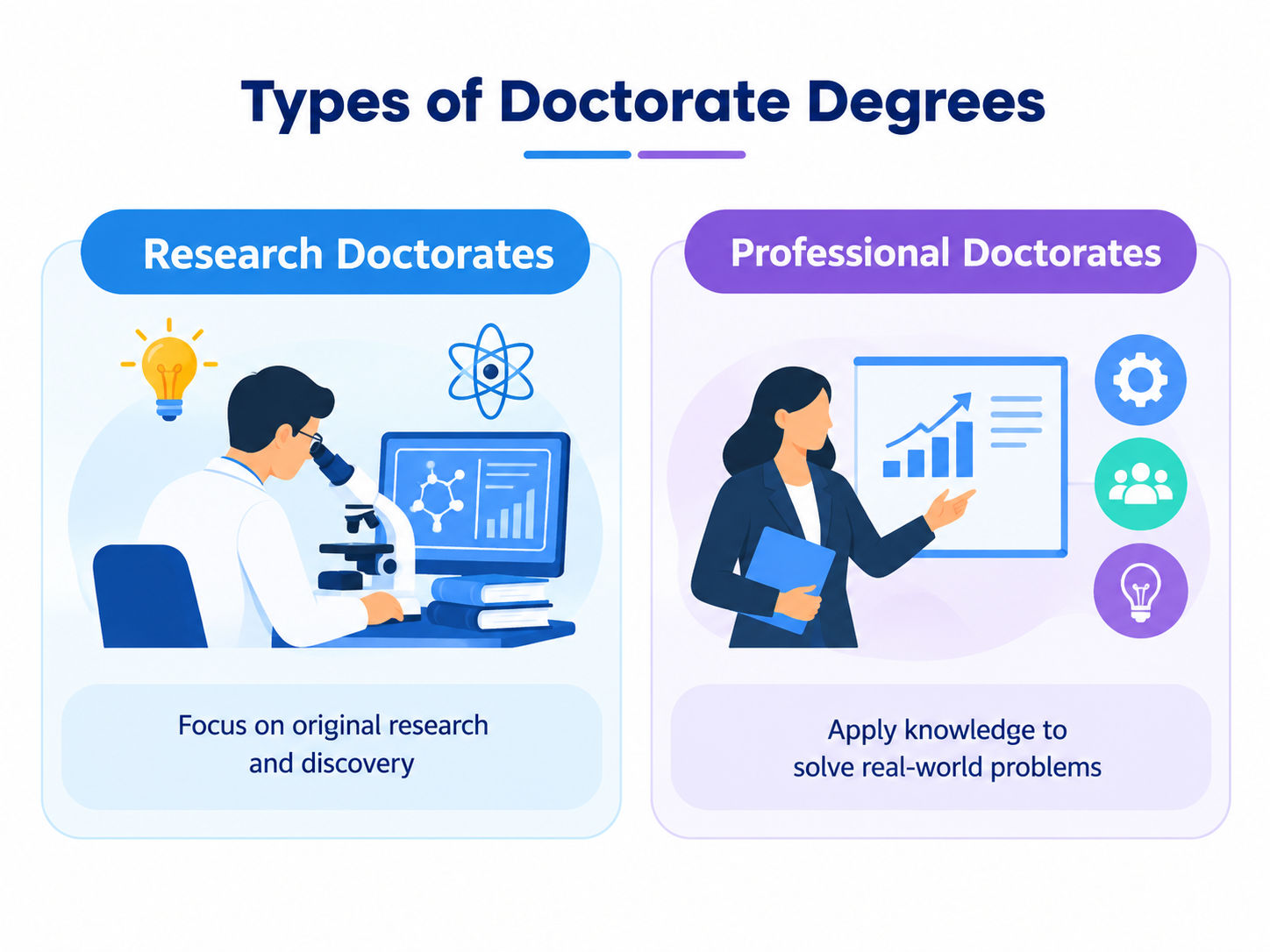
A research doctorate focuses on producing new knowledge through independent research. The Doctor of Philosophy (PhD) is the best-known example.
Students generally:
PhD programs are available in areas such as science, engineering, management, education, humanities, social sciences, and technology.
Professional doctorates are designed for people who want advanced expertise in a particular profession. They may include research, but the work is often closely connected to professional practice.
Examples include:
The exact structure and recognition of a professional doctorate vary by country and institution.
So, how many types of doctorate degrees are there? There is no single worldwide number. Universities offer doctoral qualifications across hundreds of disciplines, and the names and structures can differ between countries.
Free Courses
Although there is technically only one degree known as a PhD, this can be offered in a number of different disciplines and specialisations. For instance, a university may offer a PhD in Computer Science, while another may offer a PhD in Economics or Biotechnology.
Some typical fields for PhDs include:
Field |
Examples of PhD specialisations |
| Science | Physics, Chemistry, Biology, Mathematics |
| Technology | Computer Science, Artificial Intelligence, Data Science |
| Engineering | Mechanical, Civil, Electrical, Chemical Engineering |
| Management | Finance, Marketing, Human Resources, Operations |
| Social Sciences | Sociology, Economics, Political Science |
| Humanities | English, History, Philosophy, Languages |
| Education | Educational Psychology, Leadership, Curriculum Studies |
| Healthcare | Public Health, Nursing, Health Sciences |
| Commerce | Accounting, Commerce, Business Studies |
Therefore, how many types of doctorate degrees are there cannot be answered by simply counting PhD subjects. A PhD is one type of research doctorate with numerous academic specialisations.
The right specialisation usually depends on the student's previous education, research interests, and long-term career plans.
Also read: How To Do Market Research - [Ultimate Guide]
Recommended Courses to upskill
Explore Our Popular Courses for Career Progression
IIIT Bangalore
Executive Diploma in Machine Learning and AI360° Career Support
O.P.Jindal Global University
MBA from O.P.Jindal Global UniversityLive Case Studies and Projects
Healthcare offers several doctoral pathways. Some are research-focused, while others prepare professionals for advanced clinical or public health practice.
Common examples include:
A PhD in healthcare or health sciences is primarily research-oriented. Students may investigate areas such as healthcare systems, epidemiology, health policy, medical technology, public health, or patient outcomes.
Graduates can pursue careers in research institutions, universities, healthcare organisations, pharmaceutical companies, and policy organisations.
The DNP is a professional doctorate for advanced nursing practice. It focuses on applying evidence and advanced clinical knowledge to improve patient care and healthcare delivery.
A DrPH focuses on public health practice, policy, leadership, and population-level health issues. It is generally suited to professionals who want leadership roles in public health organisations or government agencies.
The PharmD is a professional pharmacy qualification in several countries. It prepares students for professional practice involving medicines, patient care, and pharmaceutical services.
The structure and level of the PharmD can differ by country, so students should check the regulations applicable to their location.
Healthcare professionals may also find doctoral programs in areas such as:
These options show why the types of doctorate degrees in healthcare cannot be reduced to a single qualification. The appropriate route depends on whether the learner wants to practise clinically, conduct research, or move into healthcare leadership.
Also read: Difference Between Law and Ethics Explained
The phrase "medical doctorate" can mean different things depending on the country. In some countries, degrees such as MD or DO are primary professional medical qualifications. In others, similar titles may represent postgraduate medical training.
Some commonly known medical and healthcare doctoral-level qualifications include:
An MD is a medical degree in countries such as the United States. It prepares students for medical practice after completing the required education and licensing process.
In India, however, MD is generally a postgraduate medical degree pursued after MBBS, rather than the equivalent of the US medical degree.
The DO is a professional medical degree in the United States. DO physicians receive training in medical diagnosis and treatment and can pursue medical specialisations after completing the required training.
DDS and DMD are professional dental degrees used in some countries. Both prepare graduates for careers in dentistry, subject to local licensing requirements.
The PharmD prepares graduates for professional pharmacy practice and focuses on the safe and effective use of medicines.
The DPT is a professional qualification for physical therapists in countries where this degree structure is used.
It is important to distinguish these professional qualifications from research doctorates. A PhD in a medical or healthcare subject is generally designed around original research, whereas a clinical doctorate is usually centred on professional practice.
Ready to lead with confidence? Enroll in upGrad's Certificate Programme in General Management for Young Leaders (YLP) from IIM Bangalore and build practical leadership, strategic thinking, and decision-making skills.
Psychology has both research-oriented and practice-oriented doctoral pathways.
A PhD in Psychology is primarily research-focused. Students may specialise in areas such as:
A psychology PhD can lead to careers in academia, research, consulting, policy, and specialised professional settings, depending on local licensing rules.
A PsyD is generally more practice-oriented than a traditional psychology PhD. It places greater emphasis on applying psychological knowledge in professional settings.
Students interested in clinical practice may consider a PsyD where this qualification is recognised and relevant to their intended career.
PhD in Psychology |
PsyD |
| More research-oriented | More practice-oriented |
| Strong focus on research methods | Strong focus on professional application |
| Common pathway into academic research | Common pathway toward professional psychology practice |
| Dissertation or substantial research is generally required | Program structure varies by institution |
The best option depends on whether the learner wants to focus more heavily on research, teaching, clinical practice, or another area of psychology.
Also read: Market Research Analyst Skills: What You Need for Success
Education is another field with multiple doctoral pathways. Two of the most common are the PhD in Education and Doctor of Education (EdD).
A PhD in Education is generally research-oriented. It can suit people interested in studying educational theory, policy, learning, curriculum, assessment, or educational technology.
Graduates may work in universities, research institutions, policy organisations, and education-focused research roles.
The EdD is generally designed for experienced education professionals who want to solve practical problems and take on leadership responsibilities.
Possible areas of focus include:
A simple way to understand the difference is to consider the main purpose of each program. A PhD generally places greater emphasis on creating new academic knowledge through research. An EdD often focuses on applying research to real-world educational challenges.
However, program structures vary between universities, so prospective students should examine the curriculum, research requirements, and career outcomes before applying.
Also read: Investment Management: A Practical Guide to How It Works
It depends on a number of factors including the field of study, the university, the country, whether one is studying full-time or part-time and the type of doctorate. Normally, it takes between three and seven years to complete a research doctorate, but some people take longer or shorter than average. For professional doctorates, the range varies greatly depending on the nature of the course, the required clinical placements, the research component and the level of prior qualifications.
Factors that can affect completion time include:
For example, a research project requiring extensive fieldwork may take longer than a project based mainly on existing datasets.
Students should therefore look at the official program duration rather than assuming that all types of doctorate degrees require the same number of years.
India offers PhD programs in a variety of disciplines. Universities and colleges offer doctoral-level research in fields such as:
1. PhD in Management
Research may be done in marketing, finance, human resources, operations, strategy, entrepreneurship, or organisational behaviour.
2. PhD in Computer Science
Areas of research could include, but are not limited to, artificial intelligence, machine learning, cybersecurity, data science, computer networks, and software engineering.
3. PhD in Engineering
Doctoral research is available in areas such as, but not limited to, civil, mechanical, electrical, electronics, chemical, aerospace, and computer engineering.
4. PhD in Science
Students may do research in areas such as physics, chemistry, mathematics, biotechnology, environmental science, and life sciences.
5. PhD in Education
Research may be done in educational psychology, teaching methods, curriculum, technology-enabled learning, educational policy, or leadership.
6. PhD in Humanities and Social Sciences
Popular areas include English, history, sociology, economics, psychology, political science, philosophy, and related fields.
The eligibility criteria, entrance requirements, coursework, research process, and duration can vary by institution and discipline. Students should contact individual universities to learn more about their requirements and doctoral-level research opportunities.
The choice of which type of doctorate degree to pursue requires more than looking at the title that will appear at the end of the program name. Think about these points before applying to any school:
You should know whether you would like to pursue research, academia, healthcare, consulting, administration, or a specific industry career
Your doctoral subject should connect with your previous education and research interests. A strong academic foundation can make the research process easier.
Check whether the program requires a dissertation, thesis, research project, clinical training, internship, or other practical component.
Universities can have different requirements for master's degrees, entrance examinations, work experience, academic scores, and research proposals.
For research doctorates, the expertise of the research supervisor can be particularly important. Look at faculty research areas, available facilities, publications, and the institution's doctoral policies.
Doctoral programs demand a considerable amount of effort. We offer to compare the costs, funding opportunities, duration, and mode of study of the programs to help you make a choice.
A degree obtained after a doctorate can create opportunities in various fields, including academia, research, industry, healthcare, education, and specialised professional fields.
Some of the common career opportunities include:
The opportunities available depend heavily on the subject, qualification, professional licensing requirements, work experience, and country.
For example, a PhD in Computer Science may lead toward research and technology roles, while a doctorate in education may support careers in academic research or educational leadership.
The types of doctorate degrees consist of research-based doctorates (PhDs) and professional doctorates for advanced professional practice. Doctorate degrees are awarded in medicine, education, psychology, management, science, and technology, among other fields.
There is no exact number of types of doctorate degrees because different fields, countries, and universities offer various doctorate programs. In India, PhD is the most common program for students who want to pursue research and professional careers.
Ready to start your journey? Book a free consultation with upGrad today to find the best path for your career.
A PhD is one type of doctorate degree. The term doctorate is broader and includes research doctorates and professional doctorates. A PhD usually focuses on original research, while professional doctorates generally emphasise advanced practice in a specific profession.
There is no fixed worldwide number. Doctoral qualifications vary by country, university, and subject. Broadly, they can be grouped into research doctorates, such as PhDs, and professional doctorates, such as EdD, PsyD, DBA, and DNP.
The PhD is one of the most widely recognised research doctorates. Other common doctoral qualifications include the EdD in education, PsyD in psychology, DBA in business, DNP in nursing, and DrPH in public health.
A doctorate can take around three to seven years or longer, depending on the program, subject, country, research requirements, and study mode. Professional doctorates may follow different timelines because they can include practical or clinical training.
The major options include a PhD in Psychology and a PsyD. A PhD generally has a stronger research focus, while a PsyD is typically more practice-oriented. Program structures and professional licensing requirements differ between countries.
Common options include a PhD in Education and a Doctor of Education (EdD). A PhD generally focuses more on research and academic knowledge, while an EdD often focuses on applying research to educational leadership and professional challenges.
Yes. Universities offer PhD programs across numerous disciplines, including management, computer science, engineering, science, education, economics, humanities, and social sciences. Eligibility normally depends on the applicant's academic background and the requirements of the chosen institution.
Healthcare doctoral pathways include PhDs in health-related disciplines, Doctor of Nursing Practice programs, Doctor of Public Health programs, PharmD programs, and other specialised professional or research doctorates. The available qualifications vary considerably between countries.
India offers PhD programs in areas including management, engineering, computer science, science, education, commerce, humanities, and social sciences. The exact specialisations and admission requirements depend on the university and the discipline.
Yes. A PhD is generally designed around original academic research and the creation of new knowledge. Professional doctorates usually focus more on applying advanced knowledge to professional practice, although they may also include substantial research.
The answer depends on the career. Researchers and academics often pursue PhDs, while professionals in education, psychology, business, nursing, public health, and other fields may have professional doctorate options. The most suitable qualification depends on the role and local professional requirements.
Get Free Consultation
By submitting, I accept the T&C and
Privacy Policy
Top Resources
Certification
3 Months
Certification
6 Months
O.P. Jindal Global University
Masters in International Accounting and Finance (Accredited by ACCA, UK)Master's Degree
12 Months