Top BCA Project Topics & Mini Projects for Students in 2026
Updated on Jul 29, 2026 | 32 min read | 51.22K+ views
Share:

All courses
Certifications
More
Updated on Jul 29, 2026 | 32 min read | 51.22K+ views
Share:
Table of Contents
Quick Overview:
Looking to take your technical skills beyond BCA projects? Explore Artificial Intelligence Courses in India by upGrad to gain hands-on experience in machine learning, deep learning, generative AI, and real-world AI applications
Popular AI Programs
Software development-based BCA project topics help students build real-world software applications using programming, database management, and UI development. They are ideal BCA final year project topics due to their strong practical application across industries.
1. Smart Attendance Management System
Creates an automated digital solution that records student or employee attendance using facial recognition or QR scanning with techniques such as object recognition in OpenCV. This system eliminates manual entry errors, reduces proxy attempts, and generates instant attendance reports. It supports academic institutions and offices in streamlining attendance, improving accuracy, and saving administrative time. Web or mobile interface access enables remote tracking and monitoring.
Skills Required:
Tools Required:
Estimated Time: 6–8 weeks
Advance your leadership skills with the IIIT-B & IIMU Chief Data and AI Officer Program Online. Gain expertise in AI strategy, data governance, and business transformation to prepare for senior leadership roles.
2. Automated Timetable Generator
Develops an intelligent timetable creation engine that allocates subjects, faculty, and classroom slots without conflicts. The algorithm manages multiple departments, teacher availability, and lab scheduling constraints. It removes manual scheduling complexity and ensures optimal resource utilization. Ideal for institutions managing large student volumes with frequent timetable updates.
Skills Required:
Tools Required:
Estimated Time: 6–7 weeks
3. Employee Payroll Management System
Builds a complete HR automation platform that calculates salaries, attendance, leave, and tax deductions. It generates payslips, automates compliance reporting, and maintains historical salary records for audits. Small and medium companies rely on such systems to eliminate calculation errors and enable structured payroll documentation.
Skills Required:
Tools Required:
Estimated Time: 5–6 weeks
4. Inventory Tracking and Billing System
Develops a software system that tracks product stock levels, manages vendor purchase records, automates billing invoices, and maintains real-time sales updates. Retail shops, pharmacies, and warehouse operations use such systems to avoid stock shortages, maintain reorder levels, and manage barcode-enabled product tracking.
Skills Required:
Tools Required:
Estimated Time: 7–8 weeks
5. Hospital Patient Record System
Creates a digital platform for hospitals to record patient history, diagnoses, prescriptions, laboratory results, and doctor schedules. It reduces paperwork, improves emergency care support, and increases accuracy by centralizing medical data. Doctors can access patient records quickly, enabling faster treatment and better decision-making across hospital departments.
Skills Required:
Tools Required:
Estimated Time: 8–10 weeks
6. Library Management System With Barcode Integration
Develops a digital library system that manages book issue, returns, catalog records, and fine calculation. Integrating barcode scanning helps speed up transactions and prevents manual entry errors. Students and librarians can track availability, reservation status, and borrower history. The system improves efficiency, eliminates paperwork, and supports transparent library administration.
Skills Required:
Tools Required:
Estimated Time: 6–7 weeks
7. Vehicle Service and Maintenance System
Creates a digital platform for automotive service centers to manage customer vehicle details, service appointments, billing, and maintenance reminders. It tracks repair history, spare parts usage, and service schedules. Customers receive automated notifications for due maintenance, improving satisfaction and workshop management efficiency.
Skills Required:
Tools Required:
Estimated Time: 6–8 weeks
8. Online Examination System
Builds a secure web-based examination portal that enables students to take objective or subjective tests online. It includes question banks, automatic evaluation, and real-time result generation. Security features like browser lockdown and random question order reduce malpractice. Educational institutions use it for internal assessments and competitive exams.
Skills Required:
Tools Required:
Estimated Time: 7–9 weeks
9. Hostel and PG Management System
Creates a complete accommodation management application that handles room allocation, rent payments, complaints, visitor logs, and vacancy tracking. Students can apply for rooms, submit requests, and track payment history online. Administrators can monitor capacity and generate reports for hostel operations, improving service efficiency.
Skills Required:
Tools Required:
Estimated Time: 6–7 weeks
10. College Admission Automation System
Automates the entire college admission workflow, including applications, document upload, merit list generation, and seat allocation. It reduces clerical errors and speeds up the admission process. Students can track application status online, while administrators manage data efficiently during peak admission periods.
Skills Required:
Tools Required:
Estimated Time: 8–10 weeks
Web development and full-stack BCA project topics help students build dynamic web platforms and interactive user interfaces connected to secure backend systems. They are widely chosen as BCA final year project topics since they demonstrate modern development practices aligned with current industry hiring demands.
1. E-commerce Website with Product Recommendation
Develops an online shopping platform allowing users to browse products, manage carts, and complete secure payments. The recommendation engine suggests products based on user history, search patterns, and preferences. This enhances conversion rates and improves customer engagement. Ideal for retail-based startups and commercial platforms targeting personalized online shopping experiences.
Skills Required:
Tools Required:
Estimated Time: 8–10 weeks
2. Online Food Delivery and Restaurant Booking System
Creates a dual-purpose platform for ordering food online and reserving restaurant tables. Customers can track delivery status, view menus, and schedule dining slots. The system supports real-time order updates, customer reviews, and automated notification services. Restaurants manage inventory, staffing schedules, and order analytics.
Skills Required:
Tools Required:
Estimated Time: 7–9 weeks
3. Tourism and Travel Booking Portal
Offers curated travel packages, hotel reservations, itinerary recommendations, and online booking services. Users can compare pricing, read reviews, and make secure payments. Integrating map and weather services enhances trip planning efficiency. Ideal for tourism agencies targeting digital-first booking experiences.
Skills Required:
Tools Required:
Estimated Time: 6–8 weeks
4. Real Estate Property Listing Platform
Creates a platform that connects sellers, buyers, and agents through searchable property listings with photos, pricing charts, and location filters. Users can submit inquiries, schedule site visits, and compare properties. Admins manage listings and verify property authenticity to maintain transparency and reduce fraud.
Skills Required:
Tools Required:
Estimated Time: 7–9 weeks
5. Alumni Networking and Career Portal
Builds a professional community platform that allows alumni to share job openings, mentorship opportunities, and institution updates. Users create profiles, attend online events, and interact through discussion forums. Colleges use this system to track graduate success and enhance placement support.
Skills Required:
Tools Required:
Estimated Time: 8–10 weeks
6. Online Learning Management System
Creates an educational platform that hosts study materials, course modules, video lectures, and assessments. Students track progress using dashboards, while instructors upload assignments and evaluate submissions. It is widely adopted in remote and hybrid education models, improving accessibility.
Skills Required:
Tools Required:
Estimated Time: 9–11 weeks
7. Freelance Job Marketplace Platform
Builds a web portal connecting clients with freelancers, offering bidding mechanisms, project management, and secure prepaid payment release. The platform supports portfolio uploads, client reviews, messaging, and contract milestones. Helps students understand marketplace workflow and FinTech integrations.
Skills Required:
Tools Required:
Estimated Time: 8–10 weeks
Must Read: Is Full Stack Development Hard? How to Learn & Tips!
8. Blood Bank and Organ Donation Portal
Enables hospitals and emergency units to request blood or organs in real time. Donors register availability by location and blood type. Automated alerts improve response time during emergencies. Hospitals update stock status for transparency and faster coordination between districts.
Skills Required:
Tools Required:
Estimated Time: 6–8 weeks
9. Online Event Scheduling and Ticket Booking System
Develops a web platform where users browse event listings, book seats, and download digital tickets. Admins create events, monitor revenue, and manage event capacity. Integrated payment systems and QR-based entry validation enhance the attendee experience.
Skills Required:
Tools Required:
Estimated Time: 6–7 weeks
10. Digital Resume Builder and Portfolio Generator
Creates an interactive online tool that lets users design resumes using drag-and-drop templates. Users download resumes in PDF format and generate a hosted portfolio link showcasing projects and skills. Beneficial for job seekers building a professional brand.
Skills Required:
Tools Required:
Estimated Time: 6–8 weeks
Free Courses
These BCA Project Topics involve predictive modeling, NLP, recommendation engines, and AI-driven automation. Students learn data preprocessing, visualization, model training, evaluation metrics, and real-time deployment. The following ideas align with modern industry requirements and provide strong portfolio value.
1. Student Performance Prediction System
Uses previous academic records, attendance percentages, behavior indicators, and test scores to predict final exam outcomes. Helps institutions identify struggling students early and provide personalized academic support. Students learn how predictive models assist with decision-making and improve educational planning using real-time data interpretations.
Skills Required:
Tools Required:
Estimated Time: 4–6 weeks
2. Sentiment Analysis for Social Media
Analyzes social media comments, tweets, or reviews to determine whether user emotions are positive, negative, or neutral. Useful for brand monitoring, political opinion research, or customer experience tracking. Students learn text preprocessing, word embeddings, feature extraction, and real-time sentiment classification models using NLP.
Skills Required:
Tools Required:
Estimated Time: 5–7 weeks
3. Credit Card Fraud Detection Model
Detects unusual financial transactions using machine learning-based anomaly detection techniques. Helps banks reduce fraud losses and enhance transaction monitoring reliability. Students work with imbalanced datasets, real-time classification pipelines, and evaluation metrics such as recall and accuracy to improve detection rates without false alarms.
Skills Required:
Tools Required:
Estimated Time: 5–7 weeks
4. Disease Prediction Using Machine Learning
Predicts possible diseases based on symptoms, demographic data, and medical test reports. Useful for early diagnosis support systems in digital healthcare. Students learn how ML assists doctors with data-backed diagnosis recommendations and helps improve medical efficiency in clinical environments.
Skills Required:
Tools Required:
Estimated Time: 6–8 weeks
5. Customer Churn Prediction System
Identifies customers likely to leave a service based on behavior analysis, usage history, and feedback patterns. Helps telecom, banking, and SaaS businesses retain customers through proactive strategies. Students understand predictive systems used widely in CRM and customer lifecycle management.
Skills Required:
Tools Required:
Estimated Time: 5–6 weeks
6. Price Prediction for Real Estate or Stock Market
Forecasts future prices based on historical financial trends, market indicators, location parameters, and external economic factors. Helps students understand how regression models and time-series forecasting support investment decisions. The project equips learners to analyze fluctuating patterns and design predictive dashboards that help stakeholders plan better and reduce risk exposure.
Skills Required:
Tools Required:
Estimated Time: 6–8 weeks
7. Face Recognition Attendance System
Automates daily attendance by identifying faces using recognition algorithms instead of manual roll calls or biometric fingerprints. Useful for educational institutions and workplaces. Students apply image processing, feature extraction, and AI pattern recognition techniques to build an efficient smart attendance system with real-time validation.
Skills Required:
Tools Required:
Estimated Time: 6–8 weeks
8. Movie Recommendation System
Suggests movies to users based on preferences, browsing history, and ratings using collaborative or content-based filtering. Similar to Netflix-style AI recommendations. Students learn how recommendation engines personalize digital content and analyze user behavior for improving engagement and retention in entertainment platforms.
Skills Required:
Tools Required:
Estimated Time: 5–7 weeks
9. Smart Chatbot for Customer Support
Provides automated responses for customer queries by analyzing user intent with NLP. Supports multiple domains such as banking, e-commerce, telecom, and education. Helps students gain experience building conversational interfaces that reduce human workload and improve service efficiency.
Skills Required:
Tools Required:
Estimated Time: 4–6 weeks
10. Spam Email Detection System
Classifies incoming emails as spam or legitimate using machine learning-based filtering methods. Helps protect users from phishing and unwanted advertisements. Students learn about text classification, feature extraction methods like TF-IDF, and real-time filtering systems used in secure communication platforms.
Skills Required:
Tools Required:
Estimated Time: 4–6 weeks
AI Courses to upskill
Explore Artificial Intelligence Courses for Career Progression
These BCA Project Topics focus on IoT systems, cybersecurity solutions, blockchain security, wireless communication, and cloud computing workflows. Students gain hands-on expertise with modern networking infrastructure, edge devices, distributed systems, and system security frameworks widely used in industrial automation, logistics, smart cities, and digital safety implementations.
1. IoT Smart Home Automation System
Controls home appliances such as lights, fans, alarms, and smart locks using IoT sensors and a mobile-based dashboard. Users can automate schedules, monitor devices remotely, and track energy usage in real time. This project introduces smart living technology and demonstrates how IoT networks connect physical devices through wireless communication.
Skills Required:
Tools Required:
Estimated Time: 6–8 weeks
2. IoT-Based Environmental Monitoring
Monitors air quality, humidity, temperature, and pollution levels in real time. Used in industries, agriculture, and smart cities for environmental assessment and safety measures. Students learn sensor-based analytics, threshold alert systems, and live data dashboards that support government and research agencies.
Skills Required:
Tools Required:
Estimated Time: 5–7 weeks
3. Blockchain-Based Secure Voting System
Provides a transparent and tamper-proof digital voting platform where each vote is stored as a blockchain transaction. Prevents vote manipulation, ensures voter privacy, and enhances election system trust. Students learn cryptographic security, distributed ledger technology, and decentralized application development.
Skills Required:
Tools Required:
Estimated Time: 6–9 weeks
4. Cybersecurity Threat Detection System
Monitors network traffic to detect suspicious activity such as unauthorized access, DDoS attempts, and malware signatures. Helps organizations strengthen security and prevent data breaches. Students learn cybersecurity analytics, intrusion detection systems, and automated threat alerting.
Skills Required:
Tools Required:
Estimated Time: 6–8 weeks
5. Cloud-Based File Storage and Backup System
Provides secure file storage with automatic backup scheduling, version tracking, and data encryption. Ideal for businesses to protect data from device loss or system failures. Students learn cloud computing architecture, security layers, and distributed file systems used in modern SaaS products.
Skills Required:
Tools Required:
Estimated Time: 5–7 weeks
6. Secure File Encryption Tool
Encrypts confidential files before transfer and decrypts them only with authorized credentials. Prevents data theft and ensures safe file sharing. Students learn cryptographic algorithms, secure key exchange, and end-to-end encryption concepts used widely in cybersecurity products.
Skills Required:
Tools Required:
Estimated Time: 4–6 weeks
7. Network Traffic Analysis System
Analyzes network bandwidth usage, packet flow behavior, and router-level traffic patterns. Helps detect bottlenecks and optimize performance for enterprise networks. Students gain exposure to network management, real-time monitoring, and performance visualization.
Skills Required:
Tools Required:
Estimated Time: 5–7 weeks
8. Vehicle Tracking and Accident Alert System
Tracks vehicle movement using GPS signals and sends emergency alerts in case of collision or accident detection. Useful for fleet management and road safety. Students build experience in embedded systems, GPS data interpretation, and real-time emergency response logic.
Skills Required:
Tools Required:
Estimated Time: 6–8 weeks
9. RFID-Based Attendance Monitoring System
Automates attendance recording using RFID cards and scanners. Logs entry and exit times automatically and stores records in a database dashboard. Eliminates manual tracking errors and improves access control management in academic or corporate settings.
Skills Required:
Tools Required:
Estimated Time: 5–6 weeks
10. Drone Navigation and Control System
Controls drone flight movement using GPS tracking and wireless navigation algorithms, enabling aerial surveillance and monitoring operations. Students learn UAV programming, sensor processing, and automation logic used in logistics, agriculture, and security surveillance applications.
Skills Required:
Tools Required:
Estimated Time: 7–10 weeks
The latest BCA project trends focus on artificial intelligence, cybersecurity, blockchain, and IoT-based automation. These technologies are transforming industries and creating strong demand for practical, industry-ready applications.
Choosing trending BCA final year project topics can help students build technical expertise, strengthen portfolios, and improve placement opportunities in high-growth technology domains.
1. Generative AI Chatbot
Develop an AI-powered chatbot capable of answering user queries, generating responses, and automating customer support using natural language processing and large language models.
2. AI Resume Screening System
Build a smart recruitment tool that analyzes resumes, filters candidates based on job requirements, and automates the initial hiring process using machine learning algorithms.
3. Blockchain Voting Application
Create a secure and transparent digital voting system using blockchain technology to prevent vote tampering and ensure data integrity during elections.
4. Smart IoT Healthcare Monitoring System
Design an IoT-based healthcare solution that tracks patient vitals such as heart rate, temperature, and oxygen levels in real time using connected sensors and cloud dashboards.
5. Fake News Detection System
Develop a machine learning model that identifies misleading or false news articles using text analysis, NLP techniques, and classification algorithms.
6. AI-Based Interview Preparation Tool
Create an intelligent platform that helps students prepare for interviews through mock questions, AI-generated feedback, and performance analysis.
7. Cybersecurity Threat Detection System
Build a network security solution that monitors suspicious activity, detects cyber threats, and generates alerts using intrusion detection and anomaly analysis techniques.
8. Voice Assistant for Smart Homes
Develop a voice-controlled virtual assistant that automates home appliances such as lights, fans, and security systems using speech recognition and IoT integration.
Also Read: 30 Beginner to Final Year Cloud Computing Project Ideas
What Is a BCA Project?
A BCA project is a practical application developed by Bachelor of Computer Applications students to apply programming, database, and software development concepts learned during the course. These projects help students build technical skills, solve real-world problems, and gain hands-on experience before entering the industry.
Choosing the right BCA final year project topics allows students to strengthen their coding, analytical thinking, and project management skills. Exploring a diverse BCA project topics list also helps students identify projects that align with their career goals, whether in web development, AI, cloud computing, or mobile applications. Well-planned project ideas for BCA students can significantly improve portfolios and placement opportunities.
BCA Project Development Process
Most successful BCA final year project topics follow a structured development approach.
System Design & Architecture for BCA Projects
A well-designed architecture makes a BCA project easier to develop, maintain, and scale.
| Layer | Purpose |
|---|---|
| Presentation Layer | Provides the user interface for interaction |
| Business Logic Layer | Handles application workflows and processing |
| Database Layer | Stores and manages application data |
| Integration Layer | Connects APIs, cloud services, or third-party systems |
This architecture is commonly used in many project ideas for BCA students, including web applications, management systems, and mobile apps.
Best Programming Languages for BCA Projects
The right programming language depends on the type of project you want to build.
Selecting the appropriate language from the beginning helps you successfully complete BCA final year project topics while building practical skills for internships and campus placements.
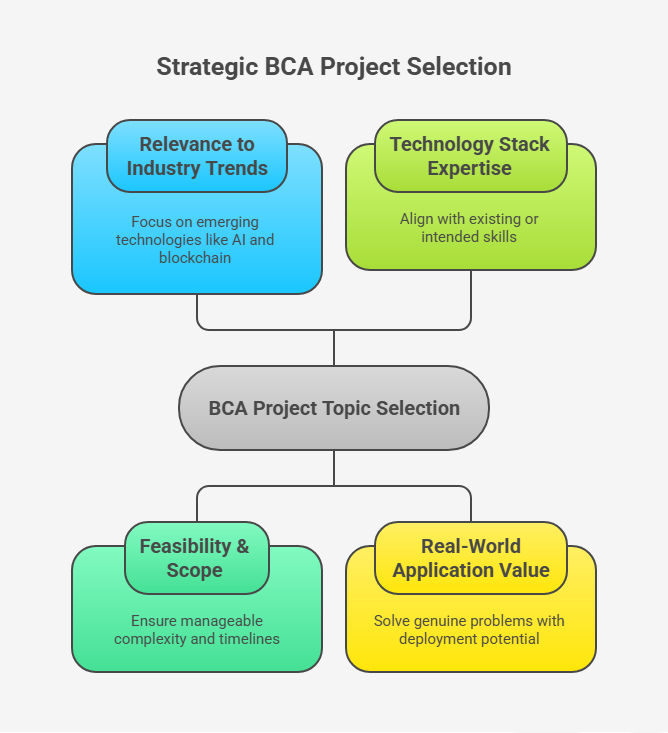
Identifying a suitable BCA project topic involves strategic evaluation of both technical feasibility and academic relevance, ensuring clear learning outcomes and real-world value.
Key Criteria for Selection
A well–defined technology stack is essential for building high-performance academic solutions. The following tools are widely adopted in industry-driven BCA projects and ensure practical implementation, scalability, and deployment readiness.
Python, Java, C++, JavaScript, PHP, Kotlin, Swift
Used for developing backend logic, automation scripts, mobile and web application functionality, and core system programming.
MySQL, MongoDB, PostgreSQL, Firebase
Facilitates structured and real-time data storage, query processing, and secure handling of application data across distributed environments.
React.js, Angular, Node.js, Django, Laravel, Spring Boot
Helps build end-to-end applications with dynamic front-end interfaces and scalable server-side architectures, enabling API connectivity and seamless performance.
TensorFlow, PyTorch, Scikit-Learn, Power BI
Used for machine learning model development, deep learning research, predictive analytics, visualization dashboards, and intelligent process automation.
Many students overlook key evaluation factors during project development, which can significantly impact academic performance and practical implementation outcomes. Avoiding these common pitfalls ensures strong delivery and higher scoring.
Subscribe to upGrad's Newsletter
Join thousands of learners who receive useful tips
Working on a BCA project is one of the best ways to apply your technical knowledge and prepare for a successful career in software development. By selecting relevant BCA final year project topics that match your interests and career goals, you can build practical skills in programming, database management, and system design.
A well-executed project not only strengthens your portfolio but also improves your confidence during project evaluations, internships, and campus placements.
For expert guidance, connect with upGrad’s free counselling sessions and offline learning centers to receive personalized academic and career support.
BCA Project Topics help students apply theoretical concepts to real-world solutions, strengthening technical expertise and problem-solving capabilities. A well-executed project demonstrates practical experience with tools, frameworks, and coding best practices, enhancing placement readiness. Recruiters evaluate project depth to judge analytical abilities, innovation, and hands-on skills, making projects a critical differentiator during internships and job interviews.
Evaluators typically assess problem clarity, feasibility, creativity, technology implementation, UI design, testing quality, and documentation standards. Effective presentation and project defense also impact scoring significantly. Real-world use cases and deployment readiness receive higher grades. Industry-relevant BCA Project Topics with measurable outcomes gain preference over theoretical or repetitive implementations.
Students should focus on structured documentation, strong UI/UX design, functional testing, optimization, and real-time datasets. Integrating modern technologies such as cloud computing, automation, or analytics increases impact. Projects offering measurable improvements or solving local industry problems stand out. Well-prepared demonstrations and clear communication during viva enhance evaluation results.
Check research papers, GitHub repositories, and online project libraries to ensure your idea is not a direct replica. Add custom modules, automation layers, or analytics capabilities to enhance uniqueness. Integrating modern technologies like AI features or IoT sensors increases originality. Unique value propositions help secure higher scores and demonstrate innovation.
Core programming knowledge, database management, version control, debugging, testing methods, and UI/UX understanding are essential. Additional skills like API integration, deployment tools, cloud platforms, and report writing strengthen project execution. Students should develop strong presentation and documentation capabilities to communicate value clearly during evaluation or interviews.
Yes. Hybrid BCA Project Topics combining web, mobile, cloud, and analytics offer greater impact and industry relevance. For example, a healthcare monitoring system integrating IoT sensors, cloud dashboards, and AI-based prediction models demonstrates multi-layer architecture. Evaluators appreciate complexity when backed by solid planning, testing, and feasibility.
Real-time or real-world datasets improve model accuracy and strengthen project credibility. They help validate results with measurable metrics. Using publicly available datasets from platforms like Kaggle or government portals enhances authenticity. Evaluators prioritize realistic outcomes instead of theoretical assumptions, especially in AI-based BCA Project Topics.
Use structured flow: problem summary, architecture, modules, tech stack, demo, testing results, and future enhancements. Keep visuals clean with workflow diagrams, dashboards, and performance graphs. Demonstrate key features live instead of general narration. Strong clarity and confidence play a major role during evaluation.
Deployment is not mandatory but highly recommended. Hosting a live demo on cloud platforms such as AWS, Firebase, or Render increases authenticity and practical value. It demonstrates understanding of DevOps fundamentals and real-environment testing. Deployment also strengthens resume impact and interview discussion.
Yes. Students can use beginner-friendly boards like Arduino and Raspberry Pi with guided libraries, sensors, and drag-and-drop configuration tools. Many IoT projects require basic circuit understanding, not deep engineering knowledge. Combining hardware with software dashboards makes projects more competitive and practical.
Focus on simple navigation, clear layout, consistency in colors and typography, accessible forms, and minimal user actions. Use frameworks like Bootstrap, Material UI, or Tailwind for design efficiency. Strong UI/UX presentation significantly enhances evaluation scores even if project logic is straightforward.
Architecture diagrams such as UML, DFD, ER diagrams, and flowcharts illustrate clear system understanding. They visually communicate workflow, module interaction, and data movement. Evaluators consider diagram quality a key scoring factor since it reflects planning and technical depth. Well-designed diagrams strengthen documentation and viva performance.
Common errors include copied source code, weak testing, unrealistic scope, missing documentation, and lack of deployment planning. Ignoring UI design and last-minute development leads to low scoring. Students must avoid outdated BCA Project Topics, incomplete models, and unstructured presentations.
Yes. Students can collaborate with startups, freelancers, or academic mentors for real-world requirements and feedback. Industry collaboration enhances credibility, exposes students to professional workflows, and supports better implementation quality. Real-time feedback improves innovation and increases placement opportunities.
Cloud platforms support hosting, data storage, live deployment, and analytics dashboards. Integrating services such as Firebase, AWS, Azure, or Google Cloud improves project scale, performance, and availability. Cloud-based architecture strengthens technical depth and increases practical relevance for industry.
Version control platforms like Git and GitHub enable collaborative development, code tracking, and rollback management. They reduce errors and improve project organization. Evaluators appreciate structured commits and repository documentation, as they reflect professional coding practices and engineering discipline.
Yes. Metrics such as accuracy, speed, processing time, load handling, and memory usage show measurable output. They differentiate strong projects from superficial ones. Performance evaluation is especially crucial for AI-based BCA Project Topics, demonstrating analytical understanding and validation strength.
Internships provide exposure to real client problems, professional tech stacks, workflow structure, and project deployment. They improve technical confidence and help students select industry-relevant ideas. Practical experiences often lead to higher scoring and better placement outcomes.
Yes. Innovative projects can be submitted to academic journals and research conferences for publication or filed for patenting with proper mentorship. Published research adds significant academic value and strengthens postgraduate and job applications.
Students can extend their projects into commercial solutions by adding scalability, user testing, pricing models, and marketing validation. Platforms like incubators and startup accelerators support early-stage development. Market-oriented BCA Project Topics addressing real gaps often evolve into viable business products.
911 articles published
Pavan Vadapalli is the Director of Engineering , bringing over 18 years of experience in software engineering, technology leadership, and startup innovation. Holding a B.Tech and an MBA from the India...
Speak with AI & ML expert
By submitting, I accept the T&C and
Privacy Policy
Top Resources
Master's Degree
18 Months
Executive Diploma
12 Months
IIIT Bangalore
Executive Programme in Generative AI & Agentic AI for LeadersIndia’s #1 Tech University
Dual Certification
5 Months