Markov Random Fields in Machine Learning: A Complete Guide
By Sriram
Updated on Jun 23, 2026 | 8 min read | 2.23K+ views
Share:

All courses
Certifications
More
By Sriram
Updated on Jun 23, 2026 | 8 min read | 2.23K+ views
Share:
Table of Contents
Markov Random Fields in machine learning become really valuable because they help the models understand how connected variables affect each other and make better guesses based on what is happening nearby. Machine learning models usually look at each piece of data by itself. A lot of real problems have to do with how the data points around each other are connected.
In this blog, you'll learn what Markov Random Fields (MRFs) are, how they work, where they are used, their advantages and limitations, and how they compare to models that use probability.
Advance your Machine Learning expertise in Markov Random Fields with upGrad’s Machine Learning Courses Online master the probabilistic modeling, gain practical skills, and grow faster.
Popular AI Programs
Markov random fields in machine learning are like a map that shows how things are connected. This map is made up of a bunch of points that are linked together. Each point is like a variable that can have values. The lines between the points show how these variables affect each other.
Here is the basic idea:
A variable is only affected by the variables that are its immediate neighbor. It does not care about the variables that are far away as long as it knows what the nearby variables are doing.
Also Read: This is what makes MRFs effective for modeling spatial and contextual relationships.
Imagine a weather map divided into regions.
If one region is rainy, nearby regions are more likely to be rainy as well. Instead of analyzing each region independently, an MRF captures these local dependencies.
This same principle applies to:
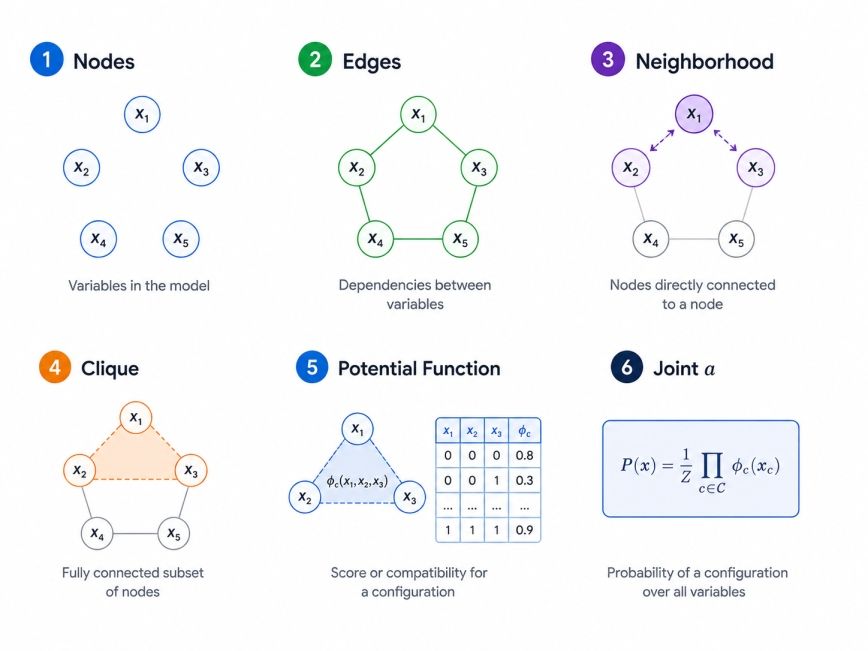
Component |
Description |
| Nodes | Random variables |
| Edges | Relationships between variables |
| Neighborhood | Connected nodes influencing a variable |
| Clique | Group of fully connected nodes |
| Potential Function | Measures compatibility among variables |
| Joint Probability | Overall probability distribution |
Traditional models often think that each piece of data is separate from the others. Real world data does not work that way.
For example:
MRFs capture the way these pieces of data are connected to each other. That makes predictions better. MRFs are used a lot in things like making images look better, separating things in images and recognizing objects in images. Research from people who work with computer vision and look at images says that MRFs are very good at understanding how things are related to each other in space.
For beginners, it is helpful to think of Markov Random Fields as a network. In this network, neighboring data points work together to produce better results.
Also Read: Hidden Markov Model in Machine Learning: Key Components, Applications, and More
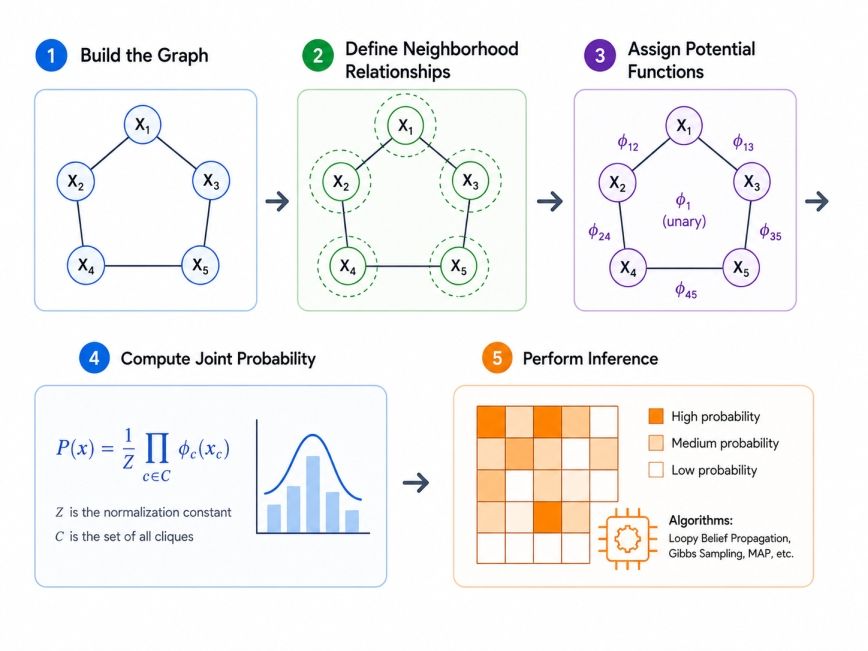
You can understand Markov fields in machine learning if you take your time and go through each step.
Step 1: Build the Graph
The model starts with an undirected graph. Each node represents a variable.
For example, in image analysis:
Each pixel becomes a node. Adjacent pixels are connected by edges.
Step 2: Define Neighborhood Relationships
Every node interacts with its neighboring nodes.
The Markov property states:
A node is conditionally independent of all other nodes once its neighbors are known.
Step 3: Assign Potential Functions
Potential functions measure how compatible neighboring values are.
For example:
| Pixel A | Pixel B | Compatibility |
| Same Label | Same Label | High |
| Different Label | Different Label | Low |
The model prefers configurations with higher compatibility scores.
Step 4: Compute Joint Probability
MRFs combine local relationships into a global probability distribution.
The probability depends on:
This enables the model to evaluate many possible outcomes and select the most likely one.
Step 5: Perform Inference
Inference determines the most probable configuration of variables.
Common techniques include:
Simple Example:
Suppose an image contains a cat. Some pixels clearly belong to the cat. Others are uncertain. Instead of labeling each pixel independently, an MRF considers neighboring pixels.
If surrounding pixels belong to the cat, the uncertain pixel is more likely to receive the same label. This produces smoother and more accurate segmentation.
Also Read: Machine Learning Tutorial: Basics, Algorithms, and Examples Explained
MRFs are closely connected to Gibbs distributions and energy-based models.
The objective is often framed as minimizing an energy function:
Lower energy = more likely solution
This framework has made MRFs useful across computer vision, pattern recognition, and statistical learning applications.
AI Courses to upskill
Explore Artificial Intelligence Courses for Career Progression
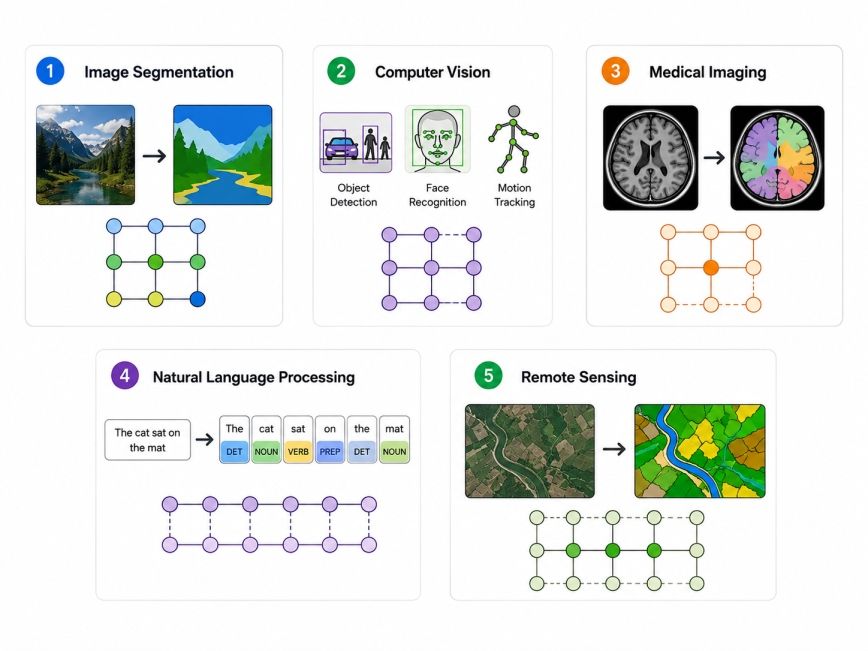
The popularity of Markov Random Fields in machine learning comes from how flexible they are. Markov Random Fields are helpful when the things you observe near each other affect one another.
One of the most common applications is image segmentation. The goal is to assign labels to pixels. MRFs improve segmentation by enforcing spatial consistency.
Benefits include:
Numerous image processing studies have demonstrated the effectiveness of MRFs for segmentation and restoration tasks.
By modeling local context, they improve visual interpretation.
MRFs support many vision-related tasks:
Medical imaging often contains noise and uncertainty. MRFs help create more reliable predictions.
Healthcare systems use MRFs for:
MRF-based methods are good at solving these types of problems, so they are still used today. People use MRF-based methods to solve prediction problems because they work well.
In NLP, neighboring words influence meaning.
MRFs can help with:
Although newer deep learning approaches dominate today, MRF-based methods still contribute to structured prediction problems.
Satellite imagery relies heavily on spatial relationships.
MRFs assist with:
Some recommendation models use MRF concepts to represent interactions among users, products, and preferences.
Application Area |
Use Case |
| Computer Vision | Object detection |
| Medical Imaging | MRI segmentation |
| NLP | Sequence labeling |
| Remote Sensing | Land classification |
| Pattern Recognition | Context modeling |
| Image Processing | Noise reduction |
Recent research has explored combining MRFs with neural networks.
The result is usually a job with complex vision tasks when it understands the context of what it is looking at.
These hybrid systems aim to capture:
Also Read: Deep Learning: Dive into the World of Machine Learning!
Like any tool in machine learning, MRFs have an advantage and when you're working in it, they're hard to beat.
Understanding both advantages and limitations helps determine when to use them.
Choose MRFs when:
Avoid them when:
People are still using MRFs even though deep learning is getting more popular.
Researchers are finding that combining models with neural networks is a good way to make things more understandable and improve the performance of MRFs when it comes to making predictions that follow a structure. Recent surveys highlight ongoing interest in integrating MRF variants with deep learning systems.
Subscribe to upGrad's Newsletter
Join thousands of learners who receive useful tips
Markov random fields in machine learning provide a powerful framework for modeling relationships between connected variables. While they can be computationally demanding, their ability to represent structured relationships remains highly valuable.
As machine learning continues to evolve, MRFs are increasingly being combined with deep learning models to create systems that are both accurate and context aware. For anyone exploring probabilistic graphical models, understanding MRFs is an important step toward mastering advanced machine learning concepts.
Want to explore more about Markov random fields in machine learning? Book your free 1:1 personal consultation with our expert today.
The main purpose of Markov random fields in machine learning is to model dependencies between neighboring variables. Instead of treating observations independently, MRFs capture local relationships that influence predictions. This makes them especially useful for structured and spatial data problems.
Markov chains model sequential dependencies where each state depends on the previous state. Markov random fields model relationships among multiple interconnected variables in an undirected graph. They are better suited for spatial and network-based problems.
Images contain strong spatial relationships between neighboring pixels. MRFs use these relationships to improve segmentation, restoration, denoising, and object recognition. This often results in smoother and more accurate image analysis outcomes.
Yes. Although deep learning dominates many applications, MRFs remain valuable for structured prediction and contextual modeling. Modern research often combines MRFs with neural networks to improve performance and interpretability.
The Markov property states that a variable depends only on its immediate neighbors once those neighbors are known. This simplifies modeling and computation while preserving important local relationships within the data.
Industries such as healthcare, autonomous vehicles, remote sensing, robotics, manufacturing, and computer vision use MRFs. They help solve problems involving uncertainty, spatial dependencies, and structured data representations.
Clique potentials are mathematical functions that measure compatibility among connected variables. They help define the joint probability distribution and influence which configurations are considered more likely by the model.
Yes. MRFs can model relationships between words, phrases, and labels in text data. They have been applied to sequence labeling, entity recognition, and information extraction tasks where context plays an important role.
The biggest challenges include computational complexity, parameter estimation, scalability, and inference efficiency. Large graphs often require approximation methods to make training and prediction practical for real-world applications.
Structured prediction involves outputs that depend on one another rather than independent labels. MRFs naturally model these dependencies, allowing predictions to remain consistent across related variables and improving overall accuracy.
Several software libraries support MRF implementation, including PyMC, OpenGM, Infer.NET, GraphLab, and probabilistic graphical model libraries in Python. Researchers also use frameworks built on TensorFlow and PyTorch to combine MRF concepts with deep learning workflows. These tools support experimentation, inference, and model training across different applications.
706 articles published
Sriram K is a Senior SEO Executive with a B.Tech in Information Technology from Dr. M.G.R. Educational and Research Institute, Chennai. With over a decade of experience in digital marketing, he specia...
Speak with AI & ML expert
By submitting, I accept the T&C and
Privacy Policy
Top Resources
Master's Degree
18 Months
Executive Diploma
12 Months
IIIT Bangalore
Executive Programme in Generative AI & Agentic AI for LeadersIndia’s #1 Tech University
Dual Certification
5 Months