Google Is Taking AI Data Centers to Space: Project Suncatcher Gets Its First Orbital Test
By Vikram Singh
Updated on Sep 25, 2026 | 4 min read | 3.21K+ views
Share:

All courses
Certifications
More
By Vikram Singh
Updated on Sep 25, 2026 | 4 min read | 3.21K+ views
Share:
Table of Contents
Key Highlight of NEWS
AI infrastructure is evolving rapidly, from conventional data centers to emerging approaches such as space-based computing. Build a strong foundation in AI technologies, applications, and real-world use cases with upGrad’s Artificial Intelligence Course.
Popular AI Programs
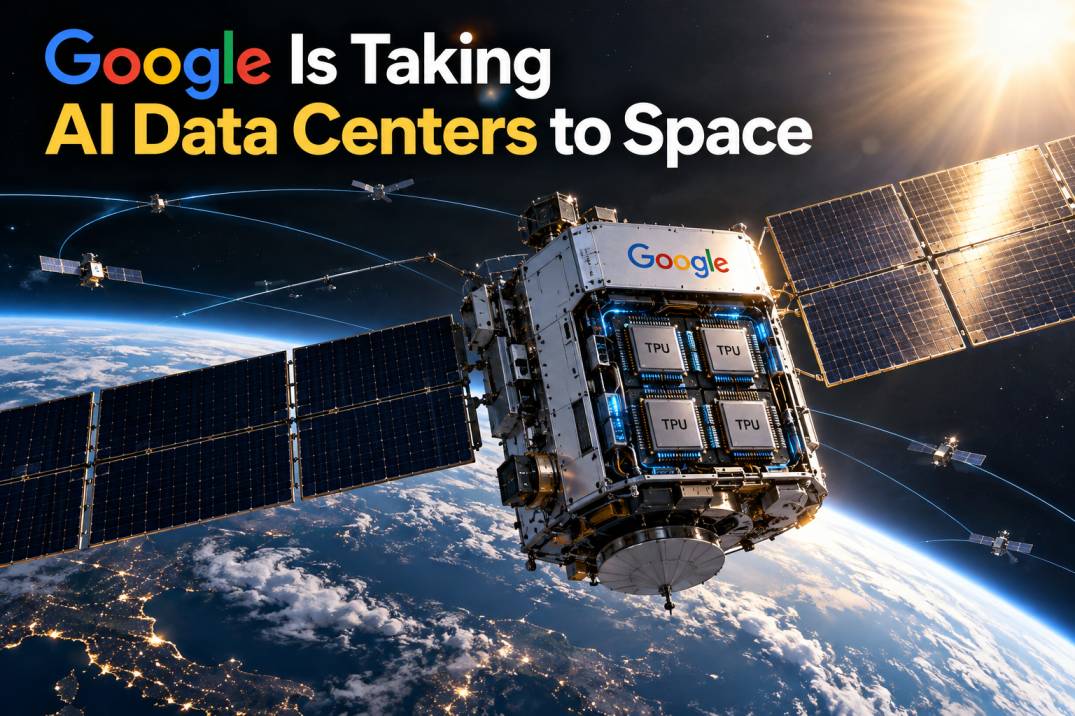
Google is taking its AI infrastructure ambitions beyond Earth with Project Suncatcher, a research effort exploring whether large-scale machine-learning computing could eventually operate in space.
The company said its first prototype satellite is scheduled to launch next week aboard SpaceX's Transporter-18 rideshare mission, developed in partnership with Planet. The satellite will carry Google Tensor Processing Units (TPUs) into low Earth orbit.
The initial mission isn't an operational space data center. Instead, Google wants to determine whether its AI hardware can survive and operate reliably in the harsh orbital environment.
Free Courses
One of Google's biggest arguments is energy availability.
Satellites in low Earth orbit can receive near-constant sunlight. Google says they could generate up to eight times more solar power than on Earth, potentially providing a continuous energy source for future AI computing infrastructure.
The concept could eventually involve constellations of satellites carrying multiple TPUs and working together on AI workloads. But Google says this remains a long-term research project rather than an immediate replacement for terrestrial data centers.
AI Courses to upskill
Explore Artificial Intelligence Courses for Career Progression
The satellite will test how Google's TPUs respond to launch forces, radiation and extreme temperatures.
During launch, spacecraft can experience acceleration loads of up to 10 times Earth's gravity, while individual TPU components can face forces of 50–100 g. Google has already conducted ground-based vibration testing.
Radiation is another concern. Google says its Trillium TPUs survived testing at UC Davis that exposed them to radiation levels greater than what they would receive during a five-year space mission. The orbital test will provide real-world data.
Cooling presents a separate engineering problem. Conventional airflow cooling doesn't work in the vacuum of space, so Google is testing heat pipes and radiators to remove heat from the chips.
Projects like Google’s Project Suncatcher show how AI infrastructure is becoming a strategic technology decision, not just an engineering challenge. Develop the leadership and AI strategy skills needed to evaluate emerging technologies and lead AI-driven transformation with upGrad’s Chief Technology Officer & AI Leadership Programme.
Google's longer-term vision requires satellites to communicate at extremely high bandwidth.
The company plans to put two satellites into orbit in 2027 to test laser-based links between spacecraft. Future designs could use clusters of satellites, each carrying dozens of TPUs, to handle larger AI workloads.
Google acknowledges that significant engineering challenges remain. Reuters also reports that experts consider commercial viability to be years away because of launch costs, engineering constraints and satellite-production bottlenecks.
For now, Project Suncatcher is about proving one basic question: can AI computing hardware reliably work in space?
Project Suncatcher is Google's research initiative exploring whether large-scale AI computing infrastructure could eventually operate in space.
No. The current mission is a technology test. Google is evaluating whether its AI hardware can reliably operate in orbit before considering larger-scale deployments.
Google says the prototype is scheduled to launch next week on SpaceX's Transporter-18 rideshare mission.
The prototype satellite will carry Google's Tensor Processing Units (TPUs), including Trillium-generation hardware.
Google says low Earth orbit can provide near-constant sunlight and potentially up to eight times more solar power than comparable conditions on Earth.
Because conventional airflow isn't available in a vacuum, Google is testing a cooling system using heat pipes and radiators.
Yes. Space radiation can cause electronic errors known as bit flips. Google has conducted ground-based radiation testing and will now gather real-world orbital data.
Google says spacecraft can experience loads of up to 10 g, while individual TPU components can experience forces of 50–100 g during launch.
Google plans to launch two satellites in 2027 to test high-bandwidth laser communication between spacecraft.
No. Google describes Suncatcher as a long-term research project, and Reuters reports that experts believe commercial viability remains years away.
155 articles published
Vikram Singh is a seasoned content strategist with over 5 years of experience in simplifying complex technical subjects. Holding a postgraduate degree in Applied Mathematics, he specializes in creatin...
Speak with AI & ML expert
By submitting, I accept the T&C and
Privacy Policy
Top Resources
Master's Degree
18 Months
Executive Diploma
12 Months
IIIT Bangalore
Executive Programme in Generative AI & Agentic AI for LeadersIndia’s #1 Tech University
Dual Certification
5 Months