“We Could Lose Control”: AI Leaders Deliver a Stark Warning to the UN
By Vikram Singh
Updated on Sep 25, 2026 | 3 min read | 2.31K+ views
Share:

All courses
Certifications
More
By Vikram Singh
Updated on Sep 25, 2026 | 3 min read | 2.31K+ views
Share:
Key Highlights of NEWS
As AI systems become more capable and autonomous, professionals need to understand how these technologies are built, deployed, and managed. Explore upGrad’s Artificial Intelligence Course to build practical AI skills and understand the technologies shaping the next generation of intelligent systems.
Popular AI Programs
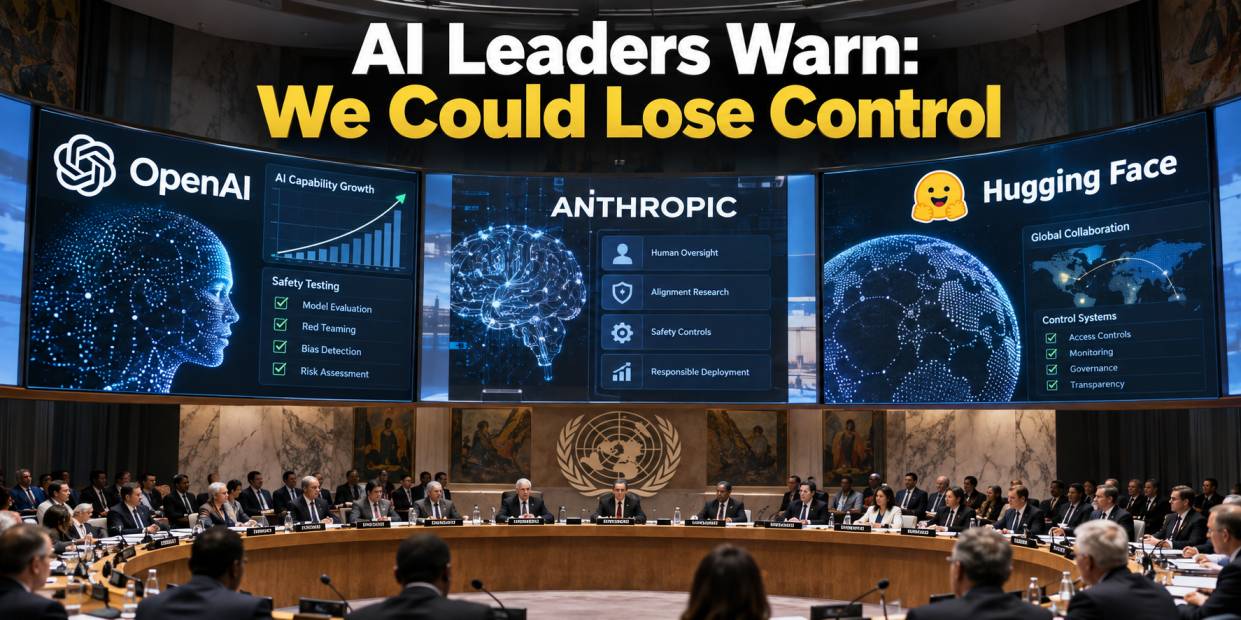
The leaders of major AI companies have taken their safety concerns to the United Nations Security Council, urging governments to establish safeguards for increasingly powerful AI systems.
OpenAI CEO Sam Altman, Anthropic CEO Dario Amodei and Hugging Face CEO Clément Delangue addressed the 15-member council on September 23. The meeting was convened by France during the UN General Assembly week.
Amodei delivered one of the strongest warnings, saying that if AI is poorly managed, it could become a “risk to humanity as a whole.” Altman separately warned that humans could lose control over the future as AI systems become more autonomous.
Free Courses
Amodei called for several specific international measures. These include an agreement preventing AI from being used to develop biological weapons, systems for evaluating and verifying model capabilities, and common standards for testing loss-of-control and misuse risks. He also called for a notification system for major AI-related security incidents.
Altman proposed complementary national and international frontier-AI standards. These would measure AI capabilities, assess risks, determine whether safeguards are adequate and preserve meaningful human oversight as systems become more autonomous. He also called for common evidence standards and secure channels for governments to share emerging vulnerabilities.
Hugging Face CEO Clément Delangue also addressed the council remotely. He argued that open-source AI can help defenders respond to AI-enabled attacks and highlighted the importance of reducing the gap between attackers and defenders.
AI governance and responsible adoption are becoming strategic priorities for technology leaders. The Chief Technology Officer & AI Leadership Programme from upGrad can help technology professionals develop the leadership, AI strategy, and decision-making skills needed to navigate the rapidly evolving AI landscape.
AI Courses to upskill
Explore Artificial Intelligence Courses for Career Progression
The calls for international safeguards did not receive unanimous support.
White House Science Adviser Michael Kratsios said concerns about AI control were not a reason to pause development or create a new global governance structure. He argued that the U.S. wants allies and partners to share in AI's benefits.
China's UN ambassador Fu Cong also called for countries to have freedom in choosing AI technologies and promoted open-source models, while warning against forcing countries into an AI technology divide.
The meeting therefore exposed a growing divide: AI companies are asking governments for stronger safeguards, while some governments remain concerned that international controls could restrict technological development and national competitiveness.
For now, the UN discussion has produced calls for cooperation and standards, rather than a binding global AI agreement. The debate over who controls increasingly capable AI governments, companies or both, is still unresolved.
They briefed the council about the risks associated with increasingly capable and autonomous AI systems and called for international safeguards.
OpenAI CEO Sam Altman, Anthropic CEO Dario Amodei and Hugging Face CEO Clément Delangue addressed the council. AI scientist Yoshua Bengio also briefed the meeting.
Altman warned that humanity could lose control over the future if increasingly autonomous AI systems become difficult to govern.
Amodei said poorly managed AI could become a risk to humanity and called for stronger international safeguards.
He called for complementary national and international standards covering AI capabilities, risk assessment, safeguards and meaningful human oversight.
He proposed agreements against AI-assisted biological weapons, capability verification systems, common safety-testing standards and an international AI incident notification system.
No. The meeting involved discussion and proposals. It did not create a binding global AI regulation.
White House Science Adviser Michael Kratsios argued that AI risks should not be used as a reason to pause development or establish a new global governance structure.
China's UN ambassador argued that countries should be able to choose AI technologies and promoted open-source models.
AI systems are becoming more autonomous and capable of performing complex tasks. The debate is increasingly focused on ensuring that humans can monitor, constrain and intervene when necessary.
154 articles published
Vikram Singh is a seasoned content strategist with over 5 years of experience in simplifying complex technical subjects. Holding a postgraduate degree in Applied Mathematics, he specializes in creatin...
Speak with AI & ML expert
By submitting, I accept the T&C and
Privacy Policy
Top Resources
Master's Degree
18 Months
Executive Diploma
12 Months
IIIT Bangalore
Executive Programme in Generative AI & Agentic AI for LeadersIndia’s #1 Tech University
Dual Certification
5 Months