What is a Forward Deployed Engineer? Inside the Role, Skills and Career Path
By upGrad
Updated on Nov 10, 2026 | 9 min read | 2.36K+ views
Share:

All courses
Certifications
More
By upGrad
Updated on Nov 10, 2026 | 9 min read | 2.36K+ views
Share:
Table of Contents
Key Highlights
Knowing how to build AI is one thing, and making it work for a real company is another. Develop both skills with upGrad’s Artificial Intelligence Courses and move toward high-growth AI roles.
Popular AI Programs
A forward deployed engineer (FDE) is a software engineer who works directly inside a customer’s environment to deploy, customize and operationalize a complex technical product on the customer’s real systems and data. Rather than staying within internal product teams.
They sit with the people who will use the product and make it work on the customer’s own systems, data and daily processes.
How an FDE differs from nearby roles:
Role |
What they typically do |
| Software developer | Builds a product whose scope is already defined |
| Consultant | Studies the problem and ends with a recommendation |
| Forward deployed engineer | Defines the problem with the client, then builds working software that stays behind |
AI is the main reason this role is in the spotlight. Models are now very capable, but capability alone doesn’t change how a business runs. A company can have the best model but still can sell no improvement because no one handles it better.
This is where the forward deployed engineer in AI steps in. They turn a general model into something specific..
What that involves in practice:
How AI has changed the craft:
Free Courses
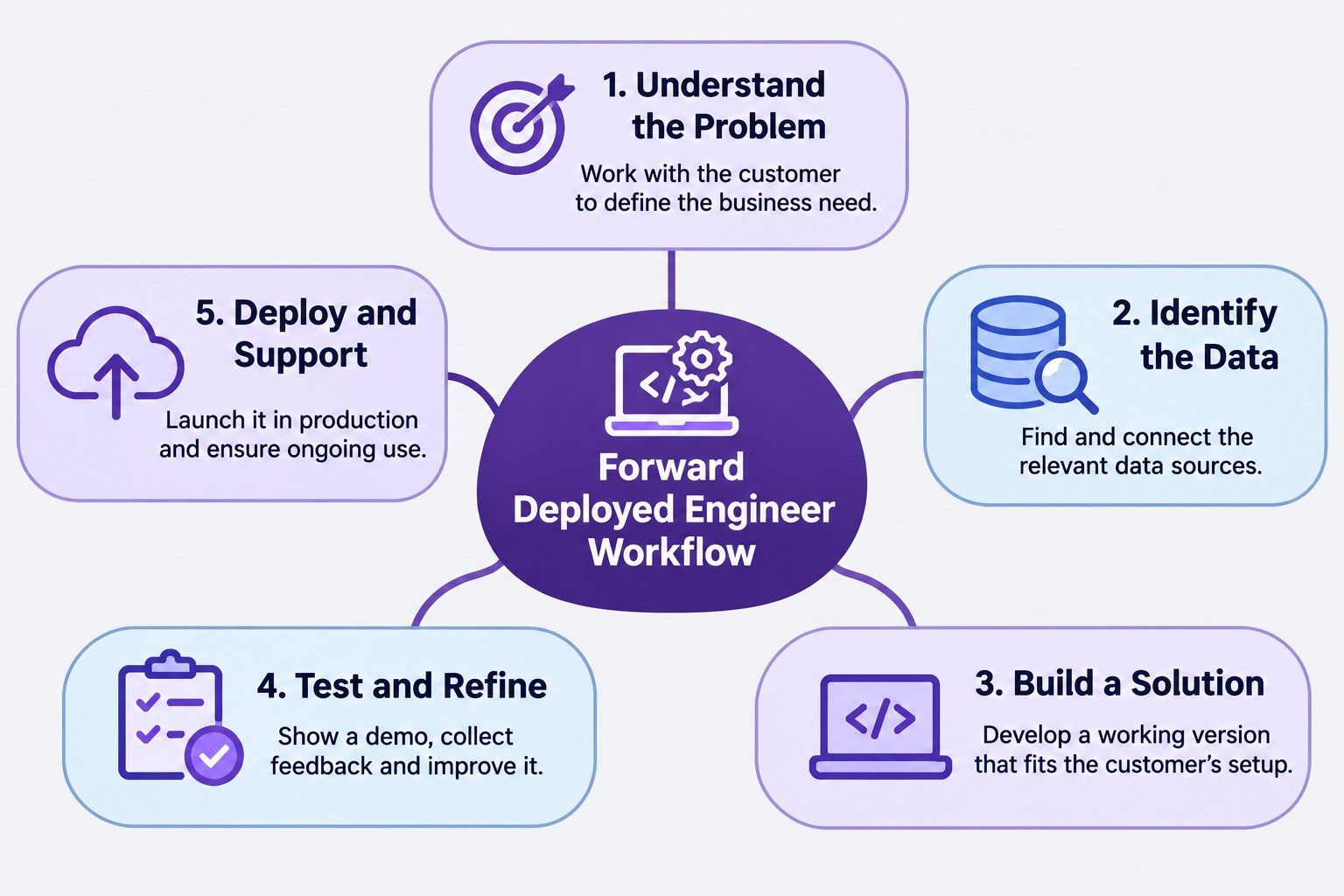
A typical engagement between a FDE and a customer looks like this:
What the first few weeks usually involve:
What an FDE does day to day depends on the employer, but most roles come down to the same four jobs.
Where an FDE spends their time:
Area |
Focus |
| Customer Understanding | Listening, scoping, aligning on outcomes |
| Building | Coding, integration, customization |
| Deployment | Testing, launching, monitoring |
| Feedback Loop | Documenting and sharing lessons with product teams |
Forward deployed engineers turn AI from a demo into a working system. Build the same skills, from RAG and AI agents to deployment, with upGrad’s AI-Native Software Engineering program from IIT Kharagpur.
AI Courses to upskill
Explore Artificial Intelligence Courses for Career Progression
Forward deployed engineer skills have two parts: strong engineering and strong people skills. Technical ability gets the solution built, while communication and judgment get it adopted. One without the other leaves the job half done.
An FDE writes production-grade code, so the engineering foundation has to be solid. Most of the work happens in someone else’s environment, which makes adaptability as important as raw skill.
Core Technical Skills
This is the side that separates a good FDE from a good engineer. The customer rarely hands over a clear spec, so you have to find the real problem yourself.
Must read: Top Machine Learning APIs for Data Science Projects in 2026
The FDE jobs are growing, but they are concentrated in a small group of employers and often hidden behind different titles. Knowing who hires and what to search for makes the hunt much easier.
The hype suggests every tech company is hiring FDEs. In reality, a smaller set of employers does most of the hiring, and they fall into a few clear groups.
Where forward deployed engineer roles are found:
Industries that rely on FDEs:
The common thread is complex deployment. Wherever a product has to be adapted to messy customer environments, FDEs get hired.
Many employers don’t use the exact title. If you search only “forward deployed engineer,” you’ll miss a large share of relevant openings.
Titles that often mean the same work:
Variants of the FDE title itself:
Adjacent titles worth checking:
The role is rewarding, but it is not an easy one. Most of the difficulty comes from working in someone else’s environment, with real stakes and few guardrails.
An FDE works on live systems that the customer uses every day. If something breaks, the customer sees it first. A failed data sync or a broken integration can show up right before an important meeting.
The work also does not end at launch. The engineer stays accountable until the customer’s team confirms the solution works. That means long hours during rollouts and a lot of pressure when deadlines are fixed.
People are often harder to deal with than technology. A well-built tool is useless if the team does not use it. Most teams already have a routine, and a new system feels like extra work to them.
Experienced professionals can be the most resistant, especially if an earlier tool failed them. A few things usually help:
Every customer brings a different industry, dataset and process. One project may involve hospital records and the next may involve shipping routes. The tools stay the same, but the language and the unwritten rules change each time.
Fast learning is part of the job, and deadlines are often short. Some engineers enjoy this variety. Others find the pace tiring over time.
Conclusion
AI is moving from experiments to everyday business, and the hard part is no longer building the model. The hard part is making it work for a particular company, with its messy data, its habits and its people. That gap is where the forward deployed engineer lives, and it is why the role is likely to matter for years to come, not just for one hiring cycle.
If this path appeals to you, you don’t need to wait for the perfect job title. Pick a real problem, build a working solution for it, and put it in front of the people who would use it. Doing that once teaches you more about the role than any amount of reading, and it is exactly what employers want to see.
Book a one-on-one consultation with upGrad counsellors to get personalized guidance on selecting the best course for your career.
No. A solutions engineer mainly supports the sales process with demos, technical guidance and proofs of concept. A forward deployed engineer goes much further and writes production-grade code, builds custom integrations and stays until the solution runs in the customer’s live environment.
It depends on the employer and the customer. Some roles involve regular time at the customer’s location, while others are fully remote or hybrid. Security-sensitive work, such as government projects, is more likely to be on-site.
Some FDEs stay with a single customer for months, while others split their time across a few smaller engagements. The scope varies widely by company and by how complex each deployment is.
Most work with a programming language such as Python or TypeScript, a major cloud platform, databases, APIs and version control. FDEs working on AI projects also use large language model APIs, vector databases and agent frameworks.
Not necessarily. Employers care more about whether you can ship working software and solve customer problems than about a specific degree. A strong portfolio and real deployment experience can outweigh formal credentials, though a technical background helps.
It is possible but harder, because most openings prefer a couple of years of engineering experience. Freshers can improve their chances by starting in adjacent roles such as backend, data or implementation engineering, by building customer-facing projects, and by looking for internships.
For an engineer who already has solid software experience, a focused effort of several months can be enough to build the missing deployment and customer skills. Starting from scratch typically takes a year or more, since you need both the engineering foundation and real project experience.
Most processes include a recruiter screen, a technical coding round, a case study and a conversation with the hiring manager. The case study is often the most telling part, because it tests how you break down a vague problem and think through it out loud.
It can be. Live systems, tight deadlines and customer expectations create pressure, especially around launches. Many people manage it well if they like varied work, and workload usually eases between major deployments.
AI is changing the work more than it is removing it. Tools now write much of the code, but someone still has to understand the customer’s problem, connect the systems, earn the users’ trust and take responsibility for results. Those human parts are what the role is built around.
Yes, for the right person. It offers high impact, strong pay and fast skill growth, along with a path into senior technical, architecture, product or leadership roles. It suits people who enjoy unclear problems and working with customers, and it is a weaker fit for those who prefer focused, internal product work.
1353 articles published
We are an online education platform providing industry-relevant programs for professionals, designed and delivered in collaboration with world-class faculty and businesses. Merging the latest technolo...
Speak with AI & ML expert
By submitting, I accept the T&C and
Privacy Policy
Top Resources
Master's Degree
18 Months
Executive Diploma
12 Months
IIIT Bangalore
Executive Programme in Generative AI & Agentic AI for LeadersIndia’s #1 Tech University
Dual Certification
5 Months