E Commerce and Digital Marketing
By Sriram
Updated on Aug 11, 2026 | 10 min read | 7.01K+ views
Share:

All courses
Certifications
More
By Sriram
Updated on Aug 11, 2026 | 10 min read | 7.01K+ views
Share:
Table of Contents
Key Highlights
Want to build practical digital marketing skills? Explore the Digital Marketing Course Online from upGrad and learn SEO, social media, PPC, and analytics.
Even a good online store with good products can struggle to generate sales. People need to find the store, know what it sells, trust the company and have a simple way to buy.
So what is e commerce and digital marketing ? E commerce is the practice of buying and selling products or services thru digital channels. Digital marketing encompasses the online tactics businesses use to attract, engage, convert, and retain customers.
E-commerce means buying and selling on the Internet. A customer can visit a physical store, view products, compare products, make an order, pay for it and get the product. The common e commerce models are B2C, B2B, C2C, and C2B.
For instance, a customer buys a pair of shoes from an online retailer then the product search, online payment, order confirmation and delivery are all parts of the e commerce process.
E-commerce doesn't mean only websites. Online transactions can also be supported by marketplaces, social commerce sites, mobile apps and other digital shopfronts.
Read: Ecommerce Marketing Essentials: How to drive more sales?
Digital marketing is the process of using online channels to build relationships between businesses and potential and existing customers. These channels include search engines, social media, websites, email, content and paid advertising.
Imagine a person looking for "running shoes for beginners." They had the ability to locate a buying guide thru Google, go to a product page, view a product video, and then get an email about a related offer down the line.
That is digital marketing backing an e-commerce journey.
The connection becomes easier to understand through the customer journey.
Search or social media → Website visit → Product discovery → Consideration → Purchase → Follow-up → Repeat purchase
The journey isn't always neat. A customer may see an advertisement today, compare products for several days, and purchase after receiving an email.
That's why understanding what is e commerce and digital marketing involves more than memorising two definitions. It means understanding how marketing activities help customers move toward a transaction.
Free Courses
Digital marketing starts before someone visits an online store and continues after the purchase. The aim is to connect customer acquisition, conversion, and retention rather than treating every activity as a separate campaign.
The exact approach depends on the product, audience, buying cycle, and available resources. A fashion retailer may depend heavily on visual social content, while a specialist equipment seller may rely more on search and educational content.
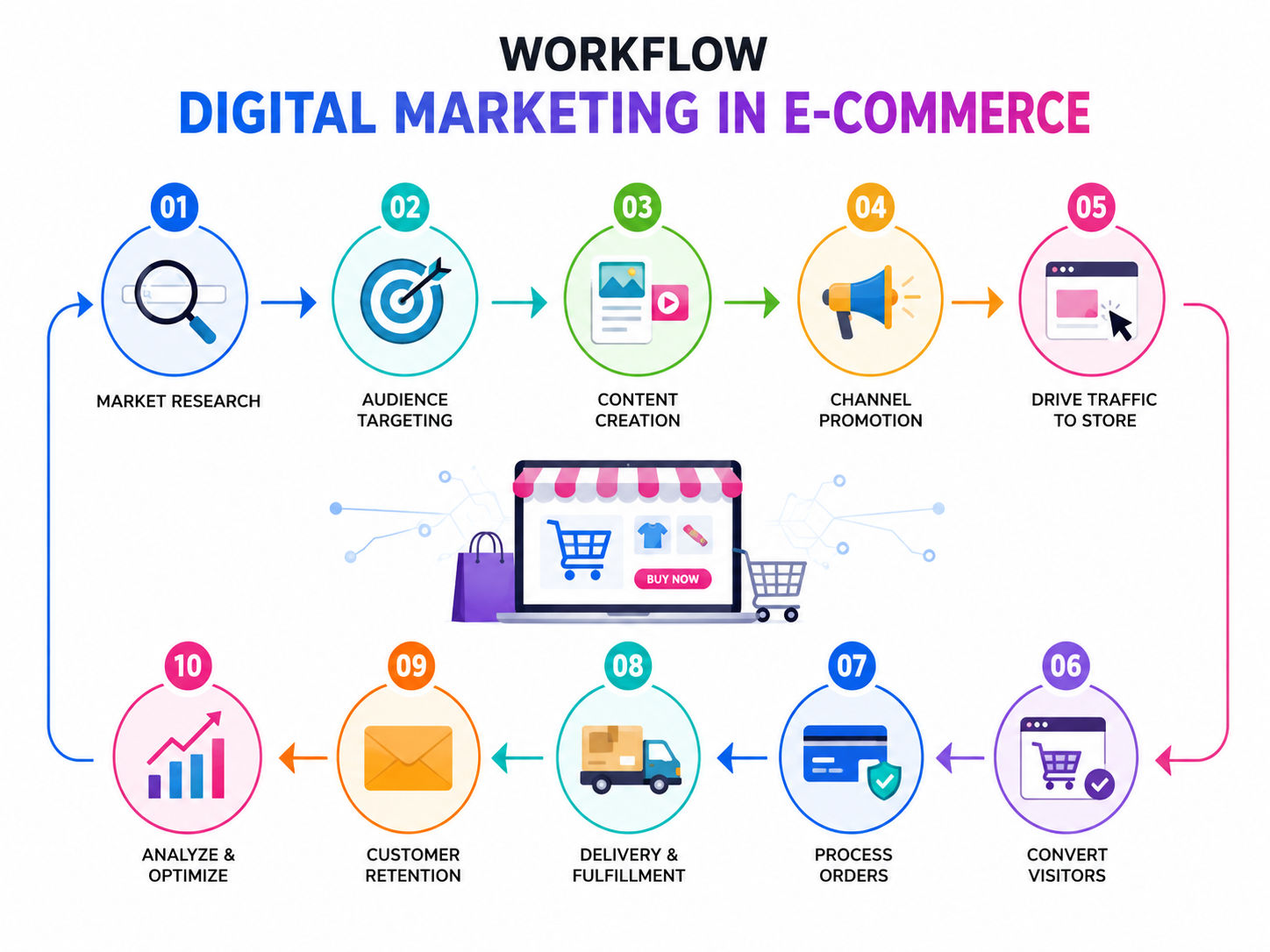
This is how digital marketing supports e-commerce beyond the first transaction.
Read: Product Management in E-Commerce: Top Skills and Facts You Need to Know!
Digital Marketing Courses to upskill
Explore Digital Marketing Courses for Career Progression
MICA Executive Alumni Status
A good online store still needs visibility. Digital marketing helps e-commerce businesses reach the right customers, build trust, and drive sales.
Want to strengthen your e-commerce marketing skills? Explore the IIIT-B & IIMU Chief Data and AI Officer Programme Online by upGrad and learn how data and AI can support smarter digital marketing decisions.
E commerce businesses can use several digital marketing channels, but they don't need to use all of them at once. The right combination depends on customer behaviour, product type, competition, and business resources.
Quick view:
| Channel | Main purpose | Example |
| SEO | Capture organic search demand | Product-page optimisation |
| Social media | Product discovery | Product videos |
| Content marketing | Educate customers | Buying guides |
| Email marketing | Retention and conversion | Abandoned-cart emails |
| Paid advertising | Generate targeted traffic | Search and shopping ads |
| CRO | Improve conversions | Checkout testing |
The most useful approach is to understand what each channel does and where it fits into the customer journey.
E-commerce SEO strategies help product and category pages appear for relevant searches. Focus on keyword research, product optimisation, internal links, mobile usability, page speed, and structured data.
For example, a running shoe store can create a guide for beginners and link it to relevant product pages. Good SEO isn't only about rankings. It helps customers find the right products.
Social media helps customers discover products, explore reviews, and see products in use. Short videos, user-generated content, product launches, and creator content can support product discovery.
Don't use every platform. Focus on channels where your target customers are active.
Content answers customer questions before they purchase. Useful formats include:
For example, a furniture store can publish a guide on choosing a dining table and link to relevant products.
Read: Digital Marketing Course Duration and Fees: Complete Overview
Email marketing helps businesses communicate with customers and encourage repeat purchases. Common campaigns include welcome emails, promotions, abandoned-cart reminders, product launches, and post-purchase emails.
Segmentation makes emails more relevant. A new subscriber shouldn't receive the same message as a loyal customer.
Paid advertising can bring targeted traffic quickly. Search ads capture purchase intent, while social and display ads can support product discovery and retargeting.
The landing page should match the advertisement. More ad spending won't fix a poor product page or checkout.
Do read: How To Become a Google Ads Specialist: A Step-by-Step Guide
Conversion rate optimization for e commerce focuses on turning more visitors into customers.
Use clear images, descriptions, reviews, pricing, delivery details, and strong calls to action. Customers should quickly understand the product and its value.
Reduce unnecessary steps, forms, and unexpected costs. Offer convenient payment options and make checkout easy on mobile devices.
Test product images, page layouts, offers, calls to action, and checkout elements. Change one key element at a time so you can identify what improves conversions.
Also read: Starting A Career In Digital Marketing: All You Need To now
The difference between e commerce and digital marketing becomes clearer when you look at their roles. E-commerce and digital marketing serve different purposes, but they work closely together.
The table below highlights their key differences in a simple way
| E-Commerce | Digital Marketing |
| Focuses on buying and selling products or services online. | Focuses on promoting products and reaching customers online. |
| Includes product pages, shopping carts, payments, and order processing. | Includes SEO, social media, email, content, and paid advertising. |
| Provides the platform where customers make purchases. | Brings the right customers to the online store. |
| Focuses on creating a smooth shopping experience. | Focuses on attracting, engaging, and retaining customers. |
| Example: An online clothing store selling products through its website. | Example: Google rankings, Instagram campaigns, email newsletters, and paid ads promoting that store. |
Read: Future of Digital Marketing: How It Goes From Here
Increasing sales is not always about getting more traffic. Start by understanding what customers need and match each stage of their journey with the right marketing channel.
Marketing decisions become easier when businesses know which numbers actually matter. A campaign can generate thousands of clicks while producing very little revenue.
Start with the business goal, then choose metrics that help explain performance.
| Goal | Useful metrics |
| Improve visibility | Organic traffic, impressions |
| Generate sales | Revenue, conversion rate |
| Control acquisition cost | CAC |
| Evaluate advertising | ROAS |
| Increase order value | AOV |
| Improve retention | Repeat purchase rate |
| Understand customer value | CLV |
| Reduce checkout losses | Cart abandonment rate |
Don't treat every metric as equally important. If revenue is the goal, clicks alone won't tell you whether the campaign worked.
Read: Importance of Digital Marketing: Top 10 Reasons Your Business Needs it
Even good campaigns can struggle when the online store has basic problems. Avoid these common mistakes:
Read: Digital Marketing Challenges: How to Win Amidst the Challenges in Digital Marketing
A practical strategy doesn't need dozens of complicated rules. It needs a clear customer focus and regular optimisation.
The best approach isn't always the one with the biggest channel mix. A focused strategy that's maintained well can produce better results than a complicated plan that nobody has time to manage.
E commerce and digital marketing serve different roles but work best together. E-commerce handles online buying and selling, while digital marketing helps customers discover products, build trust, and make purchases.
A strong strategy combines SEO, social media, content, email, paid advertising, and conversion optimisation. Focus on attracting the right customers, creating an easy shopping experience, and improving based on customer behaviour. This approach can help e-commerce businesses increase visibility, sales, and repeat purchases.
Ready to start your journey? Book a free consultation with upGrad today to find the best path for your career.
E commerce refers to buying and selling products or services online, while digital marketing covers the methods used to attract and engage customers through digital channels. Together, they connect online stores with potential buyers through search, social media, email, content, advertising, and other digital touchpoints.
Yes, e commerce can offer career opportunities across online sales, merchandising, analytics, marketing, operations, and customer experience. Digital marketing skills can also support roles such as e commerce specialist, SEO analyst, and marketing executive, giving beginners several possible paths rather than one fixed career route.
It’s possible but not a typical starting income. Earning ₹10 lakh monthly usually requires substantial experience, specialised skills, strong business results, senior leadership, consulting, agency ownership, or successful freelance work. Income varies widely by expertise, clients, market, role, and ability to demonstrate measurable results.
Seven commonly discussed types are SEO, search engine marketing, social media marketing, content marketing, email marketing, affiliate marketing, and influencer marketing. Businesses may combine several depending on their audience and goals, rather than treating these categories as completely separate marketing activities.
Digital marketing isn't strictly an IT job. It combines marketing, communication, creativity, analytics, and technology. Some roles involve technical SEO, analytics, advertising platforms, or automation, while others focus more on content, social media, branding, or campaign management.
SEO is the process of improving web pages so they can appear more prominently for relevant search queries. For e commerce businesses, it can involve product pages, category pages, technical SEO, internal linking, content, and structured data that help search engines understand the website.
You don't usually need advanced coding skills to start. Basic knowledge of websites, analytics, HTML, tracking, and marketing platforms can be useful, while technical roles may require deeper skills. Your required technical knowledge depends on whether you specialise in SEO, advertising, analytics, content, or e-commerce operations.
Useful skills include SEO, paid advertising, social media, email marketing, content creation, analytics, customer research, and conversion optimisation. Employers also value practical experience because professionals often need to interpret performance data, manage campaigns, improve online stores, and connect marketing activity with business outcomes.
The basics can be learned within a few months, but becoming job-ready requires practice. Working on campaigns, analysing results, building a portfolio, and learning relevant tools can make a bigger difference than simply completing courses. Skills also need regular updating as platforms and search behaviour change.
Beginners should start with marketing fundamentals, customer and search intent, SEO, content, social media, paid advertising, email, and analytics. After learning the basics, practical projects can help connect these skills and show how traffic, engagement, conversions, and revenue relate to one another.
730 articles published
Sriram K is a Senior SEO Executive with a B.Tech in Information Technology from Dr. M.G.R. Educational and Research Institute, Chennai. With over a decade of experience in digital marketing, he specia...
Get Free Consultation
By submitting, I accept the T&C and
Privacy Policy
Level Up Your Digital Marketing Career Today!
Top Resources
MICA
Advanced Certificate in AI-Powered Digital Marketing & Communication from MICAMICA Executive Alumni Status
Certification
5 Specialisation
Classroom
4 Months
Certification
2 Months