Context Engineering vs Prompt Engineering: Key Differences, Examples, and Use Cases
By upGrad
Updated on Oct 26, 2026 | 5 min read | 1.33K+ views
Share:

All courses
Certifications
More
By upGrad
Updated on Oct 26, 2026 | 5 min read | 1.33K+ views
Share:
Table of Contents
Key Highlights
Ready to build your AI skills? Explore upGrad’s Generative AI and Agentic AI Programs to understand how AI models work, build intelligent applications, and learn how agentic AI systems handle complex tasks.
Agentic AI Courses to upskill
Explore Agentic AI Courses for Career Progression
IIIT Bangalore
EPGP in Applied AI and Agentic AIIIIT Bangalore
Executive Diploma in Machine Learning and AI360° Career Support
For an AI model to work according to your wishes, you have to give instructions in very clear words that the large language model (LLM). understands. So that it gives you a useful, accurate answer. The only important thing in Prompt Engineering is that you give very concise, clear instructions and not vague sentences.
For a better prompt, you have to construct the prompt with these key elements:
How good an answer a prompt generates depends on your prompt quality. If your prompt has all these elements in it and you compose a clear instruction, the results are more precise.
But one major drawback is that any AI model does only what it has trained for. For example, if an AI system is asked to find how much leave is left for an employee. If the model does not have access to any historical data, then it is impossible for the model to give a correct answer. This is when context engineering comes into play.
Must Read: How to Become a Prompt Engineer
The term context engineering refers to the practice of designing, selecting, and managing all the pieces of information that LLM will receive within the context window. The context window is the fixed quantity of text that an LLM will be able to read at one time. Context engineering decides what goes into that space, in what order, and in what form.
Just like prompt engineering, some components of context engineering has to be present to make it most effective:
Here is how Context Engineering works:
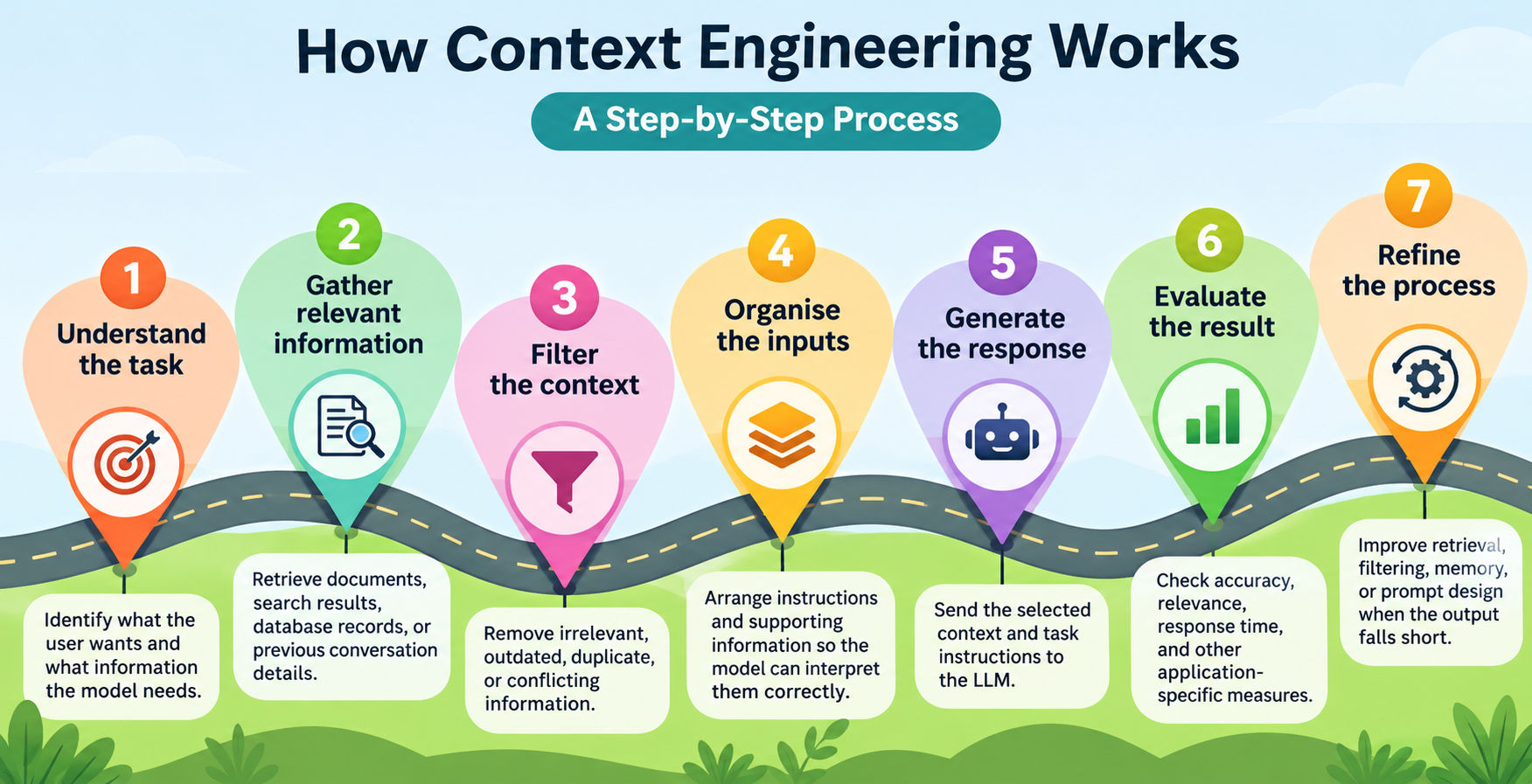
For a LLM to give accurate answer, context engineering provides it with correct and relevant information. Without this correct information the LLM will produce answers which would be vague or generalised.
But more information isn't always the correct way. It is better to feed the model 2,000 meaningful words rather than 20,000 words that do not necessarily fit. Over-providing context will lead to high costs, confusion, and contradictions.The goal is to giive the model the right information, not more information.
Ready to strengthen your AI and data science skills? Explore the Data Science and Generative AI Certification from IIIT Bangalore to learn data-driven techniques, understand generative AI applications, and apply these skills to real-world problems.
Agents work across many steps. They plan, call tools, examine the results, and decides what to do next. Every step adds new text. So, it is not managed, the window fills with old or outdated material.
Context engineering keeps an agent on track. It stores progress notes, drops finished steps, and reloads only what the next action needs. Without that discipline, long agent runs drift or loop.
Also Read: Prompt Engineering Salary in India
Here are the major differences between Context engineering vs. prompt engineering:
Factor |
Prompt Engineering |
Context Engineering |
| Scope | One request or template | The full input to the model |
| Main question | How should I phrase this? | What should the model know right now? |
| Inputs managed | Instructions and examples | Instructions, documents, memory, tools, history |
| Handles real-time data | No | Yes, through retrieval and tool calls |
| Memory across sessions | None | Built in through memory systems |
| Typical owner | Writers, analysts, product teams | AI engineers and platform teams |
| Effort to set up | Low | Medium to high |
| Best for | Single tasks and quick tests | Production apps and agents |
| Approach | Mostly Manual, you craft, edit and test prompts.
|
Mostly technical. You manage pipelines, databases, and rules for selecting information. |
| How it fails | Bad prompts yield vague and irrelevant responses. | A bad context will yield confident responses based on wrong facts. |
| Main challenge | Creating clear directions for the model. | Offering the right data at the right moment. |
| Example | Having ChatGPT rewrite a product description in friendly style, not exceeding 50 words, mentioning the target audience. | A support bot that retrieves the order history of the customer and the current refund policy before responding. |
Related Article: Prompt Engineering Jobs
Though Context engineering vs. prompt engineering have major differences still they also share some similarities. These two are needed together to finish the task more efficiently.
Here are their similarities:
Context engineering and prompt engineering both work together. Even if the AI program has correctly identified the information, unclear instructions will still result in a poor answer.
Both approaches also require regular testing. Test the AI’s response and modify the instructions/information where necessary. Prompt engineering instructs the model, whereas context engineering provides the model with the necessary information.
Also read: 5 Significant Benefits of Artificial Intelligence [Deep Analysis]
If the task is small and simple you can go for prompt engineering. If the answer depends on information the model doesn't have or if the task have many steps then you can move to context engineering.
Here are situations when to choose context engineering vs. prompt engineering:
Situation |
Better fit |
Why |
| Drafting an email or blog outline | Prompt engineering | The model needs style guidance, not outside data |
| Classifying 100 support tickets | Prompt engineering | A clear prompt with examples is enough |
| Answering questions from company documents | Context engineering | The model needs the right files at the right moment |
| A chatbot that remembers each customer | Context engineering | Memory and history must carry across sessions |
| An AI coding agent working across a repo | Context engineering | The agent needs files, test results, and progress notes |
| Quick experiments with a new model | Prompt engineering | Fast to try, nothing to build |
Budget also plays a very important role. Context systems needs time and add running costs for retrieval and longer inputs.
Ready to start your journey? Book a free consultation with upGrad today to find the best path for your career.
No. Prompts are still one input inside the context window. Context engineering wraps around them and decides what else the model sees. Simple chat tasks rely mostly on prompt skills, while production systems and agents need both working together.
Context engineering does not work well without prompt engineering. Every context package includes instructions, and those instructions still need clear wording. You can have perfect retrieval and memory, but a vague system prompt will still produce uneven answers. The two practices support each other.
Generative models only know their training data and whatever you put in front of them. Context engineering controls that second part. It lets a model answer with current, private, or task-specific information, which is what makes business use cases reliable.
RAG is one technique inside context engineering. It retrieves documents and adds them to the prompt. Context engineering is wider. It also covers memory, tool outputs, instruction design, ordering, and trimming. RAG answers where facts come from, while context engineering manages the whole input.
Context engineering changes the information supplied to a model at inference time. Fine-tuning updates a model's parameters through additional training on selected examples.
Since hallucinations occur due to lack of information and making assumptions, supplying documents that provide factual information can help here. Also, proper design of the context tells the model to answer "I do not know" when there is no information about it in the source documents.
Context window management is the procedure of deciding what will be contained within the context that the model reads. Summarization of previous interactions, removal of irrelevant data, and document scoring are the components of context window management.
Memories save information outside the context window and bring it into the model whenever needed. Short-term memory organizes the current conversation and long-term memory saves users' preferences and prior decisions made. Memory makes an AI consistent across sessions and does not start from scratch each time.
Overstuffing is the most common mistake. Teams put all the available documents, and they miss the core point of the question. Teams do not remove outdated information, omit testing on real queries, or allow tool outputs to fill the context window. Longer context is not always better.
A test set of real queries with known correct answers should be created. Then run queries through your system and measure accuracy, relevance of the retrieved text, and citations. You need to track reasons for failures and fine-tune retrieval, ranking, and trimming accordingly.
Longer context increases tokens which increases cost and latency.Prompt engineering keeps inputs short and cheap. Context engineering adds retrieval steps and bigger inputs, but good filtering and caching can hold costs down while improving accuracy where it counts.
1320 articles published
We are an online education platform providing industry-relevant programs for professionals, designed and delivered in collaboration with world-class faculty and businesses. Merging the latest technolo...
Speak with AI & ML expert
By submitting, I accept the T&C and
Privacy Policy