What is Alpha Beta Pruning?
By Rahul Singh
Updated on Jun 01, 2026 | 12 min read | 3.67K+ views
Share:

All courses
Certifications
More
By Rahul Singh
Updated on Jun 01, 2026 | 12 min read | 3.67K+ views
Share:
Table of Contents
Alpha-beta pruning is a widely used search optimization technique in artificial intelligence that helps AI systems make faster and smarter decisions. It works alongside the minimax algorithm by reducing the number of game tree branches that need evaluation, allowing the system to focus only on moves that could affect the final outcome.
By eliminating paths that are guaranteed to be less favorable than already discovered options, alpha-beta pruning improves efficiency without changing the result. This makes it an essential concept in game-playing AI, particularly in applications such as chess, checkers, and other strategic decision-making systems.
This blog is built to take you from zero to a solid understanding of alpha beta pruning in Artificial Intelligence. You will learn what it is, how the algorithm works step by step, how to read a real alpha beta pruning example.
Popular AI Programs
Imagine you're shopping for a laptop and have already found one that perfectly matches your needs within your budget. As you continue browsing, you come across several options that are clearly more expensive and offer fewer features. Instead of spending time comparing every detail, you immediately ignore those options because they cannot beat the choice you already have.
Alpha beta pruning works in a similar way. While the Minimax algorithm explores every possible move in a game, alpha beta pruning skips paths that are already known to be worse than the best option found so far. This helps the AI reach the same optimal decision while evaluating far fewer possibilities.
The name comes from two values the algorithm tracks:
The pruning happens when alpha becomes greater than or equal to beta. At that point, the algorithm knows that continuing down that branch is pointless. No matter what comes next, the result cannot improve the current best option for either player.
Also Read: Beginner Guide to the Top 15 Types of AI Algorithms and Their Applications
Minimax is logically correct but computationally brutal. In chess, the number of possible game states is estimated to be around 10 to the power of 120. Even for simpler games like Tic-Tac-Toe, the tree has hundreds of nodes. For anything more complex, exploring every single node is just not practical.
Alpha beta pruning solves this by making the search smarter, not just faster. It does not change the outcome of Minimax. The final decision is always the same. It just eliminates the work that would never have changed that decision anyway.
| Player | Role | Goal |
| Maximizer | The AI or computer | Picks the highest-value move |
| Minimizer | The opponent | Picks the lowest-value move |
The game tree alternates between these two players at each level. The Maximizer is trying to get the highest score. The Minimizer is trying to keep the score as low as possible. Alpha beta pruning tracks both of their best discovered options and prunes as soon as a branch cannot beat what is already known.
Also Read: The Ultimate Machine Learning Cheat Sheet For 2026
Free Courses
The alpha beta pruning algorithm is a recursive search that travels through a game tree from the top (the current game state) down to the leaf nodes (the final outcomes). At each node, it decides whether to keep exploring or cut off the search.
Here is how it works, step by step.
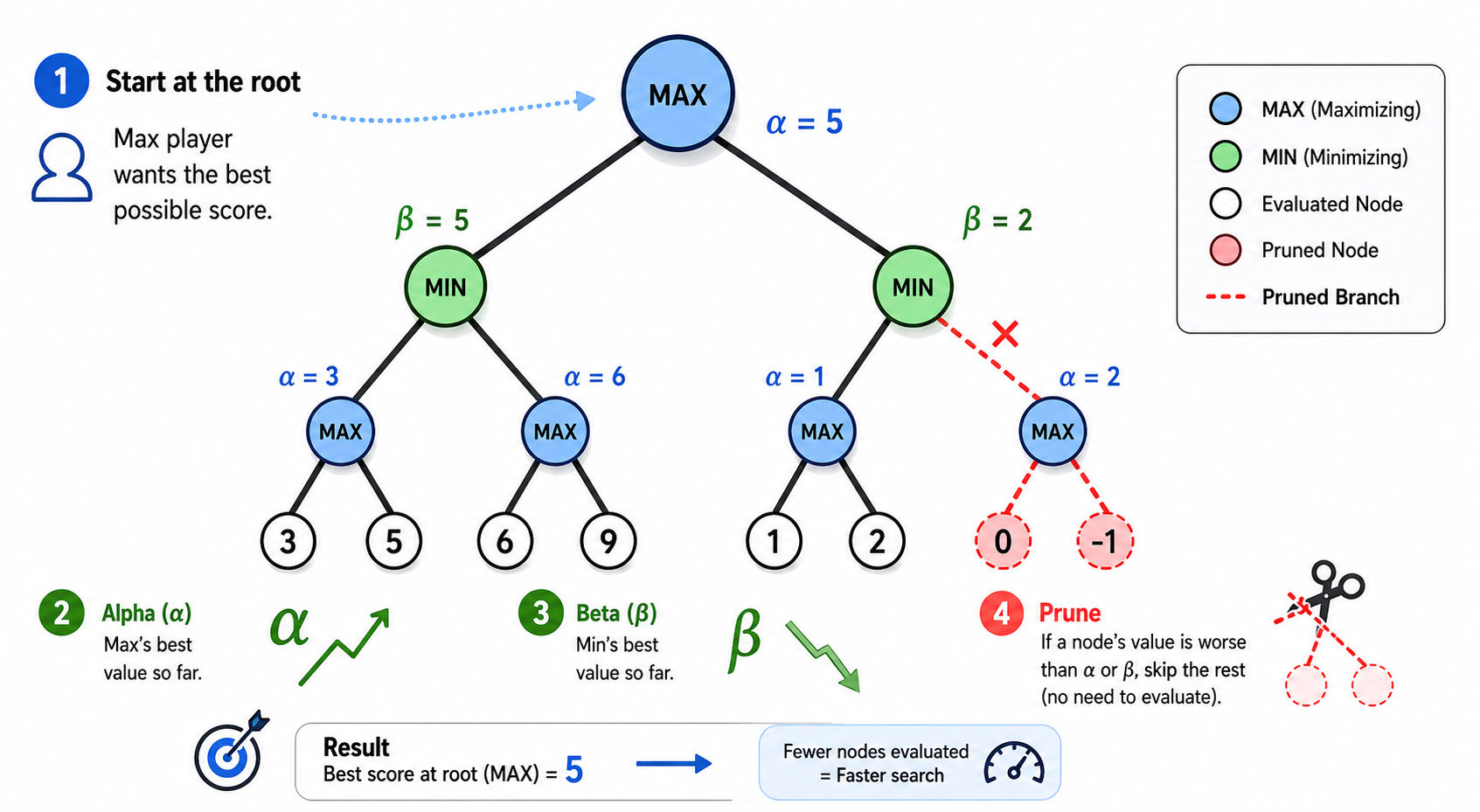
Step 1: Start at the root node Set alpha to negative infinity and beta to positive infinity. This means no good moves have been found yet for either player.
Step 2: Expand child nodes At a Maximizer node, explore the children one by one. Update alpha with the highest value found so far.
Step 3: Prune when possible If at any Maximizer node, the value found is greater than or equal to beta, stop exploring that branch. The Minimizer already has a better option elsewhere and will never choose this path.
Step 4: Do the reverse for Minimizer nodes At a Minimizer node, update beta with the lowest value found. If beta drops below or equals alpha, prune. The Maximizer already has a better option and will never come here.
Step 5: Backtrack and return values Once a branch is fully explored or pruned, pass the value back up to the parent node, which updates its own alpha or beta.
| Situation | Action |
| Alpha >= Beta at a Maximizer node | Prune remaining children (beta cutoff) |
| Beta <= Alpha at a Minimizer node | Prune remaining children (alpha cutoff) |
| No cutoff | Continue exploring |
The algorithm is recursive. Each call to a child node passes the current alpha and beta values down, so the pruning information from one part of the tree informs decisions in other parts.
Also Read: Types of Algorithms in Machine Learning: Uses and Examples
function alphaBeta(node, depth, alpha, beta, isMaximizing):
    if depth == 0 or node is terminal:
        return evaluate(node)

    if isMaximizing:
        maxEval = -infinity
        for each child in node.children:
            eval = alphaBeta(child, depth-1, alpha, beta, False)
            maxEval = max(maxEval, eval)
            alpha = max(alpha, eval)
            if beta <= alpha:
                break  // Beta cutoff (prune)
        return maxEval

    else:
        minEval = +infinity
        for each child in node.children:
            eval = alphaBeta(child, depth-1, alpha, beta, True)
            minEval = min(minEval, eval)
            beta = min(beta, eval)
            if beta <= alpha:
                break  // Alpha cutoff (prune)
        return minEval
The break statement is where the actual pruning happens. When that condition is met, the loop stops and the remaining children of that node are never evaluated.
AI Courses to upskill
Explore Artificial Intelligence Courses for Career Progression
The best way to understand alpha beta pruning is to trace through a real alpha beta pruning example. Let us walk through a simple game tree.
Imagine a game tree with:
[MAX] / \ [MIN] [MIN] / | \ / | \ 3 5 2 9 1 7 |
Left subtree (first MIN node):
Right subtree (second MIN node):
Final result: Root MAX picks between 2 (left) and 1 (right) = 2.
The leaf node with value 7 was never checked. It could not have changed the outcome because the Minimizer on the right would never let the score go higher than 1, and the Maximizer already had 2 from the left.
Also Read: Top 5 Machine Learning Models Explained For Beginners
In a real game like chess, this kind of pruning can eliminate millions of node evaluations. The efficiency gain grows dramatically with the depth of the search tree. A well-implemented alpha beta pruning algorithm can reduce the number of nodes evaluated from O(b^d) to roughly O(b^(d/2)), where b is the branching factor and d is the depth. That means the AI can search twice as deep in the same amount of time.
Alpha beta pruning in artificial intelligence is not just an academic concept. It has been the backbone of game-playing AI for decades, and it still powers many systems today.
The most famous applications of alpha beta pruning in artificial intelligence are in board games:
Also Read: Automated Machine Learning Workflow: Best Practices and Optimization Tips
| Application | How Alpha Beta Pruning Is Used |
| Chess engines | Core search algorithm with extensions |
| Checkers and Othello | Full game solving |
| Video game AI | Turn-based strategy games |
| Decision trees in AI research | Pruning search spaces |
| Puzzle solvers | Two-player adversarial puzzles |
Researchers have built several improvements on top of the basic alpha beta pruning algorithm:
These enhancements do not change what alpha beta pruning is at its core. They just make it faster and more intelligent in practice.
Also Read: Explore 8 Must-Know Types of Neural Networks in AI Today!
Alpha beta pruning is powerful, but it is not perfect. Understanding where it struggles is just as important as knowing where it excels.
The effectiveness of alpha beta pruning depends heavily on the order in which moves are evaluated. In the best case, when the best moves are always evaluated first, the algorithm prunes the maximum number of branches. In the worst case, when moves are evaluated in the worst possible order, no pruning happens at all and the algorithm degrades to plain Minimax.
Good move ordering heuristics make a massive difference. This is one reason modern chess engines invest heavily in evaluation functions.
The alpha beta pruning algorithm searches to a fixed depth. At that depth, it uses a static evaluation function to score the position. This means the AI cannot see past its search horizon, which can lead to poor decisions in positions that are stable but about to change dramatically in the next few moves.
Alpha beta pruning works best in:
It works poorly in:
Also Read: Top 20 Challenges of Artificial Intelligence: Key Issues and Solutions for 2026
Even with pruning, deep searches on complex games consume significant memory and computation. This is why practical implementations always pair alpha beta pruning with time limits, transposition tables (caching previously evaluated positions), and hardware acceleration.
Subscribe to upGrad's Newsletter
Join thousands of learners who receive useful tips
Alpha beta pruning takes the brute-force approach of Minimax and turns it into something practical. By tracking two values, alpha and beta, and cutting off branches that cannot possibly improve the outcome, the algorithm makes game-playing AI fast enough to run in real time.
If you are learning AI or competitive programming, mastering the alpha beta pruning algorithm is one of the most valuable steps you can take. It teaches you how to think about search efficiency, trade-offs, and optimization in a concrete, visual way. The concepts extend far beyond board games and show up in everything from scheduling problems to decision tree optimization.
Want personalized guidance on AI and upskilling? Speak with an expert for a free 1:1 counselling session today.
Minimax explores every node in a game tree to find the best move. Alpha beta pruning is an optimization of Minimax that skips branches that cannot affect the final decision, making the search faster while producing the same result.
Yes. Alpha beta pruning only removes branches that cannot influence the final outcome. It never skips a potentially better move, so the result is always identical to a full Minimax search while requiring fewer computations.
In the best case, alpha beta pruning reduces complexity from O(b^d) to O(b^(d/2)). This allows the AI to search much deeper within the same time, especially when moves are evaluated in an optimal order.
Alpha starts at negative infinity and beta starts at positive infinity. As the search progresses, alpha increases when better moves are found for the Maximizer, while beta decreases when better moves are found for the Minimizer.
Alpha beta pruning is designed for two-player zero-sum games. Multiplayer games involve multiple objectives, making pruning more difficult. Specialized extensions exist, but they are generally more complex and less efficient than standard alpha beta pruning.
Move ordering evaluates promising moves first. This updates alpha and beta values earlier, allowing more branches to be pruned. Better move ordering increases efficiency and helps the algorithm search deeper within the same computational budget.
AlphaGo mainly uses Monte Carlo Tree Search and deep neural networks. ChatGPT does not use alpha beta pruning because it is a language model. Alpha beta pruning is mainly used in game-playing AI and adversarial search problems.
A transposition table stores previously evaluated positions and their scores. If the same position appears again through a different move sequence, the stored result is reused, reducing repeated calculations and improving search speed.
A depth limit is applied, and positions at that depth are evaluated using a heuristic function. This speeds up the search but may introduce inaccuracies, which techniques like quiescence search attempt to reduce.
Alpha beta pruning removes branches that cannot improve the result and still guarantees the optimal answer. Beam search keeps only the top candidates at each level, making it faster but without guaranteeing the best solution.
You need a game state, a recursive alpha beta function, and an evaluation function. The algorithm searches moves within alpha and beta bounds, while the evaluation function scores positions such as wins, losses, or draws.
98 articles published
Rahul Singh is an Associate Content Writer at upGrad, with a strong interest in Data Science, Machine Learning, and Artificial Intelligence. He combines technical development skills with data-driven s...
Speak with AI & ML expert
By submitting, I accept the T&C and
Privacy Policy
Top Resources
Master's Degree
18 Months
Executive Diploma
12 Months
IIIT Bangalore
Executive Programme in Generative AI & Agentic AI for LeadersIndia’s #1 Tech University
Dual Certification
5 Months