Self-Aware Artificial Intelligence Examples: Real and Fictional
By upGrad
Updated on Sep 30, 2026 | 9 min read | 3.47K+ views
Share:

All courses
Certifications
More
By upGrad
Updated on Sep 30, 2026 | 9 min read | 3.47K+ views
Share:
Table of Contents
Key Highlights
Turn your interest in technology into a high-growth career. Check artificial intelligence courses in India and learn through hands-on projects, expert mentors, and real industry tools.
Popular AI Programs
Self-aware AI is a machine that knows it exists. It can tell itself apart from everything around it, and it understands that what it does has effects on the world.
Think of the gap between a calculator and a person doing math. The calculator gets the answer right. The person knows they're the one solving it.
Computer scientist Arend Hintze sorted AI into four types, and this is where most people first meet the idea:
Such a system would be able to check its own mistakes and build a model of its own body or code. It might even set goals nobody gave it.
Don't confuse this with being smart, though. A chess engine can crush a grandmaster and still have no idea it's playing a game.
As of today, no AI has been confirmed as self-aware. The examples below come close in some ways, but none of them settles the question.
Also read: Top 20 Types of AI in 2026 Explained
Free Courses
Nobody has built a truly self-aware machine. Researchers have tested small pieces of the puzzle, though. Can a machine know its own state? Can it picture its own body? Can it tell when it is being tested? Three experiments come up most often.
Selmer Bringsjord, a cognitive scientist at Rensselaer Polytechnic Institute, ran this test in 2015. He used three Nao humanoid robots and built it on the classic "wise men" logic puzzle.
Here is how it played out:
The key moment was the robot recognizing its own voice and using that fact to update what it believed about itself.
Critics note that the reasoning ran on formal logic the team programmed. To them, this is skilled rule-following, not self-understanding.
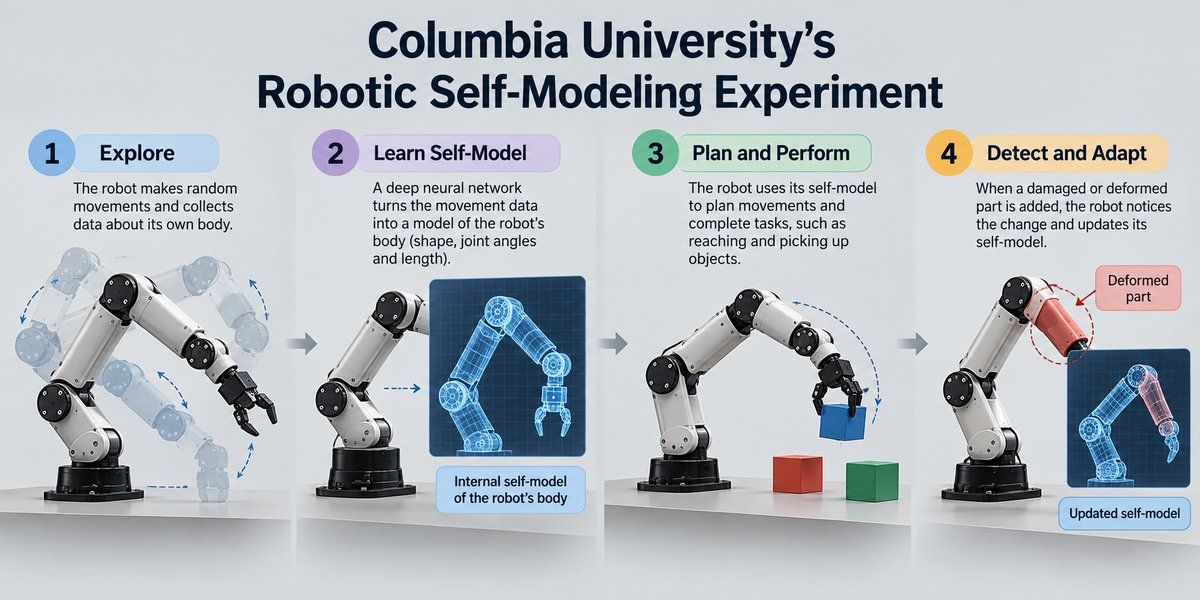
Hod Lipson and Robert Kwiatkowski at Columbia University published this study in Science Robotics in 2019. Their subject was a robotic arm that had to learn its own body from scratch.
Stage |
What happened |
| Starting point | The arm had no data on limb length, joint layout, or shape. |
| Learning | It made random movements and recorded the results. |
| Self-model | A deep neural network turned that data into a model of the arm's body. |
| Use | The robot planned motions, reached targets, and picked up objects with the model. |
| Damage test | Researchers swapped in a deformed part. The arm noticed and rebuilt its model. |
| Limit | It knows its shape, but it has no sense of being someone. |
Lipson has called this kind of self-modeling a possible early form of self-awareness. Many researchers agree it is a useful building block, but not the finish line.
In March 2024, Anthropic prompt engineer Alex Albert shared a surprising result on X. It came from a "needle in a haystack" test, which checks whether an AI can find one planted fact inside a huge pile of text.
What happened:
Albert called this meta-awareness, and the post spread fast. Many people saw it as a sign of a thinking machine.
Language models learn from huge amounts of human writing, including text about tests and evaluations. Spotting an odd sentence and guessing why it is there may be pattern matching, not real awareness.
Also read: Types of AI: From Narrow to Super Intelligence with Examples
AI Courses to upskill
Explore Artificial Intelligence Courses for Career Progression
Some AI systems act so human that people wonder what is going on inside them. None of these three is self-aware. Each one only simulates a piece of it.
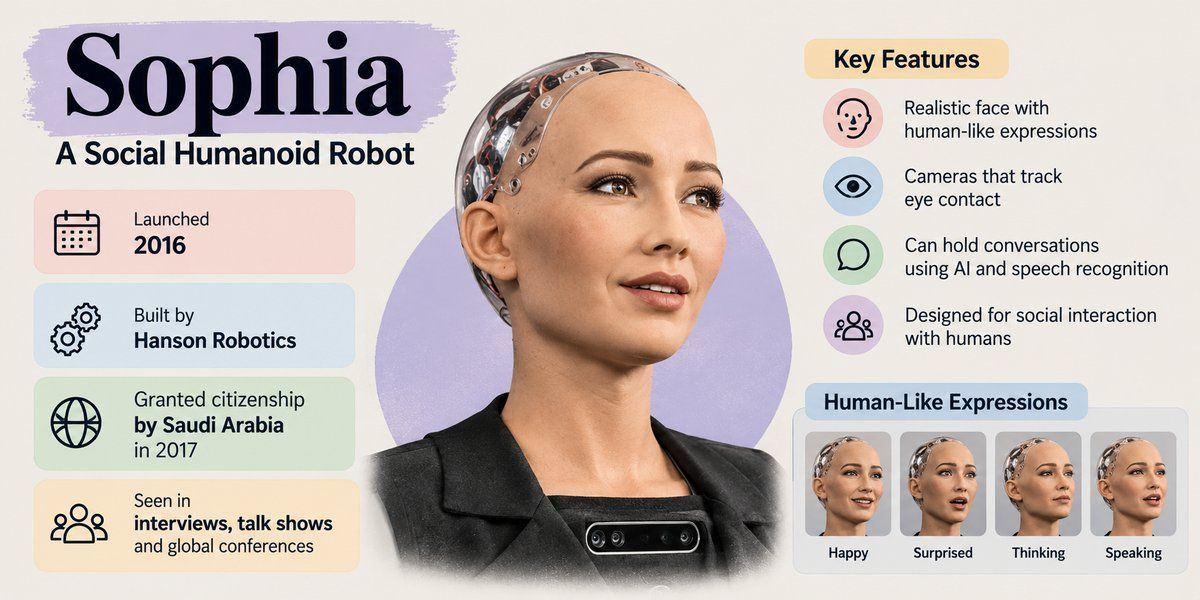
Sophia is a humanoid robot built by Hanson Robotics.
She talks about feelings, goals, and wanting a family. Most of it is scripted. Her replies come from pre-written lines, chatbot software, and speech recognition. Researchers like Yann LeCun call her closer to a puppet than a mind.
Eugene is a chatbot with the persona of a 13-year-old boy from Odesa, Ukraine.
The persona was the trick. A teenager who speaks English as a second language makes odd mistakes, and judges forgive them. Eugene also dodged hard questions with jokes. It is not an self-aware AI passing a five-minute chat proves little. Eugene was built to sound human, not to understand anything.
AlphaGo is a Go-playing AI built by DeepMind, a Google-owned lab.
It judges its own positions and learns from its own errors. It is not self-aware because it has no idea it is playing Go or that it exists. It only optimizes a score.
Ready to lead at the intersection of technology and business? Our Chief Technology Officer & AI Leadership Programme is built for leaders ready to master deep tech, AI, strategy, and boardroom leadership, all in one structured path to becoming an AI-first CTO.
Today's AI can write, translate, and beat world champions at games. But it does all of this without knowing that it exists. Self-aware AI would be a different kind of machine altogether.
Here is how the two compare:
Feature |
Existing AI |
Self-Aware AI |
| Sense of self | None. It processes inputs and produces outputs. | Would know it exists as a separate entity. |
| Goals | Set by humans through code or training. | Could form its own goals. |
| Understanding | Finds patterns in data. | Would grasp what its actions mean. |
| Emotions | Can imitate emotional language. | Might have real feelings or inner experience. |
| Learning | Improves within limits set by its design. | Could question and rewrite its own limits. |
| Errors | Repeats mistakes unless retrained. | Could notice and reflect on its own mistakes. |
| Status | Exists today (chatbots, self-driving cars, game engines). | Does not exist. Purely theoretical. |
Also read: AI in Cybersecurity: Market Trends, Applications, and Future
Scientists do not agree on whether AI can ever become self-aware. Some say it is possible with the right software. Others say it is impossible without a living body. The answer depends on how you define consciousness.
This section covers the main debates, the current state of research, and why proving machine consciousness is so hard. These are the key questions experts disagree on:
1. Is the mind just computation?
If yes, the right software could be conscious on any hardware. Supporters of Global Workspace Theory and Integrated Information Theory lean this way. If no, code alone will never get there.
2. Does consciousness need a body?
Some scientists say awareness grows out of a living body with needs, emotions, and something to lose. Software has none of that.
3. Is sounding aware the same as being aware?
Philosopher John Searle said no. A program can shuffle symbols perfectly and understand none of them. Today's language models predict text, so their claims about themselves may be just that.
There is no agreed test for machine consciousness. Even with other humans, we rely on behavior and trust.
So if an AI says "I am conscious," how would we check? It might be true. It might be an echo of millions of human texts. Right now, no one can tell.
Self-aware AI is likely a long way off. AI will keep getting better at seeming aware in the meantime, so telling the real thing from the imitation will matter more every year.
Also read: What is Generative AI? Understanding Key Applications and Its Role
Conclusion
No AI today is truly self-aware. The examples in this article each show one small piece of it, but none show the whole. Bringsjord's robots, Columbia's self-modeling arm, and Claude 3 Opus came closest. Sophia, Eugene Goostman, and AlphaGo only simulate it through scripts, tricks, and scores.
The gap is clear. Existing AI processes data. A self-aware AI would know it is the one processing it. The hard part may not be building it. It may be knowing when we have. Until a reliable test exists, treat bold claims with care.
AI will keep sounding more human. Learning to tell sounding aware from being aware is the most useful takeaway here.
Have any questions about AI courses? Book a free consultation call with our experts and get personalized guidance on the right learning path for you.
No. No AI system has been confirmed as self-aware. Some simulate it well, but there is no proof of real inner experience.
The idea goes back to early computer science and science fiction. Alan Turing asked in 1950 whether machines can think. Writers like Isaac Asimov later explored what conscious robots would mean for society.
AGI means a machine that can learn and do any intellectual task a human can. Self-aware AI means a machine with an inner sense of self. An AGI could exist without being self-aware.
HAL 9000 from 2001: A Space Odyssey, Skynet from Terminator, Data from Star Trek, and Samantha from Her are the best known. Each shows a different idea of what machine awareness could look like.
Nobody knows. Feeling emotions may need more than self-awareness, such as a body or biological signals. Some researchers think a machine could have emotions. Others think it could only imitate them.
The risk is debated. Some experts worry that an AI with its own goals could act against human interests. Others say the bigger danger is humans misusing today's AI, not machines waking up.
There is no agreed method yet. Researchers suggest checking for consistent self-reports, flexible reasoning about its own state, and behavior that matches known theories of consciousness. No single test is trusted.
No country grants AI legal rights today. If a machine were ever shown to be conscious, courts and lawmakers would face new questions about ownership, responsibility, and protection.
They learned from human writing, where people describe feelings and thoughts all the time. The chatbot copies this style. The words do not prove anything is felt.
It can say false things, but it does not lie the way a person does. It has no intent to deceive. It generates the most likely response, which may claim awareness or deny it depending on the prompt.
Check who is making it. Look for peer-reviewed research, not viral posts. Be careful with claims that rely on a single chat with a chatbot. Credible reports name their tests and admit their limits.
1008 articles published
We are an online education platform providing industry-relevant programs for professionals, designed and delivered in collaboration with world-class faculty and businesses. Merging the latest technolo...
Speak with AI & ML expert
By submitting, I accept the T&C and
Privacy Policy
Top Resources
Master's Degree
18 Months
Executive Diploma
12 Months
IIIT Bangalore
Executive Programme in Generative AI & Agentic AI for LeadersIndia’s #1 Tech University
Dual Certification
5 Months