20+ Low Stress Jobs That Pay Well in 2026
By upGrad
Updated on Jul 10, 2026 | 5 min read | 1.98K+ views
Share:

All courses
Certifications
More
By upGrad
Updated on Jul 10, 2026 | 5 min read | 1.98K+ views
Share:
Table of Contents
Key Takeaway
This blog walks you through what actually makes a job low stress, which careers fit the bill in 2026, and how to find one that suits your skills.
Explore upGrad's MBA programs to develop practical business skills in leadership, strategy, marketing, finance, operations, business analytics, and AI-driven decision-making. Gain hands-on experience through real-world case studies and industry projects to build the expertise needed for sustainable career growth across diverse industries.
Popular upGrad Programs
A low stress job is one where the workload feels manageable, deadlines don't choke you, and your day doesn't depend on constant firefighting. It's not about doing less. It's about doing work that fits your pace.
Stress isn't fixed to a job title. A teaching role can feel calm in one school and chaotic in another. Company culture, your manager, and your own temperament all shape how a job actually feels day to day.
Here's a common myth worth busting. Low stress doesn't mean low pay or a dead end career. Plenty of low stress high paying jobs exist in tech, healthcare support, writing, and skilled trades. You just need to know where to look.
Some traits show up again and again in low stress jobs. These characteristics reduce unnecessary pressure and allow employees to stay productive without feeling overwhelmed every day.
Signs of a calmer job:
On the flip side, certain factors push stress levels up fast. Tight deadlines, rotating shifts, aggressive sales targets, and constant multitasking all add pressure, even in roles that pay well.
Factor |
Low Stress Job |
High Stress Job |
| Schedule | Fixed, predictable | Rotating or unpredictable |
| Targets | Few or none | Aggressive quotas |
| Interaction | Limited conflict | Frequent complaints |
| Autonomy | High | Low, heavily monitored |
| Pace | Steady | Constant multitasking |
Also read: Best Career Options in India 2026: Salary, Future Scope, Jobs
Free Courses
Here's a practical list of best low stress jobs that pay well across industries, along with typical salary ranges in India.
| Job | Stress Level | Average Salary (INR/year) | Degree Required | Remote Option |
| Technical Writer | Low | ₹5-12 LPA | Preferred Bachelor's | Yes |
| Book Editor | Low | ₹5-9 LPA | Bachelor's Preferred | Yes |
| Graphic Designer | Low | ₹4-8 LPA | Preferred (Portfolio matters more) | Yes |
| Translator | Low | ₹4-8 LPA | No (Language proficiency required) | Yes |
| Archivist | Low | ₹4-7 LPA | Bachelor's/Master's | No |
| Photographer | Low | ₹3-8 LPA | No | Partial/Freelance |
| Medical Coder | Low | ₹3-7 LPA | Diploma/Certification | Hybrid |
| Virtual Assistant | Low | ₹3-7 LPA | No | Yes |
| Fitness Instructor | Low | ₹3-7 LPA | Certification | Partial |
| Librarian | Low | ₹3-6 LPA | Bachelor's + Library Science | No |
| Bookkeeper | Low | ₹3-6 LPA | No (Commerce preferred) | Yes |
| Massage Therapist | Low | ₹3-6 LPA | Certification | No |
| Laboratory Technician | Low | ₹3-6 LPA | Diploma/B.Sc. | No |
| Office Administrator | Low | ₹3-6 LPA | Preferred | Partial |
| Proofreader | Low | ₹3-6 LPA | No | Yes |
| UX Designer | Low-Medium | ₹7-15 LPA | Preferred | Yes |
| Data Analyst | Low-Medium | ₹6-12 LPA | Bachelor's | Yes |
| Electrician | Low-Medium | ₹3-7 LPA | ITI/Trade Certification | No |
| Travel Consultant | Low-Medium | ₹3-6 LPA | No | Hybrid |
| Web Developer | Medium | ₹5-12 LPA | No (Skills matter more) | Yes |
Source: Ambitionbox/Glassdoor
Technical writers and proofreaders get steady, self-paced work with almost no client-facing pressure. Data analysts earn well and being low stress high paying jobs. They increasingly work remotely, though deadlines can spike during reporting cycles.
Bookkeeping and medical coding are solid picks if you want structure without a customer service angle. Electricians and lab technicians trade remote flexibility for job security and consistent demand, which isn't a bad deal either.
Do read: How To Improve Your Career Skills for a Job and Employability
Recommended Courses to upskill
Explore Our Popular Courses for Career Progression
IIIT Bangalore
Executive Diploma in Machine Learning and AI360° Career Support
O.P.Jindal Global University
MBA from O.P.Jindal Global UniversityLive Case Studies and Projects
Not everyone wants the same thing from a calm job. Here's how to narrow the list based on what matters to you.
Remote work gives professionals more control over their day. That doesn't automatically remove stress, but it can eliminate commuting, reduce interruptions, and improve flexibility.
Good options include:
Job Role |
Why It's a Good Remote Career |
| Technical Writer | Documentation and content creation can be done entirely online. |
| Data Analyst | Most analysis and reporting tools are cloud-based. |
| Graphic Designer | Design projects are easily managed remotely. |
| UX Designer | Research, wireframing, and collaboration happen online. |
| Translator | Assignment-based work with flexible deadlines. |
| Virtual Assistant | Administrative tasks are handled remotely. |
| Proofreader | Reviews documents independently from any location. |
| Editor | Editing digital content requires minimal office presence. |
| Bookkeeper | Accounting software enables remote financial management. |
| Web Developer | Development, testing, and deployment can be done remotely. |
These careers usually rely on digital collaboration rather than physical presence.
Must read: Job vs Career: Difference Between Job and Career
Need a schedule that fits around family, education, or another commitment?
Consider these careers.
Job Role |
Why It's Flexible |
| Technical Writer | Project-based work with flexible deadlines |
| Graphic Designer | Freelance and remote opportunities |
| Translator | Assignment-based work with self-managed schedules |
| Photographer | Client bookings determine your work hours |
| Virtual Assistant | Flexible scheduling with remote clients |
| Fitness Instructor | Choose class timings or personal sessions |
| Massage Therapist | Appointment-based work schedule |
| Bookkeeper | Flexible hours outside peak accounting periods |
Flexibility often increases with experience because professionals gain more control over the projects they accept.
Also read: What Does it Take for a Fresher to Get a Job?
A university degree isn't always necessary.
Several rewarding careers focus more on practical skills, certifications, or hands-on training.
Examples include:
Job Role |
Why It's a Good Choice Without a Degree |
| Electrician | Skilled trade where ITI training or certification is valued over a degree |
| Massage Therapist | Requires professional certification rather than a college degree |
| Photographer | Strong portfolio and practical experience matter more than formal education |
| Virtual Assistant | Employers prioritize organizational and communication skills |
| Travel Consultant | Customer service and destination knowledge are often more important than a degree |
| Proofreader | Excellent language skills and attention to detail are the key requirements |
| Fitness Instructor | Industry-recognized fitness certifications are typically sufficient |
Building a strong portfolio or completing industry certifications can improve earning potential significantly.
Some professionals simply prefer limited public interaction.
If that's you, consider careers where independent work forms the majority of daily responsibilities.
Suitable options include:
Job Role |
Why It Involves Minimal Customer Interaction |
| Data Analyst | Focuses on analyzing data and preparing reports for internal teams |
| Technical Writer | Creates documentation with limited direct customer interaction |
| Medical Coder | Works with medical records and billing codes rather than patients |
| Proofreader | Reviews written content independently before publication |
| Bookkeeper | Manages financial records with minimal client-facing responsibilities |
| Archivist | Organizes and preserves records in a quiet, research-focused environment |
| Laboratory Technician | Performs testing and analysis with limited public interaction |
| Web Developer | Primarily collaborates with internal teams to build and maintain websites |
These roles usually involve collaborating with internal teams rather than handling continuous customer requests.
Explore upGrad's MBA from Liverpool Business School with IIM Udaipur Certification to build expertise in leadership, strategy, finance, marketing, business analytics, operations, and AI-powered business transformation. Learn through live faculty sessions, industry projects, real-world case studies, and a globally recognised curriculum designed to accelerate your leadership career.
A good salary is important, but so is having time for your personal life. Jobs with predictable schedules, manageable workloads, and flexible work arrangements help reduce stress while supporting long-term career satisfaction. Many low stress jobs also offer a healthy work-life balance without limiting growth opportunities.
Job Role |
Why It Offers Good Work-Life Balance |
| Technical Writer | Flexible deadlines and remote work |
| Data Analyst | Structured projects and hybrid work |
| Graphic Designer | Flexible schedules and freelance options |
| Bookkeeper | Predictable workload |
| Librarian | Fixed working hours |
| Medical Coder | Regular office shifts |
| Virtual Assistant | Remote and flexible schedule |
| UX Designer | Planned project timelines |
| Proofreader | Independent, deadline-based work |
| Translator | Assignment-based flexible work |
When evaluating a role, consider these factors:
The best low stress jobs combine flexibility, steady income, and a supportive work environment. Choosing a role that matches your lifestyle can help you build a rewarding career while maintaining a healthy balance between work and personal life.
Must read: Future of Work: What Jobs Will There Be in the Future & How to Prepare Yourself
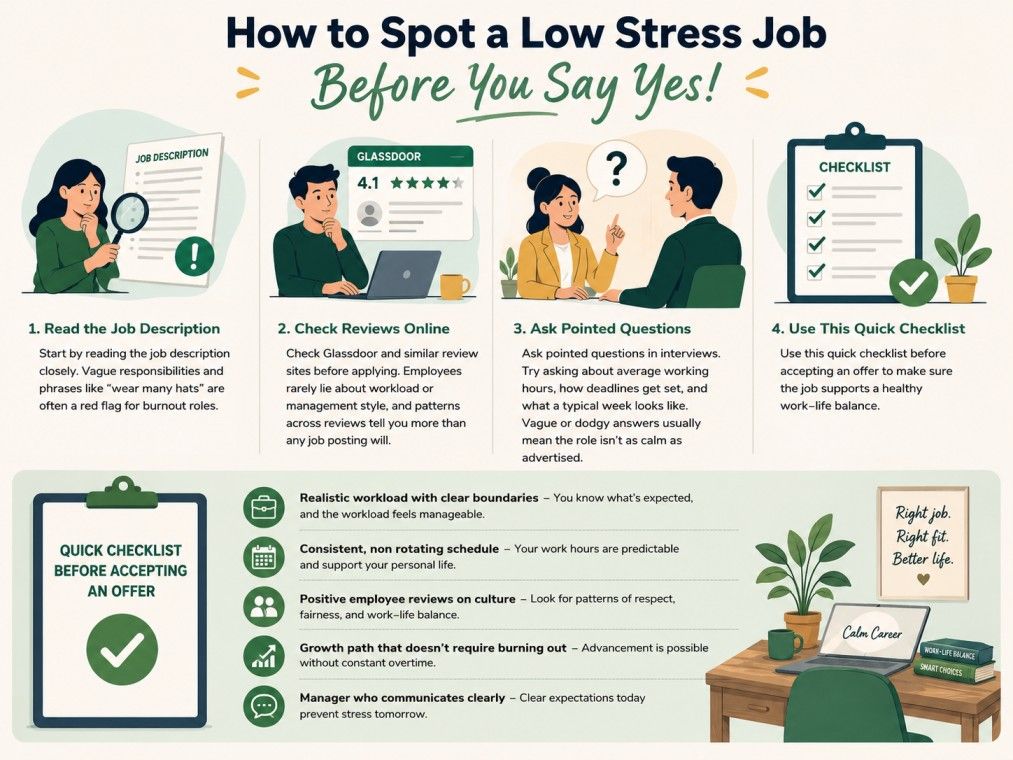
Finding the right fit low stress high paying jobs takes more than scrolling job boards. Here's a process that actually works.
Also read: Top High-Paying Career Options in India (2026)
A career can look perfect on paper and still feel exhausting in real life. That's because job titles don't tell the whole story. Company culture, workload, management style, and growth opportunities all shape your day-to-day experience.
Before applying for any role, spend time understanding what actually causes stress for you. Someone who enjoys meeting clients every day may struggle with solitary work, while another person may find constant meetings draining. There's no universal answer.
Skills matter, definitely, but Interests matter too. Think about the type of work that keeps you engaged without leaving you mentally exhausted.
Ask yourself these questions.
Your answers will narrow your choices quickly.
Not all stress comes from heavy workloads. Sometimes it's unclear expectations, constant interruptions, or frequent meetings that make work difficult.
Common workplace stress triggers include:
Knowing your triggers helps you avoid roles that are likely to become frustrating over time.
Do read: Top 10 Career Options in Future You Should Be Aware Of
Salary is important. Still, it shouldn't be the only deciding factor. A role paying slightly less but offering flexible hours, remote work, and a supportive environment may provide a much better quality of life than a high-paying job with constant pressure.
Think long term rather than focusing only on your first paycheck.
Check Future Career Growth
Some careers remain stable for years, while others evolve rapidly. Look beyond the current role.
Ask questions such as:
This approach helps you identify low stress jobs with future demand instead of choosing careers with limited progression.
Also read: Top 27+ Highest Paying Work From Home Jobs for 2025: Opportunities and Tips
Here's something many job seekers overlook. The same role can feel completely different depending on the organization.
Before accepting an offer:
A supportive workplace often reduces stress more than the job itself.
Know your strengths
↓
Identify stress triggers
↓
Shortlist suitable careers
↓
Compare salary and flexibility
↓
Research employers
↓
Apply confidently
Taking time to evaluate these factors increases the chances of finding work that remains satisfying for years instead of months.
Must read: AI Proof Jobs: Careers That AI Can’t Replace in 2026
Here's the honest answer. It depends on what you're optimizing for.
Low stress careers generally mean better mental health, fewer burnout cycles, and more consistent output over time. You show up rested, and that adds up over a career, not just a quarter.
The trade off is real too. Some low stress roles have slower salary growth compared to high pressure sales or leadership tracks. Fewer of these paths lead straight to a C-suite title.
If you value stability and sustainable pace over rapid promotions, low stress high paying jobs are worth pursuing. If you thrive on pressure and want the fastest possible climb, a higher stress track might suit you better. Neither choice is wrong. It's just a different bet on what makes work worth doing.
Choosing a calmer career isn't settling. It's picking a pace you can sustain for the next twenty years, not just the next two.
The best career isn't always the one with the biggest paycheck. It's the one that lets you grow professionally without sacrificing your health, relationships, or personal time. That's why more professionals are exploring low stress jobs that offer meaningful work alongside financial stability.
Take time to understand your strengths, preferred work style, and long-term goals before making a decision. A thoughtful career choice today can lead to greater satisfaction for years to come. Whether you're looking for your first job, planning a career change, or searching for low stress jobs that pay well, focusing on balance instead of constant pressure is a smart investment in your future.
Ready to start your journey? Book a free consultation with upGrad today to find the best path for your career.
Yes. Many professionals transition into low stress jobs through upskilling rather than starting from scratch. Careers such as technical writing, UX design, data analysis, and digital marketing value transferable skills. Certifications, practical projects, and relevant experience can help you switch industries while maintaining long-term career growth.
The best low stress jobs for introverts usually involve focused, independent work with fewer interruptions. Roles like proofreader, technical writer, archivist, laboratory technician, web developer, and data analyst allow professionals to work with minimal customer interaction while offering stable career opportunities.
Several low stress jobs that pay well are expected to remain in demand due to digital transformation and evolving business needs. Careers in data analytics, UX design, cybersecurity, technical writing, healthcare support, and web development continue to grow, offering strong employment prospects and competitive salaries.
Freelancing can become one of the more flexible low stress jobs if you manage your workload carefully. Writers, designers, translators, bookkeepers, and consultants often choose their clients, working hours, and projects. However, inconsistent income and client management require good planning and financial discipline.
In many cases, government roles provide greater job security, structured responsibilities, and predictable working hours. However, stress levels vary depending on the department, workload, and role. Some low stress jobs in India are available in both public and private sectors, making employer culture equally important.
Not every low stress high paying job requires years of experience. Entry-level professionals can qualify for roles such as junior data analyst, graphic designer, technical writer, or web developer after completing relevant certifications and building a strong portfolio. Experience generally improves salary and career progression over time.
Yes. AI-powered tools now automate repetitive tasks such as documentation, scheduling, reporting, and data processing. Professionals in writing, analytics, customer support, and administration can use these tools to improve productivity, reduce manual effort, and create more manageable day-to-day workloads without replacing human decision-making.
Ask about workload expectations, overtime frequency, performance metrics, team size, flexible work policies, and manager communication styles. These questions often reveal more than the job description itself. Understanding daily responsibilities helps determine whether a role truly supports work-life balance before accepting an offer.
Yes. Many parents prefer low stress jobs because they offer predictable schedules, hybrid work, or remote flexibility. Careers such as bookkeeping, technical writing, virtual assistance, education support, and content creation can make it easier to balance professional responsibilities with family commitments.
Absolutely. Working in a lower-pressure role doesn't prevent career advancement. Professionals who consistently build expertise, develop leadership skills, and contribute strategically can progress into managerial or specialist positions. Sustainable performance often creates stronger long-term growth than constantly working in high-pressure environments.
1141 articles published
We are an online education platform providing industry-relevant programs for professionals, designed and delivered in collaboration with world-class faculty and businesses. Merging the latest technolo...
Get Free Consultation
By submitting, I accept the T&C and
Privacy Policy
Top Resources
Certification
3 Months
Certification
6 Months
O.P. Jindal Global University
Masters in International Accounting and Finance (Accredited by ACCA, UK)Master's Degree
12 Months