Understanding “Is ChatGPT Generative AI?”
By Sriram
Updated on Jun 17, 2026 | 7 min read | 2.31K+ views
Share:

All courses
Certifications
More
By Sriram
Updated on Jun 17, 2026 | 7 min read | 2.31K+ views
Share:
Table of Contents
Is ChatGPT Generative AI? To answer this, we need to understand what generative AI is. Generative AI is a type of intelligence that creates new content instead of just looking at old data or putting it into categories. ChatGPT is part of this group of intelligence that is good at creating new content and is one of the most widely used examples of Generative AI
Millions of people use ChatGPT to write emails, answer questions, generate content, summarize documents, and even help with coding. People are using intelligence every day now for simple questions or whenever they have a little doubt.
In this blog You’ll learn what generative AI is, how ChatGPT generates responses, what kind of generative AI model is ChatGPT.
Interested in AI tools like ChatGPT? Explore upGrad's Agentic AI Courses Online covering generative AI, machine learning, and emerging technologies for career growth.
Generative AI Courses to upskill
Explore Generative AI Courses for Career Progression
IIIT Bangalore
Executive Diploma in Machine Learning and AI360° Career Support
The direct answer is yes. ChatGPT is a type of intelligence that can create new content based on patterns learned from lots of training data. It is called generative AI.
Unlike other software that just follows rules, generative AI creates original outputs. These outputs may include:
Also Read: What is Generative AI? Understanding Key Applications and Its Role in the Future of Work
ChatGPT is about generating human-like text. The way it works is, it tries to figure out what word should come next in a conversation. It does this by analyzing what has been said. It is good at understanding the context of a conversation.
ChatGPT does not just look up information in a database. It creates answers on the spot.
For example, if you ask: "Explain climate change to a 10-year-old."
ChatGPT comes up with a brand explanation of climate change based on the data it learned when it was being trained. This ability to create new content is what makes ChatGPT a type of generative AI.
Also Read: Generative AI Chatbot: How Intelligent Conversational Systems Work
Key Characteristics of Generative AI
Characteristic |
ChatGPT |
| Creates new content | Yes |
| Understands prompts | Yes |
| Produces human-like text | Yes |
| Learns patterns from data | Yes |
| Uses fixed rule-based responses only | No |
Artificial intelligence is a broad area. Generative artificial intelligence is a part of intelligence. ChatGPT is one of the well-known generative AI applications that uses large language models (LLMs)
People often ask what kind of AI model ChatGPT is.
The classification is:
Artificial Intelligence → Machine Learning → Deep Learning → Large Language Model (LLM) → Generative AI Application (ChatGPT)
The classification of ChatGPT within AI models is useful to know. It is a type of AI application that is good at performing language-based tasks.
Also Read: How Does Generative AI Work? Key Insights, Practical Uses, and More
Not all artificial intelligence systems generate content.
For example:
These are all intelligence applications, but they do not generate new content, like ChatGPT does. ChatGPT is special because its primary purpose is to create new text-based results.
That is why ChatGPT is different, and that answers the question: is ChatGPT a type of Generative AI? Yes, it is.
Also Read: 23+ Top Applications of Generative AI Across Different Industries in 2025
To really understand what ChatGPT is, we need to look at what kind of technology it is.
A lot of people who're new to this are often curious to know what kind of model ChatGPT is because there are various kinds of models out there, in the world of generative AI models.
At the heart of ChatGPT are GPT models.
GPT stands for:
Each part of GPT is important:
A research paper Attention Is “All You Need from 2017” showed that Transformer models greatly improved how well machines understand and generate language.
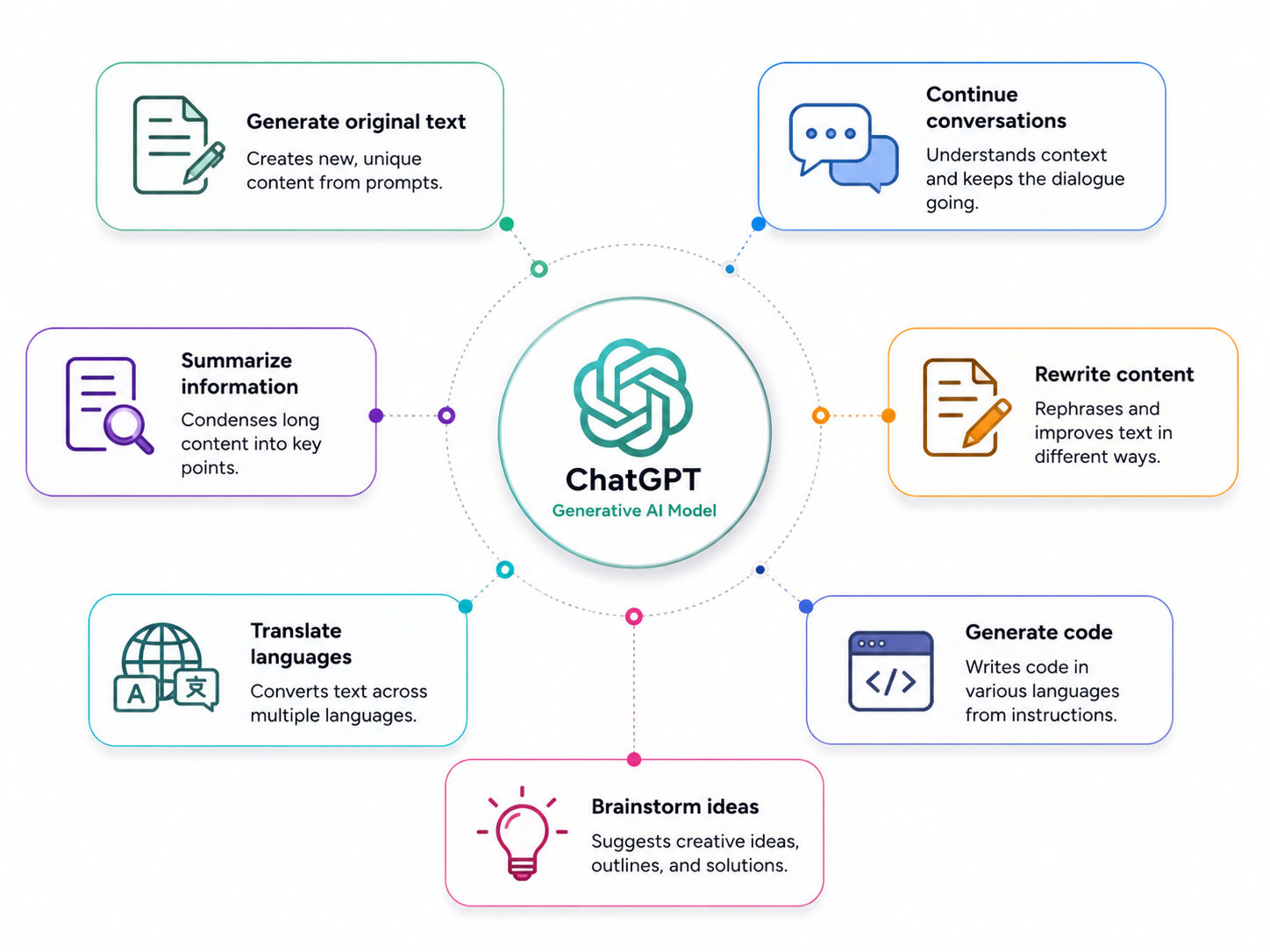
When discussing, “what is the classification of ChatGPT within generative AI models,” experts generally place it under conversational large language models.
ChatGPT meets every requirement of generative AI because it can perform several tasks:
Among these categories, ChatGPT mainly focuses on generating text and having conversations. Thus, it helps in interaction to the users.
Type |
Example Output |
| Text Generation | ChatGPT |
| Image Generation | DALL·E |
| Video Generation | Sora |
| Audio Generation | AI voice models |
| Code Generation | GitHub Copilot |
Understanding classification helps businesses and learners choose AI tool. ChatGPT is an AI system that focuses on text, so it is good for tasks related to language.
Students, professionals and organizations that want to use AI need to know this.
For instance:
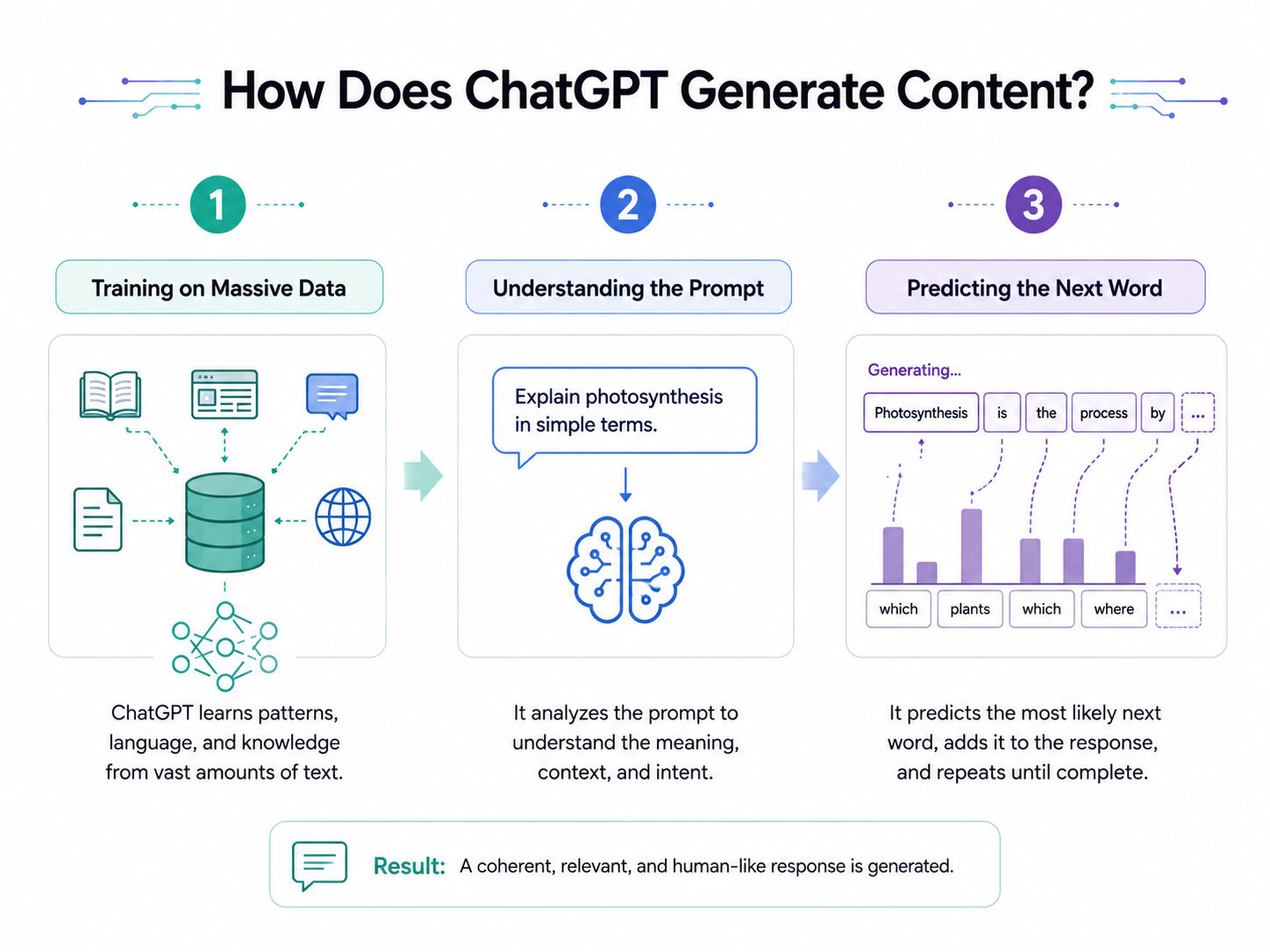
So, you want to know how ChatGPT creates responses. It is pretty interesting. The way ChatGPT creates responses is based on advanced machine learning techniques.
ChatGPT is trained using enormous collections of publicly available text, licensed data, and human-created examples.
During training, the model learns:
It does not memorize every sentence.
Instead, it learns statistical relationships between words and concepts.
When a user enters a question, ChatGPT analyzes:
This helps to determine the most relevant response.
The model generates text by predicting one token at a time.
A token can be:
The model repeatedly predicts what comes next until a complete answer is formed.
Also Read: GPT-4 vs ChatGPT: What’s the Difference?
Prompt: "The capital of France is..."
Prediction: "Paris"
The same principle scales to entire articles, emails, and conversations.
Several factors contribute:
Factor |
Purpose |
| Large training datasets | Language understanding |
| Transformer architecture | Context awareness |
| Reinforcement learning | Better responses |
| Fine-tuning | Improved accuracy |
Despite its strengths, ChatGPT has limitations.
It may:
This is an important reminder that while the answer to is ChatGPT generative AI is yes; generative AI systems are not perfect knowledge engines.
They generate likely responses rather than verify every fact.
Humans naturally communicate through dialogue. ChatGPT is optimized for conversational interaction. This makes it feel more intuitive than many earlier AI systems.
The result is an experience that closely resembles talking to a knowledgeable assistant rather than using traditional software.
Understanding both strengths and weaknesses provides a balanced view of ChatGPT
Use Case |
Example |
| Writing | Blog drafts |
| Education | Study explanations |
| Customer Support | Automated responses |
| Marketing | Content ideas |
| Programming | Code assistance |
| Research | Summaries |
Not entirely. A more practical view is that ChatGPT enhances human productivity rather than replacing human expertise.
The best results often come from collaboration between humans and AI.
For example:
The generative AI market continues to grow rapidly. According to research from McKinsey and Gartner, organizations across industries are investing heavily in AI-powered tools to improve efficiency and innovation.
The technology will likely become more accurate, more personalized, and more integrated into everyday workflows.
So, is ChatGPT generative AI? Yes. ChatGPT is a generative AI application built on large language models that can create human-like text in response to user prompts. Its ability to generate original content, understand context, and support conversational interactions places it firmly within the generative AI category.
As generative AI continues to evolve, ChatGPT will remain one of the most recognizable examples of how AI can create, assist, and enhance human work across industries.
Want to explore more about, is ChatGPT generative AI? Book your free 1:1 personal consultation with our expert today.
ChatGPT is an artificial intelligence system, but it is not the entire field of AI. Artificial intelligence includes many technologies such as computer vision, robotics, recommendation systems, and machine learning. ChatGPT specifically belongs to the generative AI category focused on creating text-based content.
ChatGPT is called generative AI because it generates new content rather than simply retrieving stored information. It creates responses based on patterns learned during training. This ability to produce original text is the defining feature of generative AI systems.
The classification of ChatGPT within generative AI models is that it is a conversational large language model built using transformer architecture. It sits under machine learning, deep learning, and generative AI within the broader artificial intelligence hierarchy.
Yes, ChatGPT generates original responses based on user prompts. While it learns from large datasets during training, it does not simply copy existing content. Instead, it creates new combinations of words and ideas to answer questions or complete tasks.
Yes. ChatGPT is powered by large language models that are trained on extensive text datasets. These models learn language patterns, context, and relationships between words, enabling them to generate human-like responses across many topics.
The core version of ChatGPT is primarily focused on text generation. However, when integrated with multimodal AI systems, it can work alongside image-generation models. This allows users to create both written and visual content using AI technologies.
ChatGPT can provide helpful explanations and summaries, but it may sometimes generate inaccurate information. Search engines retrieve information from indexed web pages, while ChatGPT generates responses. Users should verify important facts from reliable sources.
ChatGPT is both. It is built using machine learning techniques and belongs to the generative AI category. Machine learning is the broader technology that enables the model to learn patterns, while generative AI describes its ability to create content.
Many industries use ChatGPT, including education, marketing, software development, healthcare, customer support, and finance. Organizations use it to improve productivity, automate routine tasks, assist employees, and enhance communication workflows.
Businesses should use ChatGPT as a productivity tool rather than a complete replacement for human review. Human oversight helps ensure accuracy, brand consistency, compliance, and quality. The strongest results typically come from combining AI assistance with expert editing.
Generative AI will likely complement traditional software rather than replace it completely. Many applications now combine AI features with conventional functionality. This hybrid approach allows users to benefit from automation while maintaining reliability and control.
727 articles published
Sriram K is a Senior SEO Executive with a B.Tech in Information Technology from Dr. M.G.R. Educational and Research Institute, Chennai. With over a decade of experience in digital marketing, he specia...
Speak with AI & ML expert
By submitting, I accept the T&C and
Privacy Policy