Importance of Management: Why It Is Essential for Organizational Success
By Sriram
Updated on Jun 09, 2026 | 6 min read | 4.58K+ views
Share:

All courses
Certifications
More
By Sriram
Updated on Jun 09, 2026 | 6 min read | 4.58K+ views
Share:
Management is a basic function which helps an organization to achieve its objectives efficiently. It coordinates people, resources and processes to organize the day-to-day work. Whether it is a small business or a large corporation, good management ensures that everyone works towards a common goal.
Without proper management, organizations tend to lose their way, wasting resources and making bad decisions. Good management improves productivity, helps companies grow and enables them to deal with the changing market environment. It is the force that keeps operations organized and allows for long-term success.
In this article, you will learn why management is important, how it contributes to the success of organizations, the importance of financial management, and the practical benefits that strong management practices bring to businesses and professionals.
Build stronger self-management skills with upGrad’s management courses and learn how to manage your time, goals, productivity, and professional growth more effectively.
Popular Management Programs
Management is the process of planning, organizing, leading, and controlling resources so that specific goals are achieved. These resources may be people, finances, technology, information and physical assets.
The core of management is using these resources properly. Organizations operate in environments that are uncertain, competitive, and constantly changing. Management sets the direction and ensures that all activities are aligned to the bigger business goals.
Imagine a software development company. Developers might be technically brilliant, but without clear timelines, role assignments and performance monitoring it is easy to miss deadlines. Management bridges this gap by creating systems and accountability frameworks.
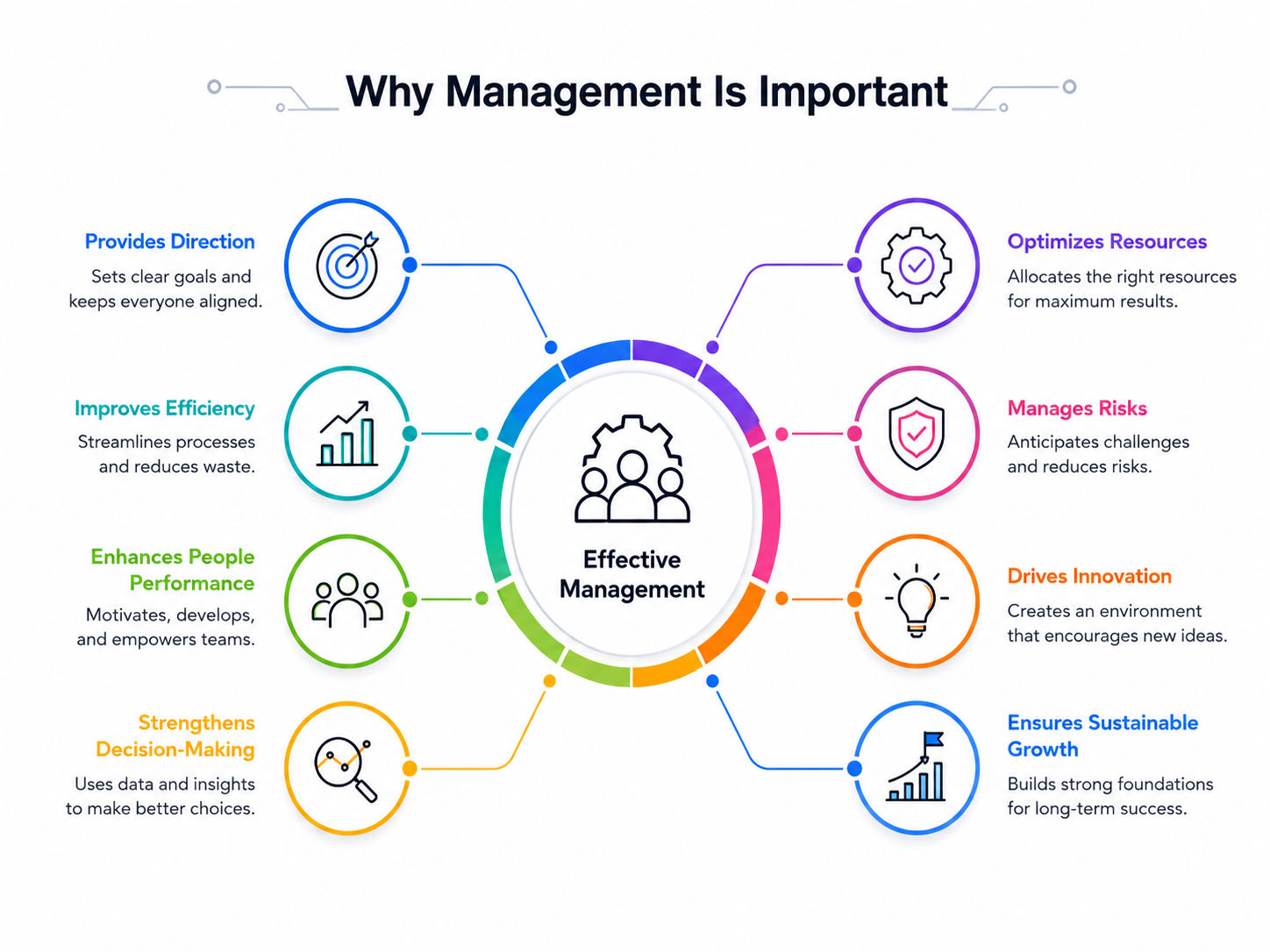
Some of the key reasons why management is important include:
Management also cuts confusion. Employees are aware of their duties, teams are more effective at communicating, and leaders are able to spot problems before they become a major issue.
The table gives the functions of Management and its impact :
| Management function | Bussiness impact |
| Planning | Defines goals and strategies |
| Organizing | Allocates resources efficiently |
| Leading | Motivates and guides employees |
| Controlling | Monitors performance and results |
Organizations that invest in strong management practices often experience better operational efficiency and higher employee engagement than those that operate without structured leadership.
Free Courses
The importance of management becomes more visible when examining its practical benefits. Good management creates an environment where individuals and teams can perform effectively while supporting organizational goals.
Management defines clear workflows, responsibilities, and performance expectations. Employees spend less time on confusion and more time on meaningful work.
For instance, project managers working at technology firms frequently implement agile frameworks to accelerate development cycles. This allows teams to get products out faster and meet quality standards.
Every organization makes decisions around investments, hiring, product development and customer experience.
Managers collect information, analyze alternatives, evaluate risks and make decisions that help achieve the long term goals.
Strong decision making helps organizations:
Different departments often have different priorities. Marketing is customer acquisition, operations is efficiency, finance is cost.
Management combines these functions to achieve common objectives. This coordination reduces conflicts and enhances collaboration.
It is often assumed that management stifles creativity. Good management builds systems that let innovation thrive.
Technology firms often have innovation teams, research projects and experimentation frameworks. Management keeps those efforts tied to strategic goals.
Managers play a crucial role in identifying skill gaps and supporting professional growth.
This includes:
Organizations that prioritize employee development often experience stronger retention and engagement rates.
Ultimately, the importance of management extends beyond operational efficiency. It directly influences organizational culture, employee satisfaction, and long-term competitiveness.
Read more : Complete Guide to Business Management Course Fees and Duration
Management Courses to upskill
Explore Management Courses for Career Progression
IIIT-B & IIM, Udaipur
Chief Technology Officer & AI Leadership ProgrammeThe importance of financial management has grown significantly as businesses face increasing competition, economic uncertainty, and technological disruption.
Financial management involves planning, organizing, controlling, and monitoring financial resources to achieve organizational objectives.
Without effective financial management, even profitable businesses can encounter cash flow issues, funding shortages, or unsustainable growth.
All businesses are limited by finite resources.
Financial management allows organizations to make decisions about:
For example, a growing SaaS company may have to decide between deploying more developers or increasing marketing spend. Financial analysis can help you decide which option will give you the most strategic value.
To expand you need capital.
Financial managers analyze the sources of funding, such as:
The decisions made will have a direct impact on an organization’s ability to scale in a sustainable way.
Economic downturns, fluctuating interest rates, market volatility or operational disruptions may pose financial risks.
Good financial management helps organizations:
Profitability is more than just about increasing revenues.
Financial management recognizes opportunities to:
This shows why financial management is more than just accounting. It has a strategic role in underpinning stability, growth and long term sustainability.
Must Read : Best Business Management Courses in India [2026]
The importance of management becomes even clearer when examining how it supports different organizational functions.
HR managers are responsible for hiring, training and compensating employees, as well as shaping the workplace culture.
Effective management attracts and retains talented professionals, without compromising a productive work environment.
Operations management is about delivering products and services efficiently.
Managers arrange processes, monitor levels of quality and spot chances to make improvements.
A manufacturing company, for instance, relies heavily on operational management to minimize production delays and maintain consistent output.
Marketing managers create strategies to reach customers and generate demand.
Their duties include:
Marketing activities are aligned with broader business objectives, which good management helps to ensure.
Technology is becoming more and more important for modern organizations.
Technology managers manage :
Effective management allows organizations to optimize their investment in technology while reducing operational risks.
Strategic management is about positioning and long term direction.
It helps companies :
Without strategic management, businesses tend to react to changes rather than prepare for them proactively.
Also read : MBA in International Business Scope: Career Opportunities, Salary and Future Growth
The absence of effective management can create significant organizational problems.
Common challenges include:
Imagine a fast-growing startup that’s hiring employees at a rapid pace but there are no management processes. Work can be duplicated by teams, priorities can change often, and customer expectations can be unmet.
These problems rarely come from a lack of talent. More often, they are the result of weak management systems.
Management becomes more and more important as organizations grow, because complexity increases. Structured leadership and clear processes are needed to coordinate people, technology, finances, and operations.
Companies that do not develop strong management practices often find it difficult to sustain performance through periods of growth or market disruption.
Know more: Management Free Online Course with Certification [2026]
Management is more than managing people. It directs, improves efficiency, assists in better decision making and enables organizations to achieve their goals in a more effective manner. Good management ensures that resources, processes and people work together to achieve common goals.
Management is key to organisational success, from operations and human resources, to finance and technology. In a competitive business environment, effective management enables organizations to adapt to change, drive growth and maintain long-term stability, making it an essential skill for professionals and future leaders alike.
Want personalised guidance on Management and upskilling? Speak with an expert
for a free 1:1 counselling session today.
As a company grows, operations become more complex. Teams expand, responsibilities increase, and decision-making involves more stakeholders. Management helps maintain clarity by setting priorities, defining roles, and coordinating activities across departments. Without structured management, growth can create confusion, missed deadlines, and inconsistent customer experiences, even when the company has talented employees.
Management helps organizations prepare for unexpected changes such as economic shifts, supply chain disruptions, or changing customer demands. Managers assess risks, create contingency plans, and allocate resources strategically. This allows businesses to respond more quickly and minimize disruptions instead of reacting without a clear plan when challenges arise.
Management directly influences employee engagement and motivation through communication, recognition, and career development opportunities. Employees tend to perform better when they understand expectations and receive constructive feedback. Effective managers create an environment where people feel valued and supported while working toward shared organizational goals.
A business may experience short-term success without formal management structures, especially in its early stages. However, as operations grow, the lack of management often leads to inefficiencies, communication gaps, and poor resource utilization. Sustainable growth usually requires management practices that help maintain consistency and accountability across the organization.
Management helps establish processes that ensure products and services meet customer expectations consistently. It coordinates teams, monitors quality standards, and addresses operational issues before they affect customers. Businesses with strong management practices are often better equipped to deliver reliable customer experiences and build long-term relationships.
Remote and hybrid teams require clear communication, goal tracking, and collaboration systems. Management helps employees stay aligned despite working from different locations. Managers establish workflows, monitor progress, and maintain team engagement, ensuring that productivity and accountability remain strong regardless of where employees work.
Innovation requires more than creative ideas. Management provides the structure needed to evaluate opportunities, allocate resources, and implement new initiatives. Managers help balance experimentation with business priorities, ensuring innovative projects receive support while remaining aligned with organizational objectives and customer needs.
Digital transformation often involves adopting new technologies, changing workflows, and training employees. Management oversees these transitions by setting objectives, managing budgets, and addressing resistance to change. Effective management helps organizations implement technology successfully while minimizing operational disruptions during the transition period.
Management improves productivity by reducing confusion and ensuring employees focus on high-priority tasks. Clear goals, defined responsibilities, and regular performance reviews help teams work more efficiently. Managers also identify bottlenecks and process inefficiencies that may slow down operations and impact overall performance.
Modern managers need a combination of leadership, communication, problem-solving, and decision-making skills. They must also understand data, technology, and change management. As workplaces become more dynamic, managers who can adapt quickly and lead diverse teams are often better positioned to drive organizational success.
Understanding management principles helps students and professionals develop leadership, planning, and organizational skills early in their careers. These skills apply across industries and job roles. Even individual contributors benefit from learning how organizations operate, how decisions are made, and how teams work together to achieve business objectives.
715 articles published
Sriram K is a Senior SEO Executive with a B.Tech in Information Technology from Dr. M.G.R. Educational and Research Institute, Chennai. With over a decade of experience in digital marketing, he specia...
Get Free Consultation
By submitting, I accept the T&C and
Privacy Policy
Top Resources
Certification
3 Months
Certification
6 Months
O.P. Jindal Global University
Masters in International Accounting and Finance (Accredited by ACCA, UK)Master's Degree
12 Months