Golang vs Python: Which Programming Language Should You Choose?
By Sriram
Updated on Jul 07, 2026 | 7 min read | 1.54K+ views
Share:

All courses
Certifications
More
By Sriram
Updated on Jul 07, 2026 | 7 min read | 1.54K+ views
Share:
Table of Contents
Key takeaway
This blog breaks down the Golang vs Python debate across differences, similarities, performance, syntax, DevOps use, web development and concurrency, with real examples instead of vague claims.
Explore upGrad's AI programs to build in-demand skills in programming, artificial intelligence, machine learning, cloud computing, backend development, data science, and modern software engineering.
Popular upGrad Programs
When comparing Golang vs Python, both languages initially appear similar because they prioritize clean, readable code and developer productivity. However, as you start developing real-world applications, the differences become more apparent. They vary in performance, typing, execution model, memory management, concurrency, deployment, and the kinds of projects they are best suited for.
The table below provides a detailed comparison of Golang vs Python, highlighting their key differences and including Golang vs python syntax comparison to help you evaluate both languages more effectively.
Feature |
Golang |
Python |
| Typing | Static | Dynamic |
| Execution | Compiled | Interpreted |
| Performance | Fast | Moderate |
| Memory Usage | Low | Higher |
| Concurrency | Goroutines | Threads & Async |
| Syntax | Simple and explicit | Clean and concise |
| Error Handling | Explicit errors | Exceptions |
| Garbage Collection | Built-in GC | Automatic GC |
| Deployment | Single binary | Requires Python runtime |
| Ecosystem | Backend & Cloud | AI, Web & Data Science |
| Learning Curve | Easy to moderate | Beginner-friendly |
| Best For | APIs, Cloud, Microservices | AI, Automation, Web Development |
Although both languages are highly versatile, they excel in different areas. Golang is designed for speed, simplicity, and efficient resource management, making it ideal for backend services, cloud infrastructure, and distributed systems. Python, on the other hand, emphasizes rapid development and offers a vast ecosystem, making it a popular choice for AI, machine learning, automation, and data-centric applications.
The sections below take a closer look at these differences, explaining how Golang vs Python compare across key aspects and why those distinctions matter when choosing the right language for real-world software development.
Also read: What Is REST API? Main Elements, Examples & Challenges
Free Courses
Golang, officially known as Go, is an open-source programming language developed by Google in 2009. It was created by Robert Griesemer, Rob Pike, and Ken Thompson to address the challenges of building fast, reliable, and efficient software for modern computing environments.
Go is a statically typed, compiled language designed with simplicity in mind. It removes many unnecessary language features while providing built-in support for concurrency, making it easier to develop applications that handle multiple tasks simultaneously. Since Go compiles directly into a native executable, applications typically run faster and require fewer system resources than interpreted languages.
Go Use Case |
Description |
| Backend Development | Build fast, scalable APIs and backend services. |
| Cloud-Native Applications | Develop applications for cloud environments and distributed systems. |
| Microservices | Create lightweight, independent services for modern architectures. |
| Distributed Systems | Build reliable systems that run across multiple servers. |
| Networking Software | Develop high-performance network services and communication tools. |
| Command-Line Tools | Create fast, standalone CLI applications and utilities. |
| DevOps & Infrastructure Automation | Build infrastructure tools, automation utilities, and cloud orchestration software. |
Popular technologies such as Docker, Kubernetes, and Terraform are built using Go, highlighting its strength in building high-performance infrastructure and cloud applications.
Do read: Top 26 Golang Project Ideas & Topics
Recommended Courses to upskill
Explore Our Popular Courses for Career Progression
IIIT Bangalore
Executive Diploma in Machine Learning and AI360° Career Support
O.P.Jindal Global University
MBA from O.P.Jindal Global UniversityLive Case Studies and Projects
Python is a high-level, open-source programming language created by Guido van Rossum and first released in 1991. It was designed to make programming simple, readable, and accessible, allowing developers to write clean code with fewer lines than many other languages.
Unlike Go, Python is an interpreted and dynamically typed language. Developers can write and execute code quickly without compiling it first, making Python an excellent choice for rapid application development, experimentation, and learning. Its vast ecosystem of libraries also enables developers to build everything from web applications to artificial intelligence models without starting from scratch.
Python Use Case |
Description |
| Artificial Intelligence & Machine Learning | Build AI models, deep learning applications, and intelligent systems. |
| Data Science & Analytics | Analyze, visualize, and process large datasets. |
| Web Development | Develop dynamic websites, web applications, and APIs. |
| Automation & Scripting | Automate repetitive tasks, workflows, and system operations. |
| Scientific Computing | Perform simulations, numerical analysis, and scientific research. |
| Desktop Applications | Create cross-platform desktop software with GUI frameworks. |
| Cybersecurity | Develop security tools, penetration testing scripts, and threat analysis solutions. |
| Game Development | Build simple games and game prototypes using Python libraries. |
Popular frameworks and libraries such as Django, Flask, FastAPI, TensorFlow, PyTorch, NumPy, and Pandas have made Python one of the most widely adopted programming languages across industries. Its beginner-friendly syntax and extensive community support continue to make it a top choice for both new and experienced developers.
Go is designed for developers who value performance, simplicity, and reliability. Its compiled architecture, efficient concurrency model, and lightweight runtime make it a popular choice for backend systems, cloud-native applications, and distributed services. However, like any programming language, it has strengths as well as limitations that are worth considering before choosing it for a project.
Pros |
Cons |
| Fast execution | Smaller ecosystem |
| Low memory usage | Limited AI libraries |
| Built-in concurrency | More verbose error handling |
| Fast compilation | No traditional OOP |
| Easy deployment | Less suited for rapid prototyping |
| Strong standard library | Smaller community |
| Great for cloud applications | Fewer niche libraries |
| Easy to maintain | Static typing takes time to learn |
Python is one of the most versatile programming languages available today. Its simple syntax, extensive library ecosystem, and strong community support make it an excellent choice for beginners and professionals alike. While Python excels in rapid development and AI-driven applications, it sacrifices some performance and resource efficiency compared to compiled languages like Go.
Pros |
Cons |
| Easy to learn | Slower execution |
| Large ecosystem | Higher memory usage |
| Excellent for AI & ML | GIL limits multithreading |
| Rapid development | Requires Python runtime |
| Strong community | Less suited for high-performance systems |
| Powerful web frameworks | Dependency management can be complex |
| Great for automation | Lower performance for CPU-intensive tasks |
| Cross-platform support | Not ideal for cloud infrastructure |
Explore upGrad's Executive Diploma in Machine Learning and AI from IIIT Bangalore to build expertise in machine learning, deep learning, generative AI, MLOps, natural language processing, computer vision, and real-world AI applications through industry-relevant projects and hands-on learning.
This is where the Golang vs Python benchmark conversation gets real. Go typically runs 10 to 40 times faster than Python on CPU-heavy tasks like sorting, hashing or numerical loops. That gap of Golang vs Python performance shows up in actual production metrics.
Why the difference in Golang vs Python Performance? Go compiles to native binaries with no runtime interpreter overhead. Python's interpreter re-evaluates your code on every pass, and that adds up fast at scale.
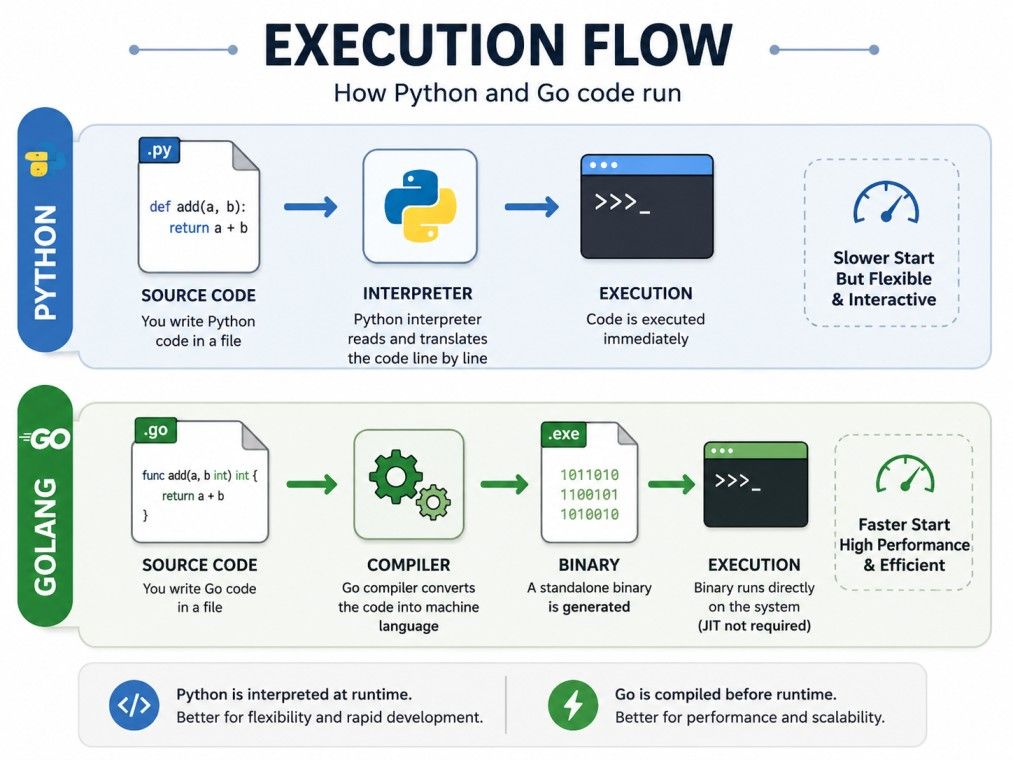
Startup time tells a similar story. A Go binary starts in milliseconds. Python needs to load the interpreter, import modules and initialize the runtime first, which can take noticeably longer for large applications.
Memory usage follows the same pattern. Go's compiled binaries and lightweight goroutines use far less RAM than an equivalent Python process running multiple threads.
That said, Python isn't slow at everything. Libraries like NumPy and Pandas drop down into C under the hood, so number crunching in data science workflows runs plenty fast despite Python's interpreted nature.
Do read: Python Classes and Objects [With Examples]
Ask any platform engineer, and you'll hear the same thing. Go dominates the DevOps and cloud-native space right now.
Docker, Kubernetes, Terraform, and Prometheus are all written in Go. That's not a coincidence. Infrastructure tools need to start fast, use minimal memory, and compile into a single portable binary you can drop onto any server without dependency headaches.
Python still has a place here, though. Ansible, most CI/CD glue scripts, and countless automation tools run on Python because it's quick to write and easy for ops teams to modify without a full build step.
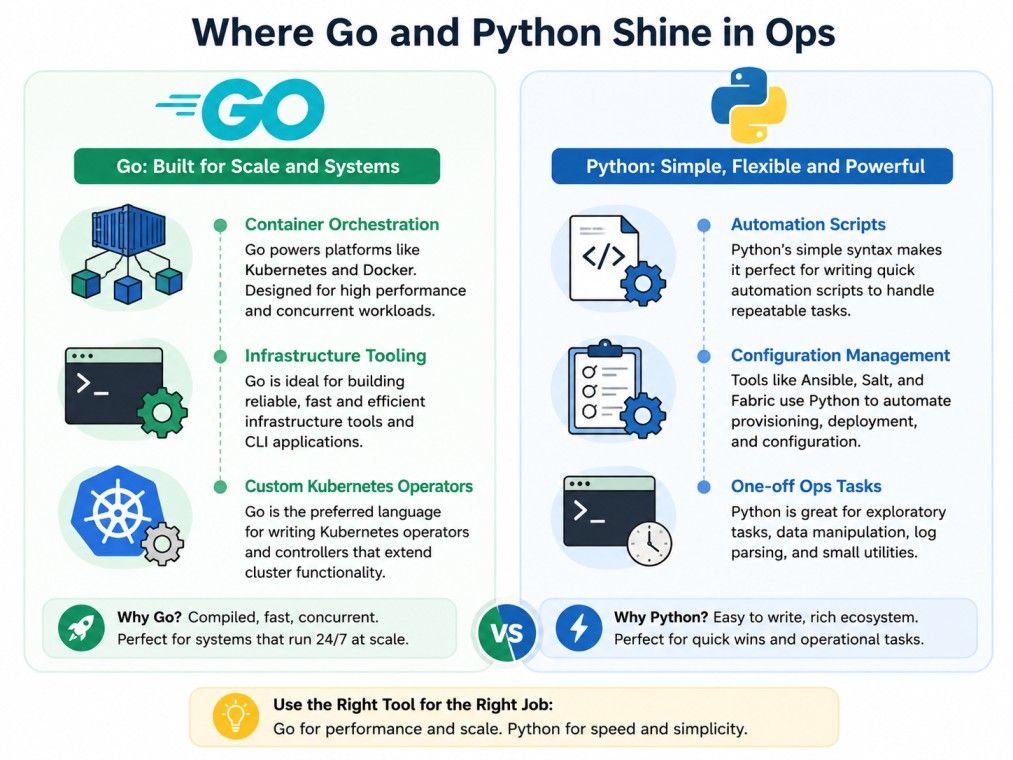
If you're building infrastructure that other engineers will deploy repeatedly, Go's single-binary deployment saves real operational pain. No "it works on my machine" dependency issues to chase down.
Also read: Top 7 Python Features Every Python Developer Should Know
Subscribe to upGrad's Newsletter
Join thousands of learners who receive useful tips
Both languages power serious web applications, just in different ways. Python's Django and Flask dominate rapid development. FastAPI has gained serious traction too, especially for teams that want async support without giving up Python's readability. You can spin up a working API in an afternoon.
Go's Gin and Fiber frameworks trade some of that development speed for raw throughput. They handle far more concurrent requests per server, which matters once you're past the MVP stage and into real traffic.
Framework |
Language |
Strength |
| Django | Python | Full-featured, batteries included |
| Flask | Python | Lightweight, flexible |
| FastAPI | Python | Async, auto docs |
| Gin | Go | High throughput, minimal overhead |
| Fiber | Go | Express-like syntax, very fast |
Here's a scenario worth considering. A startup building an MVP will usually ship faster with Django or FastAPI. But once that same product hits a few million requests a day, rewriting the hot-path services in Go often becomes the practical move. Instagram and Dropbox stuck with Python for years. Uber rebuilt several backend services in Go specifically to handle scaling pressure.
Must read: Essential Python Developer Skills and a Step-by-Step Guide to Becoming a Python Developer
This is genuinely where Go pulls ahead. Go has goroutines built into the language itself. They're lightweight, cheap to spawn by the thousands, and communicate safely through channels. You don't need external libraries or complicated locking logic for most concurrent tasks.
Python's concurrency story is messier. The Global Interpreter Lock, or GIL, means only one thread executes Python bytecode at a time, even on a multi-core machine. Multiprocessing works around this by spawning separate processes, but that adds memory overhead and complexity. Async programming with asyncio helps with I/O-bound tasks, but it isn't true parallelism.
Approach |
Best For |
| Goroutines (Go) | High-concurrency servers, thousands of simultaneous connections |
| Python Threads | Light I/O tasks, limited by GIL |
| Python Multiprocessing | CPU-bound tasks, higher memory cost |
| Python Asyncio | Network-heavy async workloads |
Building a chat server that needs to handle 50,000 open connections? Go's goroutines make that almost trivial. Try the same thing in Python and you're juggling process pools, memory limits and GIL contention just to get partway there.
Do read: Python Tutorial: Learn Python from Scratch
Backend development is one of the most common comparisons between the two languages.
Go was built for high-performance backend systems. It compiles into a single binary, starts quickly, and handles thousands of concurrent requests with minimal resource usage. That's why many cloud platforms and distributed systems rely on it.
Python focuses on developer productivity. Frameworks like Django, Flask, and FastAPI let developers build APIs rapidly without writing much boilerplate code.
Feature |
Golang |
Python |
| Performance | Excellent | Good |
| Concurrent Requests | Excellent | Good |
| Development Speed | Good | Excellent |
| Resource Usage | Low | Moderate |
| Popular Frameworks | Gin, Fiber, Echo | Django, Flask, FastAPI |
If your backend must serve millions of requests every day, Go is usually the stronger choice.
If your priority is launching features quickly, Python remains one of the fastest languages to develop with.
Must read: The Ultimate Guide to Python Web Development: Fundamental Concepts Explained
When comparing golang vs python for artificial intelligence (AI) and machine learning (ML), Python is the clear industry leader. Its extensive ecosystem of AI frameworks, libraries, and community support has made it the preferred language for researchers, data scientists, and AI engineers.
Go, on the other hand, focuses on speed, concurrency, and efficient deployment. While it isn't commonly used to train machine learning models, it can play an important role in deploying AI services and building high-performance backend systems that serve trained models.
Python simplifies every stage of the AI development lifecycle, from data preparation to model deployment. Its readable syntax also allows developers to experiment and iterate quickly.
Some of Python's most popular AI and ML libraries include:
Library |
Primary Use |
| TensorFlow | Deep learning, neural networks, and AI model training |
| PyTorch | Deep learning, computer vision, and natural language processing (NLP) |
| Scikit-learn | Machine learning, predictive analytics, and data mining |
| Keras | Building and training deep learning models with a simple API |
| NumPy | Numerical computing and mathematical operations on large datasets |
| Pandas | Data manipulation, analysis, and preprocessing |
| OpenCV | Computer vision, image processing, and object detection |
As a result, most AI research papers, online tutorials, and production-ready machine learning solutions are built using Python.
Although Go isn't a primary language for building AI models, it complements AI systems in production environments.
Developers often use Go to:
Go AI Use Case |
How Go Helps |
| High-Performance AI APIs | Serves AI models with fast response times and low latency. |
| Model Deployment | Deploys trained machine learning models efficiently in production. |
| Concurrent Inference | Handles multiple prediction requests simultaneously using goroutines. |
| Cloud-Native AI Services | Builds reliable AI services for Kubernetes and cloud platforms. |
| AI Microservices | Connects machine learning models with backend applications through scalable microservices. |
A common workflow is to train a machine learning model in Python and deploy it behind a Go-based API to achieve faster response times and better resource efficiency.
Also read: Python Frameworks: Top 10 Python Frameworks To Learn
Although Go and Python are often compared for their differences, they also share several characteristics that make them popular choices for modern software development. Both languages emphasize developer productivity, support multiple programming paradigms, and have strong communities with extensive libraries.
Whether you're building web applications, automation tools, APIs, or cloud-based solutions, both languages offer reliable ecosystems and scalable development workflows.
Feature |
Golang |
Python |
| Open Source | Free and open source | Free and open source |
| Cross Platform | Works on Windows, Linux, and macOS | Works on Windows, Linux, and macOS |
| General Purpose | Used for backend, cloud, and automation | Used for web, AI, automation, and data science |
| Standard Library | Rich built-in packages | Rich built in modules |
| Memory Management | Automatic garbage collection | Automatic garbage collection |
| OOP Support | Supports object oriented concepts | Supports object oriented programming |
| Package Ecosystem | Large collection of Go modules | Large collection of PyPI packages |
| Testing | Built in testing support | Built in and third party testing tools |
| Concurrency | Supports concurrent programming | Supports concurrency with multiple approaches |
| Scalability | Suitable for scalable applications | Suitable for scalable applications |
| Community | Active developer community | Large global developer community |
| Regular Updates | Continuously improved | Continuously improved |
Also read: Python Developer Salary in India in 2026 [For Freshers & Experienced]
There's no universal winner in the Golang vs Python decision. It genuinely depends on what you're building.
If you want to... |
Choose |
| Build AI or ML models | Python |
| Build scalable APIs | Go |
| Learn programming as a beginner | Python |
| Handle high-concurrency systems | Go |
| Automate scripts and tasks | Python |
| Build cloud-native infrastructure | Go |
| Ship an MVP fast | Python |
Small teams building data pipelines, ML prototypes or quick internal tools usually reach for Python first. It's forgiving, well documented and has a library for nearly everything.
Teams building infrastructure, high-traffic APIs or systems that need predictable performance under load tend to land on Go. It takes a bit more discipline upfront but pays that back in stability at scale.
Plenty of companies use both. Python handles the data science and prototyping. Go handles the backend services that need to survive real traffic. That combination isn't a compromise. It's often the smartest architecture decision available.
The Golang vs Python debate doesn't end with a single winner. Go stands out when performance, efficient concurrency, and lightweight deployment are the highest priorities. It's an excellent fit for backend services, networking applications, and cloud-native infrastructure.
Python shines when developer productivity, rapid prototyping, artificial intelligence, data science, and automation take center stage. Its mature ecosystem allows developers to build sophisticated applications with relatively little code.
If you're choosing your first programming language, Python is usually the easier starting point.
If you're building distributed systems, high-performance APIs, or cloud infrastructure, Go deserves serious consideration. For many modern applications, the smartest approach isn't choosing one over the other. It's using each language where it delivers the greatest value.
Ready to start your journey? Book a free consultation with upGrad today to find the best path for your career.
If you're comparing golang vs python for beginners, Python is usually the better starting point because of its simple syntax and extensive learning resources. Once you understand programming fundamentals, learning Go becomes much easier. Go is an excellent second language for developers interested in backend systems, cloud computing, or DevOps.
The biggest architectural difference is golang vs python compilation vs interpretation. Go compiles source code into a native executable before running, resulting in faster execution and easier deployment. Python is interpreted, allowing quicker development and testing but introducing additional runtime overhead that can reduce performance.
When evaluating golang vs python memory usage, Go is generally more memory efficient because it produces compiled binaries and uses lightweight goroutines. Python requires an interpreter and dynamic object management, which increases memory consumption, especially in long-running services or high-concurrency applications.
A typical golang vs python benchmark shows that Go outperforms Python in CPU-intensive tasks, concurrent processing, and network-heavy applications. However, benchmark results depend on the workload. Python remains highly competitive for AI and data science because many of its numerical libraries execute optimized native code.
When comparing golang vs python for DevOps, Go is preferred for building infrastructure tools because of its speed, portability, and efficient concurrency. Python remains popular for automation scripts, configuration management, and CI/CD workflows, making both languages valuable in modern DevOps environments.
The choice between golang vs python for web development depends on your project requirements. Python frameworks like Django and FastAPI enable rapid application development, while Go frameworks such as Gin and Fiber are designed for high-performance APIs that handle large volumes of concurrent requests efficiently.
No. The golang vs python debate isn't about replacing one language with the other. Go excels in backend infrastructure, cloud-native services, and distributed systems, while Python continues to dominate AI, machine learning, automation, and data science. Many organizations successfully use both languages within the same technology stack.
Yes. Although Go generally scales more efficiently, Python can also power large-scale applications with the right architecture. Companies often combine caching, asynchronous frameworks, load balancing, and optimized libraries to build highly scalable Python applications without sacrificing development speed.
Go is often easier to deploy because it compiles into a single standalone executable with minimal external dependencies. Python applications typically require a compatible interpreter and package management. This difference makes Go especially attractive for containerized deployments and cloud-native infrastructure.
Absolutely. Many engineering teams combine both languages to leverage their strengths. Python is commonly used for AI model development, automation, and data processing, while Go handles backend APIs, concurrent services, and production deployments that require high performance and efficient resource utilization.
The right choice depends on your priorities rather than the language itself. Choose Go if performance, concurrency, and efficient deployment are critical. Choose Python for rapid development, AI, automation, or analytics. Understanding your project goals is the best way to resolve the golang vs python decision confidently.
730 articles published
Sriram K is a Senior SEO Executive with a B.Tech in Information Technology from Dr. M.G.R. Educational and Research Institute, Chennai. With over a decade of experience in digital marketing, he specia...
Get Free Consultation
By submitting, I accept the T&C and
Privacy Policy
Top Resources
Certification
3 Months
Certification
6 Months
O.P. Jindal Global University
Masters in International Accounting and Finance (Accredited by ACCA, UK)Master's Degree
12 Months