Game Theory Economics: How Strategic Thinking Shapes Real Decisions
By upGrad
Updated on Jun 22, 2026 | 8 min read | 1.61K+ views
Share:

All courses
Certifications
More
By upGrad
Updated on Jun 22, 2026 | 8 min read | 1.61K+ views
Share:
Table of Contents
Game theory economics helps explain how people, businesses, and governments make decisions when the outcome depends on the choices of others. Instead of studying decisions in isolation, it looks at situations where participants must anticipate how others will act before making their own move.
At its core, game theory examines situations where the outcome for one participant depends partly on the actions of others.
This blog covers what game theory is, why economists care about it, and how it shows up in markets, business negotiations, auctions, and even government policy.
Explore upGrad's Management and MBA programs to develop expertise in strategic decision-making, game theory concepts, business strategy, competitive analysis, and data-driven problem-solving for real-world business challenges.
Popular Management Programs
Game theory is the study of strategic decision-making between two or more participants, where the outcome for each depends not just on their own choices but on the choices of others involved. Every economic decision involves uncertainty.
A company launching a product doesn't know how competitors will react. A government introducing a tax policy can't predict every response from businesses. That's where game theory economics becomes useful. John von Neumann and Oskar Morgenstern formally introduced it in 1944. John Nash later extended it with the concept of Nash Equilibrium, which earned him a Nobel Prize in 1994.
A "game" in this context has three basic parts. The outcomes each player receives are based on the combination of choices made.
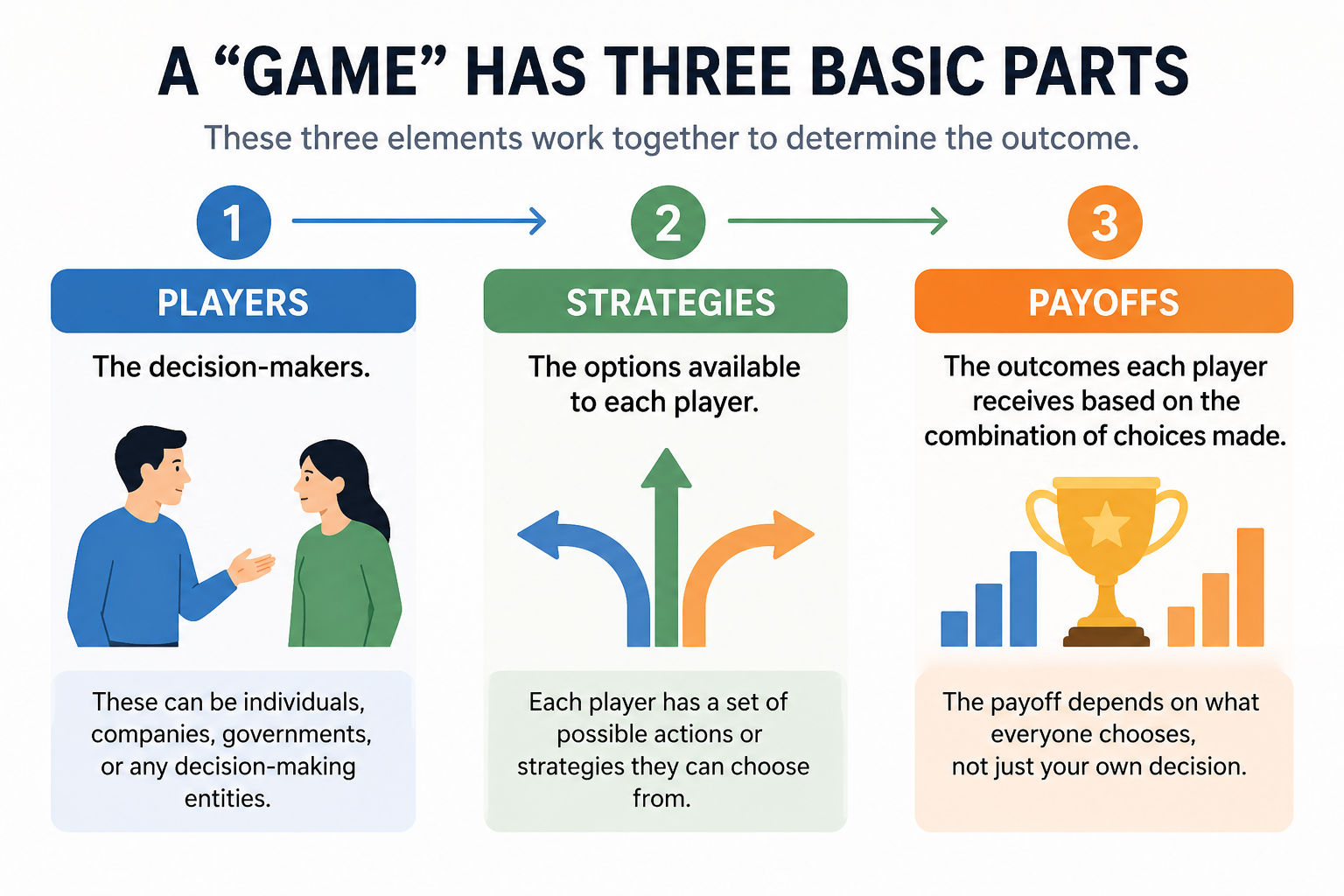
What makes it powerful is that it doesn't assume you act in isolation. Your best move depends on what you think the other person will do, and they're thinking the same about you.
Type of Game |
Description |
Examples |
| Cooperative Games | Players work together and share benefits to achieve a common objective. | Business partnerships, Trade alliances, Joint ventures |
| Non-Cooperative Games | Each participant acts independently and aims to maximize their own benefit without formal cooperation. | Market competition, Price wars, Political campaigns |
| Zero-Sum Games | One player's gain is exactly equal to another player's loss. The total payoff remains constant. | Certain bidding contests, Some financial trading situations |
| Non-Zero-Sum Games | Multiple players can gain or lose at the same time. Cooperation often creates better outcomes for everyone involved. | Trade agreements, Business collaborations, Supply chain partnerships, Environmental agreements |
Do read: Top 10 Risk Management Strategies You Need to Follow for Success!
Free Courses
Why does this matter beyond textbooks? Because markets are not isolated events. Every pricing decision, every bid in an auction, every trade negotiation involves multiple players with competing interests.
Here's where game theory has genuine influence:
In industries like airlines and telecommunications, every major decision is visible to competitors almost immediately. When one airline lowers ticket prices, rivals often respond within days or even hours.
What starts as a single pricing move can quickly spread across the entire market. Game theory helps explain why firms closely monitor each other and why stable pricing can suddenly disappear.
Governments use game theory to design auctions for spectrum licenses, oil drilling rights, and public contracts. The format of an auction changes how bidders behave. Economists design rules to get closer to a fair price.
Do read: What is Decision-making in Management: Explore Types, Tools, & Techniques
Unions and employers both have information the other side doesn't. Game theory models help explain how both sides posture, make offers, and eventually settle.
Climate agreements reveal one of the toughest challenges in economics.
Every country benefits when global emissions fall. Yet each country also faces economic costs when reducing emissions at home. This creates a difficult incentive problem. Governments often wait for others to act first, even when everyone agrees on the broader goal. Game theory views this as a coordination challenge where collective success depends on individual choices.
Game theory doesn't just describe what happens. It helps design better systems, better rules, and better incentives so that individual rational behavior leads to better collective outcomes.
Do read: What Is the Algorithmic Game Theory? Explained With Examples
Management Courses to upskill
Explore Management Courses for Career Progression
IIIT-B & IIM, Udaipur
Chief Technology Officer & AI Leadership ProgrammeThe application of game theory in economics goes far beyond theory. Companies, regulators, and policymakers use it actively.
Retailers decide whether to match competitor prices. Airlines decide when to fill seats at a discount versus holding prices. Game theory models help optimize these decisions when rivals are doing the same.
Should a company launch a product now or wait? If a competitor is close to launching something similar, timing becomes strategic. Launching first builds brand presence. Waiting allows product refinement. The right answer depends on what the competitor is likely to do.
During takeover bids, multiple buyers may be competing. How high should you bid? Going too high destroys value. Going too low loses the deal. Auction theory, a branch of game theory, helps model this.
Must read: What is Logical Thinking & How to Improve Logical Thinking Skills? [2026]
Two-sided platforms like e-commerce marketplaces set fees for both sellers and buyers. Changing fees on one side affects the other. Game theory helps model these interdependencies.
Governments and private organizations use auctions regularly. Examples include spectrum auctions, government contracts, online marketplaces, and natural resource rights. Participants must decide how much to bid while predicting the behavior of rivals.
Countries often behave like strategic players. Trade negotiations involve decisions about tariffs, import restrictions, export incentives, and market access.
Each government evaluates not only its own interests but also the possible reactions of trading partners. A single policy change can trigger responses across global markets.
Technology firms use strategic decision-making extensively.
Consider a streaming platform deciding whether to increase subscription fees while competitors maintain current prices. The outcome depends heavily on customer reactions and competitor responses.
Must read: Negotiation Skills: Definition, Process, Various Stages, Benefits [With Examples]
Let's explore some concepts that frequently appear in game theory economics.
Nash Equilibrium is a key concept in game theory economics. It occurs when no player can improve their outcome by changing their strategy while everyone else keeps theirs unchanged.
For example, two competing coffee shops may both lower prices to attract customers. Neither can raise prices without losing business, so both stick to their current strategy. The result is stable, even if it's not ideal.
Why it matters:
While the concept assumes rational decision-making and doesn't always reflect real-world complexity, it remains one of the most useful tools in economic analysis.
The Prisoner's Dilemma shows why people or organizations may choose not to cooperate, even when cooperation would benefit everyone.
Imagine two suspects arrested for a crime. Each can either confess or stay silent. If both stay silent, they receive light sentences. If one confesses while the other remains silent, the confessor goes free while the other gets a severe sentence. Because confessing appears safer for each individual, both usually confess and receive harsher penalties.
Decision |
Outcome |
| Both stay silent | Both receive light sentences |
| One confesses | Confessor goes free, other gets a harsh sentence |
| Both confess | Both receive moderate sentences |
This situation appears in economics when competing firms spend heavily on advertising or countries impose tariffs on each other. While cooperation would often create better outcomes, individual incentives push participants toward less efficient decisions.
Also Read: 4 Key Differences Between Leadership and Management
No model is perfect. Game theory has real limitations as well as advantages that you should know before relying on it too heavily.
Advantages of Game Theory |
Limitations of Game Theory |
| Improves strategic planning by helping players evaluate different choices and outcomes. | Assumes people act rationally and in their own self-interest, which isn't always true in real life. |
| Helps predict competitor reactions in competitive markets and negotiations. | Often assumes players have complete information about others' choices and payoffs, which is rarely the case. |
| Supports policy analysis by showing how businesses, consumers, and governments may respond to decisions. | Some games have multiple Nash Equilibria, making it difficult to predict which outcome will occur. |
| Explains both cooperation and conflict among individuals, firms, and countries. | Many models are static and don't fully capture how strategies evolve over time. |
| Enhances decision-making under uncertainty by providing a structured framework for analysis. | Real-world behavior is influenced by emotions, biases, and changing circumstances that models may not account for. |
Game theory economics is about thinking ahead, not just for yourself but about what others will do. That shift in perspective changes how you analyze markets, design policies, and make strategic decisions.
It's not just academic. Every negotiation you've been part of, every competitive market you've bought from, every policy debate you've followed has game theory running underneath it. Understanding it gives you a sharper way to see why people and institutions behave the way they do, even when the outcomes look irrational on the surface.
If you want to go deeper into economics, decision-making, and strategic thinking, upGrad's programs in business and economics offer structured learning paths that connect these ideas to real-world careers.
Ready to start your journey? Book a free consultation with upGrad today to find the best path for your career.
Game theory isn't limited to economics or business. People use similar strategic thinking when negotiating salaries, choosing investments, deciding whether to cooperate in teams, or even selecting a route during traffic. The core idea is simple. Your decision often depends on what you expect others to do.
Decision theory focuses on choices made by a single individual facing uncertainty. Game theory studies situations where multiple participants influence each other's outcomes. If your result depends on someone else's actions, game theory becomes the more relevant framework for analysis.
Price changes rarely happen in isolation. Businesses know competitors may react with their own discounts, promotions, or product adjustments. Game theory helps firms evaluate these possible responses before making decisions, reducing the risk of triggering costly price wars or losing market share.
Yes. Economists continue to apply game theory to digital markets, platform businesses, international trade, environmental policy, and financial markets. As economies become more interconnected, understanding strategic interactions becomes even more valuable for predicting behavior and designing effective policies.
Streaming services provide a useful example. If one platform lowers subscription prices, competitors must decide whether to match the discount or maintain pricing. Each company considers customer reactions and rival responses before acting, making it a classic game theory scenario.
Game theory provides structured predictions, but it doesn't predict every action perfectly. People aren't always rational. Emotions, biases, incomplete information, and unexpected events can influence decisions. That's why economists often combine game theory with insights from behavioral economics.
Several industries use game theory regularly, including telecommunications, airlines, banking, technology, energy, and e-commerce. These sectors involve intense competition, pricing decisions, negotiations, and market entry strategies where understanding competitor behavior can create a significant advantage.
The importance of game theory in economics becomes clear when governments design regulations, tax policies, trade agreements, or environmental initiatives. Policymakers use strategic models to anticipate how businesses, consumers, and other governments might respond before implementing new rules.
Auction participants rarely bid based only on value. They also consider how much competitors may bid. Auction theory, a specialized branch of game theory, helps governments and organizations design bidding systems that encourage fair competition and improve outcomes for sellers and buyers.
Studying game theory economics strengthens analytical thinking, problem-solving, negotiation, and decision-making skills. It teaches students how to evaluate incentives, assess risks, and understand strategic interactions, which are valuable abilities in business, finance, consulting, and public policy careers.
The application of game theory in economics includes competitive pricing, wage negotiations, trade policy, mergers and acquisitions, auction design, and market competition analysis. Economists use these models to understand how strategic decisions affect outcomes when multiple participants interact.
972 articles published
We are an online education platform providing industry-relevant programs for professionals, designed and delivered in collaboration with world-class faculty and businesses. Merging the latest technolo...
Get Free Consultation
By submitting, I accept the T&C and
Privacy Policy
Top Resources
Certification
3 Months
Certification
6 Months
O.P. Jindal Global University
Masters in International Accounting and Finance (Accredited by ACCA, UK)Master's Degree
12 Months