Elastic Net Regression: A Complete Guide for 2026
By Rahul Singh
Updated on Jun 26, 2026 | 8 min read | 4.66K+ views
Share:

All courses
Certifications
More
By Rahul Singh
Updated on Jun 26, 2026 | 8 min read | 4.66K+ views
Share:
Table of Contents
Elastic Net Regression is a regularization technique that combines both L1 (Lasso) and L2 (Ridge) penalties in a linear regression model. It helps reduce overfitting, handles highly correlated features, and performs feature selection by shrinking less important coefficients. This makes it a reliable choice for datasets with many features or strong correlations between predictors.
In this blog, you will learn what this Elastic Net Regression in Machine Learning is, how the elastic net regression model works under the hood, when to use it over other methods, and how to implement it in Python using sklearn.
Popular AI Programs
Before jumping into the math, it helps to understand the problem this technique was built to solve.
When you train a linear regression model with many input features, two common problems show up:
Two earlier techniques tried to solve this:
Method |
What It Does |
Limitation |
| Ridge Regression | Shrinks all coefficients toward zero | Keeps all features, even irrelevant ones |
| Lasso Regression | Shrinks some coefficients exactly to zero | Struggles when features are highly correlated |
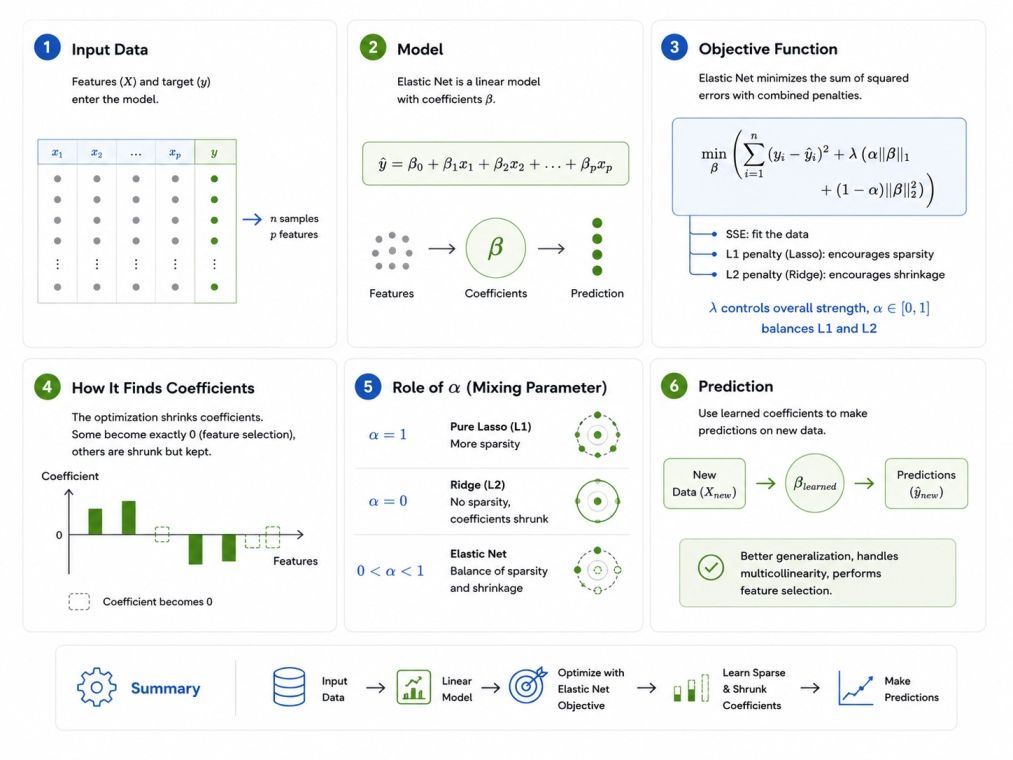
Elastic net regression takes the best of both. It shrinks coefficients like Ridge and can remove irrelevant features like Lasso. This makes the model more stable and practical in real-world scenarios.
The elastic net regression model minimizes this loss:
Loss = RSS + lambda * [alpha * |coefficients| + (1 - alpha) * coefficients^2]
Where:
When alpha is set to 0.5, the model applies equal weight to both penalties. Adjusting alpha lets you lean toward Lasso behavior (feature selection) or Ridge behavior (coefficient shrinkage).
Free Courses
To really understand elastic net regression, you need to see how regularization actually affects model training.
Regularization adds a penalty to the loss function. Without it, a model can freely grow its coefficients to fit training data perfectly, which usually leads to overfitting.
Here is a side-by-side comparison of the three regularized regression methods:
Feature |
Ridge |
Lasso |
Elastic Net |
| Penalty Type | L2 (squared) | L1 (absolute) | L1 + L2 combined |
| Feature Selection | No | Yes | Yes |
| Handles Correlated Features | Yes | Partially | Yes |
| Best For | Many small effects | Sparse models | High-dimensional correlated data |
The elastic net regression model has two key hyperparameters:
Tuning these two values correctly is the most important part of working with elastic net regression sklearn.
Also Read: How to Perform Multiple Regression Analysis?
AI Courses to upskill
Explore Artificial Intelligence Courses for Career Progression
Let us now build this model from scratch using sklearn. The implementation is straightforward and follows the standard sklearn API.
import numpy as np
import pandas as pd
from sklearn.linear_model import ElasticNet
from sklearn.model_selection import train_test_split, GridSearchCV
from sklearn.preprocessing import StandardScaler
from sklearn.metrics import mean_squared_error, r2_scoreElastic net regression in Python works best when features are scaled. Always apply standardization before fitting the model.
from sklearn.datasets import fetch_california_housing

data = fetch_california_housing()
X, y = data.data, data.target

# Split into train and test sets
X_train, X_test, y_train, y_test = train_test_split(X, y, test_size=0.2, random_state=42)

# Scale features
scaler = StandardScaler()
X_train_scaled = scaler.fit_transform(X_train)
X_test_scaled = scaler.transform(X_test)# Initialize elastic net regression sklearn model
model = ElasticNet(alpha=0.1, l1_ratio=0.5, max_iter=1000)
# Train the model
model.fit(X_train_scaled, y_train)
# Predict
y_pred = model.predict(X_test_scaled)
# Evaluate
print("R2 Score:", r2_score(y_test, y_pred))
print("RMSE:", np.sqrt(mean_squared_error(y_test, y_pred)))
Finding the best alpha and l1_ratio values is critical. Use GridSearchCV to automate this:
param_grid = {
   'alpha': [0.01, 0.1, 1.0, 10.0],
   'l1_ratio': [0.1, 0.5, 0.7, 0.9, 1.0]
}

grid_search = GridSearchCV(ElasticNet(max_iter=1000), param_grid, cv=5, scoring='r2')
grid_search.fit(X_train_scaled, y_train)

print("Best Parameters:", grid_search.best_params_)
print("Best R2 Score:", grid_search.best_score_)
This code for elastic net regression in Python is production-ready and covers data prep, model training, and evaluation in one flow.
Want to build advanced machine learning models and master regularization techniques like Elastic Net Regression? Explore these upGrad programs:
Choosing the right regression method depends on your data. Here is when this approach is the right pick.
Also Read: Machine Learning System Design: Beginner-to-Advanced Guide
Use Case |
Why It Works Well |
| Genomics and bioinformatics | Many correlated gene expression features |
| Text classification | High-dimensional sparse feature spaces |
| Financial modeling | Correlated economic indicators |
| Medical risk prediction | Many patient features with multicollinearity |
Understanding how this technique compares to similar methods helps you make better modeling decisions.
Criteria |
Ridge |
Lasso |
Elastic Net |
| Penalty | L2 | L1 | L1 + L2 |
| Coefficients go to zero | No | Yes | Yes (some) |
| Handles multicollinearity | Well | Poorly | Well |
| Feature selection | No | Yes | Yes |
| Hyperparameters to tune | 1 | 1 | 2 |
| Computational cost | Low | Low | Slightly higher |
If Lasso gives you unstable results on correlated data, switch to elastic net regression. If you want strict sparsity without caring about correlation, Lasso is enough. If you want no feature elimination at all, Ridge is the right choice.
For most real-world tabular datasets with many features, elastic net regression sklearn is a practical and reliable starting point. You can always compare all three using cross-validation and pick the one with the best validation score.
Also Read: How to Choose a Feature Selection Method for Machine Learning
Elastic net regression is a powerful and flexible tool for building linear models on complex, high-dimensional data. It solves two of the most common problems in regression: overfitting and multicollinearity. By combining L1 and L2 regularization, the elastic net regression model lets you control both feature selection and coefficient stability in a single framework.
If you want to go deeper into machine learning concepts like this, upGrad's data science and machine learning programs walk you through real-world applications with hands-on projects and mentorship from industry experts.
Want to build expertise in machine learning and AI? Speak with an upGrad expert in a free 1:1 counselling session to find the right program for your career goals.
Elastic net regression is a type of linear regression that applies two penalties at the same time to prevent overfitting. It combines Lasso (L1) and Ridge (L2) regularization. This makes the model more stable when dealing with many features or correlated predictors.
Use it when your data has many features that are highly correlated. Lasso alone can behave unpredictably with correlated features, while Ridge does not remove any features. This method handles both situations better by applying a mixed penalty that balances selection and shrinkage.
The l1_ratio in elastic net regression sklearn controls how much weight is given to the Lasso (L1) versus Ridge (L2) penalty. A value of 1 makes it pure Lasso. A value of 0 makes it pure Ridge. Values between 0 and 1 blend both penalties in proportion.
Yes. The elastic net regression model can set some feature coefficients exactly to zero, which effectively removes those features from the model. This is the L1 part of the penalty at work. The number of features removed depends on the alpha and l1_ratio values you choose.
Yes, scaling is strongly recommended. Without it, features with larger numeric ranges will dominate the regularization penalty. Use StandardScaler from sklearn before fitting elastic net regression in Python to get reliable results.
Ordinary linear regression minimizes only the residual error with no constraints. The elastic net regression model adds a regularization term to the loss function that penalizes large coefficients. This reduces overfitting and usually improves performance on unseen data when there are many input features.
Not directly. You need to encode categorical variables into numbers first using one-hot encoding or label encoding before passing them into the elastic net regression model. sklearn's preprocessing tools like OneHotEncoder make this easy.
Use cross-validation. The ElasticNetCV class in sklearn automates this process. You can also use GridSearchCV with a manual parameter grid to search across both alpha and l1_ratio together for a more thorough search.
In the standard math formula for elastic net regression, lambda controls the overall penalty strength and alpha controls the L1 to L2 mix. In sklearn, the parameter named alpha plays the role of lambda, while l1_ratio plays the mixing role. This naming difference often confuses those coming from a statistics background.
Elastic net regression is designed for continuous targets. For classification, you can use LogisticRegression in sklearn with penalty set to elasticnet and solver set to saga, which applies the same L1 plus L2 penalty logic to a classification objective.
On small datasets, the model can still be useful, but regularization becomes more sensitive. With few observations, the penalty can overpower the data signal. Start with a low alpha value and use cross-validation to avoid over-regularizing on small samples.
98 articles published
Rahul Singh is an Associate Content Writer at upGrad, with a strong interest in Data Science, Machine Learning, and Artificial Intelligence. He combines technical development skills with data-driven s...
Speak with AI & ML expert
By submitting, I accept the T&C and
Privacy Policy
Top Resources
Master's Degree
18 Months
Executive Diploma
12 Months
IIIT Bangalore
Executive Programme in Generative AI & Agentic AI for LeadersIndia’s #1 Tech University
Dual Certification
5 Months