Data Imputation: Types, Techniques and Best Practices for Handling Missing Data
By Sriram
Updated on Jul 16, 2026 | 10 min read | 4.4K+ views
Share:

All courses
Certifications
More
By Sriram
Updated on Jul 16, 2026 | 10 min read | 4.4K+ views
Share:
Table of Contents
Key Takeaways
This blog explains data imputation in simple terms, including why missing values occur, common data imputation methods, how to choose the right technique, and practical examples for data analysis and machine learning.
Understanding data imputation is just one step in preparing high-quality datasets for machine learning. Learn data preprocessing, feature engineering, model building, and deployment through upGrad's industry-focused MachineLearning programs and gain hands-on experience with real-world projects.
Popular AI Programs
Imagine you're analyzing customer purchase data. One column records customer age, but several rows are blank because some customers skipped that field. Those empty cells are called missing values. If you ignore them, your analysis could become inaccurate. If you remove every incomplete record, you might lose valuable information. That's why data imputation exists.
Simply put, data imputation is the process of replacing missing values with estimated values based on the available data. The goal isn't to guess randomly. Instead, it's to preserve the quality of the dataset while reducing the negative impact of missing information.
Missing values appear in almost every industry. They can result from human error, system failures, incomplete surveys, sensor malfunctions, or problems during data collection. Without proper handling, these gaps can reduce model accuracy, distort statistical analysis, and introduce unwanted bias.
Some missing values are unavoidable. Others happen because of preventable issues.
Common causes include:
Each cause affects your dataset differently. Understanding why data is missing helps you select the right imputation methods for missing data instead of applying a one-size-fits-all solution.
Not every missing value follows the same pattern.Researchers usually group missing data into three categories.
Missing Data Type |
What It Means |
Example |
| Missing Completely at Random (MCAR) | Missing values have no relationship with any variable in the dataset. | A survey response is lost because of a server outage. |
| Missing at Random (MAR) | Missing values depend on another observed variable. | Younger users skip income information more often than older users. |
| Missing Not at Random (MNAR) | Missing values are related to the missing value itself. | People with higher salaries choose not to disclose their income. |
Because different missing data patterns require different data imputation methods. A simple mean replacement might work for one dataset but produce misleading results in another.
Also Read: Data Cleaning Techniques
These two terms are easy to confuse, but they represent different problems.
Missing Data |
Incorrect Data |
| No value exists. | A value exists but is wrong. |
| Represented as blank cells or null values. | Represented by inaccurate or invalid entries. |
| Solved using missing data imputation techniques. | Solved through data cleaning and validation. |
Replacing an incorrect value with an estimate doesn't solve the real issue. That's why identifying the problem comes before choosing an imputation strategy.
Suppose a sales dataset contains five customer ages.
Customer |
Age |
| A | 25 |
| B | 31 |
| C | Missing |
| D | 29 |
| E | 35 |
One common approach is mean imputation.
Average age = (25 + 31 + 29 + 35) ÷ 4 = 30
The missing value is replaced with 30.
Now the dataset is complete and ready for analysis.
This isn't always the best choice. If the data contains extreme values or follows a skewed distribution, another technique may produce better results. That's why understanding different imputation methods for missing data is so important.
Also Read: Data Validation in Excel
Missing values can reduce the accuracy of analysis and machine learning models, leading to unreliable results. Instead of removing incomplete records, data imputation fills missing values with suitable estimates, preserving valuable information. This improves data quality, reduces bias, increases dataset completeness, and helps organizations build more accurate predictive models, generate reliable insights, and make better data-driven decisions.
Also Read: How to Implement Machine Learning Steps: A Complete Guide
Free Courses
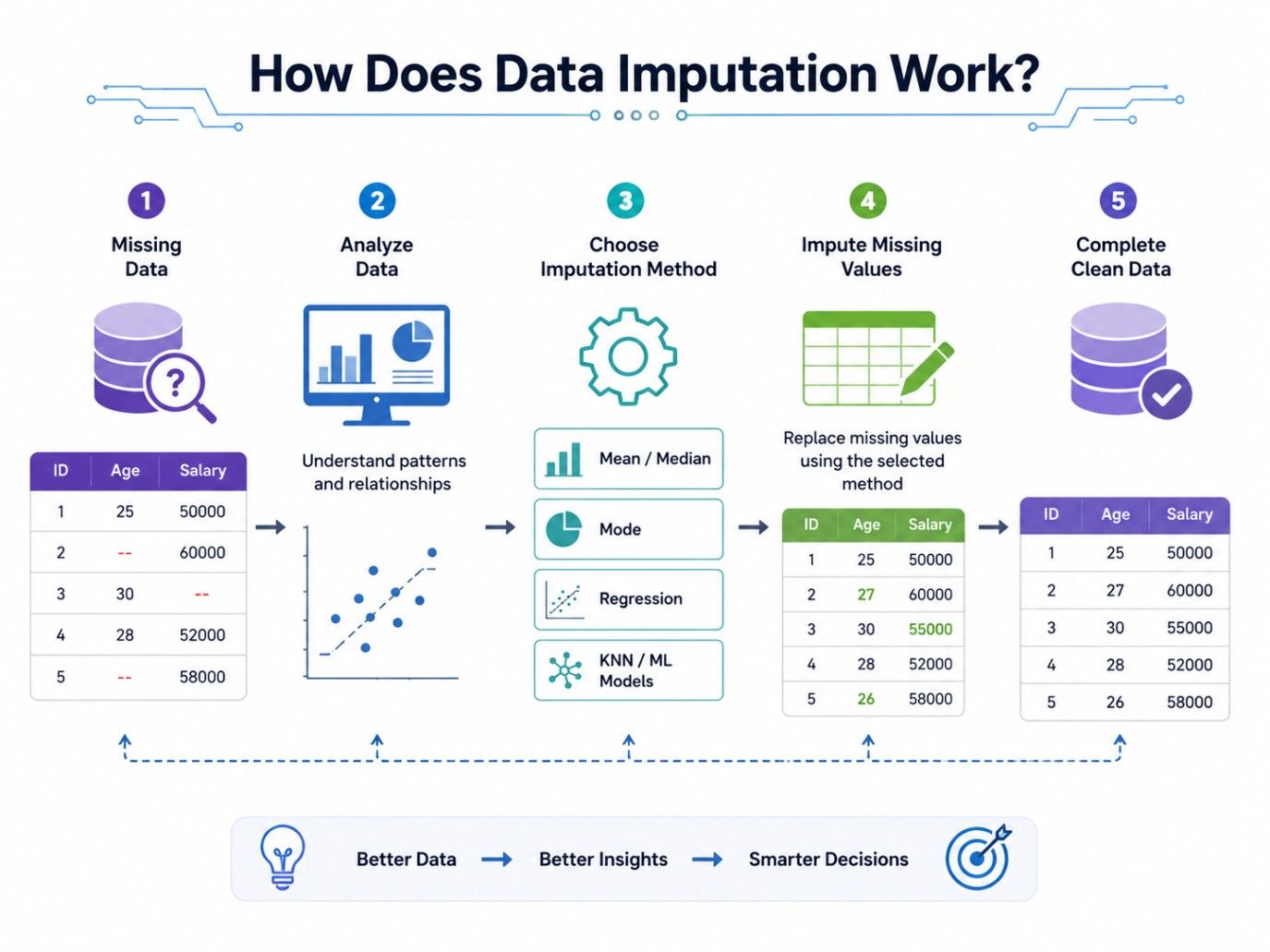
Filling a missing value isn't just about replacing an empty cell. A good imputation process follows a logical sequence that balances data quality with analytical accuracy. The better you understand your data before making changes, the more reliable your final results will be.
Most data imputation methods follow four key steps.
AI Courses to upskill
Explore Artificial Intelligence Courses for Career Progression
Different data imputation methods are designed for different scenarios. Choosing the right technique depends on the type of data, the amount of missing information, and the purpose of your analysis.
Technique |
Best Used For |
Key Limitation |
| Mean Imputation | Normally distributed numerical data | Sensitive to outliers and reduces data variability |
| Median Imputation | Skewed numerical data | Doesn't preserve relationships between variables |
| Mode Imputation | Categorical data | Can overrepresent the most frequent category |
| Forward Fill | Time-series data with sequential values | Not suitable for large gaps |
| Backward Fill | Time-series data | May not reflect actual trends |
| KNN Imputation | Machine learning and complex datasets | Computationally expensive |
| Regression Imputation | Predicting numerical values using related variables | Depends on model quality |
| Multiple Imputation | Research studies and high-accuracy analysis | Time-consuming and complex |
| Hot Deck Imputation | Survey and demographic datasets | Requires similar records |
| Cold Deck Imputation | External or historical reference datasets | Depends on the quality of external data |
Learning data imputation is a key step in preparing high-quality data for machine learning. Take the next step with upGrad's Ex. Diploma in Machine Learning & AI with MLOps, Gen AI & Agentic AI , and build practical skills in Python, machine learning, MLOps, Generative AI, and real-world AI applications.
There's no single data imputation technique that works for every dataset. The best choice depends on your data type, the amount of missing information, and your analysis goals.
Factor |
Recommended Approach |
| Data Type | Use mean/median for numerical data and mode for categorical data. |
| Missing Data Percentage | Simple methods work for small gaps, while larger gaps may require KNN or multiple imputation. |
| Missing Data Pattern | Identify whether the data is MCAR, MAR, or MNAR before selecting a method. |
| Analysis Goal | Use advanced methods like KNN or multiple imputation for machine learning and research. |
| Computational Resources | Simple methods are faster, while advanced techniques require more processing power but often provide better accuracy. |
Choosing the right method helps improve data quality while minimizing bias and preserving meaningful patterns in your dataset.
Also read : 15 Key Techniques for Dimensionality Reduction in Machine Learning
The same imputation method won't work equally well for every type of data. A numerical column behaves differently from a categorical column, while time-series data follows its own sequence. Choosing the right approach helps improve data quality and prevents inaccurate analysis.
Numerical variables contain measurable values such as age, salary, sales, or temperature.
Common data imputation methods include:
Example: If a customer's age is missing, replacing it with the median age often produces better results than using the mean when the data contains outliers.
Categorical variables represent labels rather than numbers, such as gender, city, or product category.
The most common methods are:
For instance, if a product category is missing, replacing it with the most frequent category can be a practical solution when only a few values are missing.
Time-series datasets have observations arranged in chronological order. Examples include stock prices, weather readings, and website traffic.
Common techniques include:
Using ordinary statistical methods for sequential data may break natural trends, so time-aware techniques are usually preferred.
Read more: Everything You Should Know About Unsupervised Learning
When dealing with missing values, you have two choices. You can replace them using missing data imputation, or you can remove the incomplete records.
The better option depends on how much data is missing and how important those records are.
Feature |
Data Imputation |
Data Deletion |
| Preserves dataset size | Yes | No |
| Handles missing values | Replaces them with estimated values | Removes incomplete records |
| Risk of bias | Lower when the right method is used | Higher if many records are deleted |
| Best for | Large or valuable datasets | Small datasets with very few missing values |
Choose data imputation when:
Data deletion may be appropriate when:
If a large percentage of data is removed, the remaining dataset may no longer represent the original population accurately.
Also read : Top Machine Learning Skills to Stand Out in 2026!
Like any preprocessing technique, data imputation has strengths and trade-offs. Understanding both helps you choose the right method instead of assuming every missing value should be filled.
Advantages |
Limitations |
| Preserves valuable data | Incorrect methods can introduce bias |
| Improves machine learning performance | Some techniques reduce data variability |
| Reduces information loss | Advanced methods require more computation |
| Produces more complete datasets | Imputed values are estimates, not actual observations |
| Supports better statistical analysis | Poor choices can affect model accuracy |
The goal isn't to create flawless data. It's to make informed decisions while keeping the dataset as reliable as possible.
Also Read: How to Learn Machine Learning - Step by Step
Most machine learning algorithms require complete datasets to train effectively. Missing values can reduce model accuracy, interrupt training, or even prevent some algorithms from working. That's why data imputation machine learning workflows typically include an imputation step before model development.
When applied correctly, data imputation can:
Using the wrong imputation method can negatively affect model performance. For example:
Best Practices
To achieve reliable model performance:
Following these practices helps build machine learning models that are more accurate, reliable, and better suited for real-world data.
Small mistakes during imputation can affect the quality of your analysis. Many beginners focus only on filling missing values without considering whether the chosen method actually fits the data.
Some common mistakes include:
Following these steps helps reduce bias and improves the reliability of your analysis.
Choosing a suitable method is only part of the process. Good practices help maintain data quality and improve the reliability of your results.
Here are a few recommendations:
A thoughtful approach to imputation methods for missing data helps produce datasets that are both accurate and suitable for statistical analysis or machine learning.
Also read : What is Perceptron in Machine Learning? Beginners Guide
Missing values appear across almost every industry. Data imputation helps organisations analyse data more accurately without losing valuable records.
Industry |
Common Use Case |
| Healthcare | Completing patient records for medical analysis |
| Banking | Credit risk assessment with incomplete customer data |
| Retail | Customer segmentation and demand forecasting |
| Manufacturing | Filling missing sensor readings |
| Marketing | Completing customer profiles for campaign analysis |
| Education | Analyzing student performance with incomplete records |
| Research | Improving the quality of survey and experimental data |
Use this quick reference when selecting a data imputation technique.
Situation |
Recommended Method |
| Normally distributed numerical data | Mean Imputation |
| Skewed numerical data | Median Imputation |
| Categorical variables | Mode Imputation |
| Time-series data | Forward or Backward Fill |
| Machine learning datasets | KNN or Regression |
| Research requiring high accuracy | Multiple Imputation |
| Small percentage of missing values | Simple statistical methods |
| Large percentage of missing values | Investigate before imputing or use advanced methods |
Missing values are a common part of real-world datasets, but they don't have to limit your analysis. Choosing the right data imputation technique helps preserve valuable information, improve model performance, and reduce bias. Whether you're working with business reports, research data, or data imputation machine learning projects, understanding your data before selecting an imputation method is the key to producing reliable and meaningful results.
Ready to start your journey? Book a free consultation with upGrad today to find the best path for your career.
The purpose of data imputation is to replace missing values so a dataset remains complete and useful for analysis. Instead of discarding valuable records, imputation helps preserve information, improves data quality, and allows statistical models and machine learning algorithms to produce more reliable results.
There isn't a fixed percentage that applies to every dataset. The decision depends on why the data is missing, the importance of the variable, and the analysis goal. If a large portion of a feature is missing, it's worth evaluating whether that feature should be imputed or removed.
Data imputation methods are commonly grouped into simple statistical methods, predictive methods, and multiple imputation techniques. Statistical methods use values such as the mean or median, predictive methods estimate missing values using other variables, while multiple imputation creates several possible estimates to improve reliability.
Yes, when applied correctly. Data imputation helps create complete datasets that many machine learning algorithms require for training. Selecting an appropriate imputation method can improve prediction accuracy, reduce bias, and increase the amount of usable training data without discarding valuable records.
Data imputation should be used when missing values could affect analysis, reduce model performance, or lead to unnecessary data loss. It's especially useful when the missing information represents only a small part of otherwise valuable records that should be retained for further analysis.
No. If only a few records contain missing values and removing them doesn't affect the overall dataset, deletion may be a practical option. However, when deleting records results in significant information loss, data imputation is usually the better approach for maintaining data quality.
Yes. Different variables often require different approaches depending on their type and distribution. For example, median imputation may work well for numerical values, while mode imputation is more suitable for categorical variables. Applying one method to every column isn't always the best strategy.
Yes. Imputation replaces missing values with estimated ones, creating a modified version of the original dataset for analysis. Since these values are predictions rather than actual observations, it's important to document the chosen method and evaluate its impact on the results.
A successful imputation method should preserve the overall distribution of the data without introducing unrealistic patterns or bias. Comparing summary statistics, visualizing the data, and evaluating machine learning model performance are common ways to verify whether the imputation was effective.
Yes. Many modern data science tools and machine learning libraries support automated data imputation as part of preprocessing pipelines. Automation improves consistency, saves time, and helps apply the same imputation process across training and testing datasets while reducing manual effort.
730 articles published
Sriram K is a Senior SEO Executive with a B.Tech in Information Technology from Dr. M.G.R. Educational and Research Institute, Chennai. With over a decade of experience in digital marketing, he specia...
Speak with AI & ML expert
By submitting, I accept the T&C and
Privacy Policy
Top Resources
Master's Degree
18 Months
Executive Diploma
12 Months
IIIT Bangalore
Executive Programme in Generative AI & Agentic AI for LeadersIndia’s #1 Tech University
Dual Certification
5 Months