AI in Retail: How Stores Use AI for Forecasting, Pricing and Personalization
By upGrad
Updated on Nov 02, 2026 | 5 min read | 24.35K+ views
Share:

All courses
Certifications
More
By upGrad
Updated on Nov 02, 2026 | 5 min read | 24.35K+ views
Share:
Table of Contents
Quick Insights
Ready to build your future in AI? Explore upGrad’s Artificial Intelligence courses to develop in-demand skills, gain practical experience, and advance your career in the growing field of AI.
Popular AI Programs
AI in retail means using computer programmes to help stores manage their work. It helps retailers check sales, manage stock, set prices, and suggest products to customers.
AI also studies past sales and customer choices to find patterns. For example, it can identify which products sell more during festivals or what a customer buys regularly. Stores use this information to plan stock, understand customer needs, and make better decisions.
AI uses data from different sources to help retailers make decisions. The process has four main steps:
Retailers can also use information about weather, holidays, local events, competitor prices, and social media trends. These details help them understand why customer demand may change.
Retailers use different AI technologies to manage daily tasks and improve customer service.
| AI Technology | How It Is Used in Retail |
| Machine Learning | Studies past data to predict demand, set prices, and suggest products. |
| Deep Learning | Helps AI recognise products in images and handle complex tasks. |
| Natural Language Processing (NLP) | Helps chatbots and search tools understand everyday questions. |
| Computer Vision | Uses images and videos to monitor shelves, support checkout, and track store activity. |
| Generative AI | Creates product descriptions, marketing content, and shopping assistance. |
| Predictive Analytics | Helps retailers estimate future sales, customer demand, and customer loss. |
| Internet of Things (IoT) and Sensors | Collect real-time information from shelves, warehouses, refrigerators, and delivery vehicles. |
| Cloud Computing | Provides the storage and computing power needed to run AI systems. |
Learn how to use Generative AI and Agentic AI to solve business problems and lead AI projects with upGrad’s Executive Programme in Generative AI & Agentic AI for Leaders, in collaboration with IIIT Bangalore.
Free Courses
Retail stores use AI to understand what customers want, plan stock, set prices, and improve customer service. Here are four common ways they use it.
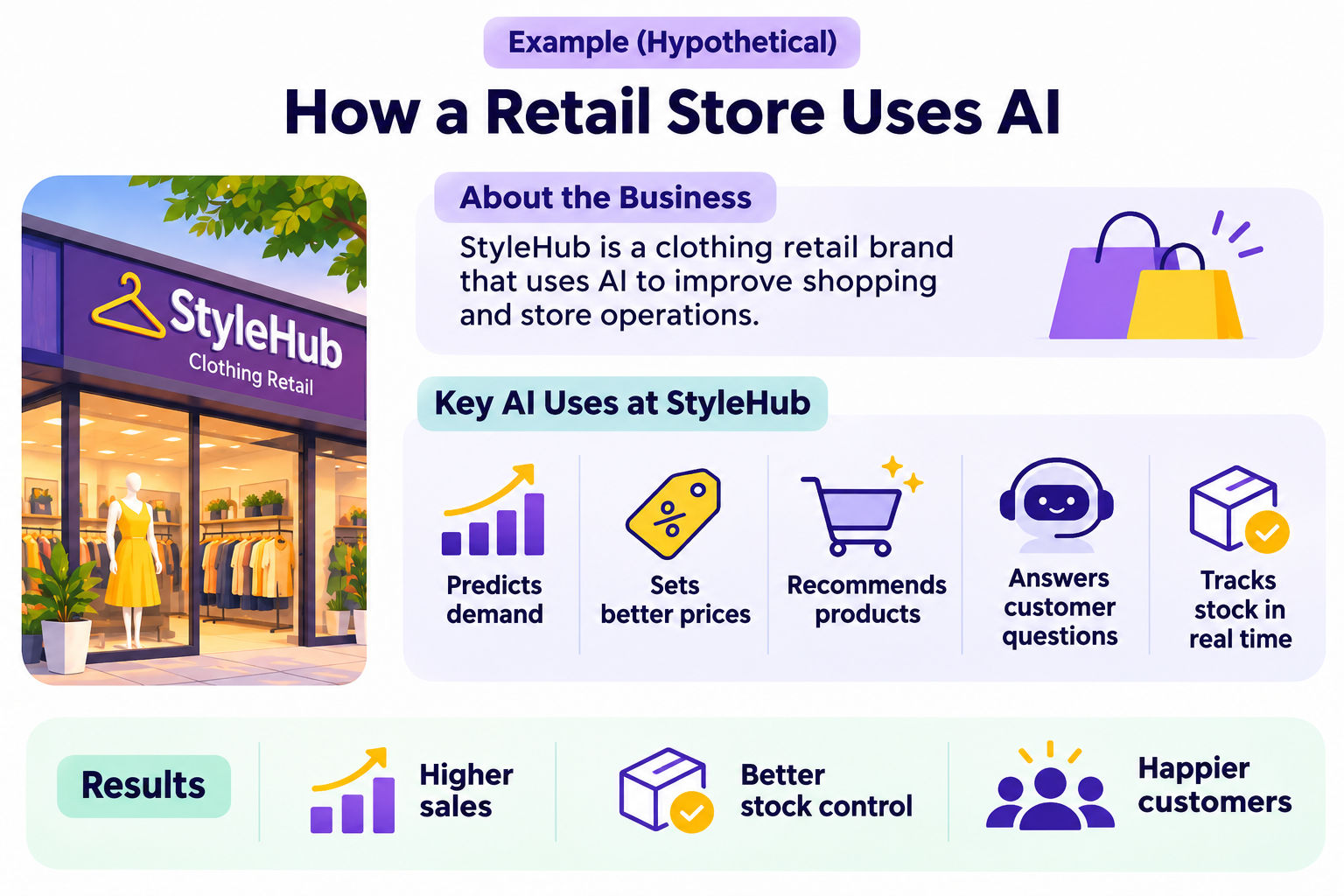
AI helps stores predict which products customers may buy and how much stock they will need. It studies past sales, seasons, discounts, weather, local events, and customer trends.
Retailers use these predictions to:
This helps stores keep enough products for customers and avoid extra stock.
AI helps retailers decide when to change product prices or offer discounts. It studies customer demand, competitor prices, stock levels, and buying habits.
Retailers use AI for:
Retailers should set clear pricing rules to avoid unfair or confusing price changes.
AI helps stores suggest products based on what customers search for, view, and buy. This makes it easier for shoppers to find products they may like.
Common examples include:
Retailers should use customer data carefully and ask for permission before collecting or using it.
Retailers use AI chatbots and virtual assistants to answer common customer questions. These tools can help with order tracking, returns, product details, sizing, and store timings.
They offer three main benefits:
AI handles common questions, giving store employees more time to help customers with problems that need personal attention.
Also Explore: Advanced Artificial Intelligence Courses
AI Courses to upskill
Explore Artificial Intelligence Courses for Career Progression
Retailers use AI to manage stock, speed up checkout, suggest products, and improve marketing. Here are some examples of how businesses use it.
AI helps stores track products and keep popular items in stock.
AI helps stores make checkout faster and spot possible theft or payment errors.
AI helps customers find products and choose items that match their needs.
Retailers use AI to understand shopping habits and offer customers more relevant deals.
Dive Deeper: Top 10 Uses of Artificial Intelligence
AI can help retailers increase sales, reduce costs, and improve customer service. However, using AI also brings challenges. Retailers need good data, the right tools, and trained employees to get the best results.
| Benefit | How AI Helps Retailers |
| Higher sales | Suggests products and offers that encourage customers to buy. |
| Lower costs and waste | Predicts demand and helps stores avoid extra stock, food waste, and last-minute deliveries. |
| Better profits | Helps set suitable prices and plan discounts. |
| Customer loyalty | Offers personalised deals and quick customer support. |
| Faster decisions | Studies large amounts of data to help teams make decisions quickly. |
| Less manual work | Handles routine tasks so employees can focus on other work. |
| Easy expansion | Allows retailers to use successful AI tools across more stores and products. |
Also Explore: Best Online Courses in AI and Data Science from IITs
Read About: Approaches of Artificial Intelligence
Retailers can follow these steps to start using AI:
Conclusion
AI in Retail is changing how stores manage stock, set prices, and serve customers. It helps retailers understand customer needs, make better decisions, and manage daily tasks more easily.
Retailers do not need to adopt every AI tool at once. They can start with one area, like demand forecasting or product recommendations. Good data, trained employees, and customer privacy are also important. Using AI along with human judgement can help retail businesses improve their operations and serve customers better.
Have any questions about artificial intelligence courses? Book a free consultation call with our experts and get personalized guidance on the right learning path for you.
More Similar Reads:
AI in retail means using smart computer programmes to study sales, products, and customer data. It helps stores predict demand, manage stock, set prices, suggest products, and improve customer service.
Retailers use AI to predict sales, manage stock, change prices, recommend products, answer customer questions, and detect fraud or theft. It is used in physical stores, online shops, warehouses, and delivery systems.
Common examples include product recommendations, shelf-monitoring cameras, cashierless checkout, virtual makeup try-ons, visual search, chatbots, and automatic stock ordering. Retailers use these tools to improve daily operations and customer service.
AI studies past sales, seasonal trends, discounts, weather, and local events to predict which products customers may buy. Retailers use these predictions to order the right amount of stock and avoid empty shelves or excess products.
AI studies customer demand, competitor prices, stock levels, and buying habits to suggest suitable prices. It also helps retailers decide when to offer discounts and how much to reduce prices.
AI studies what customers search for, view, and buy. It uses this information to suggest products, show relevant offers, and personalise emails and app notifications. This helps customers find products that match their interests.
AI can help retailers increase sales, reduce costs, manage stock, and improve customer service. It also saves time, reduces waste, and helps store teams make better business decisions.
Retailers use demand forecasting tools, stock management systems, pricing software, product recommendation tools, chatbots, and computer vision systems. They also use generative AI to create product descriptions and marketing content.
AI predicts how much stock a store may need and suggests when to order more products. It can also find slow-selling items, track stock across stores, and detect empty shelves. This helps retailers manage products and reduce waste.
Yes. Small retailers can use AI tools that come with online shopping platforms, billing software, and email marketing tools. They can start with product recommendations, chatbots, automated emails, or basic sales forecasts. Many of these tools are available on monthly plans.
Common challenges include poor data, high costs, customer privacy concerns, and difficulty connecting AI with older systems. Retailers can also face a shortage of trained staff. AI results can sometimes be unfair or incorrect, so human checks are important.
AI will make online and in-store shopping more connected. Retailers may use more virtual shopping assistants, personalised offers, automated pricing, and AI-powered customer support. They will also need to protect customer data and use AI responsibly.
1331 articles published
We are an online education platform providing industry-relevant programs for professionals, designed and delivered in collaboration with world-class faculty and businesses. Merging the latest technolo...
Speak with AI & ML expert
By submitting, I accept the T&C and
Privacy Policy
Top Resources
Master's Degree
18 Months
Executive Diploma
12 Months
IIIT Bangalore
Executive Programme in Generative AI & Agentic AI for LeadersIndia’s #1 Tech University
Dual Certification
5 Months