AI for Small Business: Everything You Need to Know to Get Started
By Sriram
Updated on Jun 11, 2026 | 6 min read | 4.47K+ views
Share:

All courses
Certifications
More
By Sriram
Updated on Jun 11, 2026 | 6 min read | 4.47K+ views
Share:
Table of Contents
Artificial intelligence helps small businesses streamline operations, automate routine tasks, and improve efficiency without requiring large teams. By applying AI to areas such as customer service, marketing, and sales, businesses can save valuable time, reduce costs, enhance customer experiences, and scale their operations more effectively.
In this blog, you'll learn how AI works in a small business environment, the most valuable use cases, popular AI tools for small business operations, implementation strategies, common challenges, and practical ways to get measurable results without a large technical team.
Discover upGrad's Artificial Intelligence and Machine Learning programs and learn how to build, deploy, and optimise intelligent systems using technologies that are driving innovation across Bussiness, healthcare, finance, and other sectors.
Popular AI Programs
There are many AI projects that fail not because of any technology limitation but because businesses adopt tools without having a clear objective.To succeed in implementation, start by finding a problem that is costing you a lot of time, money, or resources.
Instead of tackling the whole business at once, start small and grow from measurable results.
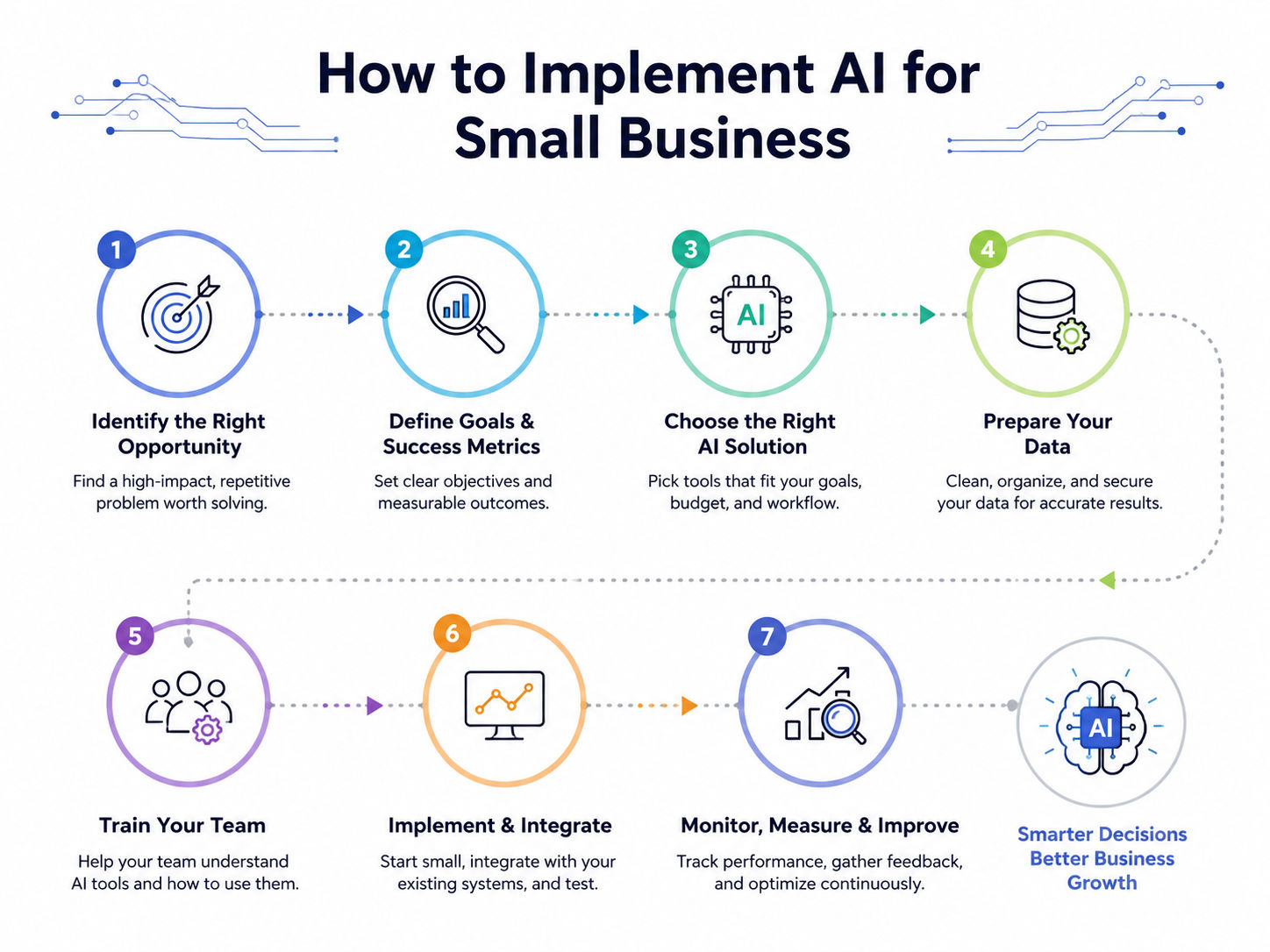
How to Implement AI for Small Business Start with high-impact use cases and clear goals. Businesses then choose the right AI tools, gather good quality data, train staff and embed solutions into existing workflows. The ongoing monitoring and optimization helps improve performance, making better decisions, more efficiency and sustainable business growth.
Also Read: Best AI Tools for Business: Top Tools & Use Cases
Free Courses
Many business owners hear about AI but struggle to identify practical use cases. The most successful implementations focus on solving specific business problems rather than adopting AI simply because it is popular.
AI applications for small business span multiple departments and functions.
One of the most common areas for AI adoption is customer support.
AI-driven chatbots can:
This enables companies to offer support after normal working hours.
Marketing teams are increasingly using AI to speed up content creation and campaign management.
AI can help with:
For instance, a small bakery marketing seasonal products can utilize AI to generate a dozen versions of social media posts in minutes instead of hours of manual content creation.
Sales teams often spend significant time qualifying leads.
AI systems can analyze customer behavior and identify prospects most likely to convert. This helps businesses focus resources where they generate the highest return.
An AI tool can automate many tasks related to accounting.
Examples of such are:
Businesses selling physical products often grapple with inventory challenges.
AI helps in predicting:
Must Read: 28+ Top Generative AI Tools in 2025: Key Benefits and Uses
AI Courses to upskill
Explore Artificial Intelligence Courses for Career Progression
The market now offers hundreds of AI solutions. Choosing the right platform depends on business goals, technical skills, and budget.
Many AI tools for small business focus on simplicity rather than advanced customization, making them suitable for teams with limited technical expertise.
The following table outlines some popular categories of AI tools:
Category |
Purpose |
| Generative AI Tools | Content creation and drafting |
| AI Chatbots | Customer support automation |
| CRM AI Platforms | Sales and customer insights |
| Marketing AI Tools | Campaign optimization |
| Analytics Platforms | Data analysis and forecasting |
| Accounting AI Software | Financial automation |
Do Read : Job Opportunities in AI: Salaries, Skills & Careers in 2026
AI offers significant opportunities, but it is not a perfect solution. Understanding limitations helps businesses make realistic decisions and avoid common mistakes. Many organizations expect immediate results and become disappointed when AI requires ongoing management.
The table below highlights the key challenges and limitations businesses may face when implementing AI solutions.
Challenge |
Explanation |
| Data Quality Issues | AI systems rely on accurate and organized data. Incomplete or outdated information can lead to unreliable results and poor decision-making. |
| Implementation Costs | While AI tools are becoming more affordable, businesses may still need to invest in software subscriptions, training, and system integration. |
| Privacy and Security Concerns | Businesses must protect sensitive customer and company data when using AI platforms and comply with relevant data protection regulations. |
| Employee Resistance to Change | Team members may hesitate to adopt new technologies due to concerns about job roles, learning curves, or workflow changes. |
| Integration Challenges | Some AI solutions may not easily connect with existing business systems, creating operational and technical difficulties. |
| Accuracy Limitations | AI-generated outputs are not always correct and may require human review, especially for important business decisions. |
| Dependence on Quality Data | AI performance depends heavily on the volume and quality of available data, which can be a challenge for smaller businesses. |
| Ongoing Monitoring Requirements | AI systems need regular evaluation and updates to maintain accuracy, relevance, and effectiveness over time. |
| Limited Customization | Many AI tools are designed for broad use cases and may not fully address industry-specific or unique business requirements. |
| Ethical and Compliance Risks | Businesses must ensure AI is used responsibly and avoid issues related to bias, transparency, and regulatory compliance. |
Also read: Top 20 Challenges of Artificial Intelligence: Key Issues and Solutions for 2026
AI capabilities continue to evolve rapidly. What was once available only to large enterprises is becoming accessible to businesses of all sizes.
Future developments could include:
AI will increasingly help small businesses manage marketing, sales, customer support, and operations from a single platform. However, human creativity, strategic thinking, and relationship-building will remain essential. Businesses that combine AI efficiency with human expertise will be better positioned to adapt, grow, and stay competitive.
Also read: Applications of Artificial Intelligence and Its Impact
AI for small business has moved past the realm of experimentation and is now a practical tool for growth, efficiency and customer engagement. AI can help improve operations from marketing automation and customer support to analytics and forecasting and doesn’t require large teams or enterprise-level budgets.
The key is to start with a clear business goal, choose the right tools, and introduce AI incrementally. Generally, the best results come from companies that are trying to solve real problems, not chasing trends. As AI technology progresses, small businesses that build AI capabilities now will be better positioned to adapt, compete and grow in an increasingly digital marketplace.
Take the next step toward an AI-driven career. Book a free consultation with upGrad and find a program that helps you to find the best path for your career.
Yes. Most modern AI platforms are designed for non-technical users and require little to no coding knowledge. Tools for customer support, marketing automation, content creation, and analytics typically offer user-friendly interfaces. Small businesses can start with ready-made solutions and only consider specialized expertise when their AI requirements become more complex.
Start by identifying a repetitive task that consumes significant time or resources. Customer support, appointment scheduling, lead management, and content creation are common starting points. Focusing on one specific problem allows you to measure results, understand limitations, and expand AI adoption gradually without disrupting daily operations.
Costs vary depending on the tools and use cases. Many AI-powered applications operate on monthly subscription models that are affordable for small businesses. Basic AI tools may cost less than hiring additional staff, while more advanced implementations involving customization, integrations, or large datasets can require higher investment.
AI can help level the playing field by automating tasks, improving efficiency, and providing insights that were previously accessible mainly to large organizations. Small businesses can respond to customers faster, create personalized marketing campaigns, and make data-driven decisions without significantly increasing operational costs.
Almost every industry can benefit from AI, but retail, e-commerce, healthcare, professional services, hospitality, education, and financial services are among the most active adopters. The specific benefits depend on business goals, customer needs, and operational challenges rather than the industry itself.
AI helps businesses provide quicker responses, personalized recommendations, and consistent support across multiple channels. Chatbots can answer routine questions instantly, while analytics tools help businesses understand customer behavior. This allows teams to deliver more relevant experiences without increasing workload significantly.
. AI can help create blog outlines, email campaigns, social media posts, and ad copy quickly. However, the best results usually come when human marketers review and refine the output. AI speeds up content production, but human input remains important for brand voice, accuracy, and audience relevance.
A common mistake is implementing AI without a clear business objective. Some businesses adopt tools because they are trending rather than solving a specific problem. Others expect immediate results without preparing data, training employees, or monitoring performance. Successful adoption usually starts with focused, measurable goals.
Yes. AI can analyze historical sales data, customer behavior, seasonal trends, and market patterns to improve forecasting accuracy. While predictions are not always perfect, they can help business owners make better decisions regarding inventory, staffing, budgeting, and future growth opportunities.
Security depends on the provider and how the tool is configured. Reputable AI platforms typically offer encryption, access controls, and compliance features. Before adopting any solution, businesses should review privacy policies, understand how data is stored, and ensure the platform meets their security requirements.
Business owners do not need advanced programming skills to benefit from AI. More valuable skills include data literacy, critical thinking, process optimization, and understanding how AI tools fit into business workflows. Knowing how to evaluate AI-generated outputs and make informed decisions remains just as important as using the technology itself.
727 articles published
Sriram K is a Senior SEO Executive with a B.Tech in Information Technology from Dr. M.G.R. Educational and Research Institute, Chennai. With over a decade of experience in digital marketing, he specia...
Speak with AI & ML expert
By submitting, I accept the T&C and
Privacy Policy
Top Resources
Master's Degree
18 Months
Executive Diploma
12 Months
IIIT Bangalore
Executive Programme in Generative AI & Agentic AI for LeadersIndia’s #1 Tech University
Dual Certification
5 Months