AI in Sales: 10 Workflows Worth Automating and What to Keep Human
By upGrad
Updated on Nov 04, 2026 | 6 min read | 1.25K+ views
Share:

All courses
Certifications
More
By upGrad
Updated on Nov 04, 2026 | 6 min read | 1.25K+ views
Share:
Table of Contents
Key Highlights
Explore upGrad’s Generative AI and Agentic AI Programs to develop practical AI skills, understand intelligent automation, and prepare for emerging opportunities in the AI-driven workplace.
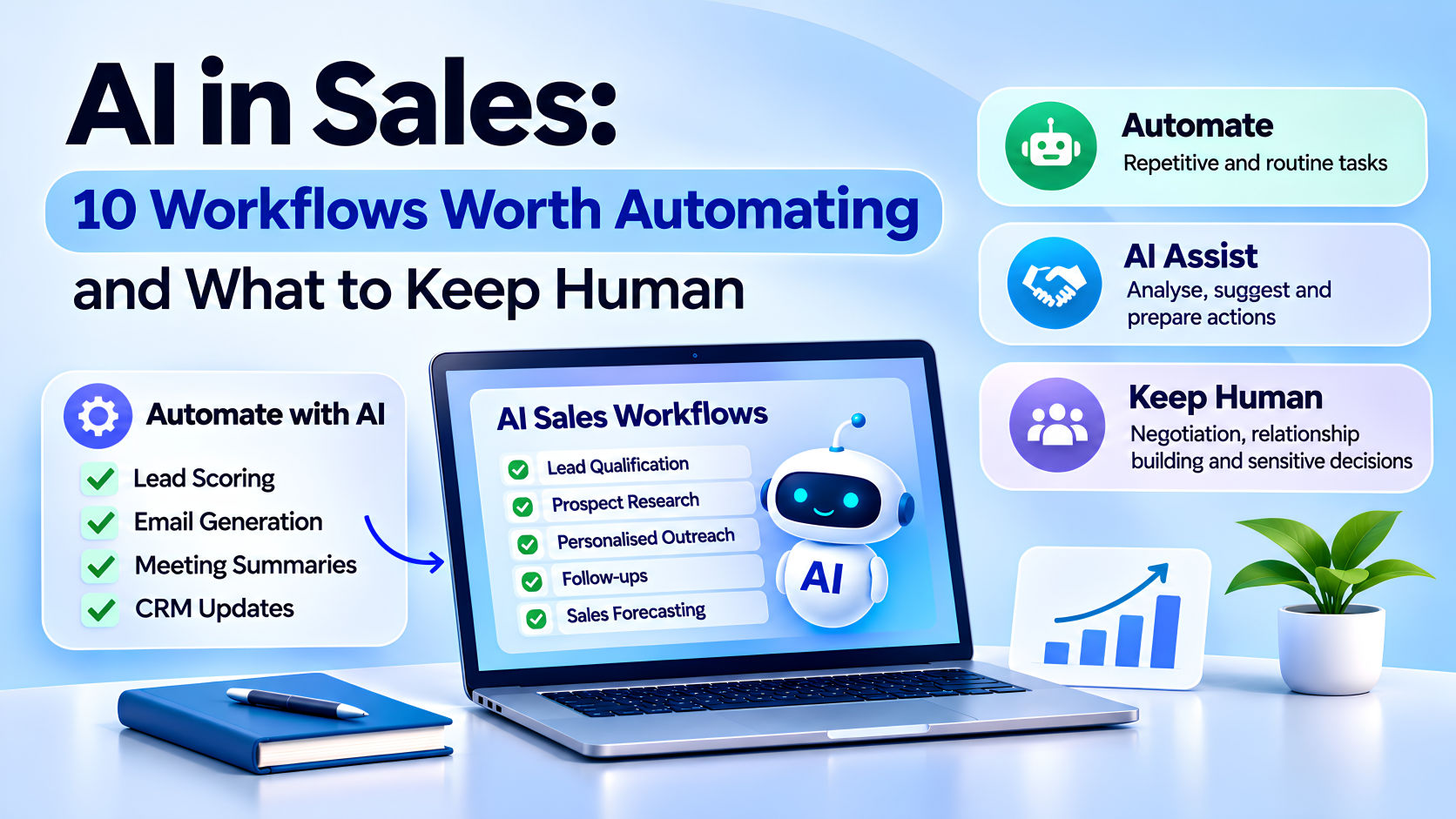
Popular AI Programs
In sales, a lot of time is wasted in admin work, manual follow-ups, and different processes. Even Hubspot’s 2025 State of Sales Report says that only 33% of their time is actually spent by a sales rep in active selling. The other part goes in these repetitive activities. AI in sales is automating their mundane tasks so that they can invest more time in actual selling which AI can’t do.
There are softwares that learn from your data and can get leads, drafts emails, summarises calls, flags risky deals and forecasts revenue.
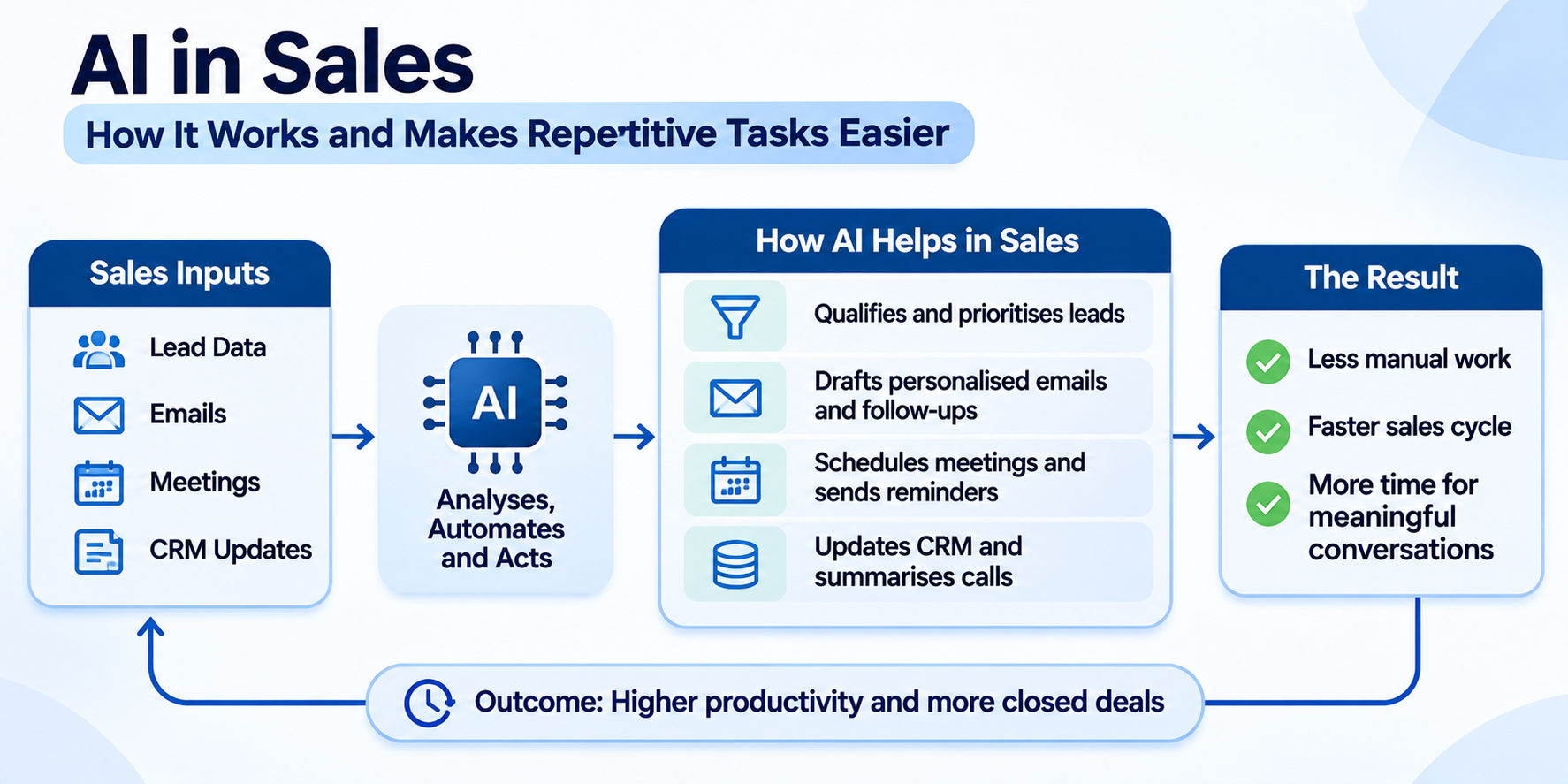
So what's the difference between using AI, Traditional Sales Automation and AI Agents for sales.
Let's find out:
Parameter |
Traditional automation |
AI workflows |
AI agents |
Approach |
Rule-based |
AI-supported decisions |
Goal-oriented actions |
Flexibility |
Limited |
Context-dependent |
Higher autonomy |
Decision-making |
Predefined rules |
Recommendations and analysis |
Selects actions within defined boundaries |
Using AI agents is still a far-fetched idea as this field requires more personal touch than any field. People dont just buy products. They buy it from people. And they focus more on the people behind the sales, trusting them. Though they can be used more in documentation.
Also Read: Generative AI vs Traditional AI: Understanding the Differences and Advantages
Free Courses
Here are the AI use cases in sales that save the most time with the least risk. Each removes a repetitive task reps dislike.
The scoring engine assigns leads incoming from the web, taking into account the job title, firm size, website traffic and conversion rate. Those who score high go directly to the right sales rep based on territory or product offering.
It is important to remember that AI may be biased if the information fed to it is somehow biased. Thus, if the model prefers one particular segment of the market in its history, so will the score; review it monthly.
A lot of effort goes into researching the customer by sales personnel. AI can research about the business from publicly available sources and come up with profiles and decision-makers.
AI collates news about funding, hiring, technology stack, and leadership changes in one summary. It can also generate lookalike profiles using your best customers. Take a peek at the output. This is especially important in AI in B2B sales, where knowing the requirements of the organization can determine the entire sales process.
Generic emails usually fail to address any specific concerns that the prospect may have. The use of generative AI will enable the system to come up with customized emails based on the information available about the prospect, their organization, and past interactions. The salesperson can use ChatGPT to craft an email for a client to make it feel personalised.
However, human intervention is required before sending out the email. AI can promise something that the company cannot deliver. Hence, a final check before sending is a must.
Following up at the right time is very important. AI can monitor email engagement, spot unanswered queries, and generate appropriate follow-up workflows.
For instance, when a prospect downloads a brochure for the product, an email with all the features of the product can be sent to them as a follow-up message. In case a call is requested, then an alert can be generated for the appropriate representative.
Timing is very important. Sending too many messages can irritate potential customers.
Sales call preparations include researching customer records and making sure they are available and their needs are known. AI can arrange all this.
AI can generate a summary of past communications and create an agenda for the meeting. Integrating calendars will also help in scheduling meetings. Then, the sales representative will do the conversation and address the concerns raised by the customer.
Relevant information in sales conversations can get lost in extensive meeting notes. Artificial intelligence can help translate conversations into summaries and action points.
Artificial intelligence can help update the CRM database. Relevant information should be reviewed by representatives before storing it to ensure no mistakes are saved in the CRM.
The AI system can analyze the engagement of the customers and pick up some signs that can show buying intentions or sales threats.
For example, a sales manager gets a notification that an important sales opportunity hasn’t had any significant engagement in several weeks.
AI can recommend a follow-up, but the representative must understand why the customer has disengaged before deciding what to do next.
Making proposals requires time, especially when different customers have different demands. Generative AI is able to generate proposals from approved product information and customer demands.
An AI can be used by a software sales team to make a proposal about product features, implementation demands, and an estimated time frame.
Human authorization is necessary for pricing and business-related issues.
To create plans and allocate their resources in a correct manner, the sales managers must be provided with the right kind of information. Predictive analytics makes it possible to analyze previous sales, current opportunities, and the status of deals to make predictions.
For instance, the use of AI will enable the manager to find out about those opportunities that are dormant or likely to close late.
Predictions do not guarantee correctness always. Managers must validate the predictions made by AI with sales and market information.
However, this is not the end of the sales cycle since the contract is signed. The AI can analyse the product usage, customer interactions, and support chat to predict the likelihood of churning.
It can also detect the possibility of upgrades that might be relevant. Once the deal is closed, the AI can generate a handover document with customer specifications and obligations.
These interactions must be managed by the human sales representative.
Explore the Generative AI for Business Leaders Programme by IIIT Bangalore to learn how to apply generative AI, identify business opportunities, and lead AI-driven transformation.
AI Courses to upskill
Explore Artificial Intelligence Courses for Career Progression
When using AI in sales, it should first be determined which tasks can be done better by using AI and which tasks should still remain for humans.
Here are the tasks that should be fully automated since these tasks have clear rules and a low cost.
Task |
AI’s Role |
| Meeting scheduling and reminders | Books meetings and sends reminders |
| Call transcription | Converts calls into text |
| CRM updates | Updates fields and contact details |
| Lead routing | Assigns leads by territory or product |
| Internal alerts | Flags inactive deals and missed follow-ups |
These tasks need some assistance from AI. though the final word has to be from the human.
Task |
AI’s Role |
| Outreach emails | Creates personalised drafts |
| Proposals and quotes | Prepares initial drafts |
| Sales forecasts | Suggests predictions |
| Deal risk scores | Flags potential risks |
| Call coaching | Highlights areas for improvement |
| Objection preparation | Suggests responses to buyer concerns |
These tasks should still remain for people. This cannot be done by AI. AI cannot interact over a call. It would not understand the mood and emotions of a client.
So this tasks is where AI should not interfere with
Task |
Human’s Role |
| Negotiations | Discusses terms and handles exceptions |
| Complex discovery | Understands customer needs |
| Executive relationships | Builds trust with key stakeholders |
| Complaints and bad news | Handles sensitive conversations |
| Final deal decisions | Decides whether to pursue or close a deal |
Also read: Sales Data Analysis Project
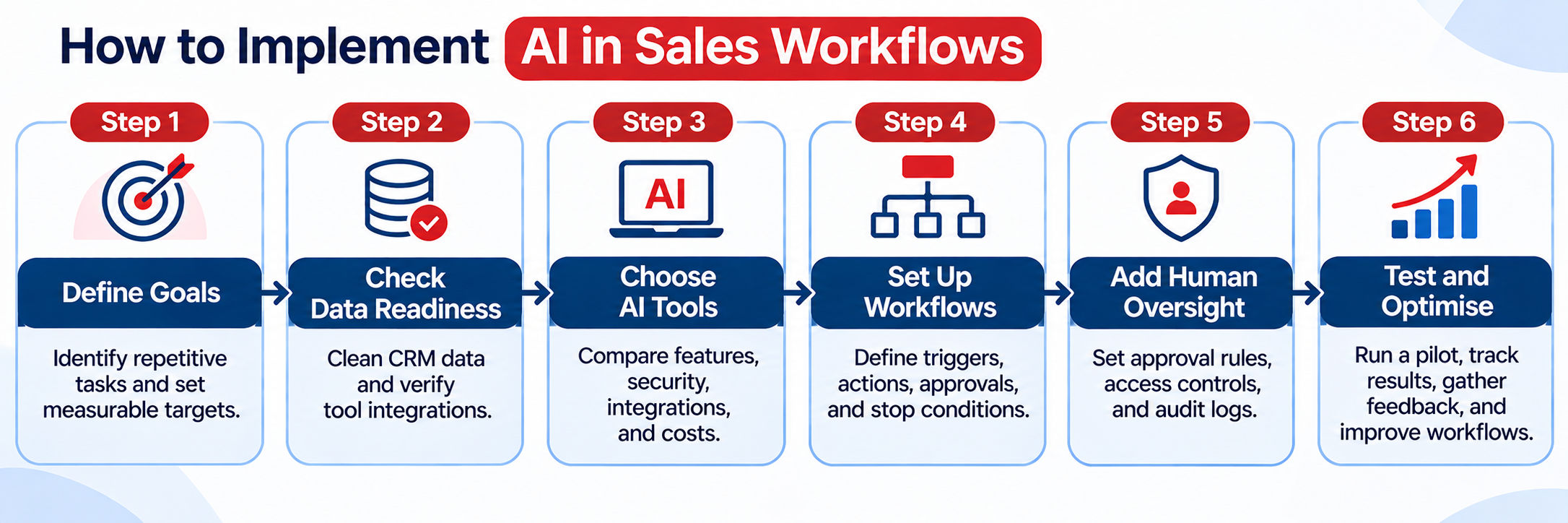
Here is how to implement AI in sales workflows:
Must read: Sales Representative Job Description
Tools for AI in sales fall into three groups. Features and pricing change frequently for each tool, so check current details before you buy.
Category |
Example Tools |
Best For |
AI-powered CRM |
Salesforce, HubSpot, Zoho CRM, Microsoft Dynamics 365 |
Lead scoring, forecasting, CRM updates |
Generative AI and Sales Intelligence |
ChatGPT, Claude, Gong, Clari, Apollo, ZoomInfo, Clay |
Email drafts, call analysis, prospect research |
Automation and Integration |
Zapier, Make, Workato, Outreach, Salesloft |
Connecting apps, automating tasks, managing sales sequences |
Do read: Sales Executive Job Description
You can avoid some common mistakes:
Common Mistake |
What to Do Instead |
| Automating before cleaning data | Clean CRM records first. |
| Starting too big | Begin with one or two workflows. |
| Sending AI drafts without editing | Review and personalise every draft. |
| Skipping sales rep input | Involve reps during implementation. |
| Tracking activity instead of results | Measure meetings, conversions, and revenue. |
| Ignoring privacy rules | Follow data security and privacy policies. |
| Treating AI as a one-time setup | Review and update workflows regularly. |
Conclusion
AI in sales implementation will be successful only if companies give tasks to the right software. Among the tasks where automation and AI could be implemented are lead generation, investigation of potential customers, follow-up, meeting summaries, and forecasting.
However, negotiation process, development of relations and clients’ decision-making need personal approach. Salespeople should start with simple tasks, make an analysis of results and move step-by-step. The main agenda is not to get rid of the human factor but to free people’s time for doing what they actually do.
Yes, AI in sales is not only used by big teams. Small teams usually get fast results due to their lack of systems integration. Begin with the AI functionality which is built into your CRM, such as lead scoring, email templates and call summarization. Choose one process, measure the time saved in a month and implement another one.
Not really, most tools are using simple prompt-based interface integrated into software that is used by sales representatives anyway. The real skill needed here is the ability to identify a bad email template, to think twice about a risky score. A short training session regarding prompt usage and review will be enough.
While the workflow performs steps you prescribe, like score the lead, route it and reply, an AI agent determines what actions should be performed to achieve its goal, e.g. book a meeting with the targeted account. The workflow is deterministic, while the agent is highly adaptive, requiring closer monitoring and proper constraints.
Traditional CRM stores data and relies on reps to enter data into it. AI-powered CRM fills in fields based on emails and phone calls, calculates scores, offers suggestions and forecasts revenues. While the data model remains the same, the difference is in the system’s ability to process your data rather than store it.
Look for native integrations first, as most CRMs already come with AI integrations. Otherwise, you can opt for native integrations, Zapier or Make services, or even the CRM API. Do field mapping prior to doing any integration and run a pilot using just one team while tracking all automation writes.
Use a comparison between the baseline and the pilot period. Hours saved by each representative, speed of responding, conversion rates from lead to meetings, winning rates, and forecast accuracy are tracked. Subtract the cost of the software and its integration. Revenue per rep is the last measure for determining if those saved hours have led to sales.
First and foremost is the poor quality of CRM data, which leads to poor results from models trained on unclean data. Also, there is low adoption among reps, lack of clear ownership, privacy regulations and tools not being integrated, and an unreasonable expectation of quick results. Give yourself several months to fine-tune outputs.
Base the AI on trusted materials like product documentation and pricing. Define what AI can respond about pricing, legalese and future roadmap. Make sure a human checks customer-facing responses. Run tests with tricky prompts and keep errors in a shared prompt log.
Select vendors with clearly defined data processing agreements and without default training on your data. Restrict permissions on a per-role basis, mask personal information wherever possible, and enable audit logs. Review relevant legal guidelines – for example, GDPR or CCPA regulations. Never enter customer details into a publicly available chatbot.
The outcome depends on where the error occurs. The wrong value in the CRM system can be easily fixed. The wrong price in the proposal or a wrong statement in the email can result in losing the deal. Track all automated actions, provide reps with a fast option to report errors and stop the workflow.
Look for increased numbers of agents doing research, outreach, and scheduling, overseen by the representatives. There will also be increased use of AI on the part of the buyer to compare different vendors, which means that there needs to be better information from the seller.
1340 articles published
We are an online education platform providing industry-relevant programs for professionals, designed and delivered in collaboration with world-class faculty and businesses. Merging the latest technolo...
Speak with AI & ML expert
By submitting, I accept the T&C and
Privacy Policy
Top Resources
Master's Degree
18 Months
Executive Diploma
12 Months
IIIT Bangalore
Executive Programme in Generative AI & Agentic AI for LeadersIndia’s #1 Tech University
Dual Certification
5 Months