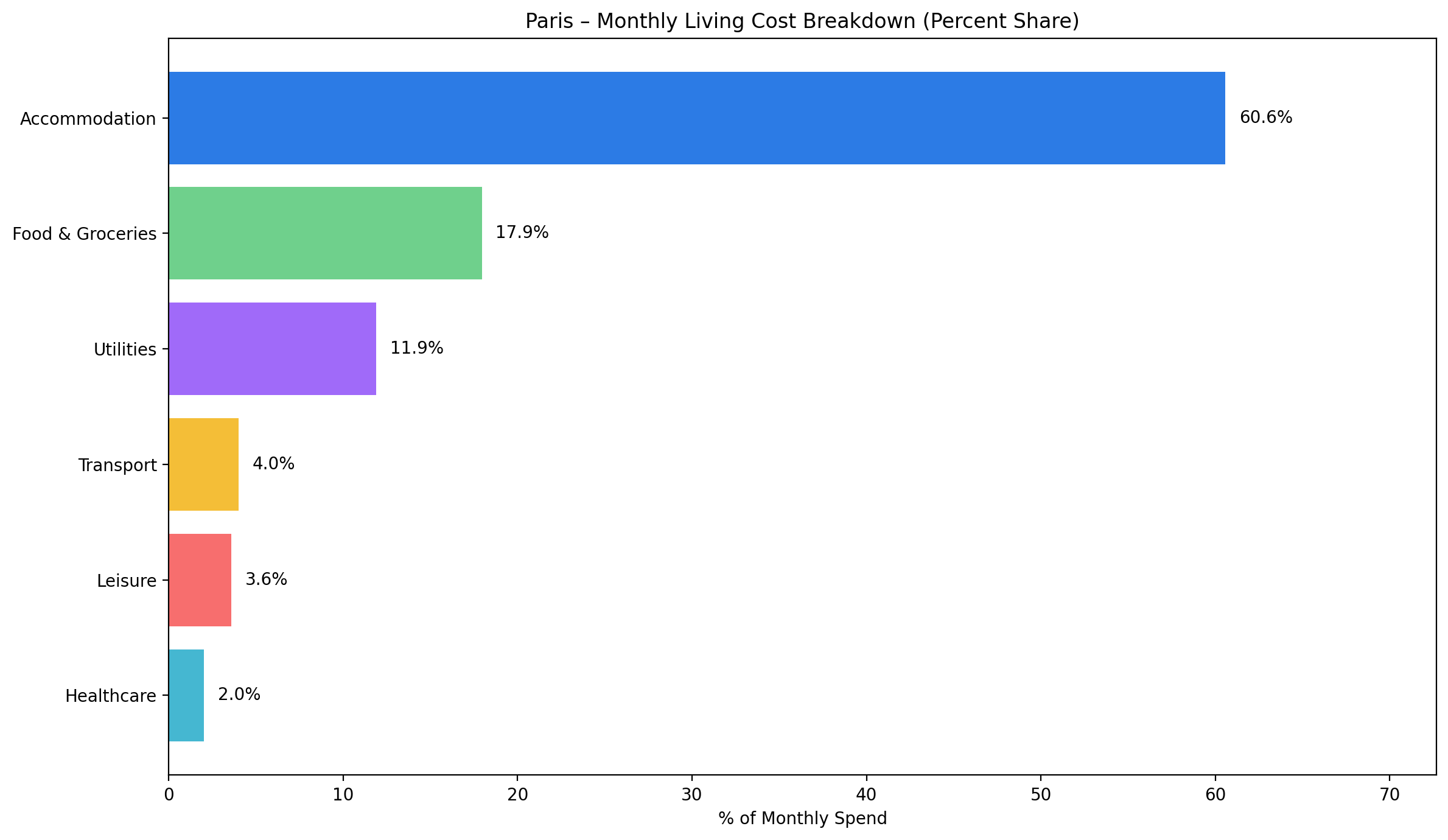
The cost of living in Paris is higher than in most other cities in France, especially when it comes to rent. For students, a monthly budget of around €900–€1,350 (₹98,835–₹1.48 lakh) can be a useful starting range, depending on the type of accommodation, food habits and lifestyle. Campus France also notes that living costs are generally higher in Paris than in other parts of France.
Below is a quick look at the monthly cost of living in Paris:
Accommodation: Around €450–€1,100 (₹49,417–₹1.21 lakh) for options ranging from CROUS housing to a private studio.
Food: Around €200–€350 (₹21,963–₹38,436) per month, depending on shopping and eating habits.
Transport: Around €31–€50 (₹3,404–₹5,491) per month for student-focused transport options.
Other expenses: Utilities, phone, leisure and personal costs can add to the monthly budget.
This article explains the cost of living in Paris for international students, including rent, food, transport, utilities and other everyday expenses.
Plan your budget smartly and explore affordable study options, start your journey to study in France.
Cost of Living in Paris by Profile
The cost of living in Paris for a single person is around €1,400–€2,300 (₹1.54–₹2.53 lakh) per month when rent, food, transport, utilities and personal expenses are included. The actual amount depends mainly on rent.
For a family of four, the monthly cost can reach around €4,000–€6,000 (₹4.39–₹6.59 lakh), especially when renting a larger home in Paris. The rent is one of the biggest expenses in the city.
Cost of Living in Paris for a Single Person
A single person living in Paris can expect to spend about €1,400–€2,300 (₹1.54–₹2.53 lakh) per month. This includes rent for a one-bedroom home, groceries, local transport, utilities, internet and some personal spending. One-bedroom rent is €750–€1,300 (₹82,365–₹1.43 lakh) outside the city centre and €1,200–€2,000 (₹1.32–₹2.20 lakh) in the city centre.
Here is a practical monthly estimate for one person living in Paris:
Please note: Paris is more expensive than many other parts of France, while its current budget guidance puts average food spending in France at about €300 (₹32,945) per month.
Cost of Living in Paris for a Family of Four
A family of four may need around €4,000–€6,000 (₹4.39–₹6.59 lakh) per month in Paris. The biggest cost is usually housing because a family needs a larger home. The three-bedroom apartment costs €1,500–€2,500 (₹1.65–₹2.75 lakh) outside the city centre and €2,500–€3,500 (₹2.75–₹3.84 lakh) in the city centre.
The main monthly expenses for a family of four can look like this:
Expense
Monthly Cost
Monthly Cost in INR
Rent
€1,500–€3,500
₹1.65–₹3.84 lakh
Food and groceries
€600–€900
₹65,890–₹98,835
Transport
€180–€360
₹19,767–₹39,534
Utilities and internet
€200–€300
₹21,964–₹32,945
Personal and leisure expenses
€300–€600
₹32,945–₹65,890
Total monthly cost
€4,000–€6,000
₹4.39–₹6.59 lakh
INR values are approximate and based on €1 ≈ ₹109.82. Numbeo figures are updated market-price data, while the total ranges above are practical planning estimates based on the listed expense categories.
The cost of living in Paris can change based on the arrondissement you choose. Rent is usually higher in central areas and lower in some outer arrondissements.
For example, current 2026 rental estimates range from €24–€50 (₹2,636–₹5,491) per m² per month across the arrondissements listed below. This makes the choice of area important for students and other people planning a monthly budget.
Paris Arrondissement
Monthly Rent Range per m²
Approx. INR per m²
5th Arrondissement
€29–€46 (₹3,185–₹5,052)
₹3,185–₹5,052
6th Arrondissement
€31–€50 (₹3,404–₹5,491)
₹3,404–₹5,491
10th Arrondissement
€26–€45 (₹2,855–₹4,942)
₹2,855–₹4,942
11th Arrondissement
€26–€45 (₹2,855–₹4,942)
₹2,855–₹4,942
13th Arrondissement
€24–€41 (₹2,636–₹4,503)
₹2,636–₹4,503
18th Arrondissement
€24–€41 (₹2,636–₹4,503)
₹2,636–₹4,503
Source: SeLoger
INR conversions are approximate and use €1 ≈ ₹109.82.
Key points:
The 6th arrondissement is among the more expensive options in this list, while the 13th and 18th arrondissements have lower rental ranges. The actual monthly rent will depend on the size and type of the apartment.
For example, a 30 m² apartment could have a base rent of roughly €720–€1,500 (₹79,070–₹1.65 lakh) per month, depending on the arrondissement and property. This shows why choosing the right area can make a big difference to the overall cost of living in Paris.
Accommodation Costs in Paris
Accommodation is the biggest monthly expense for most people living in Paris. A one-bedroom apartment costs around €750–€1,300 (₹82,365–₹1.43 lakh) per month outside the city centre and €1,200–€2,000 (₹1.32–₹2.20 lakh) in the city centre. For students, cheaper options such as CROUS rooms and shared accommodation can bring the rent down.
Below are the Accommodation Costs in Paris:
Type of Accommodation
Monthly Cost
Monthly Cost in INR
CROUS room
€200–€450
₹21,964–₹49,419
Shared accommodation
€400–€800
₹43,928–₹87,856
Private studio
€800–€1,300
₹87,856–₹1.43 lakh
1-bedroom apartment outside city centre
€750–€1,300
₹82,365–₹1.43 lakh
1-bedroom apartment in city centre
€1,200–€2,000
₹1.32–₹2.20 lakh
3-bedroom apartment outside city centre
€1,500–€2,500
₹1.65–₹2.75 lakh
3-bedroom apartment in city centre
€2,500–€3,500
₹2.75–₹3.84 lakh
Source: Numbeo; Campus France
INR conversions are approximate and use €1 ≈ ₹109.82. Numbeo figures are based on its current Paris data.
The total monthly cost of living in Paris is far higher than rent. A single person who pays €750–€2,000 (₹82,365–₹2.20 lakh) for a one‑bedroom apartment will find the total monthly budget climbing to, about €1,400–€2,800 (₹1.54–₹3.07 lakh) once food, transport, utilities and personal expenses are added.
Monthly Food & Grocery Expenses in Paris
A single person can plan around €200–€350 (₹21,964–₹38,437) per month for food and groceries in Paris. The lower end is possible when most meals are cooked at home. Eating out often can push the budget higher. Campus France gives an average food budget of about €300 (₹32,946) per month and notes that food costs are generally higher in Paris than in other French cities.
Here are the latest prices of common food items in Paris:
Food Item
Price Range
Approx. INR
Milk, 1 litre
€1.00–€1.99
₹110–₹219
Bread, 500g
€1.00–€3.75
₹110–₹412
Rice, 1 kg
€2.00–€3.00
₹220–₹329
Eggs, 12
€2.40–€6.00
₹264–₹659
Chicken fillets, 1 kg
€8–€17
₹879–₹1,867
Apples, 1 kg
€2–€4
₹220–₹439
Bananas, 1 kg
€1–€3
₹110–₹329
Tomatoes, 1 kg
€1–€5
₹110–₹549
Potatoes, 1 kg
€1–€2.50
₹110–₹275
Onions, 1 kg
€1–€3
₹110–₹329
Bottled water, 1.5 litres
€0.32–€1.70
₹35–₹187
Source: Numbeo
Eating Out in Paris
Eating out adds more to the monthly food budget. A low-cost restaurant meal in Paris is currently around €12–€22 (₹1,318–₹2,416), while a fast-food meal is around €10–€13 (₹1,098–₹1,428). A three-course meal for two at a mid-range restaurant can cost about €60–€90 (₹6,589–₹9,884).
Eating Option
Price Range
Approx. INR
Inexpensive restaurant meal
€12–€22
₹1,318–₹2,416
Fast-food meal
€10–€13
₹1,098–₹1,428
Cappuccino
€2–€6
₹220–₹659
Mid-range meal for two
€60–€90
₹6,589–₹9,884
Source: Numbeo
Note: A student who eats out a few times a week can spend around €100–€250 (₹10,982–₹27,455) extra, per month depending on how the student eats outside and where the student goes.
Transportation Costs in Paris
Public transport is the way to travel around Paris. The regular Navigo monthly pass costs €90.80 (₹9,971) for all zones in 2026. Students under 26 can use the Imagine R Student Pass, which costs €401.30 (₹44,073) for the 2026–27 school year, including application fees. A single local transport ticket costs around €2.50 (₹275).
For most students and single residents, a monthly transport budget of around €45–€95 (₹4,942–₹10,433) is enough when using a student or regular monthly pass.
Here are the latest Transportation Costs in Paris:
Transport Option
Cost
Approx. INR
One-way local transport ticket
€2.50
₹275
Navigo monthly pass, all zones
€90.80
₹9,971
Imagine R Student Pass, annual
€401.30
₹44,073
Imagine R Student Pass, monthly equivalent
€44.59
₹4,898
Petrol, 1 litre
€1.80–€1.98
₹198–₹217
Source: Numbeo; Île-de-France Mobilités
INR conversions are approximate and use €1 ≈ ₹109.82. Transport fares are based on current 2026 rates.
Note: The monthly equivalent is calculated by dividing the annual student pass by 9 instalments. The actual Imagine R payment schedule and eligibility rules apply.
Utility Bills & Costs in Paris
Utility bills in Paris depend on the size of the home and how much electricity, heating and water you use. For an 85 m² apartment, basic utilities cost around €160–€378 (₹17,571–₹41,493) per month.
Internet and mobile plans can add another €28–€60 (₹3,075–₹6,589). So, a household can plan around €188–€438 (₹20,646–₹48,082) per month for utilities, internet and mobile services.
Utility or Service
Monthly Cost
Approx. INR
Basic utilities for 85 m² apartment
€160–€378
₹17,571–₹41,493
Mobile phone plan
€8–€20
₹879–₹2,196
Home internet
€20–€40
₹2,196–₹4,393
Total utilities, internet and mobile
€188–€438
₹20,646–₹48,082
Source: Numbeo
Utility Costs for Students in Paris
Students living in a shared apartment usually pay less because electricity, heating, water and internet costs are split between the people living there. A student living alone should keep around €80–€180 (₹8,786–₹19,767) per month for utilities, internet and mobile costs, depending on the home and usage.
Expense
Monthly Cost
Approx. INR
Electricity, heating and water
€50–€120
₹5,491–₹13,178
Internet
€20–€40
₹2,196–₹4,393
Mobile phone
€8–€20
₹879–₹2,196
Total
€78–€180
₹8,566–₹19,767
Source: Numbeo; Campus France
INR conversions are approximate and use €1 ≈ ₹109.82. Utility prices are based on the latest September 2026 Paris data.
Healthcare Costs in Paris
Healthcare costs in Paris depend on the type of treatment and your health insurance coverage. The registration is free. Students can apply through the foreign-student registration website after they arrive in France. Non-EU students need to provide documents such, as their passport, proof of enrolment and valid residence permit.
For a student, a separate monthly healthcare budget is not usually very high if they have French health coverage. A practical amount of around €20–€50 (₹2,196–₹5,491) per month can be kept for medicines, small medical expenses and any part of treatment that is not covered.
Healthcare Expense
Approx. Cost
Approx. INR
Monthly healthcare budget for a student
€20–€50
₹2,196–₹5,491
Basic medicine and pharmacy expenses
€10–€30
₹1,098–₹3,295
Complementary health insurance
€15–€40/month
₹1,647–₹4,393/month
Source: Assurance Maladie; Numbeo
Health Insurance for International Students in Paris
International students need to register for French social security to get health coverage. The registration is free. Students can apply through the official foreign-student registration website after they arrive in France. Non-EU students need to provide documents such as their passport, proof of enrolment and valid residence permit.
Students can also choose complementary health insurance, often called mutuelle. It can help cover some costs that are not fully paid by the French health insurance system.
Healthcare Coverage
Cost
Approx. INR
French student social security registration
Free
₹0
Complementary health insurance
€15–€40/month
₹1,647–₹4,393/month
Suggested monthly healthcare budget
€20–€50
₹2,196–₹5,491
Source: Assurance Maladie
INR conversions are approximate and use €1 ≈ ₹109.82. Healthcare costs can vary based on treatment, insurance and reimbursement rules.
Cost of Studying in Paris
The cost of studying in Paris depends on the university, course and student status. At public universities, tuition is much lower for French and EU students. For non-EU students, the standard national fees for 2026–27 are €2,902 (₹3.19 lakh) per year for a Bachelors degree and €3,950 (₹4.34 lakh) for a Masters degree. Some universities offer full or partial fee exemptions, so non-EU students may pay less.
Tuition Fees by Study Level
Public universities in Paris have basic national tuition fees. This is because the French government covers a part of the cost. Non‑EU students may have to pay fees unless Non‑EU students qualify for an exemption.
Study Level
French/EU/EEA/Swiss Students
Non-EU Students
Bachelors degree
€178 (₹19,550) per year
€2,902 (₹3.19 lakh) per year
Masters degree
€255 (₹28,045) per year
€3,950 (₹4.34 lakh) per year
Engineering degree
€630 (₹69,180) per year
€2,902–€3,950* (₹3.19–₹4.34 lakh)
PhD
€398 (₹43,710) per year
€398 (₹43,710) per year
Source: Campus France; French Ministry of Higher Education
Note: Engineering fees can differ by institution and programme. Some engineering schools have their own rates. Non-EU doctoral students are not subject to the differentiated tuition fees.
Top 5 Universities in Paris and Their Fees
Paris has several well-known universities and higher education institutions. The fee can be very different from one institution to another, especially for private or specialised programmes.
The table below shows the 2026–27 tuition position for five major institutions.
University
Study Level
2026–27 Tuition Fees
Sorbonne University
Bachelors / Masters
€178 / €255 (₹19,550 / ₹28,045) for national fees; non-EU differentiated fees may apply
Université Paris Cité
Bachelors / Masters
€178 / €255 (₹19,550 / ₹28,045) for national fees; exemptions may apply
Université Paris-Saclay
Bachelors / Masters
€178 / €255 (₹19,550 / ₹28,045) for national fees
Université PSL
Varies by programme
Fees vary by programme and institution
Sciences Po
Bachelors / Masters
€14,900 / €20,640 (₹16.36 lakh / ₹22.67 lakh) for students with tax residence outside the EEA
INR conversions are approximate and use €1 ≈ ₹109.82. Tuition fees are for the 2026–27 academic year and can change based on the programme, student status and available exemptions.
Hidden Costs of Living in Paris
Rent, food and transport are not the only expenses in Paris. Students may also spend money on phone bills, internet, fitness, entertainment, clothes and small daily purchases. These costs may look small at first, but they can add up over the month.
Campus France also advises students to plan for food, healthcare, transport, insurance and everyday expenses before moving to France.
Here are some common hidden costs to keep in mind:
Expense
Approximate Cost
Approx. INR
Mobile phone plan
€8–€20/month
₹879–₹2,196
Internet
€20–€40/month
₹2,196–₹4,393
Gym membership
€25–€60/month
₹2,746–₹6,589
Cinema ticket
€10–€15
₹1,098–₹1,647
Fitness or sports activities
€12–€25
₹1,318–₹2,746
Jeans
€50–€130
₹5,491–₹14,277
Summer dress
€30–€70
₹3,295–₹7,687
Running shoes
€80–€140
₹8,786–₹15,375
Source: Numbeo, Paris, 2026
INR conversions are approximate and use €1 ≈ ₹109.82. Actual costs can vary based on the area, provider and personal spending habits.
Budgeting Tips to Reduce the Cost of Living in Paris for Indian Students
Paris can be expensive for Indian students, but a few simple choices can help lower the monthly budget. Rent is usually the biggest expense, so choosing affordable student housing can make a big difference. Cooking at home, using student transport passes and making use of student discounts can also help.
Here are some simple ways Indian students can reduce the cost of living in Paris:
Choose student accommodation: CROUS residences are usually cheaper than private rentals. Campus France says student residence rent in Paris is around €450 (₹49,419) per month, while some public university residences can cost €200–€300 (₹21,964–₹32,946) for a standard room.
Share your accommodation: Sharing an apartment can help split rent, electricity, internet and other household costs. This can be useful for students who want to stay in Paris without paying for a private studio.
Cook more often: Eating at home is usually cheaper than eating out. Buying groceries and cooking Indian meals at home can help keep food spending under control.
Use student transport: Students should check the available student transport plans instead of buying individual tickets every day. Campus France lists a student-rate annual Paris transport subscription at €374.40 (₹41,115).
Use student discounts: Students in France can get discounts on transport, cultural activities, food and other services. Always carry your valid student ID when visiting places that offer student prices.
Limit eating out: An inexpensive restaurant meal in Paris can cost around €12–€22 (₹1,318–₹2,416). Having restaurant meals often can quickly increase your monthly budget.
Track small expenses: Coffee, snacks, online shopping and weekend activities may not seem expensive on their own. But these small payments can add up. Keeping a simple monthly spending list can help students see where their money is going.
Look for housing close to your university: A cheaper room far from campus may not always save money if you spend more on transport and travel time. Compare rent and transport costs together before choosing a place.
Keep an emergency amount: Indian students should keep some money aside for unexpected expenses such as medical needs, travel, replacing a phone or buying study materials. This amount should be separate from the regular monthly budget.
Conclusion
The cost of living in Paris can be high, but Indian students can manage it with a clear monthly budget. Around €1,000–€1,350 (₹1.10–₹1.48 lakh) per month is a useful starting budget for many students, depending mainly on rent and lifestyle. Campus France also gives a higher average of around €1,350 (₹1.48 lakh) per month for student expenses in Paris, including housing, food, transport and social activities.
Rent is usually the biggest expense, so choosing affordable student housing or sharing an apartment can help reduce the total cost. Cooking at home, using student transport discounts and keeping track of small daily expenses can also make a big difference.
Before moving to Paris, students should also keep some extra money for healthcare, insurance, study costs and unexpected expenses. With proper planning, students can enjoy life in Paris without putting too much pressure on their monthly budget.
A net salary of around €3,000–€3,500 (₹3.29–₹3.84 lakh) per month can support a fairly comfortable lifestyle for one person. The amount you need depends mainly on rent and your daily spending. Someone sharing accommodation may manage well on less than a person renting a private apartment in central Paris.
2. Is Paris costly than India?
Yes, Paris is generally much more expensive than India, especially for housing, restaurants and daily services. The difference can be large when rent is included. However, the exact cost depends on the Indian city you compare with Paris and your lifestyle.
3. How much money do you need to live in Paris?
A single person can expect to spend around €1,400–€2,300 (₹1.54–₹2.53 lakh) per month including rent, depending on the type and location of accommodation. Students sharing a flat or staying in student housing may spend less. Living alone in central Paris can push the budget higher.
What is the monthly cost of living in Paris France for a student?
A student in Paris should generally plan around €1,000–€1,350 (₹1.10–₹1.48 lakh) per month for living expenses. Campus France currently estimates an average student budget of about €1,350 (₹1.48 lakh) per month in Paris, including housing, food, transport and social activities.
Is the cost of living in Paris high compared with other French cities?
Yes, Paris is usually more expensive than other French cities, mainly because of housing. A student budget can be around €1,350 (₹1.48 lakh) per month in Paris compared with about €940 (₹1.03 lakh) in the rest of France, according to current Campus France figures. Rent is usually the biggest reason for this difference.
How much does it cost to live in Paris for an Indian student?
An Indian student can plan for around €1,000–€1,350 (₹1.10–₹1.48 lakh) per month, depending on accommodation and lifestyle. Students living with roommates can reduce their housing costs, while private accommodation can take up a much larger share of the budget. Campus France currently places the average Paris student budget at around €1,350 (₹1.48 lakh) per month.
Is Paris more expensive than the USA?
It depends on the US city being compared. Paris can be cheaper than some very expensive US cities, particularly when housing costs are considered. A comparison with New York, Los Angeles or another major city can give a very different result from a comparison with a smaller US city.
What is the cost of living in Paris vs USA for students?
The difference depends on the city and university. Paris can be a more affordable option than some major US cities, while other US locations may have lower living costs. Students should compare rent, food, transport, healthcare and tuition before choosing between the two.
Can you live in Paris on €2,000 a month?
Yes, €2,000 (₹2.20 lakh) per month can be enough for one person with careful planning. It is easier if you share accommodation or find lower-cost student housing. Renting an expensive apartment alone can make this budget difficult.
What is the cheapest way to live in Paris as a student?
Housing is usually the first place to look for savings. Students can consider CROUS residences, shared flats or rooms instead of private studios. Cooking at home, walking when possible and using student transport options can also reduce regular spending.
11. Can Indian students afford to live in Paris?
Yes, but students need to plan their finances before moving. A budget of around €1,000–€1,350 (₹1.10–₹1.48 lakh) per month can be a useful starting point for a student, depending on rent and lifestyle. Keeping some extra money for emergencies is also a good idea.
Do utility costs fluctuate significantly across seasons in Paris?
Yes. Winter heating increases monthly utility bills toward €300–€380 (INR 31.8K–40.3K), especially in older apartments. Summer bills drop due to limited cooling needs. Residents in newer buildings with better insulation experience more stable monthly utility patterns.
12. How do childcare or schooling choices impact a family’s monthly cost of living?
Private schools, childcare centres, extracurriculars, and commuting make family budgets rise quickly. Choosing residential arrondissements or nearby suburbs often reduces transport and childcare costs, keeping family spending predictable month to month.
13. How can residents reduce expenses without compromising quality of life in Paris?
Using budget supermarkets, cooking at home, choosing colocation, and relying on the Navigo pass help control expenses. This brings the average cost of living in Paris into a more manageable range for students and working residents.
Ireland( study abroad expert) |50 articles published
Honey Gupta is a leading consultant with over 10 years of experience in helping students navigate the complexities of studying overseas, with a specialized focus on Ireland. Honey brings a wealth of a...
Refer Your Friend & Earn upto ₹15000
Help your friend upgrade to a Global Career and earn rewards together.