What Is Rolling Wave Planning: How It Works, Examples & Implementation
By Sriram
Updated on Sep 09, 2026 | 11 min read | 6.96K+ views
Share:

All courses
Certifications
More
By Sriram
Updated on Sep 09, 2026 | 11 min read | 6.96K+ views
Share:
Table of Contents
Key Highlights
Learn practical management skills that can help you lead teams, handle projects, and advance your career with online MBA programs.
Popular MBA Programs
Rolling wave planning is an iterative project management technique where you plan a project step-by-step. You plan the current work in detail and plan future work later when you have more information.
The core idea behind the technique is you cannot plan everything correctly early because with time the requirements change and information becomes more clear as the project progresses.
To instead of creating a detailed timeline for project in the start, do this:
Free Courses
These two terms are closely related but not identical. One is a broader concept, and the other is a specific technique.
Aspect |
Progressive Elaboration |
Rolling Wave Planning |
| Meaning | The general principle of refining project details as more information becomes available | A specific scheduling technique that applies progressive elaboration to work planning |
| Type | Concept or principle | Defined technique or method |
| Structure | Informal and ongoing, happens whenever new information comes | Formal and structured |
| Detail Pattern | Details increase throughout the project lifecycle | Near-term work is planned in detail, while future work remains high-level until its wave arrives |
| Relationship | The underlying principle or reason | A practical way to apply progressive elaboration |
Also read: Project Manager Skills: The 8 Most Important Ones
MBA Courses to upskill
Explore MBA Courses for Career Progression
O.P.Jindal Global University
MBA (with Career Acceleration Program by upGrad)Become interview ready with Career Services
PSB MBA + IIML Certification
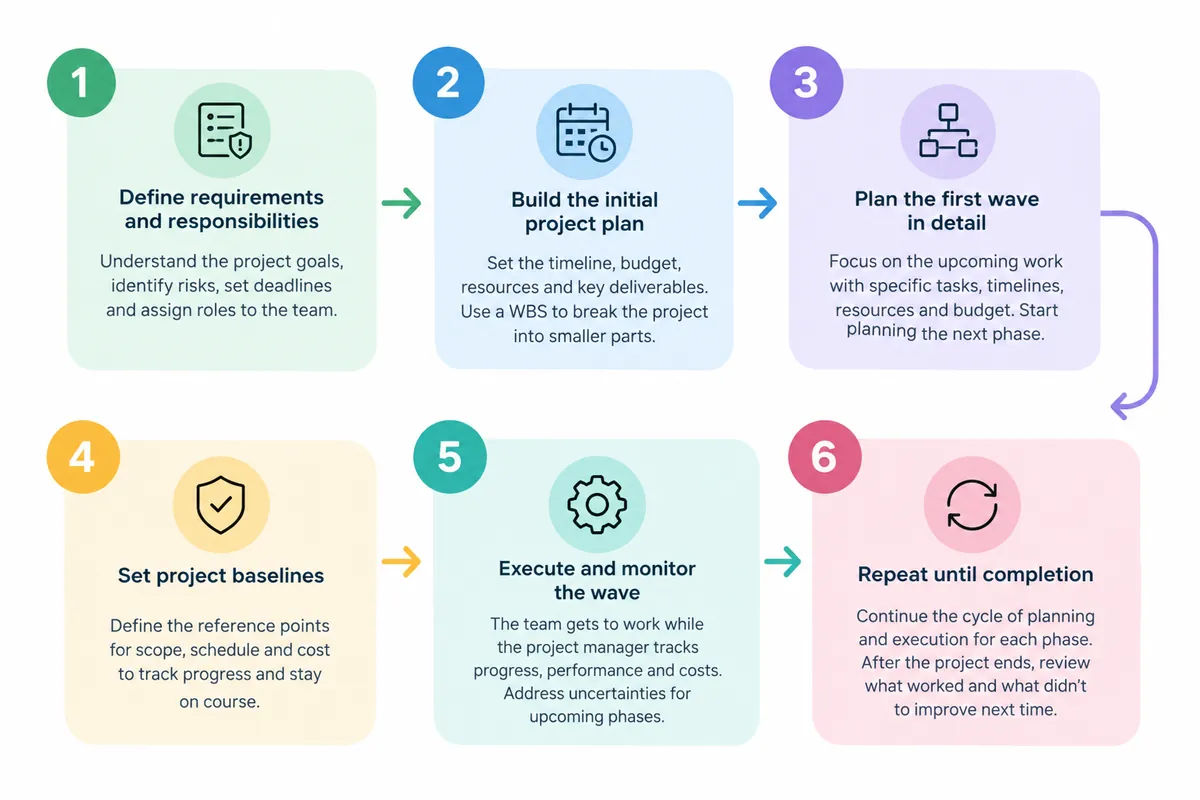
MBA from Paris School of Business with Certification from IIM LucknowThe rolling wave planning divides the complete project planning process into smaller stages. It allows teams to add more detail as the project progresses.
Check the project closely, and find uncertainties, dependencies that could affect the scope, timeline, or resources. Some risks are obvious early on, others only show up as the project moves forward.
This step matters because it tells you how far ahead you can realistically plan in detail. If there's a lot of uncertainty, you'll want to keep your detailed planning window shorter.
Write down the key facts about your project. This includes your budget, the resources you have available, what stakeholders expect from the outcome, and any regulatory or technical limits you need to work within. These constraints act as guardrails, they shape what's realistic at every stage of planning.
Decide how you'll break the project timeline into waves. Figure out how long each wave should be and where the boundaries fall. Line these waves up with your existing phases, sprints, or release cycles. This structure becomes the backbone that the rest of the process runs on, so it's worth getting right early.
Set a high-level schedule, budget, and scope for the entire project. This baseline needs to be precise enough that you can track progress against it and report on it to stakeholders. At the same time, it needs to stay flexible enough to absorb the detail you'll add wave by wave, without needing constant rework.
Move forward with the wave that's currently active. Use its detailed task breakdown, resource assignments, and timeline to guide the work. While this wave is underway, later waves stay at a summary level, they're not planned in depth yet, since their turn hasn't come.
As each wave wraps up, gather what you've learned along the way, new information, changed requirements, feedback from stakeholders. Use those lessons to plan the next wave in detail, the same way you did with the one before it. Keep repeating this cycle, wave after wave, until the entire project is complete.
Also read: Top 10 Types of Project Management Organizational Structures
Suppose a company is building a new mobile application. At the start of a project, the team knows the goal but they do not have all the information about the stages. So, they use rolling wave planning to plan the project gradually.
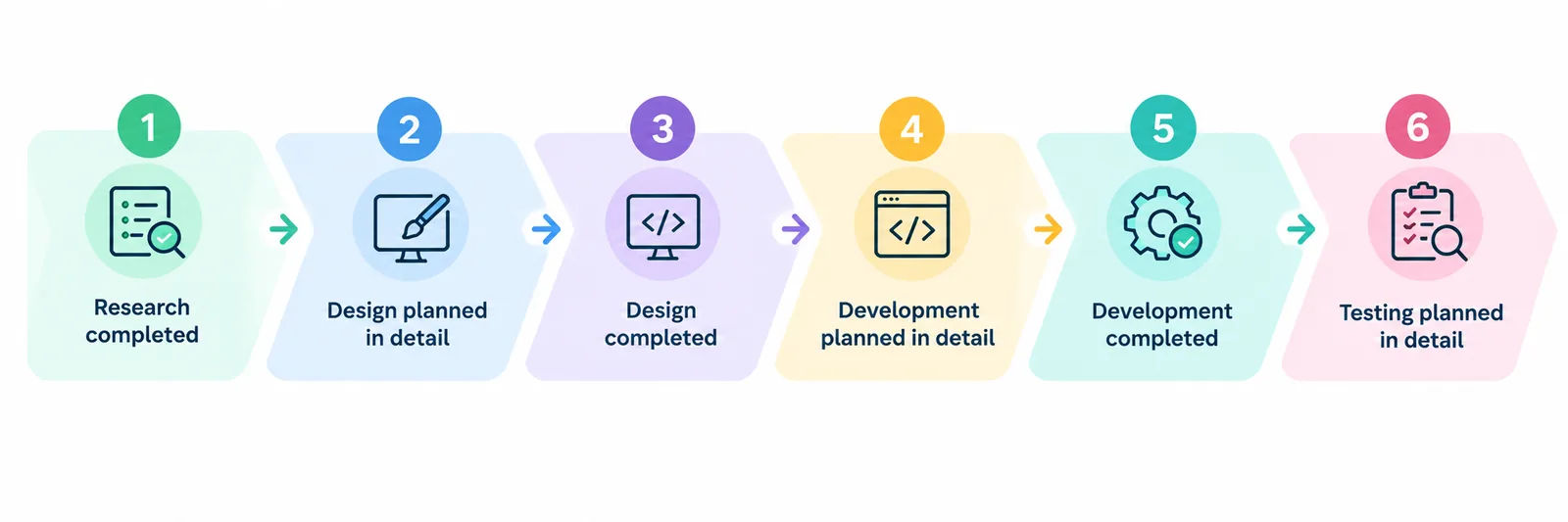
The project manager outlines the major phases of the project:
Here all the phases are clear, but the detailed plan is only created for phase 1.
The team starts their research and requirements, they defined their tasks, assign team members, set clear deadlines, and more.
The research phase is done and the team has a clear understanding about the app requirements. Now, they will move to the design phase like creating user interface, design task, timelines, individual responsibilities.
Once the design phase is completed, the team will use new information to create a plan for the development phase. This same process will be followed for testing and launch.
This process continues until the application is launched. By planning immediate work in detail and refining the future work with time. This gives time to the team to adapt to the changing requirements. No need to rebuild the plan in detail every time.
Also read: Top Project Management Case Studies with Real-World Solutions 2026
A strong rolling wave plan must be responsive to change without losing the goal. The execution works best when you check your plan and do the changes as new information comes in.
Also read: What is Project Management Process: Phases and Life Cycle
By using the rolling wave planning, the teams can handle uncertainty in projects. The project is planned as it progresses, and it helps because early assumptions cannot make a long-term plan successful.
By planning in waves, the teams can accurately do their tasks without wasting effort in every detail that is going to change with time. The best way for rolling wave planning is to keep a clear baseline for the complete project, and do regular check-ins with your team and stakeholders.
No. Rolling wave planning is a planning technique that can be used in Agile, Waterfall, or hybrid projects. Agile focuses on iterative product delivery, while rolling wave planning focuses on progressively detailing future work.
It works well for complex, innovative, long-term, or uncertain projects where all requirements cannot be defined at the beginning, such as software development, product development, construction, and research projects.
The approach requires frequent reviews and updates, which can take additional time. It may also make long-term resource allocation and cost estimation more challenging.
Yes. Although Waterfall projects follow sequential phases, rolling wave planning can still be used when future phases cannot be planned accurately at the start.
The project manager typically manages the planning process. However, team members, stakeholders, subject matter experts, and other key participants provide information needed to develop upcoming plans.
Early estimates may be less precise because future work is not fully defined. Estimates can become more accurate as additional details and information become available.
There is no fixed schedule. Updates can happen at the end of a phase, before a new wave begins, or whenever significant changes affect the project.
Yes. As work becomes clearer, teams can identify dependencies between tasks and phases more accurately, helping them coordinate upcoming activities.
No. It can be managed using spreadsheets, documents, or project management software. However, software can make it easier to update schedules, assign tasks, and track changes.
Regular planning cycles encourage frequent communication with stakeholders. Their feedback can be incorporated into upcoming work before detailed plans are finalized.
Yes. It can work with fixed deadlines as long as the overall timeline is established early. The detailed activities within future phases can then be refined without changing the final deadline.
722 articles published
Sriram K is a Senior SEO Executive with a B.Tech in Information Technology from Dr. M.G.R. Educational and Research Institute, Chennai. With over a decade of experience in digital marketing, he specia...
Speak with MBA expert
By submitting, I accept the T&C and
Privacy Policy
From MBA to Dream Job - Explore Our Alumni Success Stories
Top Resources
Master's Degree
12 Months
Master's Degree
13 Months
O.P.Jindal Global University
MBA (with Career Acceleration Program by upGrad)Become interview ready with Career Services
Master's Degree
12 Months