Systematic Literature Review: Meaning, Steps & How to Write One?
By upGrad
Updated on Oct 11, 2026 | 3 min read | 2K+ views
Share:

All courses
Certifications
More
By upGrad
Updated on Oct 11, 2026 | 3 min read | 2K+ views
Share:
Table of Contents
Want to learn strong research skills? Explore top management courses online and learn valuable business and analytical concepts.
Popular Management Programs
A systematic literature review (SLR) refers to an approach to collect, analyze, and summary of information on one’s topic based on the available research. This kind of study helps the researchers in finding reliable information to answer their research questions, thereby focusing on the topic information.
The systematic literature review is quite different from the normal literature review as it is systematic and involves a particular process of conducting research.
Features of the Systematic Literature Review:
Ready to lead tech and AI-driven teams? Enroll in our Chief Technology Officer & AI Leadership Programme and build future-ready leadership skills.
Free Courses
A systematic literature review enables researchers to evaluate the existing knowledge in a field systematically. It increases the credibility of the research, improves transparency, and enhances future research by providing a reliable source of information.
Key reasons why a systematic literature review is necessary:
Also Read: Best AI Tools for Research
A systematic literature review implies a set of clearly defined steps necessary to achieve a valid, verifiable, and unbiased result. Each part of the review has a specific purpose, and all components are equally essential in completing the task.
Research components of a systematic literature review include:
A systematic literature review is a process of collating, appraisal, and analyzing research to generate information on a specific field.
Below are the steps of conducting a systematic literature review:
Explore More: Research Methodology Courses Online
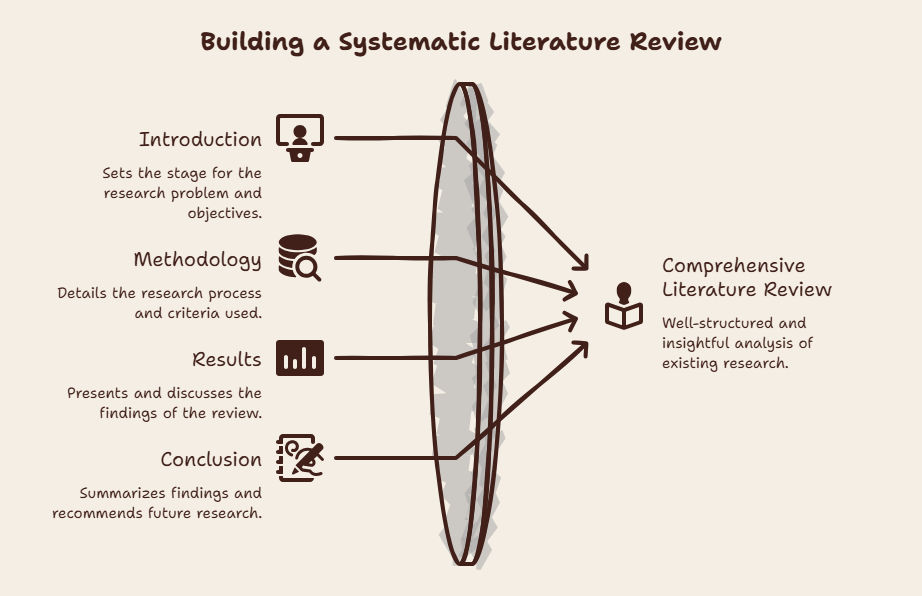
In order to write a systematic literature review, it requires a clear and well-organized format. There is a specific role for each part that helps to organizing the entire research process and findings.
Here are the main sections of a systematic literature review:
Conclusion
The systematic review of literature is an excellent research technique, which allows the researcher to gather and analyze information from various sources. By following certain steps, people can identify the gaps in the research, increase the quality of research, and achieve results.
All the steps of performing a systematic literature review are of equal importance, and it is necessary to follow the entire process of doing a systematic literature review in order to write an effective research paper.
If you want an expert guidance for your academic and career goals? Schedule a free counseling session with our experts and get personalized advice on the right course and career path.
Systematic literature review refers to the research technique that entails conducting a systematic search, evaluation, and synthesis of scholarly articles and research articles concerning a certain topic to address the posed research question.
In order to learn about the process of conducting a systematic literature review, one needs to go through a series of steps. These steps include developing the research question, conducting a search for studies, choosing the appropriate sources, and data extraction and analysis.
If you want to know, how to write the introduction of a systematic literature review, you can begin by defining your research problem and question. Furthermore, you will write the review’s methodology, results, discussion, and conclusion sections in accordance with your paper’s requirements.
The 7 steps of a systematic review are as follows:
The 5 steps of a systematic literature review are as follows:
The 7 steps in writing a literature review are as follows:
The difference between literature review and systematic literature review is that a traditional literature review provides a general summary of a topic, while a systematic review follows a structured method to answer a specific research question. A systematic review is more detailed, transparent, and evidence-based.
The main difference between systematic literature review and literature review concerns the research strategy. Whereas systematic reviews require a more formal approach to research, a traditional review is a more flexible type of a review that can take multiple forms. Consequently, systematic reviews are normally considered to be more trustworthy than conventional literature reviews.
Systematic literature review methodology refers to protocols and methods used when doing a systematic review. The methodology generally covers such aspects as research question, database selection, search strategy, the inclusion and exclusion criteria, screening procedures, and data analysis plans.
An illustrative example of a systematic literature review could involve a study that aims to examine the effectiveness of online learning and course completion rates among college students.
Systematic literature review Cochrane refers to systematic reviews performed by the Cochrane organization that conducts systematic reviews on a regular basis. This particular type of database is primarily utilized in medical and healthcare fields due to its systematic nature.
1020 articles published
We are an online education platform providing industry-relevant programs for professionals, designed and delivered in collaboration with world-class faculty and businesses. Merging the latest technolo...
Get Free Consultation
By submitting, I accept the T&C and
Privacy Policy
Top Resources
Certification
3 Months
Certification
6 Months
O.P. Jindal Global University
Masters in International Accounting and Finance (Accredited by ACCA, UK)Master's Degree
12 Months