Risk Breakdown Structure (RBS): Definition, Benefits, and How It Improves Project Risk Management
By Sriram
Updated on Jul 07, 2026 | 10 min read | 7.3K+ views
Share:

All courses
Certifications
More
By Sriram
Updated on Jul 07, 2026 | 10 min read | 7.3K+ views
Share:
Table of Contents
Every project comes with uncertainty. Some risks affect cost. Others delay schedules, reduce quality, or create compliance issues. If these risks aren't identified early, they become much harder to manage. That's why a risk breakdown structure is one of the most useful tools in project risk management. It helps teams organize risks into logical categories so nothing important gets overlooked.
This blog explains what a risk breakdown structure is, why it's important, how it works, and the steps to create one. You'll also explore key categories, practical examples, and comparisons with other risk management tools.
Build your project management expertise with upGrad's Project Management and MBA courses. Learn how to create an effective risk breakdown structure, strengthen your risk management skills, and make better project decisions through flexible online programs designed by leading universities and industry experts.
Popular MBA Programs
A risk breakdown structure (RBS) is a hierarchical framework that organizes project risks into categories and subcategories based on their source. Instead of using a long, unstructured list, it groups related risks together, making them easier to identify, analyze, assign, and manage. This structured approach improves risk visibility and keeps project risk management organized as the project grows.
A simple way to understand it
Instead of listing every possible issue in one place, you organize them into categories.
Risk Category |
Example Risks |
| Technical | Software failure, design defects |
| Financial | Budget overruns, rising material costs |
| Operational | Resource shortages, equipment failure |
| External | Weather delays, government regulations |
Most projects use a tree-like hierarchy.The top level represents the entire project.
Each lower level breaks risks into smaller categories until individual risk events are identified.
A simple hierarchy might look like this.
Large organizations often reuse the same RBS framework across similar projects. That creates consistency and makes lessons learned much easier to apply.
Also read : Performance Management System: Complete Guide
Free Courses
A risk breakdown structure organizes project risks into a clear hierarchy, making them easier to identify, analyze, and manage. Understanding its key components helps teams build an RBS that is structured, practical, and easy to maintain throughout the project.
Component |
Description |
| Risk Categories | Broad groups that classify risks based on their source and form the foundation of the RBS. |
| Risk Subcategories | Divide each risk category into smaller groups for more detailed risk identification and analysis. |
| Individual Risk Events | Specific risks that could affect the project's objectives, schedule, cost, or quality. |
| Hierarchical Numbering | Organizes categories and subcategories using a numbering system for easier navigation, reporting, and tracking. |
| Appropriate Level of Detail | Includes enough detail to identify meaningful risks without making the structure overly complex or difficult to manage. |
Also Read: Why Organizational Skills Matter in the Workplace and How to Improve Them
MBA Courses to upskill
Explore MBA Courses for Career Progression
O.P.Jindal Global University
MBA (with Career Acceleration Program by upGrad)Become interview ready with Career Services
PSB MBA + IIML Certification
MBA from Paris School of Business with Certification from IIM LucknowMost risk breakdown structure models group risks into broad categories that can be customized for different projects. The exact categories vary by industry, but the following are the most common.
Risk Category |
Typical Examples |
| Technical | Software bugs, design errors, equipment failures, cybersecurity issues |
| Project Management | Scope changes, schedule delays, poor planning, communication gaps |
| Financial | Budget overruns, inflation, funding shortages, vendor cost increases |
| Operational | Resource shortages, process failures, supply chain disruptions |
| External | Weather, regulatory changes, economic or political events |
| Organizational | Leadership changes, restructuring, conflicting priorities |
| Legal & Regulatory | Compliance issues, licensing requirements, contract disputes |
| Environmental & Safety | Workplace accidents, environmental hazards, safety violations |
Turn your project management into stronger business leadership capabilities. Explore upGrad's MBA in Business and Law from O.P. Jindal Global University to build expertise in strategy, decision-making, and people management while preparing for leadership roles across industries.
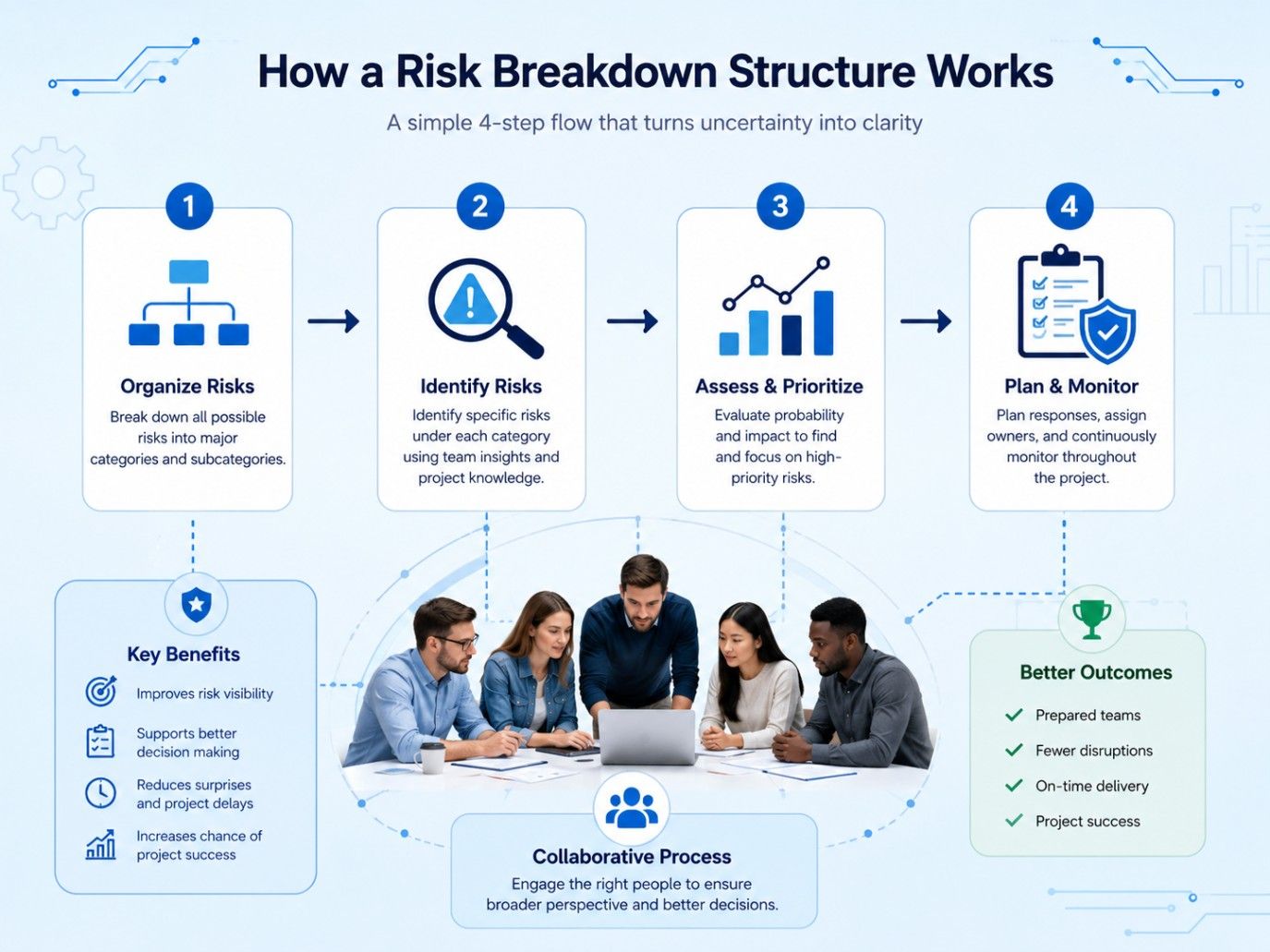
Creating a risk breakdown structure (RBS) doesn't require complex software or templates. Follow these simple steps to organize project risks and build a strong foundation for effective risk management.
Understand Project Objectives
Review the project's scope, goals, and constraints to identify potential risk areas.
Gather the Right Team
Involve project managers, technical experts, finance, operations, and key stakeholders.
Identify Potential Risks
Brainstorm risks that could affect the project's cost, schedule, quality, or scope.
Group Similar Risks
Organize identified risks into categories such as technical, financial, operational, and external.
Build the Hierarchy
Arrange categories and subcategories in a clear, logical tree structure.
Review with Stakeholders
Validate the RBS to identify missing, duplicate, or unclear risks.
Review and revise the RBS whenever project scope, requirements, or risks change.
Also Read: Why Organizational Skills Matter in the Workplace and How to Improve Them
Creating a risk breakdown structure is only the first step. Its real value comes from using it throughout the project instead of filing it away after the planning phase.
An RBS should guide discussions, support decision-making, and make risk management more consistent from start to finish.
Risk identification becomes much easier when the team reviews one category at a time.
Instead of asking a broad question like "What could go wrong?", ask focused questions for each category.
For example:
This structured approach usually uncovers risks that would otherwise be missed.
Not every risk deserves the same level of attention.
Once risks have been identified, evaluate them based on their likelihood and potential impact.
Projects often classify risks as:
Priority |
Description |
| High | Requires immediate planning and monitoring |
| Medium | Needs regular review and response planning |
| Low | Monitor periodically throughout the project |
Prioritization helps project managers focus resources where they'll have the greatest effect.
Many people confuse an RBS with a Risk Register.
They aren't the same.
The RBS identifies and organizes risks. The Risk Register stores detailed information about each risk, including:
Think of the RBS as the roadmap and the Risk Register as the detailed record.
Project status meetings become much clearer when risks are reported by category.
Instead of reviewing dozens of unrelated issues, stakeholders can quickly understand where the greatest exposure exists.
New risks appear while existing risks disappear.
Review the RBS during:
Keeping the structure current helps the team respond before issues become problems.
Also Read: Organizational Behavior Model: Comprehensive Guide to Understanding and Application
Subscribe to upGrad's Newsletter
Join thousands of learners who receive useful tips
Starting from a blank page isn't always easy.
That's why many project teams use a simple template as a starting point. The template provides a clear structure while leaving enough flexibility to adapt it to different industries and project types.

Several project management tools deal with risk.
They often work together, but they don't serve the same purpose.
Understanding the differences helps teams choose the right tool at the right time.
These two frameworks look similar because both use hierarchical structures.
Their purpose is completely different.
Risk Breakdown Structure |
Work Breakdown Structure |
| Organizes project risks | Organizes project work |
| Focuses on uncertainty | Focuses on deliverables |
| Supports risk management | Supports project planning |
| Groups risk sources | Breaks work into tasks |
The RBS identifies and classifies risks.
The Risk Register records detailed information about each identified risk.
Risk Breakdown Structure |
Risk Register |
| Categorizes risks | Documents individual risks |
| Tree structure | Spreadsheet or database |
| Used during identification | Used throughout risk management |
They complement each other rather than compete.
A Risk Matrix evaluates risks after they've been identified.
The RBS helps identify them first.
Risk Breakdown Structure |
Risk Matrix |
| Organizes risks | Prioritizes risks |
| Classification tool | Assessment tool |
| Used early | Used after identification |
Risk assessment is a broader process.It includes identifying, analyzing, evaluating, and responding to risks.The RBS supports only one part of that process.
Think of it as one important piece rather than the entire system.
Also Read: Types of Organisational Structure: A Complete Guide for Modern Businesses
A risk breakdown structure in project management helps teams identify, organize, and manage project risks using a hierarchical framework. Instead of maintaining a long list of unrelated risks, it groups them into categories, making it easier to analyze potential issues and plan appropriate responses.
Project managers typically create an RBS during the planning phase as part of the risk management process. It serves as a foundation for building the Risk Register, assigning risk owners, assessing probability and impact, and developing mitigation strategies.
How an RBS Supports Project Management :
A risk breakdown structure example helps you understand how risks are organized across different project types. While the hierarchy stays the same, the risk categories and examples vary based on the project's scope, industry, and objectives.
Project Type |
Risk Categories |
Example Risks |
| Generic Project | Technical, Financial, Operational, External | System failures, Integration issues, Budget overruns, Cost inflation, Resource shortages, Process failures, Regulatory changes, Market conditions |
| Software Development Project | Requirements, Development, Testing, Infrastructure, Security, Deployment | Changing user needs, Coding defects, Incomplete test coverage, Server outages, Data breaches, Release failures |
| Construction Project | Site, Equipment, Contractor, Material Supply, Safety, Environmental, Legal | Site hazards, Equipment failure, Contractor delays, Material shortages, Safety incidents, Environmental risks, Legal compliance issues |
| Agile Project | Sprint Planning, Backlog, Team Availability, Technical Debt, Integration, Customer Feedback | Sprint delays, Backlog changes, Resource availability, Technical debt, Integration issues, Customer feedback changes |
There's no universal template that fits every project. The best RBS is the one that accurately reflects your project's sources of uncertainty.
Following a few best practices helps keep your risk breakdown structure practical, organized, and useful throughout the project.
Avoiding these common mistakes helps keep your risk breakdown structure accurate and useful throughout the project.
A risk breakdown structure (RBS) is the foundation of effective risk management. It organizes risks into clear categories, making it easier to identify, prioritize, assign ownership, and monitor risks throughout the project, helping teams stay proactive instead of reacting to unexpected issues.
Every project follows a similar sequence.
Stage |
Purpose |
| Project Planning | Define objectives, scope, and constraints |
| Risk Breakdown Structure | Organize risks into categories |
| Risk Identification | List potential project risks |
| Risk Register | Document each identified risk |
| Risk Analysis | Evaluate probability and impact |
| Risk Response Planning | Decide how each risk will be managed |
| Risk Monitoring | Track risks and update response plans |
If the RBS misses an entire category, such as legal or supplier risks, those issues are less likely to appear in the Risk Register. That weakens the entire risk management process.
Also Read: Top 10 Management Skills Required to Become a Successful Manager
The project manager usually leads the process, but building an accurate structure requires input from people across the project. Different stakeholders identify different types of risks.That's why collaboration matters.
Roles and responsibilities
Role |
Responsibility |
| Project Manager | Leads RBS creation and coordinates workshops |
| Risk Manager | Reviews risk categories and validates completeness |
| Technical Experts | Identify technical and engineering risks |
| Finance Team | Identify budget and cost-related risks |
| Procurement Team | Highlight supplier and contract risks |
| Legal Team | Review compliance and regulatory risks |
| Project Sponsor | Approves the overall risk approach |
| Stakeholders | Provide operational and business insights |
For example, a finance manager might identify funding risks that developers never considered. Likewise, an engineer may spot technical dependencies that aren't visible to procurement teams.
Also read : What are the Different Types of MBA Courses? Master’s of Business Administration
A risk breakdown structure should be updated whenever significant project changes occur. Regular reviews help keep risks relevant and improve decision-making throughout the project.
Reviewing the RBS at key project milestones keeps it accurate and aligned with the project's current risks.
Also read : Performance Management System: Complete Guide
Every project involves uncertainty, but a risk breakdown structure (RBS) helps teams identify, categorize, and manage risks in a structured way. Whether used in software, construction, or business projects, it improves planning, communication, and decision-making throughout the project lifecycle.
By reviewing and updating the RBS regularly, teams can identify emerging risks early and respond proactively. Over time, it becomes a valuable framework for reducing uncertainty, improving project outcomes, and minimizing costly delays or unexpected setbacks.
Ready to start your journey? Book a free consultation with upGrad today to find the best path for your career.
A Risk Breakdown Structure (RBS) organizes risks into categories based on their source, making them easier to identify and analyze. A Risk Register records detailed information about each identified risk, including its probability, impact, owner, response plan, and current status. Both tools work together but serve different purposes.
Not every project requires a detailed RBS. Small projects with limited complexity may only need basic risk categorization, while large or high-risk projects benefit from a structured framework that improves risk identification, communication, and planning throughout the project lifecycle.
Yes. Agile teams use a Risk Breakdown Structure to organize risks related to sprint planning, technical debt, changing requirements, and team availability. Since Agile projects evolve quickly, the RBS should be reviewed and updated regularly during sprint reviews or major releases.
There isn't a fixed number of levels. Most projects use three to four levels, starting with broad risk categories and then breaking them into more specific subcategories. The structure should remain detailed enough to support analysis without becoming difficult to manage.
A Risk Breakdown Structure is widely used in construction, software development, engineering, manufacturing, healthcare, finance, and infrastructure projects. Any industry managing complex projects can use an RBS to identify risks systematically and improve project planning.
Yes. An RBS should reflect the project's objectives, industry, and complexity. While common categories such as technical, financial, and operational risks provide a starting point, organizations often add project-specific categories to address unique business or regulatory requirements.
Once the RBS is complete, teams identify individual risks, document them in the Risk Register, assess their probability and impact, assign ownership, develop response plans, and monitor them throughout the project. The RBS serves as the foundation for these activities.
An RBS gives project managers a clear view of where risks originate and which areas need attention. By organizing risks into logical categories, it becomes easier to prioritize mitigation efforts, allocate resources effectively, and make informed project decisions.
A Risk Breakdown Structure classifies risks based on their source, while a Risk Matrix evaluates identified risks according to their likelihood and impact. The RBS helps identify and organize risks first, and the Risk Matrix helps prioritize them afterward.
A Risk Breakdown Structure can be created using spreadsheet tools, diagramming software, or project management platforms. Many teams build RBS diagrams in Microsoft Excel, Microsoft Visio, Lucidchart, Miro, or project management software that supports hierarchical structures.
An effective Risk Breakdown Structure is simple, logical, and easy to update. It includes clear categories, avoids overlapping risks, reflects the project's scope, and provides enough detail to support risk identification without making the structure unnecessarily complex.
722 articles published
Sriram K is a Senior SEO Executive with a B.Tech in Information Technology from Dr. M.G.R. Educational and Research Institute, Chennai. With over a decade of experience in digital marketing, he specia...
Speak with MBA expert
By submitting, I accept the T&C and
Privacy Policy
From MBA to Dream Job - Explore Our Alumni Success Stories
Top Resources
Master's Degree
12 Months
Master's Degree
13 Months
O.P.Jindal Global University
MBA (with Career Acceleration Program by upGrad)Become interview ready with Career Services
Master's Degree
12 Months