9 Real-Life Machine Learning Examples and Applications
By upGrad
Updated on Oct 12, 2026 | 6 min read | 24.35K+ views
Share:

All courses
Certifications
More
By upGrad
Updated on Oct 12, 2026 | 6 min read | 24.35K+ views
Share:
Interested in learning how machine learning works? Explore real-world ML applications, and build practical skills with Machine Learning Courses Online. Start your journey towards a career in AI and machine learning now!
Popular AI Programs
To understand machine learning, think about how your email detects spam. You do not have to tell it about every spam message. It learns from old emails and finds patterns that show which messages are spam.
This is how machine learning helps computers to learn from data and to make better predictions.
Machine learning (ML) is a part of artificial intelligence (AI) where computer systems learn from data and improve their predictions without needing instructions for every task.
For example, a machine learning system can study past data to guess customer behaviour, detect fraud, or recommend products.
Machine learning follows a simple process. The computer learns from data, finds patterns, and uses them to make predictions.
But, good data is very important for good results. If the data is old, incomplete, or biased, the model may also give poor results.
Free Courses
Machine learning is actually part of many tools and services that we use every day. Here are some real-life examples of machine learning that show how ML helps businesses.
Have you ever noticed Netflix suggesting a show you might like or Spotify making a playlist for you? These are examples of machine learning recommendation systems.
They study the past activity, such as what people watch, listen, or buy. They can also look at what other users with similar interests enjoy. Based on this data, the system suggests content or products that may interest the user.
Examples include:
Social media platforms also use machine learning to decide what to show on users' feeds. The system looks at the activity, such as the posts people like, share, comment on, or watch.
It uses this information to show content that people enjoy. ML can also help platforms suggest new accounts, detect spam, and find harmful content.
Some Real Life Examples:
Image recognition is another real life example of machine learning. It helps computers understand what is shown in a picture. It can identify faces, objects, animals, and other details in images.
For example, your phone can use face recognition to unlock the device, Google Photos can group photos of the people or pets in them.
Other examples include:
Natural language processing (NLP) helps computers understand human language. It is used in many tools that we use every day.
Real Life Examples are:
NLP can also help with summarising documents, creating text, and writing code.
Virtual assistants use machine learning to understand what people say and give useful answers. When you ask Siri, Alexa, or Google Assistant a question, ML helps the system understand your words and respond.
For example, when you say “Call Mom,” the system can understand who you mean and calls that person.
Examples include:
Learn more with: Difference between AI Assistant and ChatBot
Banks and payment companies use machine learning to find unusual or doubtful transactions. The system learns what normal spending looks like and looks for activity that is looking different.
For example, ML can flag a transaction because of an unusual location, amount, device, or merchant. This helps banks detect possible fraud quickly and reduce financial losses.
Real Life Example:
Mastercard’s Decision Intelligence system helps banks check around 143 billion transactions each year. Its newer AI tools can check transactions in less than 50 milliseconds. Mastercard also reported that its early tests showed an average 20% improvement in fraud detection.
Machine learning helps apps like Google Maps and Waze predict traffic and travel time. These apps use live location data and past traffic patterns to understand how busy roads are.
They can also suggest the best route and give an estimated travel time using ML. It can also learn how traffic on one road affects nearby roads.
Also Read: How to Implement Machine Learning Steps: A Complete Guide
Another important example of machine learning is the healthcare sector to help doctors find health problems faster. It can study medical images and patient data and find signs of different diseases.
Examples include:
These tools support doctors and not replace them. Doctors still need to check the results and make the final decision.
Self-driving cars are the latest example of machine learning. ML is used to understand what is happening around the cars and to make driving decisions. They use data from cameras, radar, and lidar to detect things such as cars, people, and road lanes.
The system can then predict what other vehicles or people can do to choose a safe path. All of this happens in real time.
Self-driving cars are already being used in some places in the world. For example, Waymo reported around 500,000 paid rides each week across 10 US cities in March 2026. This shows how machine learning is moving from testing to real-world use.
Are you a working professional and want to accelerate your career? Enroll now in NIRF ranked Ex. Diploma in Machine Learning & AI.
AI Courses to upskill
Explore Artificial Intelligence Courses for Career Progression
There are four main types of machine learning which basically differ in how they learn from data and how much labelled data they need.
This model learns from labelled data, where the input is matched with the correct answer. It uses these examples to learn patterns and make predictions.
Supervised learning is used in business for tasks like:
Unsupervised machine learning works with unlabelled data. Instead of being given the right answers, the model looks at the data and finds patterns or groups on its own.
Some good examples are:
In Semi-supervised learning it uses a small amount of labelled data along with a larger amount of unlabelled data. It is useful when labelling data takes a lot of time or costs a lot of money.
Some common examples are:
This model works on a trial and error basis. The system gets a reward when it makes a good choice and a penalty when it makes a bad one. Over time, it learns which actions lead to better results.
Some real life examples:
Also Read: Types of Regression Models in Machine Learning You Should Know About
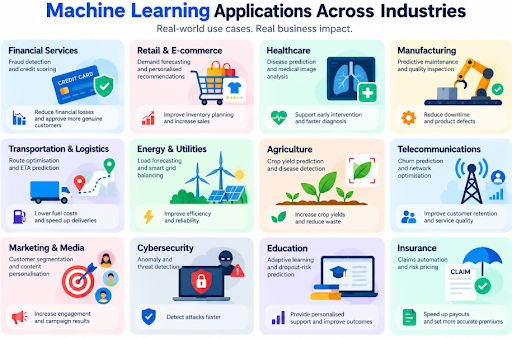
Machine learning is used in many industries to solve different business problems. It can help businesses reduce costs, manage risks, improve customer experiences, and make better decisions.
The table below shows some common machine learning applications in industries:
Industry |
Machine Learning Use Case |
Business Use |
| Financial Services | Fraud detection and credit scoring | Reduce financial losses and approve more genuine customers |
| Retail & E-commerce | Demand forecasting and personalised recommendations | Improve inventory planning and increase sales |
| Healthcare | Disease prediction and medical image analysis | Support early intervention and faster diagnosis |
| Manufacturing | Predictive maintenance and quality inspection | Reduce downtime and product defects |
| Transportation & Logistics | Route optimisation and ETA prediction | Lower fuel costs and speed up deliveries |
| Energy & Utilities | Load forecasting and smart grid balancing | Improve efficiency and reliability |
| Agriculture | Crop yield prediction and disease detection | Increase crop yields and reduce waste |
| Telecommunications | Churn prediction and network optimisation | Improve customer retention and service quality |
| Marketing & Media | Customer segmentation and content personalisation | Increase engagement and campaign results |
| Cybersecurity | Anomaly and threat detection | Detect attacks faster |
| Education | Adaptive learning and dropout-risk prediction | Provide personalised support and improve outcomes |
| Insurance | Claims automation and risk pricing | Speed up payouts and set more accurate premiums |
Gain more knowledge by reading: Types of Algorithms in Machine Learning: Uses and Examples
Final Thoughts
Want to start your AI-ML journey? Book a free consultation with upGrad today to find the best courses and path for your career.
A spam filter is one of the simplest examples of machine learning. It learns from old emails that were marked as spam or not spam and finds patterns in them. It then uses these patterns to identify new emails that may be spam. This helps the system sort emails without needing separate instructions for every new message.
Artificial intelligence (AI) is the larger concept of making computers perform tasks that normally need human intelligence. Machine learning (ML) is one part of AI that helps computers learn from data and improve their results over time. For example, a recommendation system can use machine learning to study user activity and suggest products, shows, or songs.
The four main types of machine learning are:
These types differ in how the model learns from data and receives feedback.
Yes, Netflix uses machine learning to recommend movies and shows to users. The system studies things such as what you watch and the content you choose to skip or continue watching. It can also learn from the viewing habits of users with similar interests. Netflix then uses this information to suggest content that you may enjoy.
Machine learning can help doctors and healthcare teams study large amounts of medical data. It can find patterns in medical images, predict health risks, and identify possible signs of diseases.
Some examples are:
These tools support doctors in their work, but doctors still review the results and make the final decisions.
Yes. Voice assistants like Siri, Alexa, and Google Assistant use machine learning to understand spoken language and respond to users. For example, when you give a command such as “Play XYZ song,” the system needs to understand your words and what you want it to do. It can then carry out the request or give you an answer.
No. Deep learning is a type of machine learning, so the two terms do not mean exactly the same thing. Deep learning uses neural networks with many layers to learn from large amounts of data. It is commonly used for:
In simple words, deep learning is a more specialized part of machine learning.
You do not always need coding skills to understand or use basic machine learning tools. Some platforms offer low-code or no-code features that make it easier to work with ML.
But, if you want to build and train your own machine learning models, coding skills are usually important. You may need knowledge of:
Machine learning depends heavily on the quality of its data. If the data is old, incomplete, or biased, the model can give poor or unfair results.
Some models can also be difficult to understand, especially when it is not clear why they made a particular prediction. This is why important ML systems need:
This is especially important when machine learning is used in areas such as healthcare, finance, and self-driving cars.
Machine learning can automate some tasks and change the way many jobs are done. It can handle repetitive work, analyse large amounts of data, and support decision-making. At the same time, machine learning is creating demand for new skills in areas such as:
So, machine learning can change many jobs and the skills needed for a task rather than replacing all jobs.
1022 articles published
We are an online education platform providing industry-relevant programs for professionals, designed and delivered in collaboration with world-class faculty and businesses. Merging the latest technolo...
Speak with AI & ML expert
By submitting, I accept the T&C and
Privacy Policy
Top Resources
Master's Degree
18 Months
Executive Diploma
12 Months
IIIT Bangalore
Executive Programme in Generative AI & Agentic AI for LeadersIndia’s #1 Tech University
Dual Certification
5 Months