Merge Sort in C++: Algorithm, Code, and Everything You Need to Know
By Rahul Singh
Updated on Jun 04, 2026 | 10 min read | 6.16K+ views
Share:

All courses
Certifications
More
By Rahul Singh
Updated on Jun 04, 2026 | 10 min read | 6.16K+ views
Share:
Table of Contents
Merge sort is one of those algorithms that every C++ programmer should know about it. It is fast, reliable, and built on a concept called divide and conquer, where you break a big problem into smaller ones, solve each part, and combine the results. Whether you are sorting a list of names, exam scores, or millions of records, merge sort handles it efficiently.
In this blog, you will learn exactly how merge sort works, see a complete merge sort C++ program with a line-by-line walkthrough, understand its time and space complexity, compare it with other sorting methods, and know when to actually use it. By the end, you will be comfortable writing merge sort code from scratch.
Ready to go beyond algorithms and start building real-world AI solutions? Explore upGrad’s Artificial Intelligence Courses to learn machine learning, generative AI, and cutting-edge technologies through hands-on projects and practical applications.
Popular upGrad Programs
Merge sort follows a three-step process: divide, conquer, and merge.
Here is the simple version of what happens:
This keeps repeating until every sub-array has just one element. A single-element array is already sorted by definition. Then the merge step builds the final sorted result.
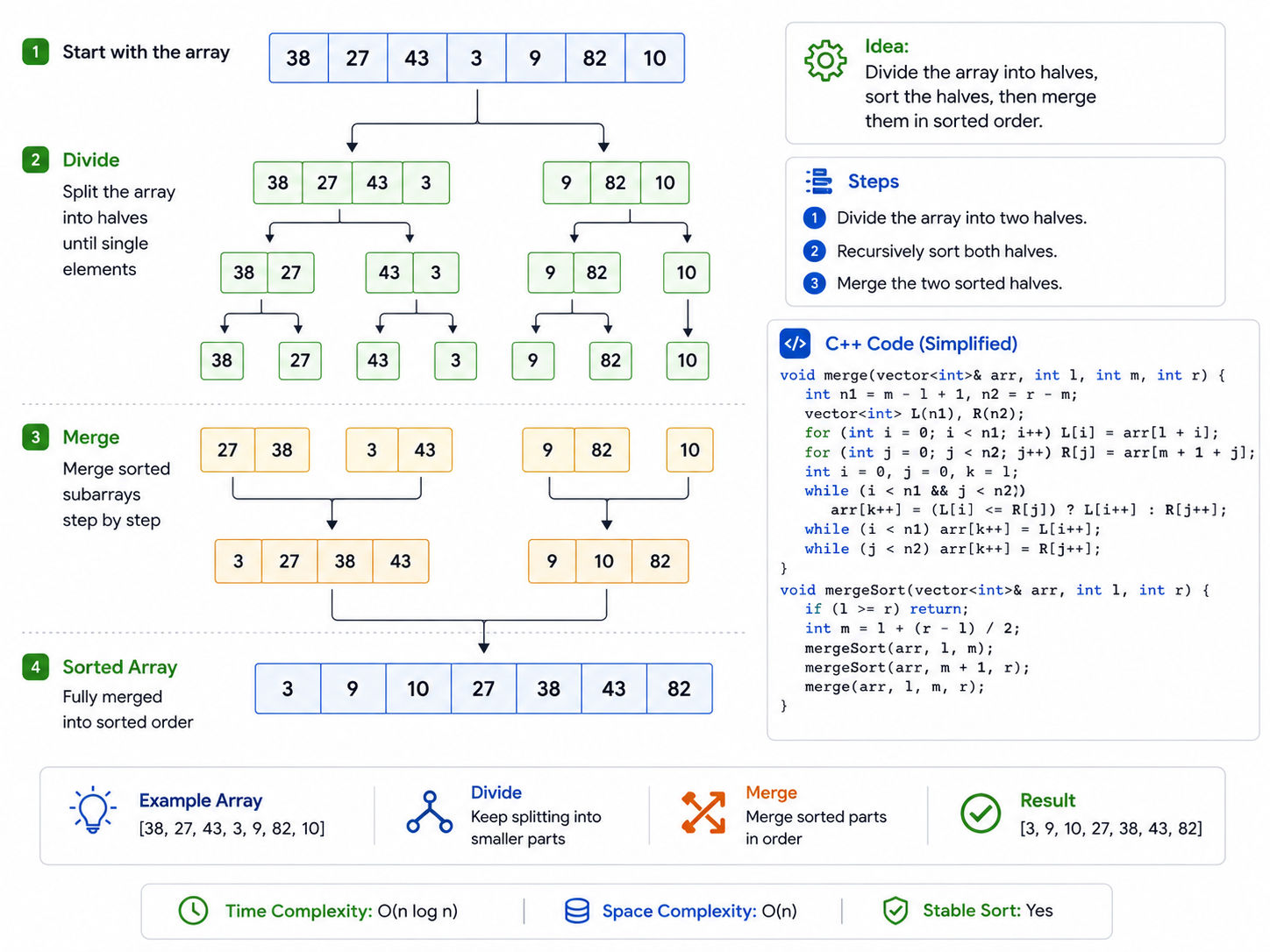
The merge step is the heart of the algorithm. Dividing is just preparation. The real work is in merging two already-sorted arrays into one.
Free Courses
Here is a complete, working merge sort C++ program. Read through the comments as you go.
#include <iostream>
using namespace std;

// Merges two sorted subarrays: arr[left..mid] and arr[mid+1..right]
void merge(int arr[], int left, int mid, int right) {
   int n1 = mid - left + 1;  // Size of left subarray
   int n2 = right - mid;     // Size of right subarray

   // Temporary arrays
   int L[n1], R[n2];

   // Copy data into temp arrays
   for (int i = 0; i < n1; i++)
       L[i] = arr[left + i];
   for (int j = 0; j < n2; j++)
       R[j] = arr[mid + 1 + j];

   int i = 0, j = 0, k = left;

   // Merge L and R back into arr
   while (i < n1 && j < n2) {
       if (L[i] <= R[j]) {
            arr[k] = L[i];
            i++;
       } else {
            arr[k] = R[j];
            j++;
       }
       k++;
   }

   // Copy remaining elements of L, if any
   while (i < n1) {
       arr[k] = L[i];
       i++; k++;
   }

   // Copy remaining elements of R, if any
   while (j < n2) {
       arr[k] = R[j];
       j++; k++;
   }
}

// Main merge sort function
void mergeSort(int arr[], int left, int right) {
   if (left < right) {
       int mid = left + (right - left) / 2; // Avoid overflow

       mergeSort(arr, left, mid);       // Sort left half
       mergeSort(arr, mid + 1, right);  // Sort right half
       merge(arr, left, mid, right);    // Merge both halves
   }
}

// Utility function to print array
void printArray(int arr[], int size) {
   for (int i = 0; i < size; i++)
       cout << arr[i] << " ";
   cout << endl;
}

int main() {
   int arr[] = {38, 27, 43, 3, 9, 82, 10};
   int n = sizeof(arr) / sizeof(arr[0]);

   cout << "Original array: ";
   printArray(arr, n);

   mergeSort(arr, 0, n - 1);

   cout << "Sorted array:  ";
   printArray(arr, n);

   return 0;
}
Output:
Original array: 38 27 43 3 9 82 10
Sorted array: 3 9 10 27 38 43 82
Function |
Purpose |
| mergeSort() | Recursively divides the array |
| merge() | Compares and merges two sorted halves |
| printArray() | Displays the array |
The mid = left + (right - left) / 2 formula is used instead of (left + right) / 2 to avoid integer overflow when left and right are large numbers. This is a common trick used in production code.
Also Read: Data Structures and Algorithms (DSA)
Recommended Courses to upskill
Explore Our Popular Courses for Career Progression
IIIT Bangalore
Executive Diploma in Machine Learning and AI360° Career Support
O.P.Jindal Global University
MBA from O.P.Jindal Global UniversityLive Case Studies and Projects
Understanding complexity helps you decide when merge sort is the right tool. Here is a quick breakdown:
Case |
Time Complexity |
When It Happens |
| Best Case | O(n log n) | Array is already sorted |
| Average Case | O(n log n) | Random order |
| Worst Case | O(n log n) | Array is in reverse order |
This is what makes merge sort special. Unlike quicksort, merge sort always runs in O(n log n) regardless of input order. There are no bad cases.
Type |
Complexity |
| Auxiliary Space | O(n) |
Merge sort needs extra memory to store temporary arrays during the merge step. This is its main drawback. For very large datasets where memory is tight, this matters.
The array is split log n times (since you keep halving). At each level of splitting, you do O(n) work during merging. Multiply them and you get O(n log n).
Knowing when to use merge sort means understanding where it stands against other options.
Algorithm |
Best Case |
Average Case |
Worst Case |
Stable |
In-Place |
| Merge Sort | O(n log n) | O(n log n) | O(n log n) | Yes | No |
| Quick Sort | O(n log n) | O(n log n) | O(n²) | No | Yes |
| Bubble Sort | O(n) | O(n²) | O(n²) | Yes | Yes |
| Insertion Sort | O(n) | O(n²) | O(n²) | Yes | Yes |
| Heap Sort | O(n log n) | O(n log n) | O(n log n) | No | Yes |
A stable sort keeps equal elements in their original order. If two students have the same score, stable sort preserves who came first. Merge sort is stable. Quicksort and heap sort are not.
Use merge sort when:
Avoid merge sort when:
Also Read: Insertion Sort Algorithm in Data Structures
Merge sort is actually the preferred algorithm for sorting linked lists. Here is why: linked lists do not support random access, so algorithms like quicksort that rely on index-based swaps perform poorly. Merge sort only needs sequential access and pointer manipulation, making it a natural fit.
The logic is similar but adapted for nodes:
#include <iostream>
using namespace std;

struct Node {
   int data;
   Node* next;
   Node(int val) : data(val), next(nullptr) {}
};

// Split list into two halves
void splitList(Node* head, Node** left, Node** right) {
   Node* slow = head;
   Node* fast = head->next;

   while (fast != nullptr && fast->next != nullptr) {
       slow = slow->next;
       fast = fast->next->next;
   }

   *left = head;
   *right = slow->next;
   slow->next = nullptr;
}

// Merge two sorted linked lists
Node* mergeSorted(Node* a, Node* b) {
   if (!a) return b;
   if (!b) return a;

   if (a->data <= b->data) {
       a->next = mergeSorted(a->next, b);
       return a;
   } else {
       b->next = mergeSorted(a, b->next);
       return b;
   }
}

// Merge sort for linked list
void mergeSort(Node** head) {
   if (*head == nullptr || (*head)->next == nullptr) return;

   Node* left;
   Node* right;

   splitList(*head, &left, &right);
   mergeSort(&left);
   mergeSort(&right);
   *head = mergeSorted(left, right);
}

void printList(Node* head) {
   while (head) {
       cout << head->data << " ";
       head = head->next;
   }
   cout << endl;
}

int main() {
   Node* head = new Node(5);
   head->next = new Node(2);
   head->next->next = new Node(8);
   head->next->next->next = new Node(1);
   head->next->next->next->next = new Node(4);

   cout << "Original: ";
   printList(head);

   mergeSort(&head);

   cout << "Sorted:  ";
   printList(head);

   return 0;
}
Output:
Original: 5 2 8 1 4
Sorted: 1 2 4 5 8
Also Read: Understanding While Loop in Python with Examples
Even experienced programmers trip up here. Watch out for these:
1. Using (left + right) / 2 for mid calculation This causes integer overflow with large indices. Always use left + (right - left) / 2.
2. Off-by-one errors in index ranges The left subarray is arr[left..mid] and the right is arr[mid+1..right]. Getting these boundaries wrong silently corrupts results.
3. Forgetting to copy remaining elements After the main merge loop, one subarray might still have elements left. You need those two while loops at the end to copy them over.
4. Not accounting for extra memory If you are solving a memory-constrained problem, merge sort might not be ideal. Always factor in the O(n) auxiliary space.
5. Confusing merge sort with quick sort Both use divide and conquer, but the key difference is: merge sort divides blindly and merges carefully. Quick sort partitions carefully and merges trivially (no actual merge step).
Also Read: Insertion Sort in Java: Explained with Examples
Merge sort is a fundamental algorithm that every serious C++ programmer needs to understand. It gives you guaranteed O(n log n) performance in all cases, it is stable, and it handles edge cases gracefully. Yes, it uses extra memory, but in most real-world scenarios, that trade-off is worth it.
Start by understanding the divide-and-conquer idea. Then study the merge step closely, because that is where the algorithm does its real work. Once you can write the merge sort C++ program from memory and explain why each line is there, you have a real edge in both interviews and production coding.
Want personalized guidance on AI and upskilling? Speak with an expert for a free 1:1 counselling session today.
Merge sort is a divide-and-conquer sorting algorithm. It splits an array into two halves, recursively sorts each half, and then merges them back in sorted order. The merging step is where the comparisons happen and the final sorted output is built.
Merge sort always runs in O(n log n) time, whether the input is sorted, reversed, or random. This consistency is one of its biggest advantages over quicksort, which can degrade to O(n²) in the worst case.
Yes, merge sort is a stable sorting algorithm. Elements with equal values maintain their original relative order throughout the sort. This matters when sorting objects by multiple fields, like sorting students first by grade and then by name.
Merge sort requires O(n) auxiliary space for the temporary arrays used during the merge step. This extra memory usage is its main drawback compared to in-place algorithms like quicksort or heap sort.
Merge sort always runs in O(n log n) and is stable but uses O(n) extra space. Quicksort is usually faster in practice due to better cache performance and runs in O(n log n) on average, but it can hit O(n²) in the worst case and is not stable by default.
Yes. An iterative (bottom-up) merge sort is possible. You start by merging subarrays of size 1, then size 2, then 4, and so on, doubling each time until the whole array is sorted. This avoids recursion stack overhead and can be more memory-efficient.
Linked lists do not support random access, so algorithms that rely on index-based swapping (like quicksort) are slow on them. Merge sort only needs sequential traversal and pointer changes, making it the standard choice for sorting linked lists efficiently.
The correct formula is mid = left + (right - left) / 2. Avoid using (left + right) / 2 directly because it can cause integer overflow when left and right are very large values, which is a common bug in competitive programming.
Merge sort is used in external sorting (sorting data that does not fit in RAM), database query engines, file system sorting, and as the base algorithm in hybrid sorts like Timsort (used in Python and Java). It is also preferred when data stability is important.
Merge sort handles duplicates correctly and stably. When two equal elements are compared during the merge step, the one from the left subarray is placed first. This preserves the original relative order of duplicates throughout the entire sort.
Top-down merge sort uses recursion to split the array from the top level down to single elements, then merges back up. Bottom-up merge sort is iterative and builds up sorted segments starting from size 1. Both achieve O(n log n) time, but bottom-up avoids recursion depth issues on very large arrays.
96 articles published
Rahul Singh is an Associate Content Writer at upGrad, with a strong interest in Data Science, Machine Learning, and Artificial Intelligence. He combines technical development skills with data-driven s...
Get Free Consultation
By submitting, I accept the T&C and
Privacy Policy
Top Resources
Certification
3 Months
Certification
6 Months
O.P. Jindal Global University
Masters in International Accounting and Finance (Accredited by ACCA, UK)Master's Degree
12 Months