ITIL vs ITSM: Key Differences, Examples, and Certification
By Sriram
Updated on Sep 08, 2026 | 11 min read | 4.24K+ views
Share:

All courses
Certifications
More
By Sriram
Updated on Sep 08, 2026 | 11 min read | 4.24K+ views
Share:
Table of Contents
Key Highlights
Want to build stronger business and management skills? Explore MBA Certification Courses Online from upGrad and take the next step in your career.
Popular MBA Programs
ITIL and ITSM are closely related, but they are not the same. ITSM is the broader approach to managing IT services, while ITIL provides a framework that helps organisations manage and improve those services.
Basis |
ITIL |
ITSM |
| Full Form | Information Technology Infrastructure Library | Information Technology Service Management |
| Meaning | A framework that provides guidance for managing IT services | An overall approach to managing and delivering IT services |
| Focus | Helps organisations improve service management practices | Covers the complete management of IT services |
| Scope | More specific | Broader |
| Key Areas | Service management practices, continual improvement, incident management, change enablement, and problem management | Incident management, service requests, problem management, change management, service level management, and more |
| Purpose | Provides guidance and best practices for effective service management | Ensures IT services meet user and business needs |
| Example | Using ITIL guidance to improve the way incidents are handled | Using an ITSM process and tool to record, assign, track, and resolve incidents |
| Relationship | ITIL can be used to support an organisation’s ITSM approach | ITSM can use ITIL as one of its guiding frameworks |
Free Courses
ITIL is a framework for IT service management that helps organisations create, deliver, support, and continually improve services.
Rather than prescribing one fixed process for every organisation, modern ITIL focuses on principles and practices that can be adapted according to business needs.
The ITIL and ITSM full form connection is straightforward: ITIL means Information Technology Infrastructure Library, while ITSM means Information Technology Service Management. ITIL provides guidance that organisations can use as part of their broader ITSM approach.
Modern ITIL is built around several guiding principles that help teams make practical decisions.

Focus on value:
IT services should create meaningful value for customers, users, and the organisation. A process should not exist simply because it has always been followed.
Start where you are:
Teams should assess existing processes, tools, and capabilities before making major changes. This can prevent unnecessary work and investment.
Progress iteratively with feedback:
Large changes can be divided into smaller improvements. Teams can implement a change, gather feedback, and make adjustments along the way.
Collaborate and promote visibility:
IT teams should work with relevant stakeholders and make important information visible. Better collaboration can reduce misunderstandings and delays.
Think and work holistically:
An IT service involves more than technology. People, processes, partners, information, and technology may all affect service quality.
Keep it simple and practical:
Processes should be as straightforward as possible. Unnecessary approvals, documentation, or steps can slow down service delivery.
ITIL gives IT teams practical guidance for managing and improving IT services. It supports areas such as incident management, service requests, problem management, change management, and continual improvement.
In simple terms, ITIL is a framework that helps organisations put their ITSM practices into action. For example, an ITSM tool can track support tickets, while ITIL guides how those tickets should be handled.
Suppose employees often face problems accessing their email. The IT team can use ITIL practices to log, prioritise, assign, and resolve these incidents in a consistent way.
If the same issue keeps coming back, the team can look for its root cause instead of fixing each ticket separately. Once the cause is found, they can apply a permanent fix and check whether the number of incidents drops.
This shows how ITIL helps teams improve services, not just resolve individual problems.
Understand how AI is reshaping businesses and build the skills to lead in this changing landscape with the Master of Business Administration from Paris School of Business with IIM Lucknow Certification.
MBA Courses to upskill
Explore MBA Courses for Career Progression
O.P.Jindal Global University
MBA (with Career Acceleration Program by upGrad)Become interview ready with Career Services
PSB MBA + IIML Certification
MBA from Paris School of Business with Certification from IIM LucknowITSM stands for Information Technology Service Management. It covers how an organisation plans, delivers, supports, and manages its IT services.
Unlike ITIL, which is a specific framework, ITSM is the broader approach to managing IT services. In ITIL vs ITSM, ITIL can be used as a framework to support an organisation’s ITSM practices.
Understanding the ITIL and ITSM full form also makes it easier to see how the two are connected.
ITSM can include several processes and practices depending on the organisation. Common areas include:
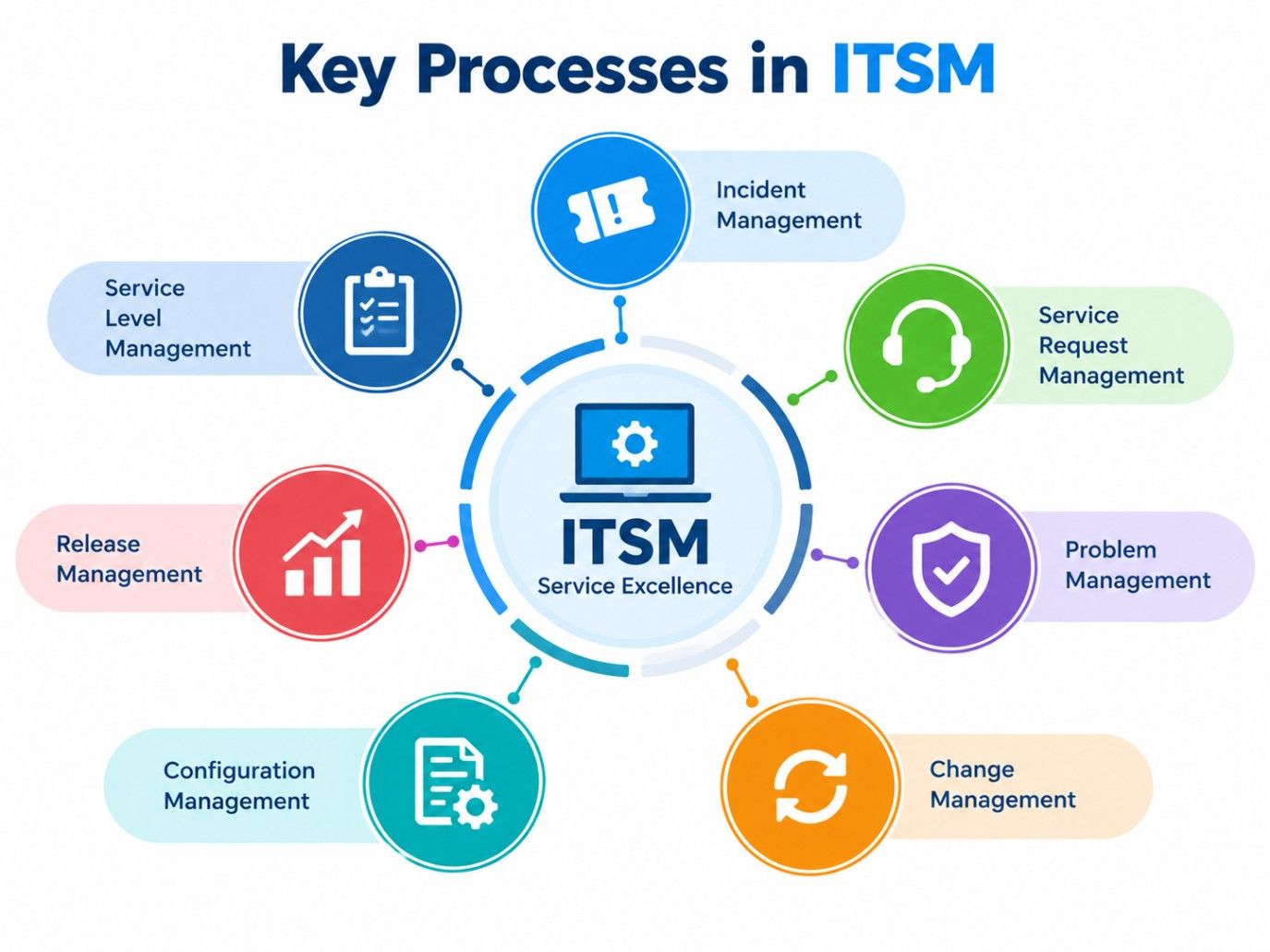
Incident management: Focuses on restoring normal service as quickly as possible after an interruption.
Service request management: Handles routine requests such as software access, password resets, or new equipment.
Problem management: Looks for the underlying causes of recurring incidents and works towards long-term solutions.
Change management: Helps organisations assess, plan, and implement changes while reducing unnecessary disruption.
Service level management: Helps define and monitor agreed service expectations between IT teams and customers.
Configuration management: Maintains information about IT assets, services, and their relationships so teams have a clearer view of the technology environment.
These practices help IT teams move from simply reacting to technical issues to managing services in a more organised way.
Also Read: Complete Guide to Product Management Career: Skills and Opportunities for Growth
Benefits of ITSM for Organisations
A good ITSM approach helps teams manage IT services more smoothly and provide better support to users. Some key benefits include:
Imagine an employee joins a company and needs a laptop, email account, business applications, and access to internal systems.
Instead of contacting different IT employees individually, the organisation can use an ITSM service portal. The employee submits a request, and the relevant tasks are automatically assigned to different teams.
The IT team can track the request from submission to completion, while managers can monitor service performance.
This is ITSM in action because the organisation is managing technology-related services through defined processes and workflows.
Read: Product lifecycle management
When choosing between ITIL vs ITSM, it is important to understand that ITSM is a broader discipline, while ITIL is a specific framework with its own certification path.
For beginners, an ITIL certification can be a good starting point for learning how IT services are managed and improved. It covers practical concepts such as service management practices, guiding principles, and continual improvement.
The right certification depends on your career goals. ITIL certification can be useful for professionals looking to work in areas such as:
Before enrolling, check the current certification levels, exam format, syllabus, and eligibility requirements. Choose a certification that matches your experience and the type of IT role you want to pursue.
In simple terms, ITSM is the broader field, while ITIL offers a structured framework and certification route for building IT service management skills.
The difference between ITIL vs ITSM is simple: ITSM is the broader approach to managing IT services, while ITIL is a framework that helps teams manage and improve those services.
ITSM covers areas such as incident, problem, change, and service request management. For a career in IT support or service management, ITIL and ITSM certifications can help build relevant skills and knowledge.
Ready to start your journey? Book a free consultation with upGrad today to find the best path for your career.
The five traditional ITSM stages are Service Strategy, Service Design, Service Transition, Service Operation, and Continual Service Improvement. Together, they describe how an IT service is planned, designed, introduced, operated, and improved over time to meet changing business needs.
ITIL provides guidance for managing IT services, while ITOM focuses on the operation and maintenance of IT infrastructure. ITOM deals more with servers, networks, systems, and infrastructure performance, whereas ITIL takes a broader service management view.
Yes, ITIL remains relevant in 2026 because organisations still need structured ways to manage digital services, improve user experience, and connect IT work with business goals. Its practices can also be adapted to modern environments involving cloud services, automation, and digital transformation.
The difficulty depends on the certification level and your preparation. Foundation-level exams are generally more approachable for beginners, while advanced certifications require deeper understanding and practical application. Regular study, practice questions, and familiarity with service management concepts can make preparation easier.
ITIL has not been replaced by a completely different service management framework. Instead, it has evolved over time, with newer versions reflecting modern approaches to digital services and business value. Organisations can also use alternatives such as COBIT or ISO/IEC 20000 alongside their service management practices.
Neither certification is automatically better; the right choice depends on your career path. PMP is aimed at project management, while ITIL is more closely related to IT service management. Choose PMP for project-focused roles and ITIL for service management or IT operations-oriented careers.
Some ITIL certifications have renewal requirements, so candidates should check the current rules for their specific certification. Renewal may involve retaking an examination or completing professional development activities. Certification holders should verify the latest requirements with the official certification provider before planning their renewal.
No. ITIL is one of several approaches organisations can use for IT service management. Other options include COBIT, ISO/IEC 20000, FitSM, and VeriSM. The best choice depends on factors such as organisational needs, regulatory requirements, existing processes, and the level of structure required.
A service desk is a function that provides a central point of contact for users, while ITSM covers the wider management of IT services. A service desk may handle incidents and requests, whereas ITSM also includes areas such as problem management, changes, assets, and service improvement.
ITIL knowledge can be useful in roles such as service desk analyst, IT support specialist, service delivery manager, IT service manager, and IT operations professional. It can also help professionals who work with incident, problem, change, or service management processes in larger IT environments.
Yes. ITIL can work alongside Agile and DevOps rather than replacing them. Agile focuses on iterative delivery, while DevOps connects development and operations. ITIL can provide service management practices around areas such as value, governance, change, and continual improvement, depending on organisational needs.
698 articles published
Sriram K is a Senior SEO Executive with a B.Tech in Information Technology from Dr. M.G.R. Educational and Research Institute, Chennai. With over a decade of experience in digital marketing, he specia...
Speak with MBA expert
By submitting, I accept the T&C and
Privacy Policy
From MBA to Dream Job - Explore Our Alumni Success Stories
Top Resources
Master's Degree
13 Months
Master's Degree
12 Months
O.P.Jindal Global University
MBA (with Career Acceleration Program by upGrad)Become interview ready with Career Services
Master's Degree
12 Months