Human Capital Management: Guide to Building a High-Performing Workforce
By upGrad
Updated on Jun 03, 2026 | 7 min read | 2.32K+ views
Share:

All courses
Certifications
More
By upGrad
Updated on Jun 03, 2026 | 7 min read | 2.32K+ views
Share:
Table of Contents
Behind every thriving business, you'll find one common thread, great people. No strategy, technology, or process can substitute for a talented, motivated, and well-supported workforce. That's exactly why Human Capital Management has moved from a back-office function to a boardroom priority in organizations around the world.
Businesses today no longer see employees as simply a pair of hands getting tasks done. They recognize them as the driving force behind innovation, growth, customer loyalty, and long-term competitive advantage. When you invest in your business, you will invest in the future.
In this guide, you'll learn what human capital management means, why it matters, its core functions, benefits, challenges, and best practices on how to achieve higher productivity, and improve business outcomes.
Explore Management Courses from upGrad and gain a deeper understanding of Human Capital Management from talent acquisition strategies and workforce planning to the leadership practices that help organizations attract the right people, build high-performing teams, and unlock the full potential of their most valuable asset.
Also Read: Human Resource Management Process: Meaning, Importance, Steps and Tools
Popular Management Programs
Human capital management (HCM) is what companies use to help them, learn, grow, and keep them happy. It is a way to manage people that use practice, technology, and what the company wants to achieve to get the best out of the people who work there.
Human capital management is different from human resources, which is mostly about doing paperwork. Human capital management looks at the picture. It tries to help people who work for the company do their best. It also makes sure the company has the right people with the right skills to meet its goals. Human capital management is about making the most of the people who work for the company.
In today's fiercely competitive business landscape, your people can be your greatest differentiator. The organizations that consistently come ahead aren't always the ones with the biggest budgets or the boldest strategies; they're the ones that know how to attract, develop and hold onto exceptional talent.
A report by the World Economic Forum points out that workforce skills are evolving at a pace we've never seen before making continuous learning and talent development not just a nice-to-have, but a genuine business imperative.
That's where Human Capital Management earns its place. When implemented well, it helps organizations:
Also Read: Difference Between Human Capital and Human Development
Free Courses
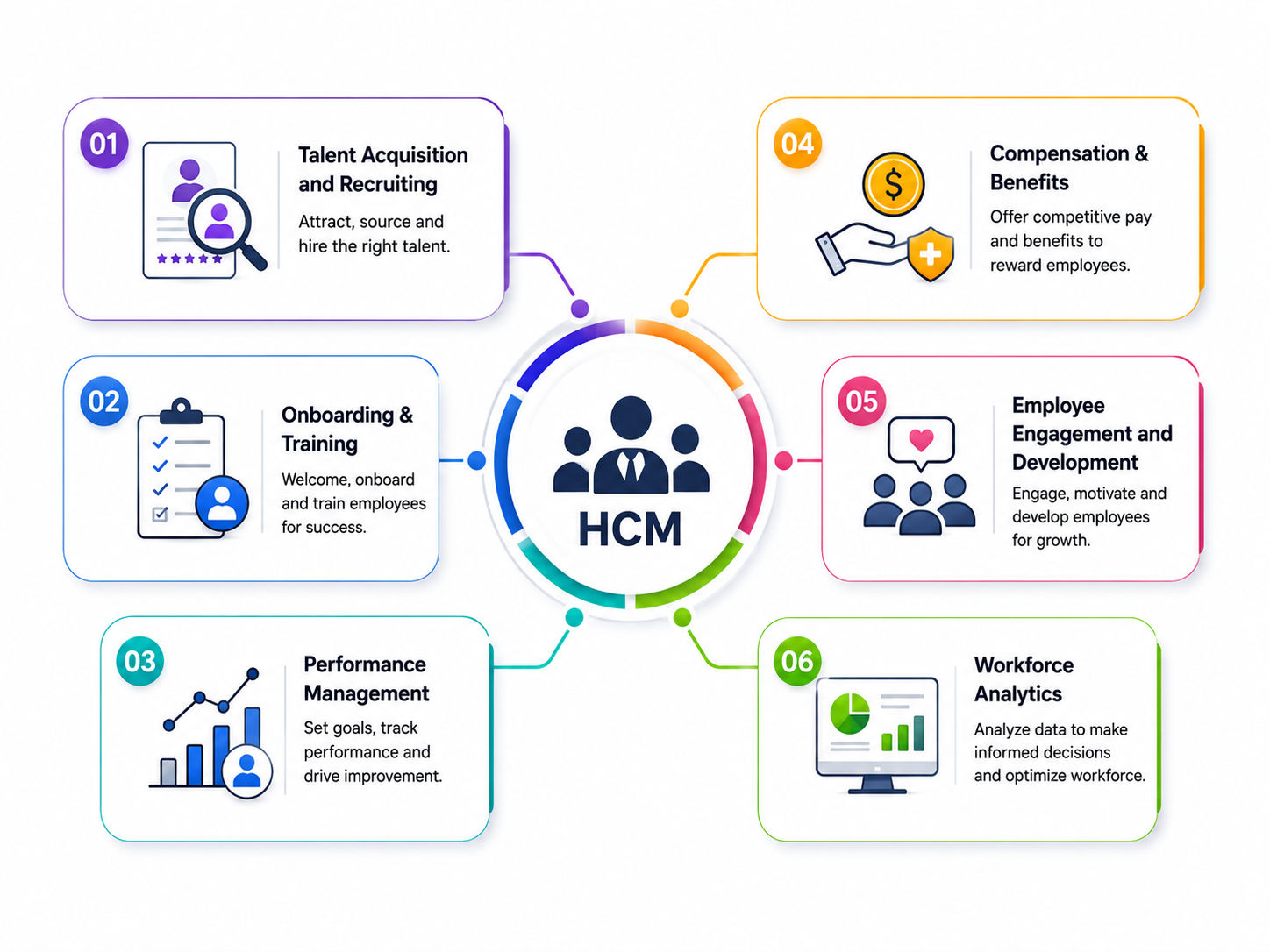
A good human capital management plan has parts that work together. These parts help companies to acquire, grow, and retention.
Human capital is very important, and a good management strategy is key. Companies need to manage Human Capital Management for their own success.
When organizations take a smarter, more modern approach to recruiting, the payoff is twofold better for teams and a healthier hiring budget.
Everything starts with hiring the right people, when we get that wrong, and even the best strategies will struggle to deliver.
Effective Talent Acquisition involves:
Hiring talent is only the beginning. Employees need support to become productive quickly. Strong training programs also contribute to Higher Productivity and Improved Retention.
Onboarding & Training programs help employees:
Performance Management helps employees know what is expected of them, Employees need to understand their goals and get feedback often. This helps them do their work.
Many companies are now replacing annual reviews with performance conversations. These conversations help employees feel more involved and work better. The goal is to make employees perform their best.
Key components of performance conversations include:
Offering competitive compensation and benefits isn't just a perk it's one of the most effective ways organizations can attract top talent and keep them from walking out the door.
Modern organizations increasingly use data-backed rewards to create fair and competitive compensation structures.
These programs may include:
There's a direct line between how engaged your employees are and how well your business performs.
Human Capital Management helps draw that line by creating real opportunities for growth and building work environments where people genuinely feel supported, valued, and motivated to bring their best every day.
Engaged employees are more likely to:
Organizations now generate large amounts of employee data.
Workforce Analytics helps leaders understand:
These insights support Data-Backed Insights that improve workforce decisions and business results.
Also Read: What is People Management? Complete Process with Best Practices
Management Courses to upskill
Explore Management Courses for Career Progression
IIIT-B & IIM, Udaipur
Chief Technology Officer & AI Leadership ProgrammeWhen organizations truly commit to Human Capital Management, the results don't just show up in employee satisfaction scores they ripple across every corner of the business in ways that are very hard to ignore.
When an organization genuinely invests in its people, word gets around and the best candidates take notice. In today's competitive talent market, moving fast and hiring smart isn't just an advantage; it's how businesses secure the skills they need before someone else does.
Done well, strong HCM practices deliver:
When people have the training, tools, and support they need to do their jobs well, something remarkable happens they actually do their jobs well. That's the productivity advantage that strong Human Capital Management delivers, and it's one of its most tangible benefits.
Replacing employees is expensive and disruptive in ways that go far beyond the hiring cost. When companies genuinely invest in their people's growth and development, employees feel valued, supported, and far less likely to look elsewhere.
The factors that keep great people around include:
Gone are the days of gut-feel workforce decisions. Human Capital Management is increasingly powered by Data-Backed Insights that give leaders a clearer, more confident basis for decisions around:
Markets shift. Industries transform. Economic conditions change without warning. The organizations that weather these moments best are the ones that have built a workforce capable of adapting.
Human Capital Management helps businesses stay nimble by enabling them to:
When employees perform at their best, the entire organization benefits. Strong Human Capital Management creates a ripple effect of value through:
Human capital management is much more than a workforce management framework. It is a strategic approach that helps organizations attract, develop, engage, and retain talented employees while supporting business growth.
By focusing on Talent Acquisition, Onboarding & Training, Performance Management, Compensation & Benefits, Workforce Analytics, and employee development, organizations can achieve Higher Productivity, Improved Retention, and stronger business performance. As workplaces continue to evolve, businesses that invest in people and leverage Data-Backed Insights through modern Software Solutions will be better positioned for long-term success.
Want personalized guidance on Human Capital Management? Speak with an expert for a free 1:1 counselling session today.
Human capital management is the process of managing employees as valuable business assets. It includes hiring, training, performance management, compensation planning, and employee development. The goal is to help people perform better while supporting organizational growth and long-term success.
Traditional HR often focuses on administrative tasks such as payroll, compliance, and employee records. Human capital management takes a broader and more strategic approach by emphasizing workforce development, talent growth, and business outcomes. It connects people strategies directly to organizational goals.
Human capital management helps organizations attract skilled employees, improve workforce performance, and reduce turnover. It supports Higher Productivity through training, engagement, and performance optimization. Strong workforce practices can also improve customer satisfaction and overall business performance.
The main components include Talent Acquisition, Onboarding & Training, Performance Management, Compensation & Benefits, employee engagement, learning and development, succession planning, and Workforce Analytics. Together, these functions help organizations build and maintain a high-performing workforce.
Workforce Analytics helps organizations collect and analyze employee-related data. It provides Data-Backed Insights about hiring effectiveness, retention trends, productivity levels, and employee performance. Leaders can then make more informed decisions about workforce planning and talent management.
Modern Software Solutions automate many workforce processes, including recruiting, learning, performance reviews, and compensation management. Technology improves efficiency while generating valuable workforce data. It also helps organizations deliver better employee experiences and more accurate decision-making.
Human capital management supports Improved Retention by creating growth opportunities, offering fair Compensation & Benefits, and fostering employee engagement. When employees feel supported and valued, they are more likely to remain with the organization and contribute positively over time.
Data-backed rewards use employee performance data, market benchmarks, and workforce trends to guide compensation decisions. This approach helps organizations create fair and transparent reward systems. It also ensures compensation strategies remain competitive and aligned with business objectives.
Effective Onboarding & Training helps new employees understand expectations, company culture, and job responsibilities. It accelerates learning, reduces adjustment time, and increases confidence. Employees who experience structured onboarding often become productive faster and stay longer with the organization.
Common challenges include talent shortages, changing skill requirements, employee disengagement, retention issues, and workforce planning complexities. Organizations must continuously adapt their talent-focused strategies to address these challenges and maintain workforce effectiveness.
Future trends include AI-powered recruiting, advanced Workforce Analytics, personalized learning experiences, skills-based hiring, flexible work models, and increased use of Data-Backed Insights. Organizations are also placing greater emphasis on employee well-being, engagement and business value creation.
972 articles published
We are an online education platform providing industry-relevant programs for professionals, designed and delivered in collaboration with world-class faculty and businesses. Merging the latest technolo...
Get Free Consultation
By submitting, I accept the T&C and
Privacy Policy
Top Resources
Certification
3 Months
Certification
6 Months
O.P. Jindal Global University
Masters in International Accounting and Finance (Accredited by ACCA, UK)Master's Degree
12 Months