12 Best Data Governance Tools in 2026
By upGrad
Updated on Aug 16, 2026 | 7 min read | 2.82K+ views
Share:

All courses
Certifications
More
By upGrad
Updated on Aug 16, 2026 | 7 min read | 2.82K+ views
Share:
Table of Contents
Key Highlights
Take your management skills to the next level with industry-relevant management certification courses designed to help you grow and lead with confidence.
Popular Management Programs
Best For: Enterprise-wide data governance
Large organizations rarely have a single data source. They may have hundreds of systems, multiple business units, and different teams defining the same business terms in different ways.
Collibra is designed for this kind of environment. It brings governance information into one place and connects technical data with business context.
What You Can Use Collibra For:
One useful example is a business term such as “customer.” Different departments may have different definitions. A governed business glossary can establish which definition should be used and connect it to the relevant data assets.
What Makes It Stand Out: Its enterprise focus. It is built for organizations where governance involves many teams, data domains, policies, and responsibilities.
Potential Limitation: Smaller companies may not need such a broad governance platform.
Best Fit: Large enterprises with complex and distributed data environments.
Free Courses
Best For: Data discovery and cataloging
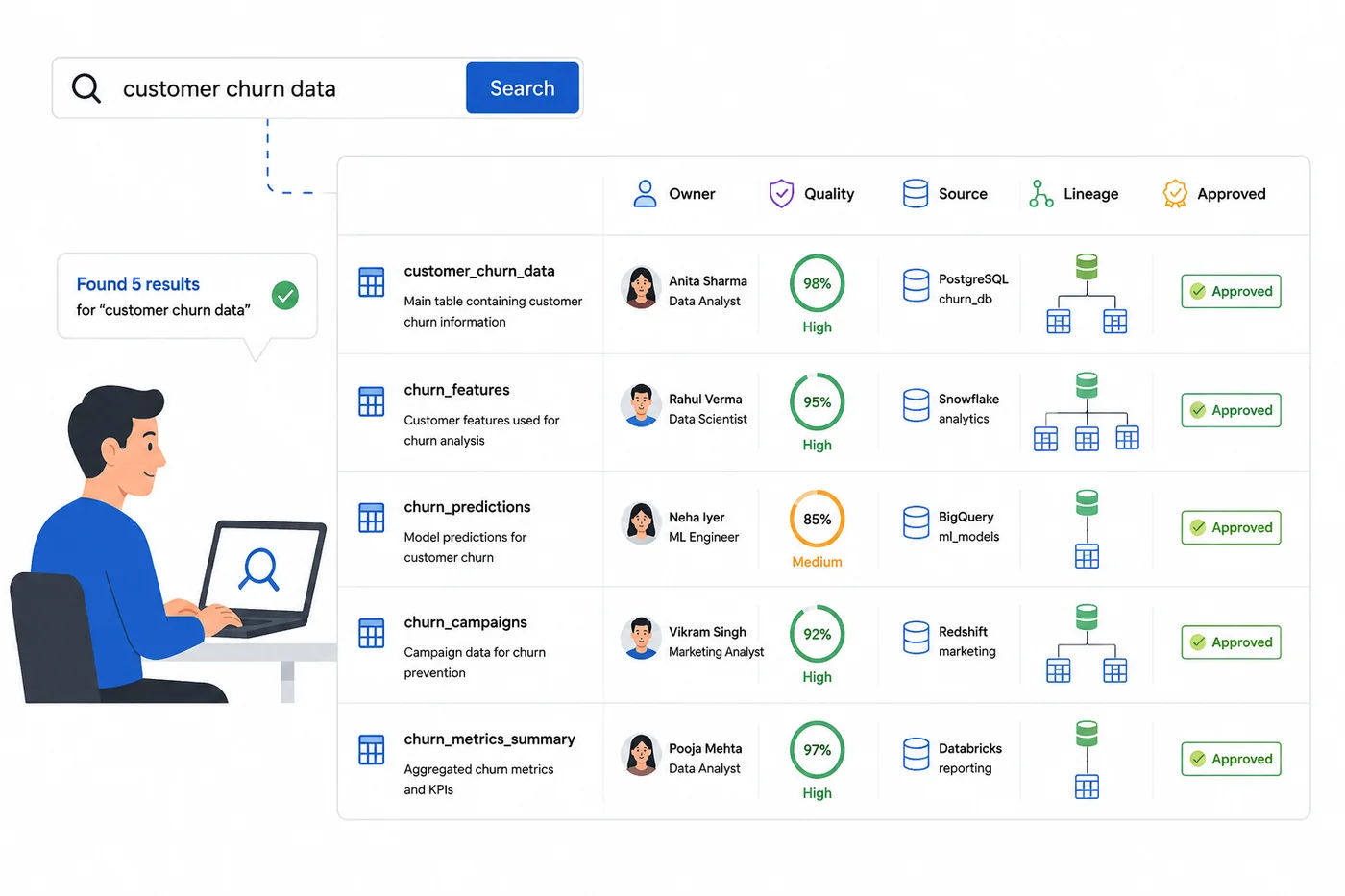
A company might have thousands of tables and reports, but an analyst could still spend hours asking colleagues which dataset is reliable. Alation focuses heavily on this discovery problem.
Its data catalog helps users search for data while seeing useful context such as:
Alation also goes beyond cataloging. Its governance capabilities include policy management, data classification, workflows, and lineage. The platform supports a broad range of data sources and integrations.
Think of it as a search and context layer for enterprise data. Instead of opening several systems and guessing which dataset to use, users can search for information in a governed catalog.
Where It Fits Best: Organizations where business users and data teams frequently struggle to discover trusted data.
Watch Out For: Catalog adoption matters. A catalog only becomes valuable when teams keep its information useful and actually use it.
Management Courses to upskill
Explore Management Courses for Career Progression
IIIT-B & IIM, Udaipur
Chief Technology Officer & AI Leadership ProgrammeBest For: Modern data teams
Atlan is designed around the modern data stack. It connects metadata from data warehouses, transformation tools, BI platforms, observability tools, and other parts of the data ecosystem. Atlan describes this approach as an active metadata layer.
For example, imagine an engineer wants to change a source table. Before making the change, they can trace downstream dependencies and identify dashboards or datasets that could be affected.
Key Strengths:
Best Fit: Companies building cloud-based analytics, data engineering, and AI workflows.
Also read: Data Quality Tools: Types, Features, Examples & Benefits
Best For: Enterprise data management and governance
Informatica takes a broader approach. Governance is part of a larger data management environment rather than an isolated capability.
That matters when an organization is dealing with several problems at once: poor data quality, scattered metadata, unclear ownership, disconnected systems, and limited visibility into data movement.
Its governance and catalog capabilities help teams:
Lineage is particularly useful when teams need to understand how a change might affect downstream data. For instance, changing a source field could affect a report, dashboard, or application somewhere else in the organization. Informatica's lineage and impact-analysis capabilities help make these relationships visible.
The platform also uses AI and automation for activities such as data classification, metadata enrichment, and relationship discovery.
The Key Question to Ask: Do you need governance as part of a wider enterprise data management strategy?
If yes, Informatica becomes more relevant.
Best Fit: Large organizations managing complex data environments across cloud and on-premises systems.
Best For: Microsoft and multicloud environments
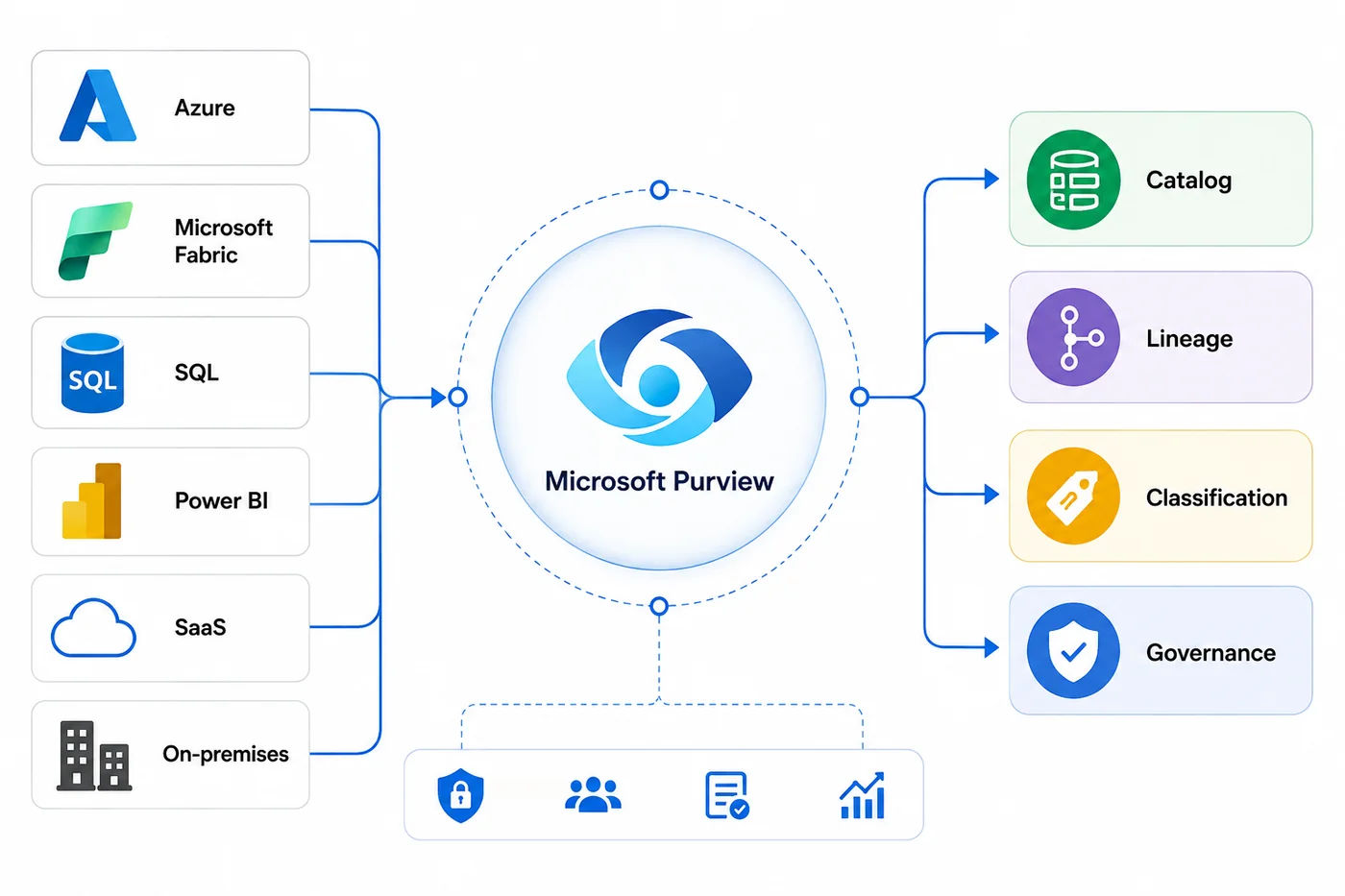
If an organization already relies heavily on Microsoft technologies, adding a separate governance platform is not always the first option to consider. Microsoft Purview provides governance and data discovery capabilities across Microsoft's broader data ecosystem and can also work with non-Microsoft sources.
Its Unified Catalog helps users discover and understand data assets, while Data Map captures metadata from connected sources. Organizations can use it for:
Purview can be useful when governance needs to cover data across cloud, on-premises, and SaaS environments rather than sitting inside just one database or warehouse.
Best Fit: Organizations already invested in the Microsoft ecosystem or managing a mixed data environment.
Potential Limitation: Teams outside the Microsoft ecosystem should compare its integrations and capabilities carefully with standalone governance platforms.
Best For: Databricks and lakehouse environments
For organizations built around Databricks, governance can be handled much closer to where data is stored and processed. Unity Catalog provides a centralized governance layer for data and AI assets within the Databricks environment.
Instead of managing access separately across different Databricks workspaces, teams can use centralized controls for assets such as:
One particularly useful feature is fine-grained access control. Organizations can apply rules at the table, row, or column level. This matters when a dataset contains information that not every employee should see.
Why It Is Different: It is not simply a catalog added on top of a data platform. Governance is integrated into the Databricks environment itself.
Best Fit: Companies already using Databricks as a core data and AI platform.
Best For: Snowflake environments
Snowflake Horizon is another example of governance capabilities being built into a cloud data platform.
It helps organizations discover, secure, classify, monitor, and govern data and AI assets within the Snowflake ecosystem. Its capabilities include:
Consider a financial services company with customer, transaction, and risk data in Snowflake. Different employees may need different levels of access. Horizon provides controls that can help apply those rules while keeping an audit trail of data access.
The Main Advantage: If Snowflake is already central to your data architecture, you can use its native governance capabilities instead of immediately adding another platform.
Best Fit: Snowflake-heavy organizations that want governance closely connected to their data platform.
Also read: Cybersecurity Tools for 2025: Protect Systems Like a Pro
Best For: Enterprise data governance and AI-ready data
IBM Knowledge Catalog is aimed at organizations that need to bring data discovery, governance, metadata, and data quality together.
Its catalog provides a central place to discover data assets and their associated business and technical information. Organizations can also use governance policies, business terms, classifications, and stewardship processes to establish how data should be managed.
Useful Capabilities Include:
The AI angle is becoming increasingly important. Organizations using generative AI or machine learning need more than access to large amounts of data. They need to know whether that data is accurate, sensitive, properly governed, and appropriate for the intended use.
That makes platforms such as IBM Knowledge Catalog relevant when an organization's governance strategy extends beyond traditional analytics.
Best Fit: Large organizations that want data governance to work alongside broader data analytics, and AI initiatives.
Potential Limitation: Smaller teams may find a broad enterprise platform unnecessary if their immediate requirement is simply data discovery or cataloging.
Ready to lead with data and AI? Build the skills to drive enterprise transformation with the IIIT-B & IIMU Chief Data and AI Officer Programme Online.
Best For: Sensitive data discovery, privacy, and data access governance
Not every governance problem starts with a data catalog. Sometimes the bigger question is:
Where is our sensitive data, and who can access it?
That is where BigID stands out.
BigID focuses on discovering and classifying sensitive, personal, regulated, and high-risk data across cloud, SaaS, on-premises, and other environments. It also connects this discovery with security, privacy, compliance, and AI governance.
For example, a company may have customer information scattered across databases, file stores, cloud applications, and analytics platforms. BigID can help identify this information and provide context around its risk and usage.
Key Capabilities
Its data access governance capabilities are especially relevant when organizations need to understand who has access to sensitive information and whether that access is appropriate. BigID also supports privacy workflows such as access, deletion, rectification, and portability requests.
Best Fit: Enterprises where privacy, sensitive-data management, compliance, and access governance are major priorities.
Think of BigID When: Your main governance question is not just “What data do we have?” but also “What sensitive data do we have, where is it, and who can access it?”
Also read: AI in Cybersecurity: Market Trends & Applications Explained
Best For: Master data governance
SAP Master Data Governance, or SAP MDG, takes a more specialized approach than many tools on this list.
Its focus is master data: the core information a business repeatedly relies on across its processes. This can include customers, suppliers, products, business partners, and financial data.
The problem becomes obvious in a large enterprise. One system may have a customer listed as “ABC Pvt Ltd,” another as “ABC Private Limited,” and a third may contain an outdated address. When these records are used across different business processes, inconsistencies can quickly create operational problems.
What Makes SAP MDG Different?
It is not primarily about helping employees search through a catalog of every dataset in the company. Instead, it focuses on making critical business records consistent and governed.
Its capabilities include:
SAP also provides cloud-ready and cloud editions of MDG, alongside its established SAP S/4HANA deployments.
Best Fit: Large enterprises already working extensively with SAP and needing strong control over master data.
Potential Limitation: If your main requirement is simply data discovery or cataloging, SAP MDG may be far broader than necessary.
Best For: Open-source data discovery and metadata management
If commercial platforms aren't the only options you're considering, DataHub deserves a place in this data governance tools list.
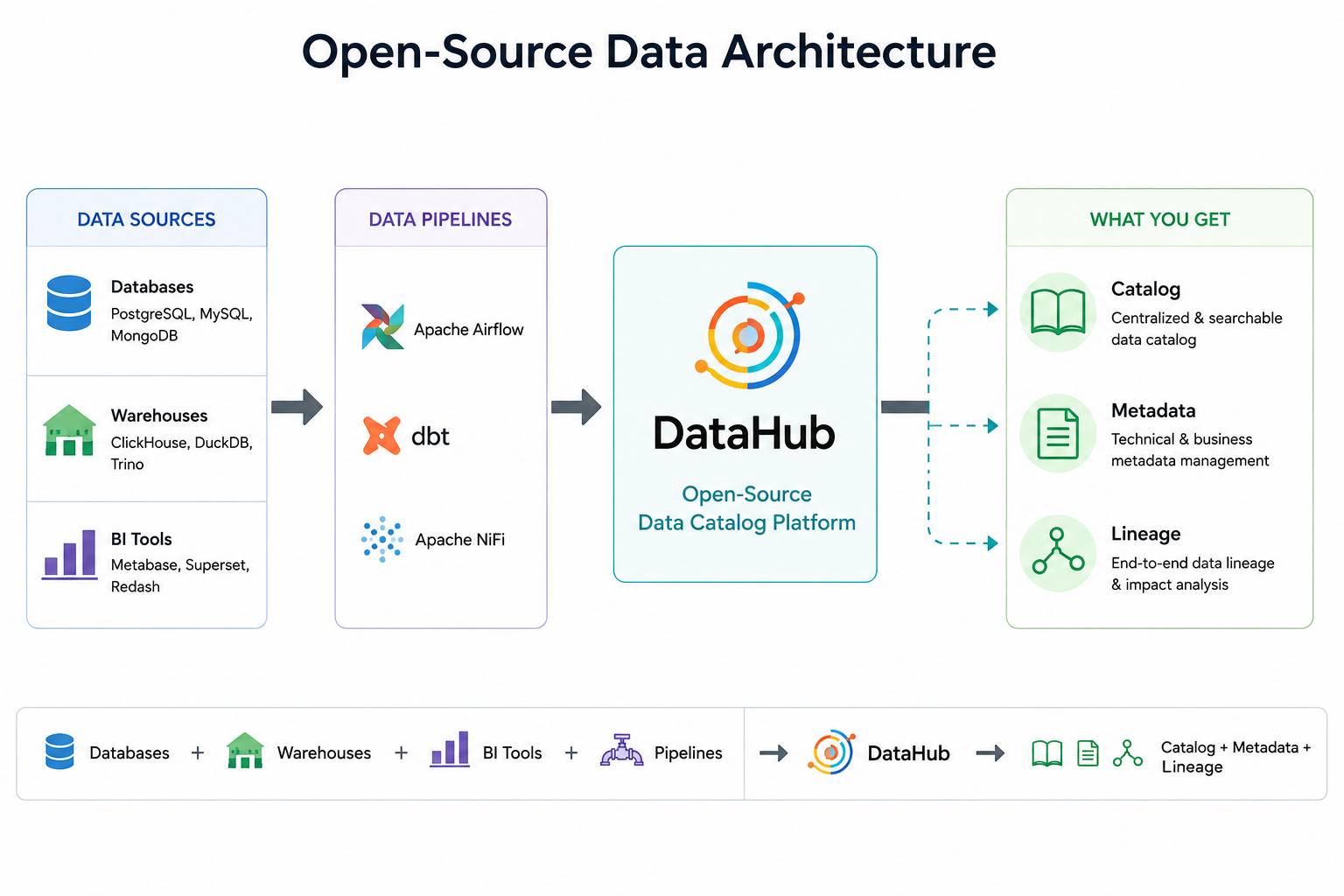
DataHub is an open-source metadata platform originally developed at LinkedIn. It helps organizations build a searchable view of their data assets and understand relationships between them.
The platform can collect metadata from different parts of a data environment and make information such as ownership, schemas, tags, usage, and lineage easier to discover.
This is where DataHub can be useful for engineering-heavy teams. Rather than buying a large enterprise platform, an organization can build a metadata layer around its own data ecosystem and customize it according to its needs.
Why Teams Consider DataHub
It is also useful for organizations that want more control over how their metadata platform is deployed and extended.
However, open source does not mean zero effort.
Your team may still need to handle deployment, upgrades, integrations, configuration, and ongoing maintenance. That technical responsibility is an important part of comparing the best open source data governance tools.
Best Fit: Technical teams that want an open-source metadata platform and have the engineering resources to manage it.
Best For: Open-source data discovery, governance, and metadata management
OpenMetadata is another strong option for organizations looking at open-source governance platforms.
Its current platform combines data cataloging, discovery, metadata management, lineage, data quality, observability, and governance. It also has a growing focus on providing context for AI systems and agents.
One of its strengths is the breadth of information it can bring together. A governed metadata graph can connect:
Tables → Columns → Dashboards → Pipelines → Owners → Classifications → Lineage
OpenMetadata also supports business semantics such as glossary terms and metric definitions. That can help bridge the gap between technical metadata and the language used by business teams.
Key Capabilities
For teams comparing data governance tools open source, OpenMetadata is particularly interesting because it combines several capabilities that are often spread across separate products.
Best Fit: Engineering and data teams looking for an open-source platform covering cataloging, metadata, lineage, quality, and governance.
Potential Limitation: As with other self-managed open-source platforms, organizations need the technical expertise to operate and customize the platform.
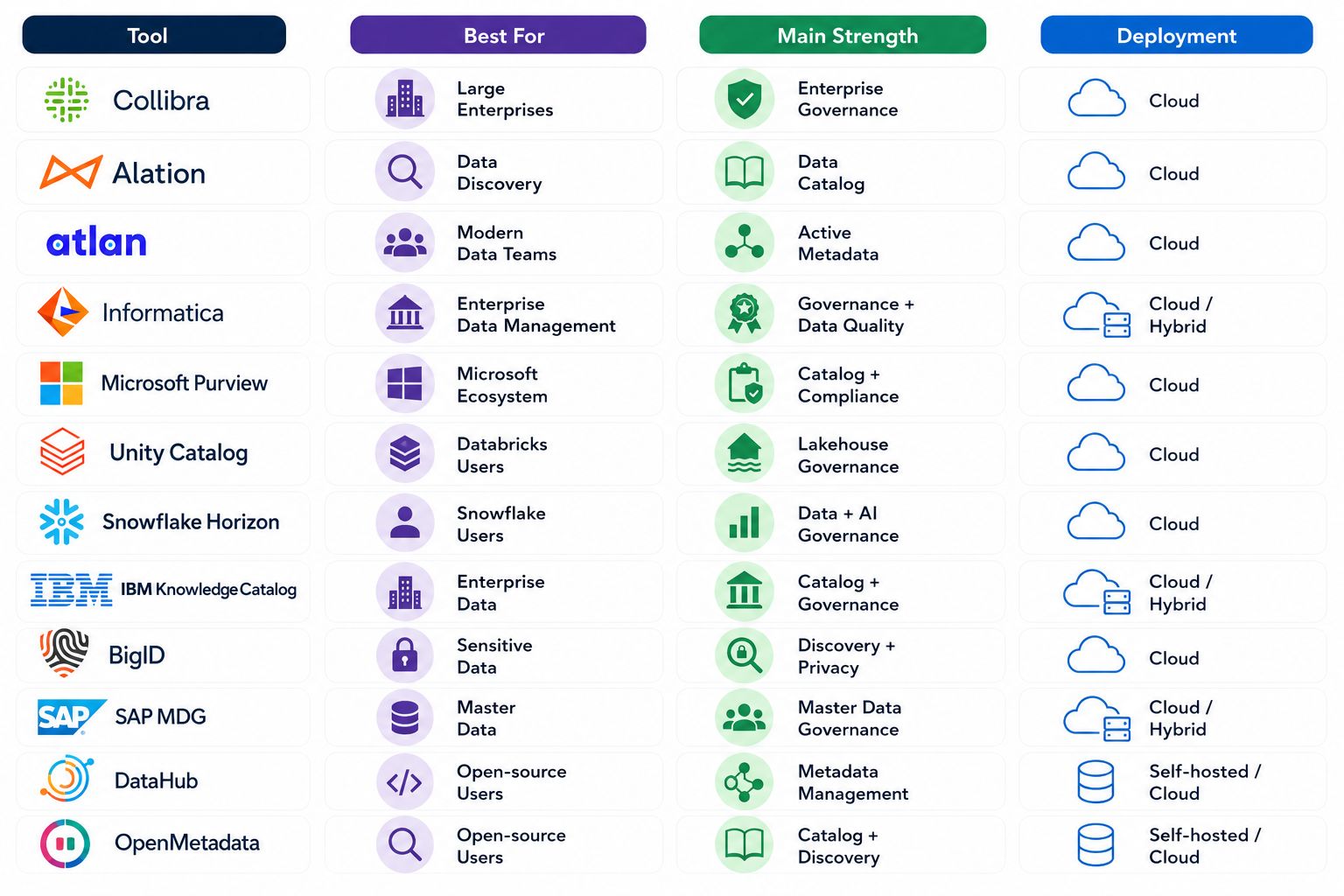
The 12 Data Governance Tools Comparison at a Glance
Also read: Data Security in Cloud Computing: Top 6 Factors To Consider
Choosing a governance platform should start with your organization's problems, not the vendor's feature list.
A tool may have dozens of capabilities, but that does not mean you need all of them.
Start by asking what you actually want to improve.
Is your team struggling to find data? Are different departments using different definitions? Do you need better control over sensitive information? Or are data-quality problems affecting reports?
Your answers will narrow down the type of platform you need.
For example:
| Your main problem | Look for |
| Can't find trusted datasets | Data catalog |
| Don't know where data comes from | Data lineage |
| Inconsistent business definitions | Business glossary |
| Poor-quality data | Data quality |
| Sensitive data is scattered | Classification + privacy |
| Too many access permissions | Access governance |
| Duplicate customer/product records | Master data management |
This is also where data access governance tools become relevant. If controlling who can access sensitive information is your main concern, don't choose a platform based only on its catalog capabilities.
Your governance tool has to work with the systems you already use.
Check whether it can connect to your:
For instance, a company heavily invested in Databricks may benefit from Unity Catalog. A Microsoft-centric organization might look closely at Purview.
Don't buy first and investigate integrations later. A governance platform that cannot access your important data sources will leave major gaps in your governance program.
Create a simple scorecard before shortlisting vendors.
Give each platform a score from 1 to 5 for the capabilities that matter to you:
You don't have to give every capability equal weight.
If privacy is your biggest concern, for example, classification and access governance should carry more weight than catalog search experience.
A platform can look impressive during a product demonstration and still be difficult to implement.
Ask:
This is especially important when comparing commercial platforms with open-source options.
An open-source platform may have no traditional software license fee, but your team still needs time and expertise to deploy, maintain, secure, and upgrade it.
Don't compare tools only by their advertised license price. Your actual cost may include:
Software + Implementation + Integrations + Training + Maintenance + Internal resources
Also think about future growth.
A platform that works for 50 data sources today may need to support hundreds or thousands later. Make sure the pricing model and architecture can scale with you.
A proof of concept can reveal problems that a product demo won't. Choose a small but realistic use case. For example:
5 data sources → 1 business domain → 2 governance policies → 1 dashboard
Then test how easily the platform can:
The goal is not to test every feature. It is to find out whether the platform works with your actual environment.
Also read: Data Governance vs Data Security: Key Differences & Use Cases
The right data governance platform depends on what you need to govern and where your data lives. An enterprise may need a broad platform such as Collibra or Informatica, while a Databricks or Snowflake user may benefit from native governance capabilities. Teams focused on sensitive information can look at BigID, while organizations seeking open-source options can consider DataHub or OpenMetadata.
Don't choose a tool simply because it has the longest feature list. Start with your governance problems, map them to the capabilities you actually need, and test the shortlisted options against your real data environment.
Ready to take the next step in your career? Book a consultation call with upGrad to explore the right learning program for your goals.
Data engineers, analysts, data stewards, compliance teams, IT leaders, and business users can use governance software. Each group may use it differently, from managing data policies and ownership to discovering datasets, monitoring quality, or controlling sensitive information.
Yes. Small businesses can start with lightweight or open-source platforms rather than complex enterprise solutions. Basic governance around data ownership, cataloging, access, and quality can help establish good practices without creating unnecessary complexity or cost.
Data stewards help maintain data quality, consistency, and appropriate usage. They may define business terms, resolve data issues, review policies, and coordinate between business and technical teams. Governance software helps them document responsibilities and manage these activities.
Many modern governance platforms support multicloud and hybrid environments. However, capabilities vary by vendor. Organizations should check available connectors, metadata coverage, lineage, and policy controls before choosing a platform for data distributed across multiple cloud providers.
Some governance platforms provide built-in data quality capabilities, while others integrate with specialized tools. They can help identify incomplete, inconsistent, duplicate, or outdated data and make it easier to assign responsibility for resolving quality problems.
Some platforms can discover and classify unstructured information such as documents, files, and other content. However, support differs between vendors. Organizations should verify whether a platform supports their specific repositories, file types, classification requirements, and governance needs.
Governance platforms can help identify sensitive information, apply policies, control access, maintain ownership records, and create audit trails. They do not guarantee compliance by themselves, but they provide visibility and controls that can support regulatory and organizational requirements.
Yes. Many platforms automate tasks such as metadata collection, data classification, lineage mapping, policy workflows, and notifications. This reduces repetitive work, although teams still need to establish standards, review decisions, handle exceptions, and maintain accountability.
Metadata management involves organizing information that describes data, including its source, owner, definition, format, relationships, and usage. It gives users more context about datasets and helps organizations improve discovery, understanding, management, and governance across their data environment.
Not always. Organizations can begin with a critical business area or selected data sources and expand gradually. A phased approach allows teams to test governance processes, identify implementation challenges, and improve adoption before rolling the platform out across the organization.
A governance pilot should use real data and focus on a limited set of sources, users, and policies. Test important capabilities such as discovery, classification, ownership, lineage, access controls, and workflows to determine whether the platform fits your requirements.
1038 articles published
We are an online education platform providing industry-relevant programs for professionals, designed and delivered in collaboration with world-class faculty and businesses. Merging the latest technolo...
Get Free Consultation
By submitting, I accept the T&C and
Privacy Policy
Top Resources
Certification
3 Months
Certification
6 Months
O.P. Jindal Global University
Masters in International Accounting and Finance (Accredited by ACCA, UK)Master's Degree
12 Months