Business Communication Skills
By upGrad
Updated on May 08, 2026 | 5 min read | 2.43K+ views
Share:

All courses
Certifications
More
By upGrad
Updated on May 08, 2026 | 5 min read | 2.43K+ views
Share:
Table of Contents
Business Communication Skills involves mastering verbal, nonverbal, and written exchanges to drive professional results. By prioritizing clarity and emotional intelligence, you can build stronger workplace relationships and foster a collaborative environment. These core competencies ensure that information is shared accurately across all levels of an organization.
Furthermore, developing skills like active listening and empathy is crucial for resolving conflicts and boosting overall productivity. When teams communicate with purpose and understanding, they streamline workflows and achieve collective goals more efficiently.
Explore Online MBA Courses to develop strong business communication skills, improve verbal, nonverbal, written, and active listening abilities, strengthen workplace collaboration, enhance clarity in professional interactions, and build confidence to communicate effectively across teams and organizational levels.
Popular Management Programs
Business communication skills are the abilities that allow professionals to share information clearly and effectively in the workplace. These skills cover verbal, nonverbal, written, and listening abilities that help employees collaborate smoothly. Strong communication ensures ideas are understood, tasks are completed efficiently, and workplace relationships remain healthy. Without it, misunderstandings, delays, and conflicts can quickly arise.
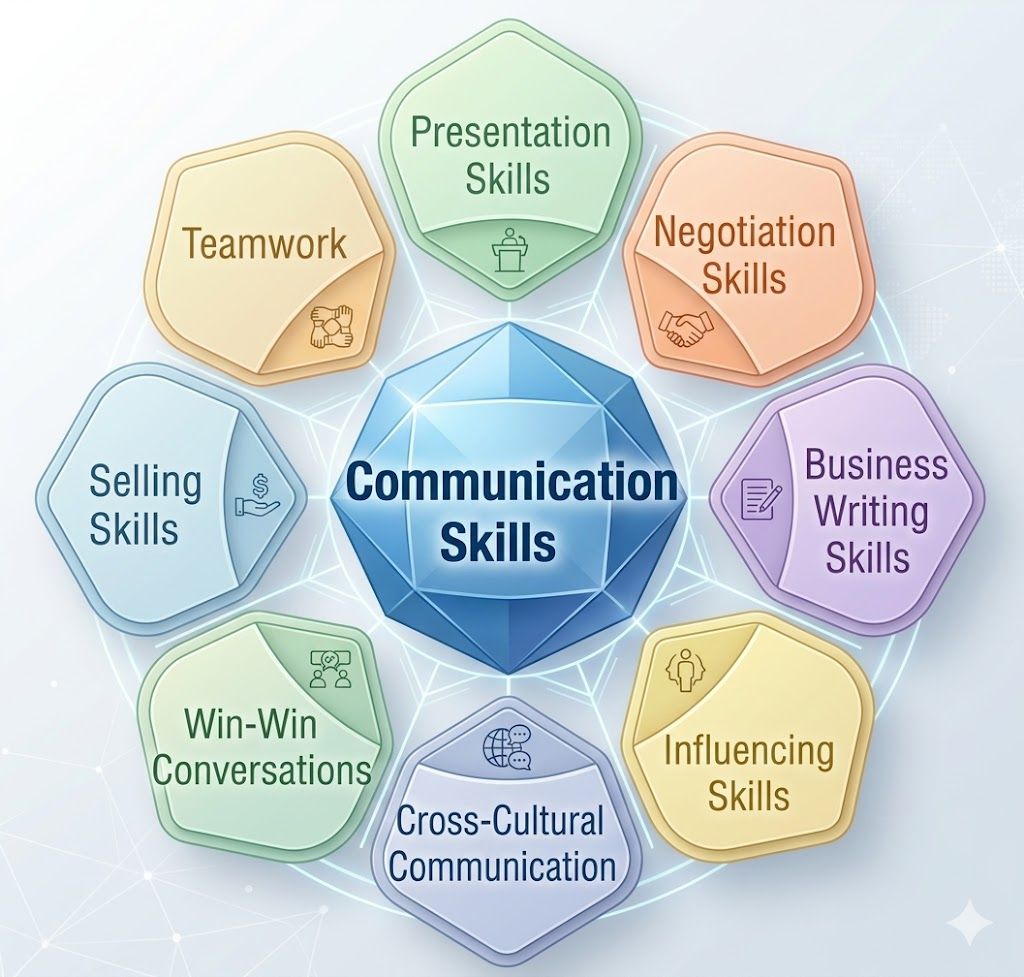
Also Read: Communication Channels for Business: Types, Importance & Examples
Business communication skills are essential for success in any workplace.
To ensure your message hits the mark, it should always be:
Also Read: Workplace Communication: Key Types, Methods, and Its Importance
Free Courses
Strong communication is the foundation of every successful organization. It influences teamwork, leadership, decision-making, and customer relationships. When employees communicate effectively, workplaces run smoothly and goals are achieved faster.
Also Read: How to Improve Communication Skills: The Ultimate Guide for Personal and Professional Growth
Employees with strong business communication skills often perform better, advance faster in their careers, and contribute more meaningfully to organizational success.
Management Courses to upskill
Explore Management Courses for Career Progression
IIIT-B & IIM, Udaipur
Chief Technology Officer & AI Leadership ProgrammeImproving business communication skills takes regular practice, self-awareness, and consistency. Small daily improvements can significantly enhance how effectively you share ideas, collaborate with teams, and respond in professional situations. Strong communication is not built overnight, but through continuous effort across different workplace interactions.
Below are practical ways to strengthen your communication abilities in a structured and simple way.
Also Read: Free Online Course on Communication with Certification [2026]
Daily practice is one of the most effective ways to improve business communication skills. The more you engage in speaking, writing, and listening, the more natural and confident your communication becomes.
Consistent practice also improves your ability to think and respond quickly in professional settings.
Feedback is essential for identifying communication strengths and areas that need improvement. Without feedback, it becomes difficult to understand how others perceive your communication style.
Constructive feedback helps you grow faster and avoid repeated communication mistakes.
Learning from experienced professionals is a simple yet powerful way to improve your communication style. Observation helps you understand how strong communicators express ideas clearly and confidently.
This approach helps you naturally improve verbal, nonverbal, written, and active listening skills over time.
Formal training programs can help you build structured and professional communication skills. These programs often provide frameworks, tools, and real-world practice scenarios.
Training acts as a strong foundation for developing advanced communication skills.
Clarity is one of the most important elements of effective communication. Simple and direct messages are easier to understand and reduce the chances of confusion.
When communication is clear, both verbal and written interactions become more effective.
Also Read: Assertive Communication: Meaning, Examples, and How to Practice It
Mastering business communication is a cornerstone of career growth. These skills empower you to articulate ideas effectively, foster meaningful professional relationships, and drive overall organizational efficiency. By integrating verbal precision, nonverbal cues, written clarity, and active listening, you ensure your message is truly understood.
Investing in these core competencies prepares professionals for the complexities of teamwork, leadership, and client management. Through consistent practice and a commitment to active engagement, anyone can transform into a more poised and impactful communicator.
The four main types of business communication, defined by their direction and audience, are upward, downward, lateral, and external communication. These types facilitate the flow of information necessary to align organizational goals, improve performance, and manage relationships with clients .
Business communication skills are important because they improve collaboration, efficiency, and workplace relationships. Clear communication helps employees avoid errors and complete tasks effectively. They also support leadership, customer interaction, and overall organizational success by ensuring information is understood correctly.
Verbal communication includes speaking in meetings, presentations, client calls, and team discussions. It focuses on clear and confident expression of ideas. Good verbal communication helps professionals build trust and ensure their message is understood without confusion.
Nonverbal communication refers to body language, facial expressions, posture, and tone of voice. It supports or sometimes replaces spoken words. It plays a major role in how messages are interpreted and helps strengthen overall communication effectiveness.
Improving written communication involves using simple language, structuring messages clearly, and avoiding grammar mistakes. Emails and reports should be concise and direct. Good written communication improves clarity and reduces misunderstandings in workplace interactions.
Active listening means fully focusing on the speaker, understanding their message, and responding thoughtfully. It involves paying attention and avoiding distractions. It helps improve teamwork, reduce misunderstandings, and strengthen workplace relationships.
You can improve business communication skills by practicing daily conversations, seeking feedback, and observing effective communicators. Training programs can also help. Consistency in verbal, nonverbal, written, and active listening skills leads to better communication over time.
Common mistakes include unclear speaking, poor writing, ignoring body language, and not listening properly. These issues can affect teamwork and productivity. Avoiding these mistakes improves overall communication quality and workplace efficiency.
Communication is essential for leadership because it helps managers guide teams, set expectations, and provide feedback clearly. Strong communication builds trust and motivation. Leaders with good communication skills can manage teams more effectively.
Active listening improves teamwork by reducing misunderstandings and encouraging collaboration. It ensures that team members feel heard and understood. This leads to better decision-making and stronger working relationships within teams.
Yes, business communication skills can be learned and improved with practice, training, and experience. Regular communication in professional settings helps build confidence. Focusing on verbal, nonverbal, written, and active listening skills leads to continuous improvement.
987 articles published
We are an online education platform providing industry-relevant programs for professionals, designed and delivered in collaboration with world-class faculty and businesses. Merging the latest technolo...
Get Free Consultation
By submitting, I accept the T&C and
Privacy Policy
Top Resources
Certification
3 Months
Certification
6 Months
O.P. Jindal Global University
Masters in International Accounting and Finance (Accredited by ACCA, UK)Master's Degree
12 Months