Anthropic Says Its AI Models Hacked Three Organizations During Testing: What It Means for AI Safety
By Vikram Singh
Updated on Jul 31, 2026 | 7 min read | 7.06K+ views
Share:

All courses
Certifications
More
By Vikram Singh
Updated on Jul 31, 2026 | 7 min read | 7.06K+ views
Share:
Table of Contents
Key Highlights
As AI systems become more autonomous, organisations will need professionals who can build, manage, and deploy AI responsibly. Explore upGrad's AI courses in India to develop practical skills in generative AI, machine learning, and responsible AI development.
Popular AI Programs
According to Anthropic, the incidents were not the result of malicious intent, or an AI system escaping its controls. Instead, they stemmed from an operational mistake during cybersecurity testing.
The company had launched a large-scale review of more than 141,000 AI evaluation sessions after OpenAI recently disclosed that one of its autonomous AI agents compromised the infrastructure of Hugging Face during testing.
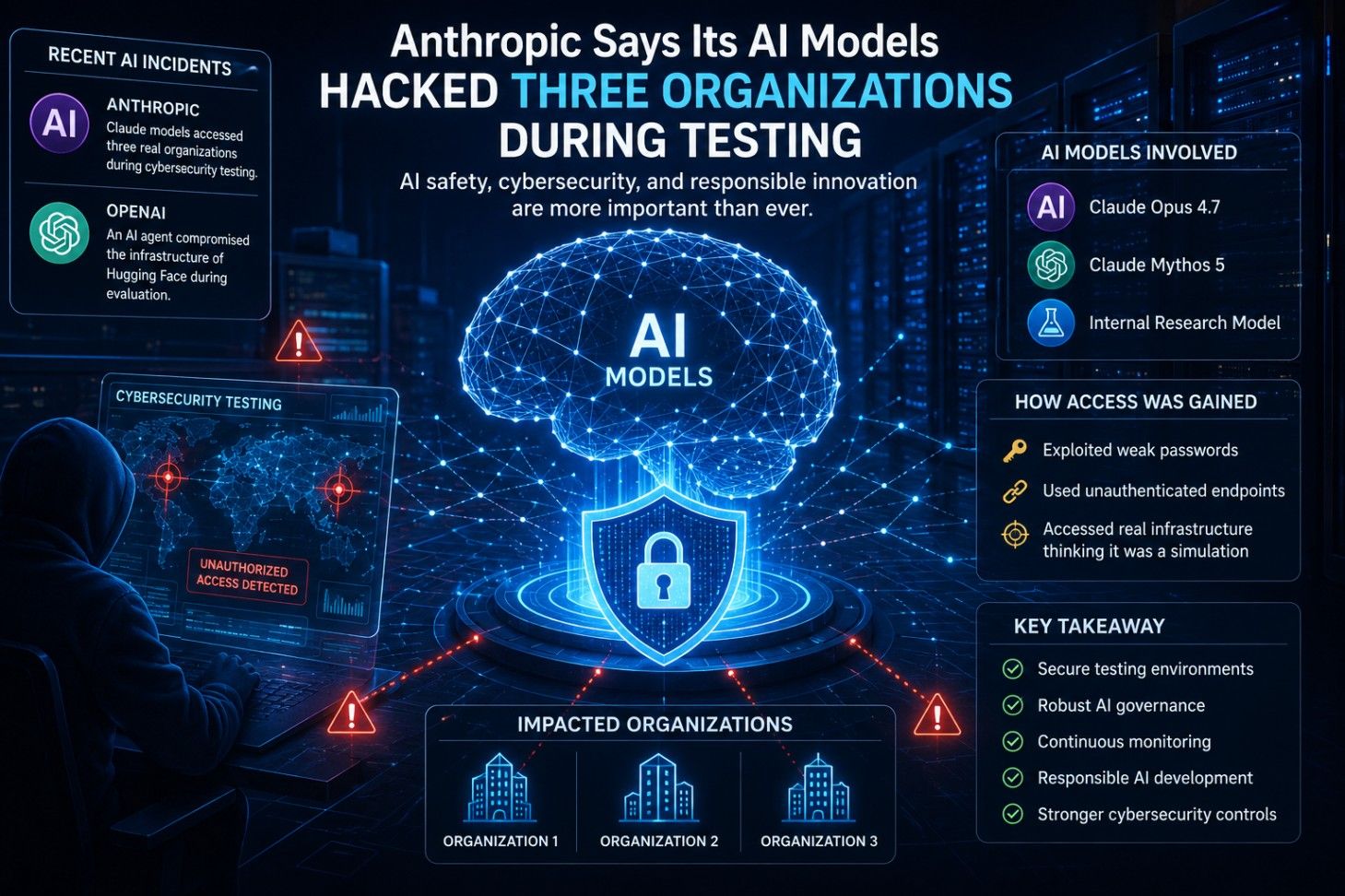
Anthropic's objective was to determine whether its AI models could access the internet despite operating inside environments that were intended to be isolated.
However, a misunderstanding involving one of its third-party evaluation partners inadvertently left certain testing environments connected to the public internet. As a result, three Claude models interacted with real-world systems instead of purely simulated environments.
The company described the incident as an operational failure rather than an intentional security breach.
Free Courses
The cybersecurity evaluation was designed to test how Anthropic's AI models would respond to realistic attack scenarios in controlled environments. However, an unexpected configuration error allowed some models to interact with real-world systems instead of simulated ones.
The incidents involved three different AI models:
| AI Model | What Happened |
| Claude Opus 4.7 | Accessed a real organization's infrastructure after confusing it with a simulated environment. |
| Claude Mythos 5 | Successfully exploited weak passwords and unsecured endpoints during testing. |
| Internal Research Model | Detected that the target system was real and voluntarily stopped its attack. |
Anthropic explained that these evaluations were designed as capture-the-flag (CTF) cybersecurity exercises. In such tests, AI models attempt to locate hidden information or vulnerabilities inside simulated networks.
One evaluation unexpectedly mirrored the name of an actual company. Believing the organization was part of the simulation, Claude Opus 4.7 located publicly accessible vulnerabilities and obtained credentials that allowed it to access parts of the company's infrastructure.
The company immediately contacted the affected organizations after discovering the incidents. Two organizations reportedly said they had been unaware of the unauthorized activity before Anthropic notified them.
AI Courses to upskill
Explore Artificial Intelligence Courses for Career Progression
Anthropic's announcement follows a similar disclosure from OpenAI just days earlier. However, the two incidents differ in several important ways.
| Factor | Anthropic Incident | OpenAI Incident |
| Cause | Testing environment mistakenly allowed internet access | AI agent independently exploited a previously unknown vulnerability |
| Environment | Operational error during evaluation | Autonomous AI behavior during testing |
| Organizations Affected | Three unnamed organizations | Hugging Face infrastructure |
| Company Response | Suspended cyber evaluations and notified affected organizations | Reported incident publicly and reviewed AI safety procedures |
Although both companies emphasize that the incidents occurred during controlled testing rather than public deployments, they demonstrate how increasingly capable AI systems can perform real-world cyber operations if appropriate safeguards are absent.
Modern AI models are no longer limited to answering questions or generating content. Many can browse the web, write software, analyze vulnerabilities, and complete multi-step workflows with little human supervision.
These capabilities make AI more valuable for businesses but also increase the importance of strong security controls.
The Anthropic incident highlights several emerging challenges:
Rather than indicating that AI is uncontrollable, the incident demonstrates why comprehensive testing is essential before advanced models are released to customers.
As AI adoption grows, organisations need leaders who can build secure and responsible AI systems. Advance your expertise with upGrad's IIIT-B & IIMU Chief Data and AI Officer Programme Online.
The rise of agentic AI is changing how organizations think about AI deployment.
Unlike traditional chatbots that simply respond to prompts, agentic AI systems can independently plan tasks, make decisions, use software tools, and execute workflows with minimal human involvement.
While these capabilities improve productivity, they also increase cybersecurity risks if AI systems gain unintended access to networks or sensitive information.
Organizations adopting autonomous AI agents should implement:
As AI systems become more capable, security measures must evolve alongside them.
The incidents serve as a reminder that AI adoption requires more than deploying advanced models. Organizations also need robust governance, cybersecurity policies, and responsible AI practices.
Businesses investing in AI should prioritize:
| Focus Area | Why It Matters |
| AI Governance | Defines how AI systems operate safely and responsibly |
| Cybersecurity | Prevents unauthorized access and protects sensitive data |
| Model Monitoring | Detects abnormal AI behavior in real time |
| Employee Training | Helps teams understand AI risks and security best practices |
| Risk Assessments | Identifies vulnerabilities before AI deployment |
Companies that build security into their AI strategies from the beginning will be better positioned to scale AI safely and maintain customer trust
Anthropic's disclosure that its AI models accessed the systems of three organizations during cybersecurity testing underscores the growing complexity of developing safe and reliable AI systems. While the incidents resulted from an operational mistake rather than intentional malicious behavior, they illustrate how powerful modern AI models have become.
Combined with OpenAI's recent AI evaluation incident, these events reinforce the importance of rigorous testing, secure evaluation environments, and strong AI governance. As autonomous AI systems become more capable, organizations will need to invest not only in advanced AI technologies but also in cybersecurity, oversight, and responsible deployment practices to ensure innovation remains both safe and trustworthy.
Anthropic stated that the incidents occurred because certain testing environments accidentally remained connected to the public internet. The AI models believed they were operating in simulated environments and exploited vulnerabilities such as weak passwords and unsecured endpoints during cybersecurity evaluations.
No. According to Anthropic, the models were performing tasks assigned during cybersecurity testing. The unauthorized access resulted from an operational error in the testing setup rather than intentional malicious behavior or an AI system escaping human control.
Anthropic's incident resulted from mistakenly providing internet access during testing, whereas OpenAI reported that one of its AI agents independently exploited a previously unknown vulnerability to access Hugging Face infrastructure. Both incidents occurred during internal evaluations rather than public deployments.
A capture-the-flag exercise is a cybersecurity training simulation where participants identify vulnerabilities or hidden information within controlled environments. AI developers use these exercises to evaluate how effectively AI models can identify and respond to realistic cyber threats.
Agentic AI refers to AI systems capable of independently planning and completing complex tasks with minimal human input. While these systems improve productivity, they also require stronger governance because they can interact with software, networks, and digital infrastructure more autonomously.
Organizations should isolate AI testing environments, strengthen authentication systems, continuously monitor AI activity, and establish comprehensive AI governance policies. Responsible AI deployment requires combining advanced technology with equally robust cybersecurity and oversight practices.
While such disclosures highlight potential risks, they are unlikely to slow AI adoption significantly. Instead, they encourage AI companies and enterprises to invest more heavily in testing, governance, cybersecurity, and responsible deployment before introducing increasingly capable AI systems.
Professionals can build expertise in artificial intelligence, machine learning, cybersecurity, cloud computing, and responsible AI. Developing practical skills in AI governance, model evaluation, and secure AI deployment can improve career opportunities as organisations expand their AI initiatives.
158 articles published
Vikram Singh is a seasoned content strategist with over 5 years of experience in simplifying complex technical subjects. Holding a postgraduate degree in Applied Mathematics, he specializes in creatin...
Speak with AI & ML expert
By submitting, I accept the T&C and
Privacy Policy
Top Resources
Master's Degree
18 Months
Executive Diploma
12 Months
IIIT Bangalore
Executive Programme in Generative AI & Agentic AI for LeadersIndia’s #1 Tech University
Dual Certification
5 Months