
All courses
Agentic AI
Agentic AI

IIIT Bangalore
Executive Programme in Generative AI for LeadersArtificial Intelligence
Degree / Exec. PG

IIIT Bangalore
Executive Diploma in Machine Learning and AI
OPJ Global University
Master’s Degree in Artificial Intelligence and Data Science
Liverpool John Moores University
Master of Science in Machine Learning & AI
Golden Gate University
DBA in Emerging Technologies with Concentration in Generative AIExecutive Certificate

IIITB & IIM, Udaipur
Chief Technology Officer & AI Leadership Programme
IIIT-B & IIM, Udaipur
Chief Data and AI Officer ProgrammeOffline Bootcamps

upGrad
Data Science and AI-MLDoctorate
For All Domains
IIITB & IIM, Udaipur
Chief Technology Officer & AI Leadership Programme
Swiss School of Business and Management
Global Doctor of Business Administration from SSBM
Edgewood University
Doctorate in Business Administration by Edgewood UniversityGolden Gate University
Doctor of Business Administration From Golden Gate University
Rushford Business School
Doctor of Business Administration from Rushford Business School, SwitzerlandGolden Gate University
Doctor of Technology in Applied & Agentic AI-d9bdeff6165f4eb1ba2adcebde78e961.svg)
University of Waterloo
Chief Technology and AI Officer ProgramLeadership / AI
Golden Gate University
DBA in Emerging Technologies with a concentration in Generative and Agentic AIMachine Learning
Machine Learning
Data Science
Degree / Exec. PG
O.P Jindal Global University
Master’s Degree in Artificial Intelligence and Data ScienceIIIT Bangalore
Executive Diploma in Data Science & AILiverpool John Moores University
Master of Science in Data ScienceExecutive Certificate

upGrad | Microsoft
Gen AI Foundations Certificate Program from MicrosoftIIIT-B & IIM, Udaipur
Chief Data and AI Officer ProgrammeupGrad | Microsoft
Gen AI Mastery Certificate for Data AnalysisupGrad | Microsoft
Gen AI Mastery Certificate for Software DevelopmentupGrad | Microsoft
Gen AI Mastery Certificate for Managerial ExcellenceupGrad | Microsoft
Gen AI Mastery Certificate for Content CreationBootcamp
Offline Bootcamps
upGrad
Data Science and AI-MLMBA
Masters

Liverpool John Moores University
Master of Business Administration from Liverpool John Moores University (LJMU) with IIM Udaipur CertificationO.P.Jindal Global University
MBA (with Career Acceleration Program by upGrad)Edgewood University
MBA from Edgewood UniversityO.P.Jindal Global University
MBA from O.P.Jindal Global UniversityExecutive Certificate
Marketing
Executive Certificate
Offline Bootcamps
upGrad
Digital MarketingManagement
Degree
O.P Jindal Global University
MSc in International Accounting & Finance (ACCA integrated)
Golden Gate University
Master of Arts in Industrial-Organizational PsychologyExecutive Certificate
IIIT-B & IIM, Udaipur
Chief Technology Officer & AI Leadership ProgrammeIIIT-B & IIM, Udaipur
Chief Data and AI Officer Programme
IIM Kozhikode
Human Resource Analytics Course from IIM-KupGrad | Microsoft
Gen AI Foundations Certificate Program from MicrosoftBootcamp
HDFC Life
Insurance Fundamentals ProgramEducation
Education

Northeastern University
Master of Education (M.Ed.) from Northeastern UniversityEdgewood University
Doctor of Education (Ed.D.)Edgewood University
Master of Education (M.Ed.) from Edgewood UniversityCertifications
Project Management
Certification

Knowledgehut
Leadership And Communications In ProjectsKnowledgehut
Microsoft Project 2007/2010-ae8d039bbd2a41318308f8d26b52ac8f.svg)
Knowledgehut
Financial Management For Project ManagersKnowledgehut
Fundamentals of Earned Value Management (EVM)Knowledgehut
Fundamentals of Portfolio ManagementKnowledgehut
Fundamentals of Program Management-35c169da468a4cc481c6a8505a74826d.webp&w=128&q=75)
Knowledgehut
CAPM® CertificationsKnowledgehut
Microsoft® Project 2016Certifications & Trainings
-7f4b4f34e09d42bfa73b58f4a230cffa.webp&w=128&q=75)
Knowledgehut
PMP® CertificationKnowledgehut
PMI-RMP® CertificationKnowledgehut
PMP Renewal Learning PathKnowledgehut
Oracle Primavera P6 V18.8Knowledgehut
Microsoft® Project 2013Knowledgehut
PfMP® Certification CourseKnowledgehut
Project Planning and MonitoringPrince2 Certifications

Knowledgehut
PRINCE2® FoundationKnowledgehut
PRINCE2® PractitionerKnowledgehut
PRINCE2 Agile Foundation and PractitionerKnowledgehut
PRINCE2 Agile® Foundation CertificationKnowledgehut
PRINCE2 Agile® Practitioner CertificationManagement Certifications
Knowledgehut
Project Management Masters Certification ProgramKnowledgehut
Change ManagementKnowledgehut
Project Management TechniquesKnowledgehut
Product Management Certification ProgramKnowledgehut
Project Risk Management- Study abroad
- Offline centres
- uGSOT - B.Tech
More

%20(2)-db0b6f38da9c485faf76e366793c9b9e.webp&w=128&q=75)



Online Digital Marketing Courses
Learn SEO, social media, PPC, and analytics in Digital Marketing Courses
Understand core marketing strategies and growth frameworks
Work on 6+ live projects for real marketing experience
Use tools like GA4, GTM, Google Ads, Semrush, and ChatGPT
Learner count
16K+
Avg. pay hike
47%
Top pay hike
500%
Download Brochure
By clicking, I accept the T&C and Privacy Policy
Digital Marketing Course from Top Universities
Marketing Courses (34)

bestseller
MICA
Advanced Certificate in AI-Powered Digital Marketing & Communication from MICAMICA Executive Alumni Status
Certification
5 Specialisation

Certification
3 months
Certification
3 Months
Classroom
4 Months
Certification
2 Months
Learn by Doing Digital Marketing Course Projects
6+
Projects


Learn From The Best Digital Marketing Course Instructors
5
Instructors
3
Industry Experts



What Our Learners Have To Say


Latest Digital Marketing Industry Trends
$671.86 billion
GMV of the digital marketing industry
32.1%
Expected CAGR of digital marketing by 2028
28%
Avg. hike upon transition
43%
Average increase in digital marketing spends
How can upGrad support you?
Dedicated student support is available
You can write to us via studentsupport@upgrad.com or for urgent queries use the " Talk to Us" option on the learn platform


Digital Marketing Course Overview
A digital marketing course online teaches you how businesses use digital platforms and channels to reach their target customers, generate leads and improve customer conversion rates. From the course you can learn areas such as SEO, paid advertising, social media marketing, analytics, content marketing and email marketing.
For learning this, upGrad offers online digital marketing courses for beginners, working professional, business owners and learners from non-marketing backgrounds.
The courses offered by upGrad combine concepts with practical projects and tools such as Google Analytics 4, Google Tag Manager, Google Ads, Semrush and ChatGPT. After completing this digital marketing course in India you can explore roles such as SEO Executive, Social Media Manager, and PPC Specialist, which offers a good pay package.
What Is Digital Marketing?
Digital marketing is the use of the internet to promote products, brands and services which includes the use of mobile devices, social media and other digital technologies.
Instead of using conventional marketing techniques such as print media, broadcasting, and billboards, companies can use search engines, websites, email, and social media platforms to market their products and services.
Digital marketing can help the business to:
- Build and engage a community on line
- Boost reach of website and content
- Drive conversions and generate leads
- Track the performance of campaigns
- Know how your customers behave
- Better marketing decisions with data
Why Choose Digital Marketing Courses in 2026?
Here are some reasons why professionals are choosing Digital Marketing Courses in 2026:
- The future growth rate of digital advertising in India will be between 15% – 30% CAGR.
- India has more than 950 million internet users, making a large number of demands for digital marketing.
- Approximately 70% of businesses have prioritized digital marketing, investing more funds into SEO, social media marketing, and paid advertising to drive growth.
- The global digital marketing industry will grow to $800 billion by 2026.
Who Can Learn Digital Marketing?
A digital marketing certification course is for anyone who wants to explore this field either they are complete beginners or a working professional looking for a job change or switch in current role. You can explore a digital marketing course in India if you are a:
1. Marketing and Sales Professionals
If you are someone who is already working in the same field of marketing or sales, a digital marketing course online helps to switch for a better job role. After this you can:
- Run better campaigns across platforms
- Generate more leads and conversions
- Improve targeting and performance
2. Business Owners and Entrepreneurs
If you are business owner or want to start your new business, this digital marketing course for beginners helps you to:
- Promote your products or services for a better reach
- Reach more customers in less time
- Increase sales using digital channels
3. Content Creators and Social Media Managers
If you are a content creator or manage social media accounts for someone else, these digital marketing online course will help you to:
- Build and engage your audience in a better way
- Improve content reach of your own content or of your client
- Track and improve performance effectively
4. Students and Freshers
If you are a student or fresher and exploring digital marketing course for beginners, these courses can help you to:
- Learn digital marketing from scratch
- Work on real campaigns to make your fundamentals strong
- Build job-ready digital marketing skills
5. Professionals From Non-Marketing Roles
If you are someone who is working in a non-marketing field and want to explore this field, after a digital marketing certification course you can:
- Use digital marketing in your current role
- Understand customer behavior
- Switch career towards digital marketing field
What Will You Learn in a Digital Marketing Course Online?
A digital marketing online course can take you from basic marketing concepts to campaign planning, execution and performance tracking.
Here is what you learn in a digital marketing certification course:
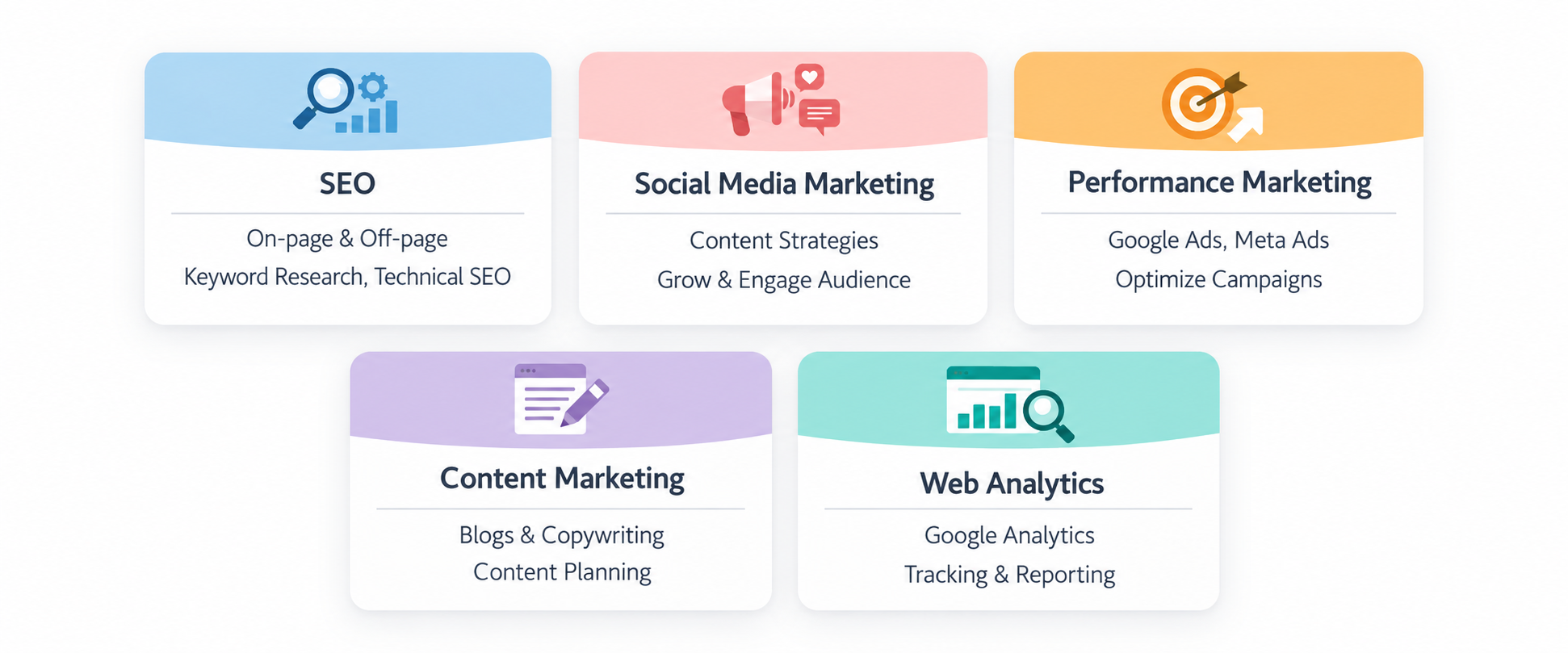
Learning Area | What You Will Learn |
SEO | On-page and off-page SEO, keyword research and technical SEO |
Social Media Marketing | Content strategies, audience growth and engagement |
Performance Marketing | Google Ads, Meta Ads and campaign optimisation |
Content Marketing | Blogs, copywriting and content planning |
Email Marketing | Automated campaigns and lead nurturing |
Web Analytics | Google Analytics, tracking and reporting |
Conversion Optimisation | Landing pages and A/B testing |
Marketing Strategy | Audience targeting and campaign funnels |
If you are someone who is looking for an SEO and Google Ads Course, upGrad’s digital marketing course online with certificate covers both in a single program.
What Specialisations Can You Choose in a Digital Marketing Course?
In upGrad’s digital marketing certification course you can choose specialisation based on your career goals. Below are the specialisation you can choose from:
- Performance MarketingLearn paid acquisition across platforms, campaign optimisation, scaling and CRO.
- Digital Brand StrategyLearn digital-first brand strategy, positioning and integrated campaigns for D2C brands.
- E-commerce Management and MarketingLearn how D2C and e-commerce businesses grow online through marketplaces.
- Social Media, Content & SEOLearn LinkedIn and X paid marketing, content strategy and advanced SEO.
- Marketing Analytics and CRMLearn to use marketing data for dashboards, insights and lifecycle growth through analytics and segmentation.
Tools And Technologies Covered In Digital Marketing Certification Courses
Digital marketing has changed a lot because of recent changes in technology. That’s why tools and technologies you explore in a digital marketing course online matters a lot.
Below are the tools which are important for campaign planning, execution and performance tracking.
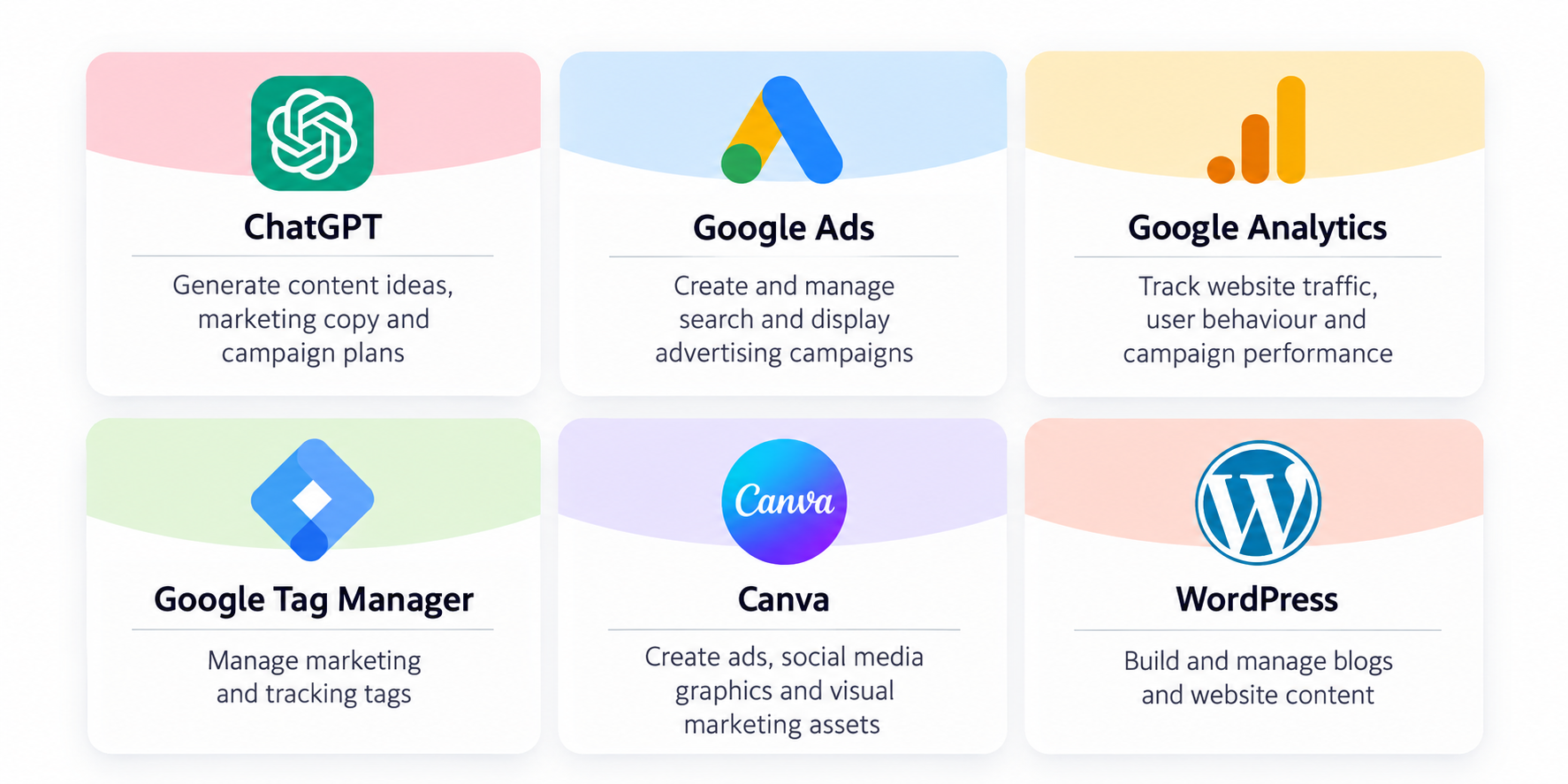
Tool | What You Can Learn |
ChatGPT | Content creation, marketing ideas and AI-assisted workflows |
WordPress | Blog creation, website management and content publishing |
Wix | Website creation and digital presence building |
Lovable | AI-assisted website and application creation |
CleverTap | Customer engagement, retention and lifecycle marketing |
Ubersuggest | Keyword research and SEO analysis |
GetResponse | Email marketing and campaign automation |
Canva | Marketing creatives, social media designs and visual content |
Ahrefs | SEO research, keyword analysis and competitor insights |
Google Ads | Search advertising and paid campaign management |
Ads Manager | Social media advertising and campaign management |
Google Tag Manager | Marketing tags and tracking setup |
Google Display & Video 360 | Display and video advertising campaign management |
n8n | Marketing workflow automation |
Make | Workflow and marketing automation |
Google Analytics | Website traffic, user behaviour and campaign analysis |
Looker | Data visualisation, dashboards and marketing reporting |
For learners looking for an AI Tools for Digital Marketing Course, AI-focused training can include content creation, campaign planning, audience insights and marketing automation, which is covered in upGrad’s digital marketing certification courses.
Hands-On Projects and Case Studies in upGrad Digital Marketing Course Online
A project or case study gives you an opportunity to explore the learned skills in real world problems, which makes your fundamentals more strong.
Below are some of the projects and cast studies covered in upGrad’s Digital Marketing course online with certificate:
Project/Case Study | What You Work On | Skills Learned |
Swiggy | Identify use cases, create content messages and select channel mixes for different target groups | Audience Segmentation, Content Strategy, Channel Planning |
Salesforce | Analyze how Salesforce used search and display campaigns to generate leads and drive software sales | Performance Marketing, Paid Advertising, Lead Generation |
Infidigit | Work on on-page and off-page SEO strategies to improve website performance | SEO Audit, On-Page SEO, Off-Page SEO |
The Whole Truth | Analyze the consumer persona and understand how the brand positions itself in the market | Consumer Understanding, Brand Positioning, Market Research |
Zivame | Segment the existing audience and identify which segments deliver better conversions | Email Marketing, Audience Segmentation, Conversion Analysis |
RentoMojo | Analyze the marketing funnel and identify suitable audiences and partners for acquisition and retargeting | Google Analytics 4, Funnel Analysis, Retargeting |
Career Options After Digital Marketing Course In India
After completing a digital marketing online course with certificate you can explore roles such as:
Job Role | What You Will Do |
Digital Marketing Manager | Plan and manage marketing strategies and campaigns |
Content Marketer | Create content and content strategies |
Performance Marketer | Run paid campaigns to generate leads and sales |
Email Marketing Specialist | Plan email campaigns and nurture leads |
Social Media Manager | Manage social pages and audience engagement |
SEO Specialist | Improve rankings and organic traffic |
Digital Marketing Executive | Support campaigns and marketing activities |
Where Can Digital Marketing Skills Be Used?
You can apply your digital marketing skills across different industries or in your own business. Some of the sectors are:
- IT Services and Software Products: In the field of IT, you need to market your products digitally, generate leads and also ensure that there is user acquisition.
- Banking, Financial Services and Insurance: In this industry, you will be marketing financial products and engaging people.
- E-commerce and Retail: In ecommerce and retail, you have to market your products and run campaigns.
- Healthcare and Life Sciences: In the healthcare industry, you will create awareness and provide information.
- Consulting and Professional Services: In this industry you have to create brand awareness and generate leads.
- Media and Content Platforms: For social media and content platforms you can grow audiences, promote content and improve engagement.
How to Choose a Digital Marketing Course In India?
Before choosing any digital marketing course online you should check these factors to ensure you are opting for the right course according to your preference.
Factor | What to Check |
Learner Level | If the course begins at the basics level or assumes that you have knowledge already |
Curriculum | SEO, content, social media, paid advertising, email marketing and analytics |
Tools | Google Ads, GA4, GTM, Semrush and AI tools as appropriate |
Live Projects | Real campaign work, case studies and practical assignments |
Portfolio Work | Whether you leave with projects that show your skills |
Mentorship | Faculty guidance, expert feedback and doubt support |
Certification | The certificate or credential awarded after completion |
Learning Format | Live sessions, recorded content, workshops and online assessments |
Specialisation | Areas such as AI-powered marketing, communication or other focused tracks |
Essential Resources to Navigate Your Digital Marketing Journey
Digital Marketing Course FAQs
1. What is an online digital marketing course?
An online digital marketing course is a way to learn how to create, launch and measure campaigns across SEO, paid advertising, social media, content and analytics. The learning could be delivered as live sessions, pre-recorded lessons, projects and case studies.
2. Can I pursue an online digital marketing course while working?
Yes, there are many digital marketing certification courses available online that are designed for working professionals including upGrad. The lessons are structured in a way by using recorded content, flexible learning hours and planned live sessions. The flexible timetable helps all working professionals to continue their occupations while learning the course material.
3. How many hours should I spend on a digital marketing course per week?
It is dependent on the online digital marketing course you choose. For example, upGrad’s MICA Advanced Certificate in AI-Powered Digital Marketing & Communication, requires about 8 to 10 hours each week.
4. Do digital marketing courses provide mentor support?
Yes, structured digital marketing courses in India have faculty access, industry experts or mentors. For example, upGrad’s MICA program has academics and industry mentors from organizations and brands like Google, Apple, Meta and JioHotstar.
5. Are doubt resolution sessions available in online digital marketing courses?
Yes, a good digital marketing certification course has dedicated doubt clearing or support session alongside regular class since it helps the learners to ask the relevant questions depending on doubts they acquire while learning.
6. Do digital marketing courses include case studies?
Yes. Case studies can provide learners with an understanding of how marketing tactics are used in real business settings. Some courses use brand-specific examples for the study of consumer segmentation, advertising, acquisition & retention. For example, case studies of companies like Zivame, Swiggy, Salesforce, and RentoMojo are available in upGrad’s MICA program.
7. What are the eligibility criteria for a Digital Marketing course in India?
Your eligibility will depend on the course you opt for. Every course has different set of eligibility. To apply for the Advanced Certificate in AI-Powered Digital Marketing & Communication from MICA you need to be a graduate in any discipline from a recognized university.
8. Can a digital marketing course include industry interaction?
Yes . Some of the programs also include webinars, guest sessions, networking events or industry immersions. For example, MICA’s Social Panga program offers a platform for learners to interact with business experts and exchange ideas during an industry immersion.
9. Are offline learning opportunities available with online digital marketing courses?
Yes, but it is contingent upon the type of course you take. Some Digital Marketing Certification Courses offer offline learning experience or campus visits along with the online classes. For example, students enrolled in upGrad’s MICA course have the option of a two-day campus immersion at its Ahmedabad location, subject to the programme’s terms and conditions and additional payments.
10. Can an online digital marketing course help me build my LinkedIn profile?
Some of the programs also offer professional branding support to help you with your career. This may involve help on your resume, optimization of your LinkedIn profile and coaching. It varies entirely on the type of online digital marketing course you take.
11. Do digital marketing courses provide access to a learner or alumni community?
Yes, most of the online digital marketing courses provide alumni access to the alumni community as a part of networking, which helps the learner to grow. upGrad MICA program (Advanced Certificate in AI-Powered Digital Marketing & Communication) provides executive alumni status of MICA.
12. Can an SEO and Google Ads Course include other marketing channels?
Yes. More than just search. Many digital marketing courses cover multiple digital platforms. Depending on the curriculum, learners may also study social media, content marketing, email marketing, analytics and paid advertising in addition to SEO and Google Ads.
13. Can automation be included in an AI Tools for Digital Marketing Course?
Yes. AI oriented courses can have AI assisted material, marketing automation, customer processes and data analysis. For example, the upGrad course has marketing automation and AI-driven triggers in its advanced curriculum.
14. Can I get multiple credentials from a digital marketing course?
Upon successful completion, several online digital marketing courses offer more than one credential. The exact requirements will vary from course to course and from the academic or industry partners. For example, the MICA program offers certificates from MICA and upGrad, along with some partner credentials for select learning routes.
upGrad Learner Support
Talk to our experts. We are available 7 days a week, 10 AM to 7 PM

Indian Nationals

Foreign Nationals
Disclaimer
1.upGrad does not grant credit; credits are granted, accepted, or transferred at the sole discretion of the relevant educational institution offering the diploma or degree. We advise you to enquire further regarding the suitability of this program for your academic, professional requirements and job prospects before .