Precision vs Recall: Understanding the Key Difference in Machine Learning
By Sriram
Updated on Jun 23, 2026 | 6 min read | 2.34K+ views
Share:

All courses
Certifications
More
By Sriram
Updated on Jun 23, 2026 | 6 min read | 2.34K+ views
Share:
Table of Contents
Precision vs recall is one of the most important ideas in machine learning, data science, information retrieval, and AI model evaluation. They help us measure how good a model is at finding positive cases. Precision and recall are two things that answer very different questions about model performance, although they seem to be similar.
In this blog, you’ll learn what precision and recall are and how to calculate them, formulas, when to prioritize. You will also see real world examples, compare precision and recall to accuracy so you can understand what the model is doing.
Explore Machine Learning Courses Online & Artificial Intelligence Courses from upGrad, master precision and recall build evaluation skills, optimize model performance, and advance your AI career.
Popular AI Programs
The precision of the model and the recall of the model are things to consider when we are evaluating a classification model.
Comparison in Table
Metric |
Focus |
Main Goal |
| Precision | Correctness of positive predictions | Reduce false positives |
| Recall | Coverage of actual positives | Reduce false negatives |
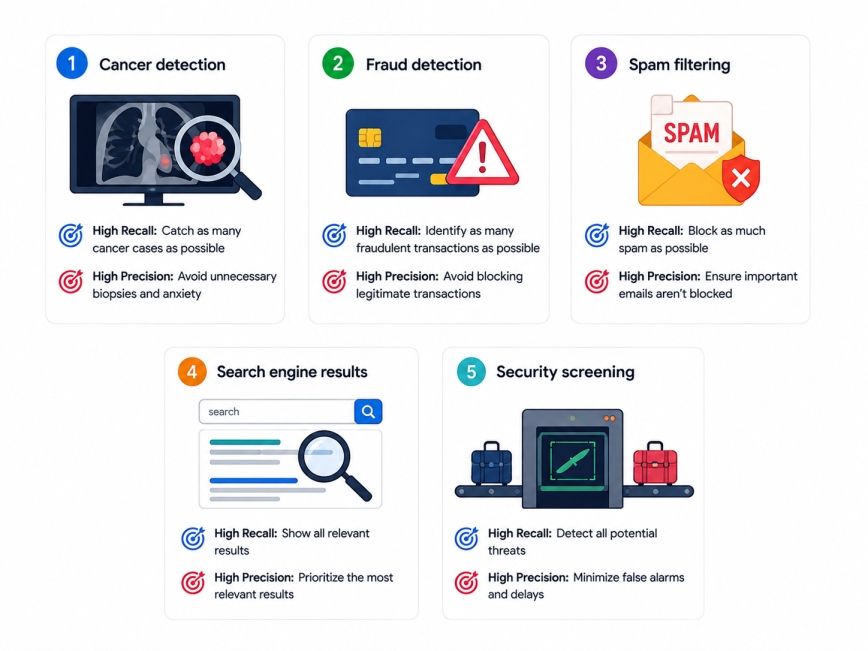
Different business problems require different priorities. The main point is that there is no universally "better" metric. The best one to use depends on what happens when you make a mistake.
For example:
Scenario |
More Important Metric |
| Cancer detection | Recall |
| Fraud detection | Recall |
| Spam filtering | Precision |
| Search engine results | Precision |
| Security screening | Recall |
Also Read: What is Classification in Machine Learning? A Complete Guide to Concepts, Algorithms, and Best Pract
Precision answers:
"Out of all the positive predictions made by the model, how many were actually correct?"
Formula:
Precision = TP / (TP + FP)
Where:
A model with high accuracy will make a few mistakes when it says something positive. Precision is a measure of how good the model is at making positive predictions.
A model with high recall misses very few positive cases. Recall measures completeness.
Recall answers:
"Out of all actual positive cases, how many did the model successfully identify?"
Formula:
Recall = TP / (TP + FN)
Where:
Imagine an email spam filter.
The model flags 100 emails as spam.
Precision:
90 / 100 = 90%
Now assume there were 120 spam emails in total. The model caught 90 of them.
Recall:
90 / 120 = 75%
In this case:
The email model is very accurate when it says that an email is spam. It still misses some spam emails.
Free Courses
Understanding the theory is useful. Understanding practical applications is even more valuable.
Disease detection systems often prioritize recall. Missing a cancer patient can have severe consequences. A few false alarms are usually acceptable.
Priority: Recall
Banks use machine learning to detect fraudulent transactions. Missing fraud is expensive. Investigating a few legitimate transactions is less costly.
Priority: Recall
Users expect relevant search results. Showing irrelevant pages hurts user experience.
Priority: Precision
Nobody wants important emails sent to spam. Therefore, precision becomes critical.
Priority: Precision
Streaming platforms and online stores need balance.
Recommendations should:
Priority: Balance between precision and recall
Self-driving systems must identify pedestrians, obstacles, and hazards. Missing a real hazard is dangerous. Therefore, recall often receives significant attention.
Application |
Priority |
| Medical diagnosis | Recall |
| Fraud detection | Recall |
| Airport security | Recall |
| Search engines | Precision |
| Spam filtering | Precision |
| Product recommendations | Balanced |
| Autonomous vehicles | Recall |
AI Courses to upskill
Explore Artificial Intelligence Courses for Career Progression
To fully understand precision vs recall, you need to understand the confusion matrix.
A confusion matrix is really helpful because it shows us how the predictions from a model compare with the outcomes from the model.
Actual Positive |
Actual Negative |
|
| Predicted Positive | True Positive (TP) | False Positive (FP) |
| Predicted Negative | False Negative (FN) | True Negative (TN) |
Each metric comes from these four values.
Precision focuses on predicted positives.
Precision = TP / (TP + FP)
Example:
Precision: 80 / (80 + 20) = 80%
This means 80% of positive predictions are correct.
Recall focuses on actual positives.
Recall = TP / (TP + FN)
Example:
Recall: 80 / (80 + 40) = 66.7%
This means the model identified 66.7% of all positive cases.
Also Read: Evaluation Metrics in Machine Learning: Types and Examples
One important thing in machine learning is balancing precision and recall. Increasing precision often reduces recall. Increasing recall often reduces precision.
Consider a disease screening model:
If the model labels almost everyone as sick:
If the model becomes extremely strict:
Visual Interpretation
Think of fishing with a net.
Recall
Precision
A huge net improves recall. A selective net improves precision.
Common Mistake Beginners Make
Many beginners focus only on accuracy.
A model can show:
Precision and recall are important because they help us understand the quality of a model. We can trust precision and recall, giving us an accurate view of model quality.
People often look up what is the difference between accuracy vs precision vs recall in machine learning. Although they are connected, they measure different things about how well something works.
Accuracy measures overall correctness.
Formula: Accuracy = (TP + TN) / Total Predictions
Precision measures prediction quality.
Formula: Precision = TP / (TP + FP)
Recall measures detection completeness.
Formula: Recall = TP / (TP + FN)
Metric |
Measures |
Best Used When |
| Accuracy | Overall correctness | Balanced datasets |
| Precision | Quality of positive predictions | False positives are costly |
| Recall | Ability to find positives | False negatives are costly |
Imagine airport security.
Out of 10,000 passengers:
A model identifies everyone as safe.
Results:
The model looks excellent based on accuracy. In reality, this is completely useless.
Accuracy is useful when:
Use precision and recall when:
In these situations, focusing only on accuracy can produce misleading conclusions.
The F1 score combines precision and recall.
Formula: F1 = 2 × (Precision × Recall) / (Precision + Recall)
It is helpful to have one metric that considers both aspects.
Also Read: Precision, Recall, and F1 Score Explained: From Basics to Advanced
Subscribe to upGrad's Newsletter
Join thousands of learners who receive useful tips
Understanding precision vs recall is essential for anyone working with machine learning, AI, analytics, or predictive models. Precision measures how accurate positive predictions are. Recall measures how many actual positive cases are successfully identified. Neither metric is universally better.
The right choice depends on your business objective and the cost of mistakes. When comparing accuracy vs precision vs recall, remember that accuracy can be misleading in imbalanced datasets. Precision and recall often provide deeper insight into model performance. By understanding their trade-offs and applications, you can make better decisions when evaluating and improving machine learning systems.
Want to explore more about precision vs recall? Book your free 1:1 personal consultation with our expert today.
Precision measures how many predicted positive cases are actually correct. Recall measures how many actual positive cases the model successfully identifies. Precision focuses on prediction quality, while recall focuses on coverage.
Accuracy measures overall correctness across all predictions. Precision evaluates the reliability of positive predictions. Recall evaluates how completely a model finds positive cases. Each metric highlights a different aspect of performance.
Think of a fishing net. Recall is about catching as many fish as possible. Precision is about making sure everything you catch is actually fish. One measures quantity, the other measures quality.
Precision refers to how precise or accurate positive predictions are. Recall refers to the model's ability to remember or retrieve all relevant positive cases. The names originated in information retrieval research and later became standard in machine learning.
In spam detection, precision measures how many emails marked as spam are truly spam. Recall measures how many spam emails were successfully identified from all spam emails received.
A simple memory trick is: Precision equals prediction quality. Recall equals finding all relevant results. Another method is remembering that precision reduces false positives, while recall reduces false negatives.
Yes. Precision reaches 100% when every positive prediction is correct and there are no false positives. However, recall may still be low if the model misses many actual positive cases.
Precision is important when false positives are costly. Examples include spam filtering, legal risk assessment, and content moderation. High precision ensures that positive predictions can be trusted.
Recall should be prioritized when missing positive cases creates serious consequences. Medical diagnosis, fraud detection, cybersecurity, and safety systems are common examples where high recall is preferred.
Not always. The F1 score provides a balanced summary of precision and recall. However, when one metric significantly matters more than the other, examining precision and recall separately gives better insights.
This usually happens in imbalanced datasets. If positive cases are rare, a model may achieve excellent accuracy by predicting most observations as negative. Despite high accuracy, it can still miss many important positive cases.
730 articles published
Sriram K is a Senior SEO Executive with a B.Tech in Information Technology from Dr. M.G.R. Educational and Research Institute, Chennai. With over a decade of experience in digital marketing, he specia...
Speak with AI & ML expert
By submitting, I accept the T&C and
Privacy Policy
Top Resources
Master's Degree
18 Months
Executive Diploma
12 Months
IIIT Bangalore
Executive Programme in Generative AI & Agentic AI for LeadersIndia’s #1 Tech University
Dual Certification
5 Months