India May Need $350–435 Billion Investment in AI and Data Centre Infrastructure by 2030
By Vikram Singh
Updated on Jul 30, 2026 | 15 min read | 4.31K+ views
Share:

All courses
Certifications
More
By Vikram Singh
Updated on Jul 30, 2026 | 15 min read | 4.31K+ views
Share:
Table of Contents
Key Highlights
As India's AI ecosystem expands with massive investments in infrastructure, professionals with practical AI skills will be in high demand. Explore upGrad's AI Courses in India to gain hands-on experience in machine learning, generative AI, and other future-ready technologies.
Popular AI Programs
India's digital economy is expanding at an unprecedented pace. Businesses across banking, healthcare, manufacturing, retail, education, and government services are increasingly integrating AI into their daily operations.
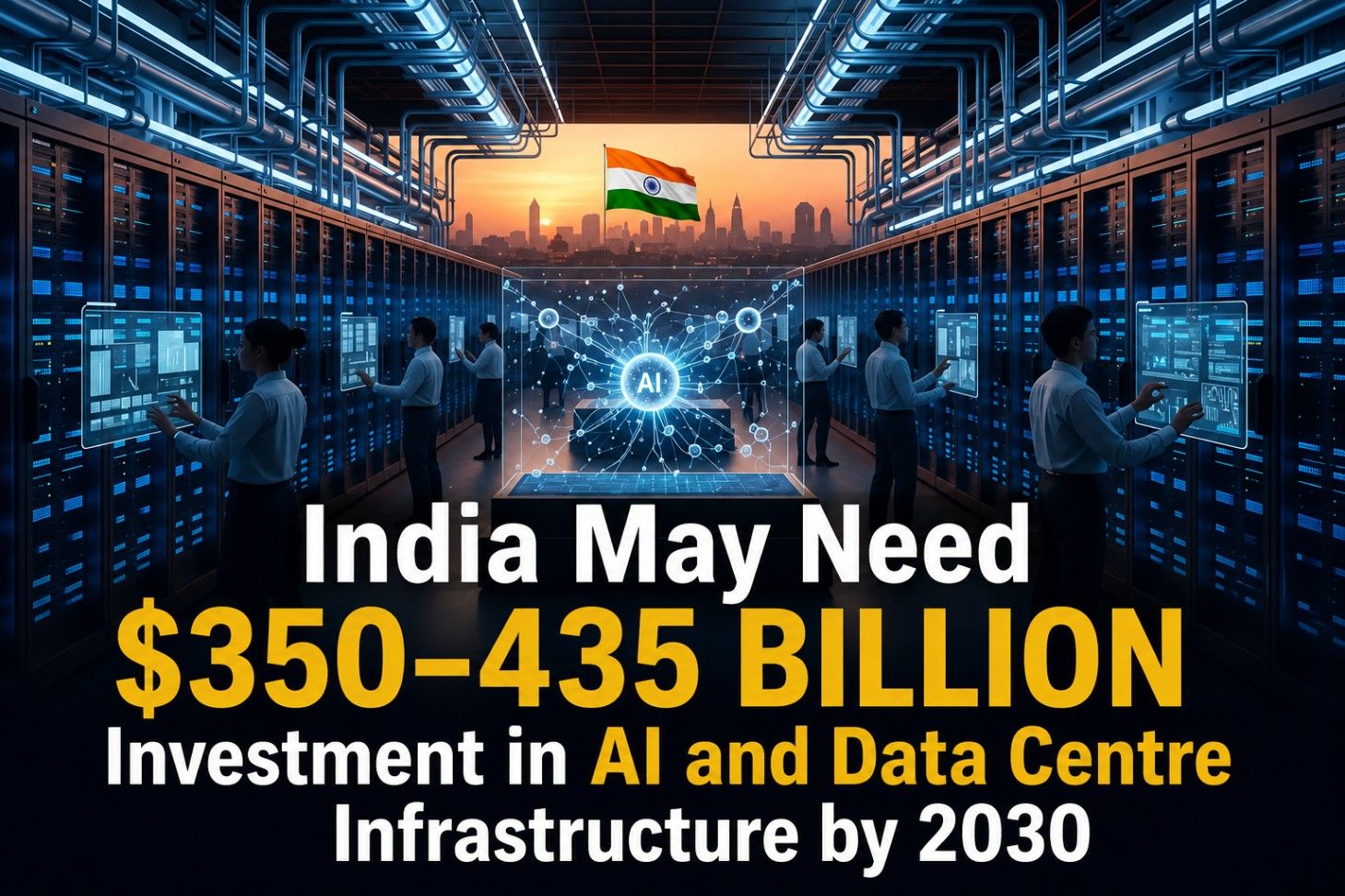
Unlike traditional software applications, AI models require enormous computing resources for training and inference. Large language models (LLMs), autonomous AI agents, and enterprise AI systems depend on high-performance GPUs, advanced networking, and energy-efficient data centres.
According to the report, India's existing installed data centre capacity of approximately 1.6 GW will be insufficient to support future AI workloads. To remain globally competitive, the country will need to expand operational capacity to nearly 19–23 GW by 2030.
Free Courses
The projected investment extends far beyond constructing new data centres. It covers the broader AI infrastructure ecosystem required to support large-scale digital transformation.
Major investment areas include:
| Infrastructure Area | Purpose |
| AI Data Centres | High-performance computing for AI workloads |
| GPU Infrastructure | Training and deploying large AI models |
| Renewable Energy | Meeting rising electricity demand sustainably |
| Cooling Technologies | Improving energy efficiency in AI facilities |
| High-Speed Networks | Faster data transfer and lower latency |
| Semiconductor Ecosystem | Supporting domestic AI hardware capabilities |
Together, these investments will create the foundation needed for India's next phase of AI-driven economic growth.
The future of AI depends on visionary technology leaders. Advance your expertise in AI strategy, digital transformation, and technology leadership with upGrad's Chief Technology Officer (CTO) & AI Course & Certification Program.
AI Courses to upskill
Explore Artificial Intelligence Courses for Career Progression
The report also points to the growing adoption of agentic AI-AI systems capable of planning, reasoning, and executing tasks with minimal human intervention.
Unlike traditional AI assistants that respond to prompts, agentic AI can independently complete multi-step workflows, coordinate with other AI systems, and automate complex business operations.
As enterprises shift from AI assistants to autonomous AI agents, organisations will require:
This evolution is expected to significantly increase demand for advanced AI infrastructure across industries.
The report suggests that India has a significant opportunity to become a global AI infrastructure hub. Factors supporting this growth include:
However, achieving this vision will require coordinated investments from government agencies, private enterprises, infrastructure developers, and technology providers.
Reliable electricity supply, land availability, regulatory support, and renewable energy integration will also play a critical role in enabling large-scale AI infrastructure expansion.
Countries including the United States, China, and several European nations are investing heavily in AI infrastructure to secure long-term technological leadership.
India's projected $350–435 billion investment reflects the scale required to remain competitive as AI becomes central to economic growth. Rather than focusing solely on AI software development, the report emphasises that physical infrastructure-including data centres, computing hardware, power systems, and connectivity-will be equally important for supporting future AI innovation.
India's AI ambitions extend well beyond developing advanced algorithms. Building a globally competitive AI ecosystem will require substantial investments in data centres, computing infrastructure, energy systems, and digital connectivity.
The projected $350–435 billion investment by 2030 highlights both the scale of the challenge and the opportunity ahead. As AI adoption accelerates and agentic AI transforms enterprise operations, expanding digital infrastructure will become essential for sustaining innovation, supporting economic growth, and positioning India as a leading player in the global AI landscape.
India's demand for AI data centres is expected to grow rapidly as businesses, cloud providers, and public sector organisations scale AI adoption. Industry estimates suggest the country could require 19–23 GW of operational data centre capacity by 2030 to support generative AI, cloud computing, and high-performance computing workloads.
Hyperscale data centres provide the computing power and scalability needed to train and deploy advanced AI models efficiently. As organisations increasingly adopt generative AI, AI agents, and cloud-based applications, these facilities help manage massive workloads while ensuring faster performance, reliability, and operational efficiency.
The Adani Group has announced plans to make substantial investments in AI-ready infrastructure, renewable energy, and digital ecosystems over the next decade. While reports mention investments approaching $100 billion by 2035, the exact amount dedicated specifically to AI-ready data centres will depend on future project execution and announcements.
Graphics Processing Units (GPUs) are critical for AI infrastructure because they perform complex computations much faster than traditional processors. They accelerate AI model training, enable real-time inference, and support large language models, making them an essential component of modern AI data centres.
Several industry reports indicate that India's technology sector is expected to approach $400 billion in annual revenue by 2030, driven by AI adoption, cloud computing, digital engineering, cybersecurity, and Global Capability Centres (GCCs). Continued investment in digital infrastructure will be essential to achieving this long-term growth.
Mumbai, Chennai, Hyderabad, Bengaluru, Pune, and Noida are emerging as key AI and data centre hubs due to strong connectivity, reliable power infrastructure, cloud investments, and enterprise demand. These cities are expected to attract significant investments as India's AI ecosystem continues to expand.
India's AI market is projected to grow significantly by 2030 as organisations increase investments in generative AI, machine learning, automation, and intelligent business applications. While market estimates differ across research firms, most forecasts indicate strong double-digit growth supported by digital transformation across industries.
As AI infrastructure expands, organisations will seek professionals skilled in artificial intelligence, cloud computing, data engineering, cybersecurity, and AI governance. Building practical experience, earning recognised AI certifications, and staying updated with emerging technologies can help professionals remain competitive in the evolving AI job market.
158 articles published
Vikram Singh is a seasoned content strategist with over 5 years of experience in simplifying complex technical subjects. Holding a postgraduate degree in Applied Mathematics, he specializes in creatin...
Speak with AI & ML expert
By submitting, I accept the T&C and
Privacy Policy
Top Resources
Master's Degree
18 Months
Executive Diploma
12 Months
IIIT Bangalore
Executive Programme in Generative AI & Agentic AI for LeadersIndia’s #1 Tech University
Dual Certification
5 Months