Apple Goes All In on AI at WWDC 2026: iOS 27, Siri Upgrades, & Apple Intelligence Take Center Stage
By Vikram Singh
Updated on Jun 09, 2026 | 5 min read | 1.35K+ views
Share:

All courses
Certifications
More
By Vikram Singh
Updated on Jun 09, 2026 | 5 min read | 1.35K+ views
Share:
Table of Contents
Key Highlights of Apple WWDC 2026
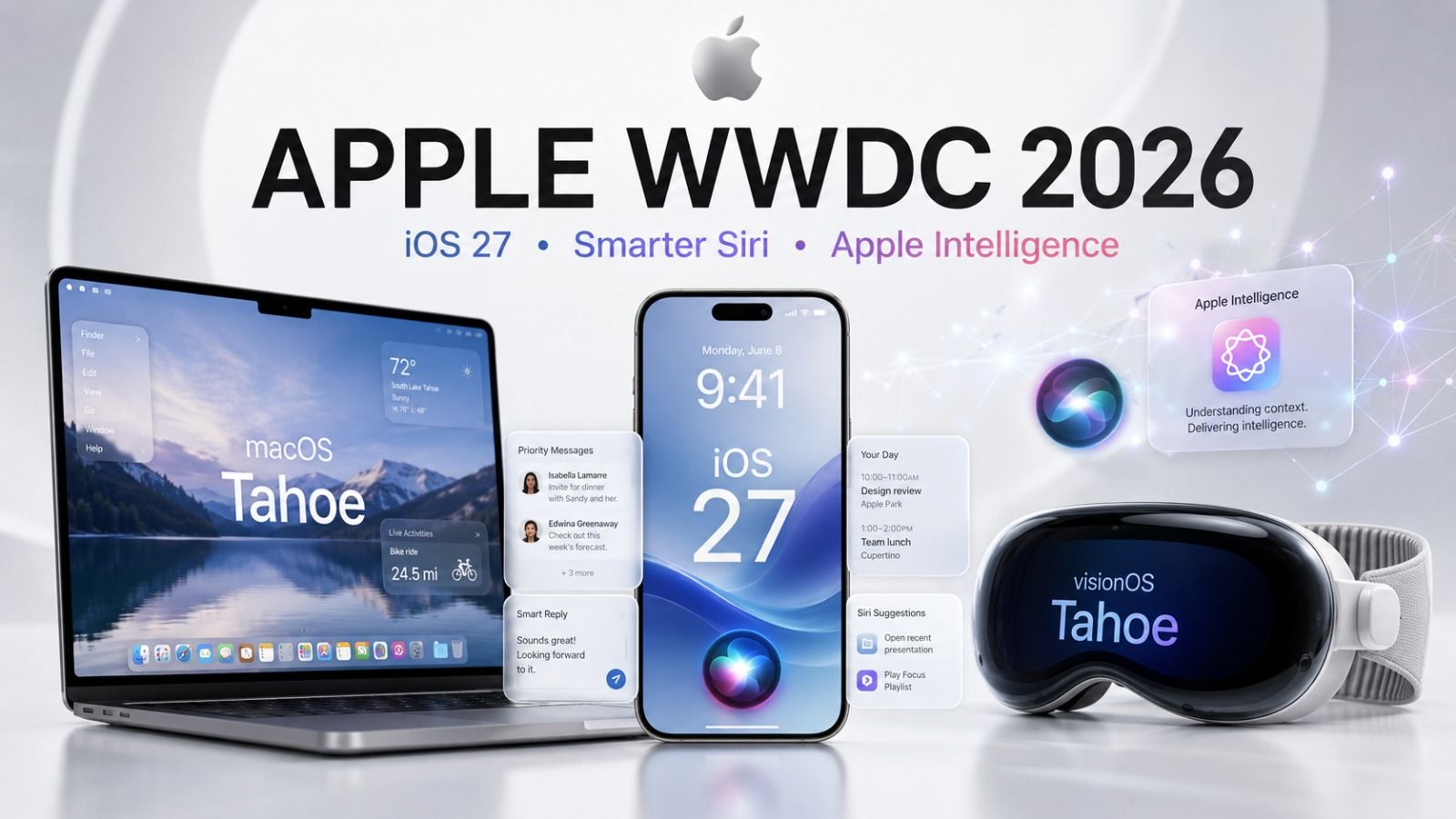
At its Worldwide Developers Conference (WWDC) 2026, Apple unveiled a broad range of software updates across the iPhone, iPad, Mac, Apple Watch, Apple TV, Vision Pro, and developer ecosystem.
While previous WWDC events focused primarily on operating system upgrades, this year's keynote made one thing clear: artificial intelligence is now central to Apple's future.
The company expanded Apple Intelligence across its ecosystem, introduced new AI-powered capabilities for Siri, revealed iOS 27 and macOS Tahoe, and provided developers with tools to build smarter applications while maintaining Apple's long-standing focus on privacy.
The keynote reflected Apple's effort to strengthen its position in an increasingly competitive AI market dominated by Google, OpenAI, Microsoft, and Meta.
Popular AI Programs
Apple officially announced iOS 27, bringing a mix of design improvements, AI enhancements, and productivity-focused features.
One of the most anticipated parts of WWDC 2026 was Apple's update to Siri.
The company demonstrated a significantly more capable Siri that can:
Examples shown during the keynote included:
While Apple showcased substantial progress, analysts noted that Siri still faces comparisons with ChatGPT, Gemini, and other advanced AI assistants.
Apple Intelligence received one of the largest updates since its introduction.
Users can:
Apple Intelligence can now summarize:
Users can create:
directly within supported apps.
The system can automate routine workflows based on user behavior.
Apple introduced macOS Tahoe, the latest version of its desktop operating system.
Apple says Tahoe is designed to reduce friction between Mac, iPhone, and iPad workflows.
Apple continued its effort to position the iPad as a productivity device.
Apple also updated watchOS with several new intelligence-driven features.
Apple continued investing in spatial computing with updates to Vision Pro.
Developers received new APIs and frameworks designed to integrate Apple Intelligence into applications.
Developers can now:
Apple announced several improvements for businesses and IT administrators.
These updates are expected to strengthen Apple's position in enterprise environments.
Unlike many competitors, Apple repeatedly emphasized privacy throughout the keynote.
According to Apple:
Free Courses
WWDC 2026 demonstrated that Apple is accelerating its AI ambitions without abandoning its traditional strengths.
Instead of launching a standalone chatbot competitor, Apple is embedding intelligence throughout its ecosystem.
The company's strategy centers on:
While competitors focus on powerful standalone AI assistants, Apple is betting users will prefer intelligence that works quietly in the background.
Whether that strategy is enough to compete in the rapidly evolving AI race remains one of the industry's biggest questions.
AI Courses to upskill
Explore Artificial Intelligence Courses for Career Progression
Despite numerous announcements, the biggest takeaway from WWDC 2026 may be that Apple is still in the middle of its AI transformation rather than at the end of it.
Competitors continue releasing increasingly capable AI models, autonomous agents, and enterprise AI platforms. Apple's focus remains centered on user experience, privacy, and ecosystem integration rather than headline-grabbing AI demonstrations.
For Apple users, this approach may feel more practical and reliable. For investors and industry observers, however, questions remain about whether Apple can move quickly enough in an AI market evolving at unprecedented speed.
WWDC 2026 showcased Apple's growing focus on artificial intelligence, with iOS 27, smarter Siri capabilities, and expanded Apple Intelligence features taking center stage. While the company didn't introduce major new hardware, it delivered meaningful software updates across its ecosystem. As competition in AI continues to intensify, Apple is betting on a combination of privacy, seamless integration, and user-friendly experiences to strengthen its position in the next generation of technology.
WWDC 2026 focused heavily on artificial intelligence and software upgrades across Apple's ecosystem. The company introduced iOS 27, macOS Tahoe, major Siri improvements, expanded Apple Intelligence features, new developer tools, and updates for iPadOS, watchOS, and visionOS. Apple also showcased how AI will be integrated into everyday tasks such as writing, communication, productivity, and device management.
Apple Intelligence is Apple's suite of AI-powered tools designed to work across iPhone, iPad, Mac, and other Apple devices. At WWDC 2026, Apple expanded its capabilities with enhanced writing assistance, content summarization, image generation, workflow automation, and contextual app interactions. The company emphasized that many of these features run directly on the device to protect user privacy.
Apple unveiled one of Siri's most significant upgrades in years. The virtual assistant can now maintain conversational context, understand more complex requests, interact across multiple apps, and perform multi-step actions. Siri is also more deeply integrated with Apple Intelligence, enabling smarter responses and more personalized assistance throughout the operating system.
iOS 27 introduces several AI-powered enhancements, including smarter notifications, intelligent email organization, contextual app suggestions, advanced photo search, improved messaging features, and writing tools powered by Apple Intelligence. Apple has also improved personalization across the operating system to help users complete everyday tasks more efficiently.
WWDC 2026 primarily focused on software, artificial intelligence, and developer technologies. While Apple discussed updates to Vision Pro and its broader ecosystem, the keynote did not center around major hardware launches. Instead, the company highlighted how existing devices will benefit from new AI-powered software experiences.
macOS Tahoe is the latest version of Apple's desktop operating system. It introduces AI-enhanced productivity tools, smarter Spotlight search, improved multitasking, deeper integration with iPhone and iPad, and expanded Apple Intelligence capabilities. The update aims to streamline workflows and help users access information more quickly across their devices.
Unlike many competitors that focus on cloud-based AI chatbots and standalone assistants, Apple is embedding AI directly into its operating systems and applications. The company continues to prioritize on-device processing, privacy, and seamless user experiences. Apple's goal is to make AI a natural part of daily device interactions rather than a separate product users must actively engage with.
Apple announced new APIs, frameworks, and development tools that allow developers to integrate Apple Intelligence into their applications. These tools enable app creators to build AI-powered experiences, automate tasks, personalize content, and access on-device intelligence while maintaining Apple's privacy and security standards.
Apple introduced several improvements for Vision Pro through updates to visionOS. New features include enhanced collaboration tools, better productivity workflows, richer spatial computing experiences, and expanded capabilities for developers building mixed-reality applications. The company continues to position Vision Pro as a key part of its long-term computing strategy.
Developer beta versions of Apple's newly announced software are available immediately following WWDC 2026. Public beta releases are expected later in the year, while stable versions of iOS 27, macOS Tahoe, iPadOS, watchOS, and visionOS are likely to roll out to eligible devices in the coming months.
158 articles published
Vikram Singh is a seasoned content strategist with over 5 years of experience in simplifying complex technical subjects. Holding a postgraduate degree in Applied Mathematics, he specializes in creatin...
Speak with AI & ML expert
By submitting, I accept the T&C and
Privacy Policy
Top Resources
Master's Degree
18 Months
Executive Diploma
12 Months
IIIT Bangalore
Executive Programme in Generative AI & Agentic AI for LeadersIndia’s #1 Tech University
Dual Certification
5 Months