AI Job Loss: Impact, Statistics, Jobs at Risk, and the Future of Work
By Sriram
Updated on Jul 30, 2026 | 10 min read | 7.04K+ views
Share:

All courses
Certifications
More
By Sriram
Updated on Jul 30, 2026 | 10 min read | 7.04K+ views
Share:
Table of Contents
Key Highlights
Want to stay ahead in the AI-driven job market? Explore upGrad's AI Courses in India to build in-demand AI skills, work on real-world projects, and prepare for the future of work.
Popular AI Programs
Jobs that are reduced, replaced or reshaped due to artificial intelligence being able to do certain tasks faster and more efficiently than humans are referred to as AI job loss. However, AI rarely replaces full roles. Instead, it automates routine tasks, enabling employees to concentrate on work that requires creativity, critical thinking, and decision-making.
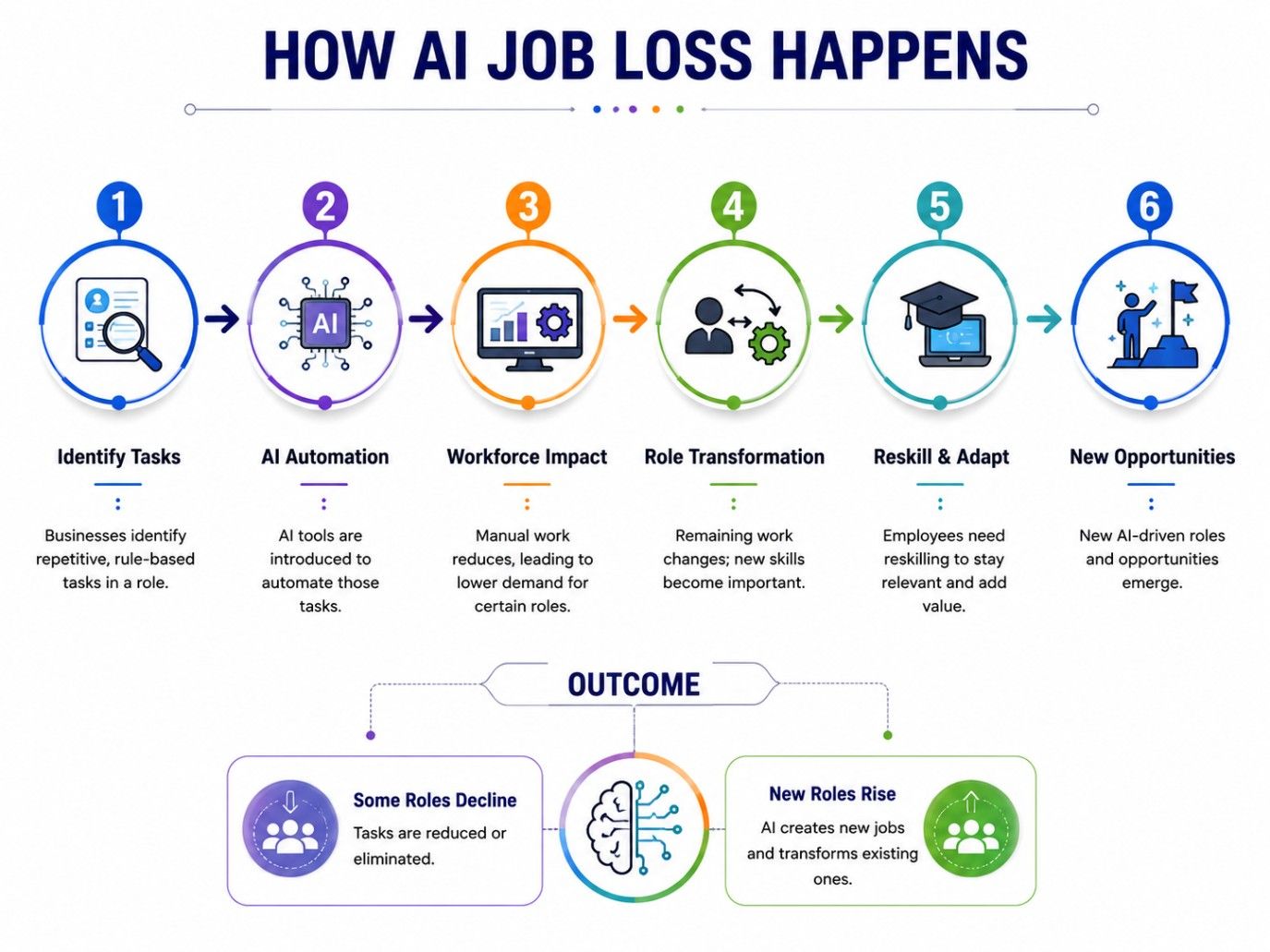
It varies by industry. Jobs involving data entry, customer support, administrative work and other repetitive tasks are among the most affected. Meanwhile, AI is also generating a need for new skills and jobs in AI development, deployment and oversight. As automation grows, fears over AI job loss and job loss due to AI in India continue.
AI is changing jobs more often than eliminating them. For example, customer support teams now use AI chatbots to handle routine queries, while software developers rely on AI coding assistants to speed up development. Rather than replacing workers completely, AI shifts responsibilities and helps employees focus on higher-value tasks. This shows that the loss of jobs due to AI is often accompanied by job transformation, where people and AI work together instead of competing.
Must read: Impact of Artificial Intelligence: Benefits, Risks, and What’s Next
Free Courses
AI is not going to replace every worker in a single day. Rather, it’s changing how work gets done. Businesses are leveraging AI to automate routine tasks, enhance productivity, and cut operating costs. When AI can perform routine work faster, companies often need fewer people doing those jobs. That is one of the main reasons for the growing conversation around AI job loss.
The effect is not the same for all professions. Jobs with repetitive, rule-based tasks are more likely to change, while jobs that depend on creativity, leadership, or human interaction are less easy to automate. This is why job loss from AI hits some industries sooner than others.
AI can do digital tasks that repeat themselves quickly and consistently. It can process data, answer common questions, generate reports and organise information in seconds.
Typical examples are:
Employees often move into roles that require problem-solving or customer interaction when these tasks are automated. However, in some organisations, fewer workers are needed, which leads to a loss of jobs due to AI.
Task |
Before AI |
After AI |
| Customer queries | Handled by support staff | Managed by AI chatbots |
| Data entry | Manual processing | Automated data extraction |
| Report creation | Hours of work | Generated in minutes |
Unlike traditional automation, generative AI can create text, code, images, and summaries. This allows professionals to complete tasks much faster.
For example:
These tools are not always a substitute for professionals. The time required to perform routine tasks decreases, which can alter hiring needs over time.
This trend is contributing to job loss due to AI in India, especially in IT services, customer support, and business process outsourcing, where many routine digital tasks can now be completed with AI assistance.
Also read : Artificial Intelligence in the Real World
AI more often automates tasks than jobs. Although it deals with repetitive work, people still make decisions, solve complex problems and build relationships-skills that AI cannot easily replicate.
As a result, many organisations are re-designing roles rather than eliminating them. Employees who can work effectively with AI will be better positioned for the future of work.
Prepare for the future of AI-driven work with upGrad's Chief Technology Officer Program - CTO & AI Course & Certification. Build leadership and AI expertise to stay competitive in a rapidly evolving job market.
AI Courses to upskill
Explore Artificial Intelligence Courses for Career Progression
AI job loss is no longer just a prediction. Studies from leading global organisations show that AI is reshaping the workforce, though most experts believe it will transform jobs faster than it replaces them. The impact of job loss due to AI will vary across industries, skills, and regions.
What the Latest Data Shows:
Organisation |
Key Finding |
| World Economic Forum | AI and automation are expected to create millions of jobs while displacing others by 2030. |
| Goldman Sachs | Generative AI could affect up to 300 million full-time jobs globally. |
| International Monetary Fund (IMF) | Nearly 40% of jobs worldwide could be exposed to AI. |
| OECD | AI is more likely to transform jobs than replace them completely. |
| Anthropic Economic Index | AI mainly assists knowledge workers by automating specific tasks. |
Being exposed to AI doesn’t always translate into AI job loss. A role is exposed if AI can do some of the tasks, but the human is still required to make decisions and solve problems.
That’s why experts believe AI-driven job losses will be slow. Companies typically roll out AI to work alongside employees before making major changes to the workforce. The conversation around job loss due to AI is also growing in India with sectors like IT services and customer support continuing to adopt AI-powered automation.
Also read : Artificial Intelligence Effects on Society: Benefits, Risks, and Real-World Impact
Not every profession faces the same level of risk. AI performs best when work follows clear rules, uses digital information, and involves repetitive tasks. Jobs that depend on creativity, leadership, negotiation, or hands-on expertise remain much harder to automate.
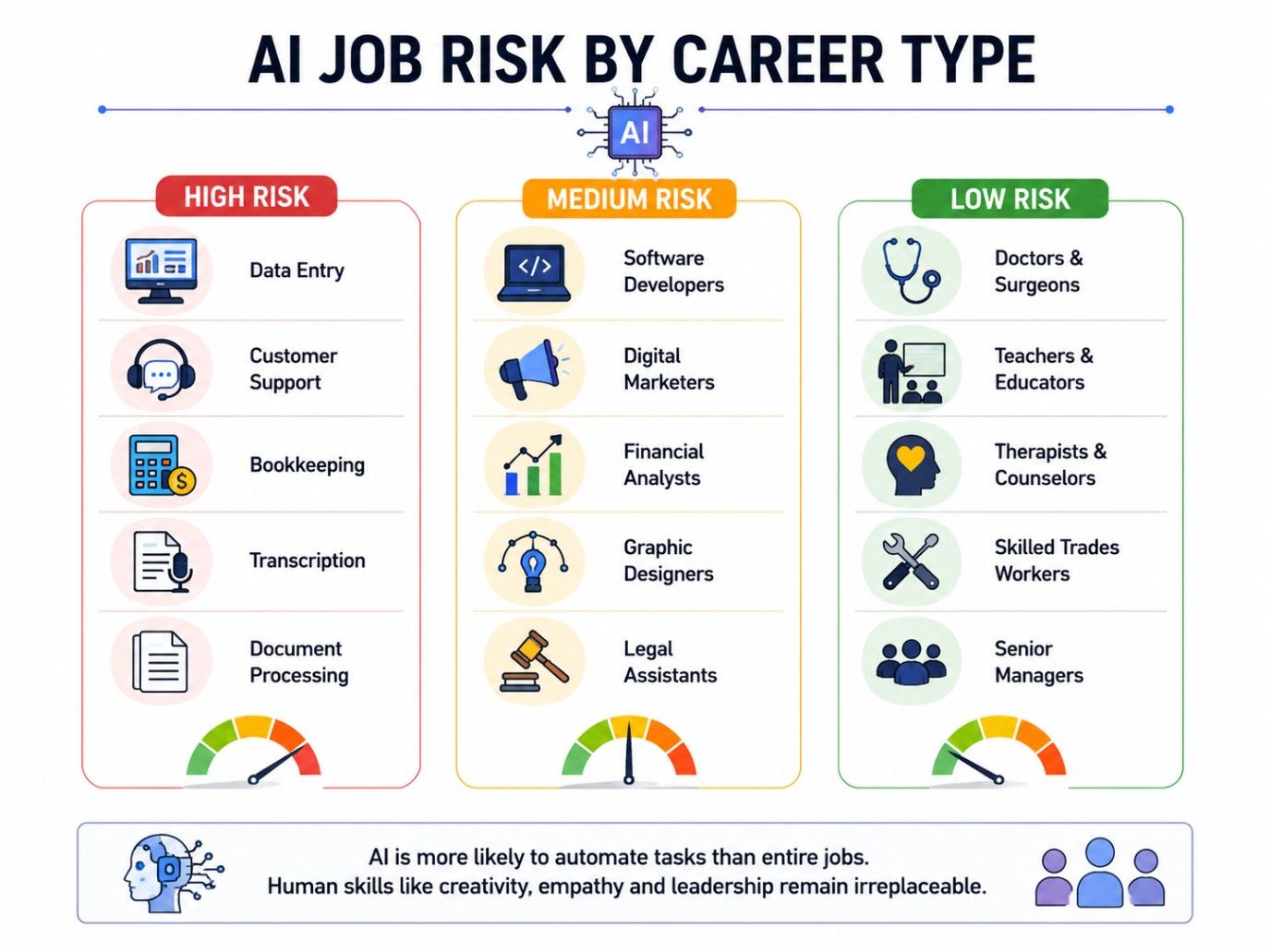
That doesn't mean they're immune. It simply means AI is more likely to assist than replace workers in those roles.
These roles involve repetitive digital tasks that AI can perform efficiently.
These professions are changing rather than disappearing.
AI helps these workers complete routine tasks faster, allowing them to focus on higher-value work.
Jobs that rely heavily on human judgement and physical interaction are less likely to be replaced.
The impact of AI job loss depends less on job titles and more on the tasks performed every day. As AI capabilities improve, organisations will continue redesigning roles instead of simply replacing employees. Understanding which skills are easiest to automate can help both individuals and businesses prepare for future workforce changes.
Careers that rely on human judgement, creativity, emotional intelligence, and physical expertise are currently the least vulnerable to AI automation. While AI can support these professionals, it cannot fully replace the human skills required in these roles.
Some of the safest careers include:
Career |
Why AI Is Less Likely to Replace It |
| Doctors and Surgeons | Clinical judgement, patient care, and complex decision-making |
| Nurses | Empathy, patient interaction, and hands-on care |
| Teachers | Personalised learning, mentoring, and classroom management |
| Psychologists and Therapists | Emotional intelligence and human connection |
| Electricians and Plumbers | Physical work in changing environments |
| Skilled Trades | Hands-on problem-solving and adaptability |
| Senior Managers | Leadership, negotiation, and strategic planning |
| Entrepreneurs | Innovation, business decisions, and risk-taking |
Do read: Applications of Artificial Intelligence and Its Impact
The discussion around AI job loss often focuses on roles that may disappear. That's only part of the story. As AI automates routine work, it is also creating demand for new skills and entirely new career paths.
This pattern isn't new. Earlier technologies changed the nature of work rather than eliminating employment altogether. AI is following a similar path, although the transition is happening much faster.
AI has the biggest impact on roles that involve repetitive, predictable, and data-driven tasks.
Some examples include:
As businesses automate these activities, the need for large teams performing identical tasks decreases. This has increased concerns about job loss due to AI, especially in industries that depend on repetitive digital work.
While some roles decline, others are growing quickly.
Examples include:
These professionals build, monitor, improve, and manage AI systems. Businesses also need employees who can combine industry expertise with AI tools to improve productivity.
Roles Declining |
Roles Growing |
| Data entry clerks | AI Engineers |
| Basic customer support | AI Product Managers |
| Manual document processing | AI Trainers |
| Routine content production | AI Ethics Specialists |
Rather than replacing every worker, AI is changing the skills employers value. This explains why many experts believe the future workforce will include both people and AI working together instead of one replacing the other.
Also read: Top Artificial Intelligence Jobs in 2026: Roles and Salary
Subscribe to upGrad's Newsletter
Join thousands of learners who receive useful tips
Automation has existed for decades. Manufacturing plants, warehouses, and factories have used machines to perform repetitive tasks for years. AI takes automation much further because it can analyse information, recognise patterns, and generate new content.
Automation follows fixed rules. AI can learn from data and respond to different situations.
Automation |
Artificial Intelligence |
| Performs repetitive tasks | Handles repetitive and cognitive tasks |
| Works with predefined rules | Learns from patterns and data |
| Limited decision-making | Supports complex decision-making |
| Mainly affects manual work | Affects both manual and knowledge work |
This difference explains why AI job loss is receiving more attention than earlier waves of automation. AI isn't only changing factory jobs. It is also reshaping professions such as marketing, software development, finance, legal services, and customer support.
The loss of jobs due to AI is therefore broader than traditional automation because knowledge workers are now experiencing the effects as well.
Also Read : Why AI Is The Future & How It Will Change The Future?
Probably not.AI is excellent at handling repetitive tasks, analysing data, and recognising patterns. However, it still cannot match human creativity, empathy, leadership, or critical decision-making.
Most jobs include both routine and complex responsibilities. AI can automate repetitive work, while people continue to solve problems, make strategic decisions, and build relationships. For example, AI can generate code or draft legal documents, but developers and lawyers still review and refine the final output.
In simple terms:
The future of work is unlikely to be humans versus AI. Instead, it will be people and AI working together, with professionals using AI to improve productivity rather than replace human expertise.
Also read: AI vs. Human Intelligence: Key Differences & Job Impact
AI job loss is already reshaping many industries, though most changes involve tasks rather than entire jobs. Employees are increasingly using AI to improve productivity while focusing on work that requires human judgement.
Industry |
AI Application |
Workforce Impact |
| Customer Service | AI chatbots | Handles routine customer queries |
| Banking | Fraud detection | Reduces manual verification |
| Marketing | AI content tools | Speeds up content creation |
| Software Development | AI coding assistants | Improves coding efficiency |
| Healthcare | AI diagnostics | Supports faster clinical decisions |
| Manufacturing | Robotics | Automates repetitive operations |
AI is changing how people work, not just replacing them.
There are many misconceptions about AI job loss. Looking at the facts provides a clearer understanding of how AI is affecting the workforce.
Myth |
Reality |
| AI will replace every job. | AI automates specific tasks, not entire professions. Human creativity, critical thinking, and communication remain difficult to replace. |
| Only low-skilled jobs are affected. | AI is also reshaping knowledge-based roles in software development, finance, marketing, legal services, and other professional fields. |
| AI only destroys jobs. | While job loss due to AI is occurring in some sectors, AI is also creating new careers in AI engineering, data science, cybersecurity, and AI governance. |
| AI adoption happens overnight. | Most organisations implement AI gradually, allowing employees to adapt and work alongside AI tools before major workforce changes occur. |
As organisations adopt AI across their operations, the focus is shifting beyond productivity to the long-term impact on employees and society. While AI offers significant business benefits, it also raises important ethical and workforce challenges that require careful planning.
Key challenges include:
The conversation around job loss due to AI in India is also growing, particularly in IT and business process outsourcing, where automation is accelerating.
The future of work will depend on how organisations, governments, and employees adapt to AI. While AI job loss will affect some roles, it will also reshape the way people work and create new opportunities.
Key trends include:
Artificial intelligence is reshaping the workplace by automating routine tasks and changing how work is performed. While job loss due to AI is affecting some roles, many jobs are evolving rather than disappearing. The impact will vary across industries, depending on the nature of the work and the pace of AI adoption.
The loss of jobs due to AI also brings new opportunities in AI-related fields and technology-driven roles. As businesses continue adopting AI, success will depend on combining human expertise with intelligent systems, making adaptability and continuous learning essential for the future workforce.
Ready to start your journey? Book a free consultation with upGrad today to find the best path for your career.
AI is reshaping India's job market by automating repetitive work while increasing demand for digital, analytical, and AI-enabled skills. Although job loss due to AI in India is a growing concern in some sectors, new roles in AI, cybersecurity, data, and cloud technologies are expanding simultaneously. The long-term impact depends largely on workforce reskilling.
AI is expected to generate employment across healthcare, fintech, manufacturing, education, logistics, and renewable energy. Rather than causing widespread loss of jobs due to AI, these industries are creating demand for professionals who can work alongside AI systems, interpret insights, and manage intelligent technologies effectively.
Most economists believe AI will change the nature of employment more than eliminate work altogether. While job loss due to AI may occur in routine occupations, history shows that technological revolutions also create entirely new industries, career paths, and opportunities requiring updated human skills.
Future-proofing starts with continuous learning. Professionals should build expertise in problem-solving, communication, leadership, creativity, and AI literacy. Combining domain knowledge with technical skills makes individuals more adaptable, reducing the risk of job loss due to AI while improving long-term career prospects.
Many entry-level jobs involve repetitive administrative tasks that AI can automate faster than complex decision-making. However, graduates who develop practical experience, industry certifications, and AI-related skills remain competitive because employers increasingly value adaptability over routine task execution.
Critical thinking, emotional intelligence, creativity, strategic decision-making, data literacy, prompt engineering, and cross-functional collaboration are becoming highly valuable. These human-centric capabilities complement AI rather than compete with it, helping professionals remain relevant as automation becomes more common across industries.
AI may place downward pressure on salaries for highly repetitive roles where automation increases productivity. However, professionals who upskill in AI tools, analytics, automation, or specialized expertise often command higher compensation because organizations value employees who can effectively leverage emerging technologies.
Yes. Many small businesses use AI to automate scheduling, customer support, marketing, inventory management, and reporting while retaining employees for relationship-building, strategy, and business growth. In many cases, AI improves productivity instead of causing loss of jobs due to AI within smaller organizations.
Beyond technology, organizations often struggle with poor-quality data, employee resistance, unclear business goals, integration issues, governance concerns, and skill shortages. Addressing these challenges through proper planning, training, and responsible implementation significantly improves the chances of successful AI adoption.
Students should combine academic knowledge with practical experience through internships, certifications, projects, and digital skills. Learning AI fundamentals, data analysis, programming, and communication creates stronger career opportunities, even as concerns about job loss due to AI in India continue to grow.
Many governments are investing in workforce development, digital education, AI regulations, and reskilling initiatives to reduce the impact of job loss due to AI. Future policies are expected to focus on responsible AI adoption, lifelong learning, and helping workers transition into emerging occupations rather than limiting innovation.
727 articles published
Sriram K is a Senior SEO Executive with a B.Tech in Information Technology from Dr. M.G.R. Educational and Research Institute, Chennai. With over a decade of experience in digital marketing, he specia...
Speak with AI & ML expert
By submitting, I accept the T&C and
Privacy Policy
Top Resources
Master's Degree
18 Months
Executive Diploma
12 Months
IIIT Bangalore
Executive Programme in Generative AI & Agentic AI for LeadersIndia’s #1 Tech University
Dual Certification
5 Months