
- Sign In
- Home
- Study Abroad
- Articles
- Study in Germany for Free
Study in Germany for Free
Updated on Aug 09, 2026 | 13.2K+ views
Share:
You can study in Germany for free at any public university, since most charge zero tuition for domestic and international students alike. What you will still pay is a semester contribution of €250 to €350 (₹27,000 to ₹37,900), plus proof of around €11,904 (₹12.88 lakh) a year for living costs before your visa gets approved.
Free only covers tuition, though. In two states, Baden Württemberg and Bavaria, non-EU students may be charged actual tuition, and living costs are entirely on you either way. None of that makes Germany less worth it, over 46,000 Indian students study there already, more than almost any other non European country. It just means the real planning happens around living costs and visa paperwork, not fees.
This guide walks through what's genuinely free, what isn't, who qualifies, and what the whole thing costs once you add it all up.
So What's Actually Free?
Public universities in Germany don't charge tuition for bachelor's and most master's programmes, for German citizens and international students alike. That's true across 14 of Germany's 16 states.
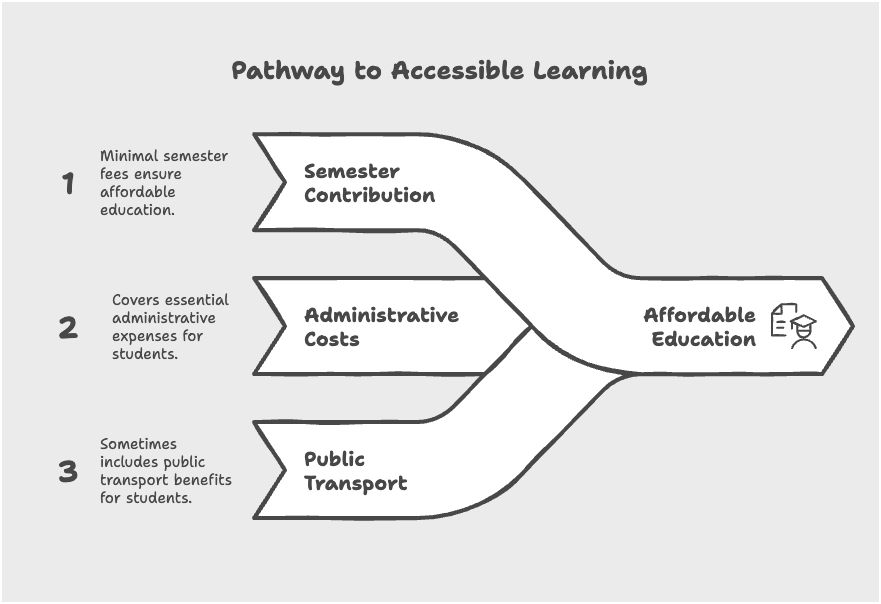
What you do pay is a semester contribution, usually between €250 and €350 (₹27,000 to ₹37,900) per term. This isn't tuition. It covers administration, student services, and in most cities, a semester transit pass that gets you free public transport.
Two states break from this:
- Baden Württemberg, home to Stuttgart, Heidelberg, Freiburg, and Karlsruhe, has charged non EU students €1,500 (₹1.62 lakh) per semester since 2017. That's around €3,000 (₹3.25 lakh) a year.
- Bavaria followed in 2023, though so far only Technical University of Munich has actually applied the fee to non EU students. Most other Bavarian public universities remain tuition-free.
Everywhere else, public university tuition stays at zero. Private universities are a different story, with fees ranging from €5,000 to €20,000 (₹5.4 lakh to ₹21.6 lakh) a year depending on the programme.
Suggested Read: Public Universities in Germany
Master's Programmes in Germany
Most Indian students who come to Germany end up in a master's programme, and it's easy to see why. Tuition stays free at public universities, a lot of courses run entirely in English, and the ECTS credit system, usually 120 credits for a master's, lines up cleanly with most Indian bachelor's degrees.
Here's a quick sense of what's out there:
Programme Type |
Focus |
Best For |
Duration |
| MSc / MA | Research and academic depth | PhD-track or specialist roles | 2 years |
| M.Eng | Applied, project-based learning | Engineering grads wanting industry roles | 1.5 to 2 years |
| MBA (English-taught) | Management and strategy | Students with 1 to 2 years' work experience | 1 to 1.5 years |
| Interdisciplinary Master's | Mixed fields, like tech and business | Students from varied academic backgrounds | 2 years |
These programmes run at scale across public universities like Technical University of Munich, RWTH Aachen, and University of Stuttgart, and none of them charge tuition outside the Baden Württemberg and Bavaria exceptions mentioned above.
Suggested Read: Masters in Germany
Bachelor's Programmes in Germany
Bachelor's degrees are a bit more layered, mostly because of language. Plenty of English-taught bachelor's programmes exist, but a large chunk still require German at B1 or B2 level, especially in traditional research universities.
Programme types generally break down like this:
- BSc, 3 to 3.5 years, available in both German and English
- BA, 3 to 4 years, mostly German-taught with some English options
- BEng, 3.5 to 4 years, available in both languages
- Dual study programmes with a paid work component, usually German-medium, 3 to 4 years
- International bachelor's programmes, fully English-taught, 3 to 3.5 years
If your Class 12 doesn't line up with the German Abitur, which is common for Indian students, you may need to complete a one-year Studienkolleg (foundation course) before starting your bachelor's. Technical universities like TU Berlin and TU Munich are usually strict about this.
Suggested Read: Study in Germany for Indian Students After 12th
Who Actually Qualifies
Eligibility in Germany isn't one uniform checklist, it shifts depending on whether you're applying for a bachelor's or a master's, and how strong your language scores need to be depends on whether the course is taught in German or English. What stays constant across both levels is this: solid academics, proof you can handle the language of instruction, and an APS certificate, which every Indian applicant needs regardless of programme or university.
For Bachelor's
Here's what German universities typically expect from Indian applicants at the undergraduate level:
- Class 12 from a recognised board, generally with 70% or above
- B1/B2 German for German-taught courses, or IELTS 6.0+ for English-taught ones
- Some courses ask for TestAS, a subject-based aptitude test
- APS certificate, mandatory for all Indian applicants
For Master's
Master's eligibility leans more on your bachelor's performance and English proficiency than on German language skills:
- A recognised bachelor's degree, usually 70% or 7.0 CGPA minimum
- IELTS or TOEFL for English-taught programmes
- German isn't required for most English-taught master's, though it helps with daily life
- APS certificate, SOP, and LORs, all mandatory
How to Apply
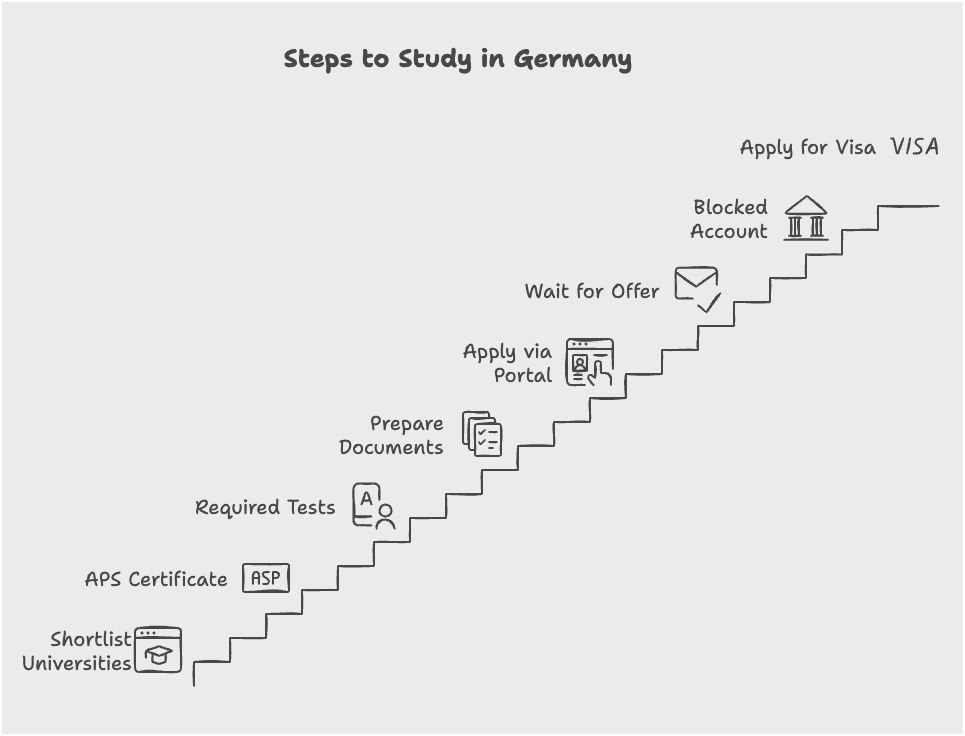
Germany doesn't run a single central application portal the way the US or UK does. You apply to universities directly, or through a platform called Uni-Assist, depending on the institution. Here's how the process typically plays out, start to finish:
- Shortlist your programmes
Use the DAAD portal or individual university sites. Check the teaching language, intake dates, and whether the course actually matches your academic background. - Get your APS certificate
This is non-negotiable for Indian applicants. It verifies your academic records and usually takes two to six weeks to process, so start early. - Take the required tests
IELTS or TOEFL for English-taught courses, TestAS if your programme asks for it, or Goethe/TestDaF for German-taught ones. - Pull your documents together
Transcripts, passport, SOP, LORs, and test scores. Every university has its own exact format, so double-check before submitting. - Apply through Uni-Assist or the university portal
Confirm which route your target university actually uses. - Wait for your offer letter (Zulassungsbescheid)
You'll need this for both the visa and the blocked account. - Open a blocked account
Deposit €11,904 (₹12.88 lakh) to show proof of funds for the year. This is required before you can apply for a visa. - Apply for your German student visa
Processing usually takes 6 to 12 weeks, sometimes longer during peak intake season. - Sort your travel and accommodation
Book flights, arrange housing, and be ready to register with the local city office once you land.
What It Actually Costs to Live There
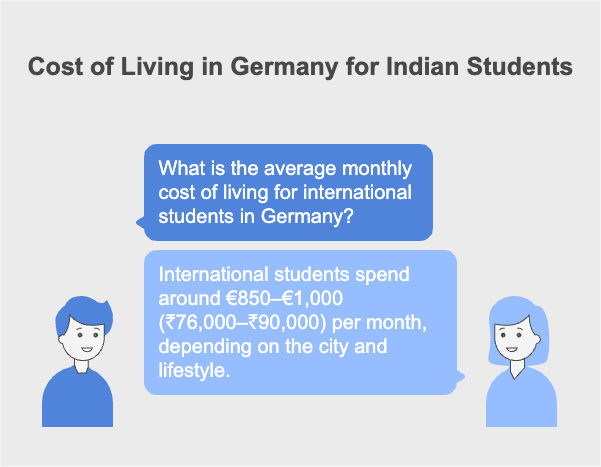
Tuition might be free, but living costs are where your real budget goes. Most international students spend between €850 and €1,000 (₹91,900 to ₹1.08 lakh) a month, depending on the city, and here's how that typically breaks down:
Expense |
Monthly Cost (EUR) |
INR Equivalent |
| Rent | €300 to €500 | ₹32,450 to ₹54,085 |
| Food and groceries | €150 to €200 | ₹16,226 to ₹21,634 |
| Health insurance | €110 to €120 | ₹11,899 to ₹12,980 |
| Public transport | €30 to €50 | ₹3,245 to ₹5,409 |
| Mobile and internet | €20 to €30 | ₹2,163 to ₹3,245 |
| Study materials | €20 to €40 | ₹2,163 to ₹4,327 |
| Personal expenses | €100 to €150 | ₹10,817 to ₹16,226 |
Munich and Frankfurt sit at the expensive end. Leipzig, Chemnitz, and Magdeburg are considerably cheaper, with rents starting around €250 to €350 (₹27,000 to ₹37,900) a month. Sharing accommodation and using your student ID for transport and museum discounts both help stretch the budget further. University canteens (Mensa) also serve full meals for €3 to €4 (₹325 to ₹433), which adds up to real savings over a semester.
Suggested Read: Cost of Living in Germany
Scholarships Worth Applying For
Scholarships won't touch your tuition since that's already free, but they're genuinely useful for covering living costs, insurance, and travel. Here are the ones worth shortlisting:
Scholarship |
Who It's For |
What It Covers |
| DAAD scholarships | Master's students, all fields | Monthly stipend around €934 (₹1.01 lakh), travel, insurance |
| Deutschlandstipendium | UG and PG students | €300/month (₹32,450), merit-based |
| Konrad-Adenauer-Stiftung | Master's/PhD, leadership record | Stipend, housing, insurance |
| Heinrich Böll Foundation | Master's and PhD, all fields | Monthly allowance plus support |
| Friedrich Ebert Stiftung | Social sciences, politics, humanities | Full funding, travel, living costs |
DAAD scholarships are especially competitive, often under a 10% acceptance rate, so apply to more than one and don't wait until the last minute.
Suggested Read: Scholarships for Indian Students in Germany
The Blocked Account and Visa Process
Even with zero tuition, you still need to prove you can support yourself. That's what a blocked account (Sperrkonto) does. For 2026, the required amount is €11,904 a year (₹12.88 lakh), or €992 a month (₹1.07 lakh), released to you in monthly instalments once you land in Germany. This figure is tied to Germany's BAföG living allowance and gets revised periodically, so it's worth confirming the current number before you deposit.
Once that's sorted, here's what the visa steps actually look like:
- Collect your admission letter from the university
- Get your APS certificate, if you haven't already
- Open and fund your blocked account
- Arrange health insurance, mandatory before the visa is issued
- Book your VFS visa appointment early, slots fill up fast during peak intake
- Submit documents and complete biometrics
- Wait for approval, typically 4 to 12 weeks
Suggested Read: Germany Student Visa
Working While You Study
This is one area that's genuinely improved. Since 2024, non-EU students can work up to 140 full days or 280 half days a year, up from the old 120/240 limit, which works out to roughly 20 hours a week during term and full-time during semester breaks.
Germany's minimum wage in 2026 is €13.90 an hour, and student jobs typically pay somewhere in this range:
Job Type |
Hourly Pay (EUR) |
| Retail or service roles | €10 to €12 |
| On-campus roles | €12 to €15 |
| Research or teaching assistant (HiWi) | €13 to €18 |
| Paid internships | €800 to €1,200/month |
Earn under €603 a month through a Minijob and your income stays tax-free. Cross that threshold and you'll likely owe tax, though it's often refundable at year-end if your total annual earnings stay below the exemption limit.
Suggested Read: Part-Time Jobs in Germany for Students
After You Graduate
Once you finish, Germany gives you real runway to find work and stay on, spread across a few different visa routes depending on where you are in your career:
- Job-Seeking Visa, valid for 18 months, to look for a role tied to your degree
- EU Blue Card, up to 4 years, needs a job offer above a set salary threshold
- Skilled Worker Visa, for employment in a qualified role
Secure a full-time job and you can later apply for permanent residency, generally after five years of legal stay.
Suggested Read: Germany Post Study Work Visa
Conclusion
Here's the honest gist. Public university tuition in Germany really is free almost everywhere, the semester fee is minor, and the actual cost of studying there comes down almost entirely to living expenses and the one-time blocked account deposit. That's a fundamentally different cost structure from US, UK, or Australia, where tuition itself is the biggest line item.
A few thoughts on where this fits, and where it doesn't:
- If you want STEM, business, or a research-heavy master's, and you're comfortable with an English-taught programme, Germany is genuinely one of the best value options out there right now. Strong universities, tuition-free, and a post-study visa runway that's better than most.
- If you're set on a bachelor's and don't already have German, budget real time for language learning or a Studienkolleg year before you commit. Skipping this step is the most common reason applications stall.
- If Munich, Frankfurt, or Stuttgart are non-negotiable for you, plan your living cost budget on the higher end, and check if you're walking into the Baden Württemberg tuition zone.
- If your finances are tight even after "free" tuition, apply to DAAD or Deutschlandstipendium early. These aren't backup options, they meaningfully change your monthly budget if you get them.
- The rest of it, honestly, holds up. APS, visa timelines, work rights, they're all fairly student-friendly compared to other big study destinations, and none of it should be a dealbreaker if the rest of the profile fits.
Have more questions? Book a Free 1:1 Live Session with upGrad Experts Today. We are here to help!
FAQs on Studying in Germany for Free for Indian Students
Who is eligible for free education in Germany?
Anyone, German, EU, or international, can access tuition-free education at public universities in most German states. For Indian students specifically, eligibility comes down to a recognised Class 12 or bachelor's qualification, the right language scores, and an APS certificate. Two states, Baden Württemberg and Bavaria, are exceptions where non-EU students may pay tuition.
Is it true that education is free in Germany?
Mostly, yes. Public universities in 14 of 16 states charge zero tuition for bachelor's and most master's programmes, regardless of nationality. You'll still pay a small semester contribution of €250 to €350 (₹27,000 to ₹37,900), and living costs are entirely on you.
Can a 12th pass get a job in Germany?
Not directly on a work visa, since Germany's skilled worker routes require a recognised degree or vocational qualification. A Class 12 pass can, however, get you into a bachelor's programme, and international students are allowed to work part-time alongside their studies once enrolled. Full-time work options open up only after graduation.
How to get a 100% scholarship to study in Germany
DAAD scholarships are the closest thing to full funding, covering tuition where applicable, a monthly stipend, travel, and insurance, though they're competitive with under a 10% acceptance rate. A strong academic record, a well-aligned SOP, and applying early all genuinely improve your odds. Applying to multiple scholarships at once is the safer strategy rather than banking on one.
Do I need to know German to study in Germany for free?
Not for most English-taught master's programmes, but it widens your options considerably, especially at the bachelor's level. Some bachelor's courses require B1 or B2 German, while English-taught ones typically ask for IELTS or TOEFL instead. Even in English-medium programmes, basic German helps with daily life and part-time work.
Are there any hidden fees apart from the semester contribution?
No tuition fees apply at public universities outside Baden Württemberg and Bavaria, but budget for health insurance at €110 to €120 a month (₹11,900 to ₹12,980), residence permit fees, and course materials. None of these are hidden exactly, they're just easy to overlook when tuition is the headline.
Can I work while studying in Germany to cover costs?
Yes. Non-EU students can work up to 140 full days or 280 half days a year, roughly 20 hours a week during term and full-time during breaks. Typical student jobs pay €10 to €18 an hour depending on the role, which comfortably helps offset rent or groceries.
What scholarships can help with living expenses in Germany?
DAAD, Deutschlandstipendium, and foundation scholarships like Heinrich Böll or Konrad-Adenauer-Stiftung all offer monthly stipends ranging from €300 to over €900. These are aimed squarely at living costs rather than tuition, since tuition is already free at most public universities. Apply during your university application cycle, not after.
Which German cities are cheapest for students?
Leipzig, Chemnitz, and Magdeburg consistently come in cheapest, with rents starting around €250 to €350 a month (₹27,000 to ₹37,900). Food and transport costs are lower too compared to Munich or Frankfurt. These cities are worth shortlisting if budget is a bigger factor than location.
Do I need a blocked account if I'm studying in Germany for free?
Yes, tuition being free doesn't remove the requirement to prove you can support yourself. For 2026, the blocked account amount is €11,904 for the year (₹12.88 lakh), deposited before your visa application and released to you monthly once you arrive.
Can free education in Germany lead to permanent residency?
Yes. After graduation, you can apply for an 18-month job-seeking visa, and once you're in a full-time role matching your qualification, that path can lead to permanent residency, generally after five years of legal stay. Germany's post-study work options are one of the stronger parts of the whole package.
Exams to Study Abroad
Top Study Abroad Destinations
Intakes in Popular Countries to Study Abroad
Cost of Living in Popular Countries
Job Opportunities for Indian Students in Popular Countries
Study Abroad for Free
Scholarships in Popular Countries to Study Abroad
Important Resources
Sr. Content Editor |274 articles published
She is an experienced writer and journalist who has extensively covered the education sector in India and Abroad. Now helping Indian aspirants realise their foreign education dream by providing them w...
Refer Your Friend & Earn upto ₹15000
Help your friend upgrade to a Global Career and earn rewards together.
Suggested Articles
Trending Searches
Documentation
Study Abroad Resources
Top Reads
IELTS Exam
Other Exams
- LOR Samples
- Work Experience Certificate
- Requirements for Studying in Germany
- How to Find Accommodation in Canada
- How to Get PR in Canada
- SOP for PhD
- SOP for Masters
- Canada PR Process
- Australian Student Visa
- Motivation Letter
- SOP for UK
- Statement of Purpose Format
- What to do if your F1 student visa to the USA gets rejected
- SOP for Australian Student Visa
Explore Your Options
Vertical Pages
Country
Top Universities
- Masters in Fashion Abroad: Top Universities, Courses, Cost, Requirements, Eligibility & Scholarships
- BBA in Germany: Top Universities, Courses, Cost, Requirements, Eligibility & Scholarships
- Masters in Computer Science USA: Top Universities, Courses, Cost, Requirements, Eligibility & Scholarships
- MBA in USA: Top Universities, Courses, Cost, Requirements, Eligibility & Scholarships
- Masters in Engineering in Germany: Top Universities, Courses, Cost, Requirements, Eligibility & Scholarships
- Masters in Artificial Intelligence USA: Top Universities, Courses, Cost, Requirements, Eligibility & Scholarships
- Masters in Finance in Germany: Top Universities, Courses, Cost, Requirements, Eligibility & Scholarships
- Masters in Data Analytics USA: Top Universities, Courses, Cost, Requirements, Eligibility & Scholarships
- Masters in Healthcare in Germany: Top Universities, Courses, Cost, Requirements, Eligibility & Scholarships
- MBA in Germany: Top Universities, Courses, Cost, Requirements, Eligibility & Scholarships
- Masters in Policy Abroad: Top Universities, Courses, Cost, Requirements, Eligibility & Scholarships
- Hotel Management Courses Abroad: Top Universities, Courses, Cost, Requirements, Eligibility & Scholarships
- Masters in Animation USA: Top Universities, Courses, Cost, Requirements, Eligibility & Scholarships
- BA in Physiology Abroad: Top Universities, Courses, Cost, Requirements, Eligibility & Scholarships