What is a Management Trainee in India: Meaning, Roles, Responsibilities, Skills, & Program Structure
By upGrad
Updated on Aug 30, 2026 | 8 min read | 3.55K+ views
Share:

All courses
Certifications
More
By upGrad
Updated on Aug 30, 2026 | 8 min read | 3.55K+ views
Share:
Table of Contents
Key Highlights
Want to switch to management roles? Explore online management courses to build practical skills in leadership, and management strategy, along with industry expert guidance.
Popular Management Programs
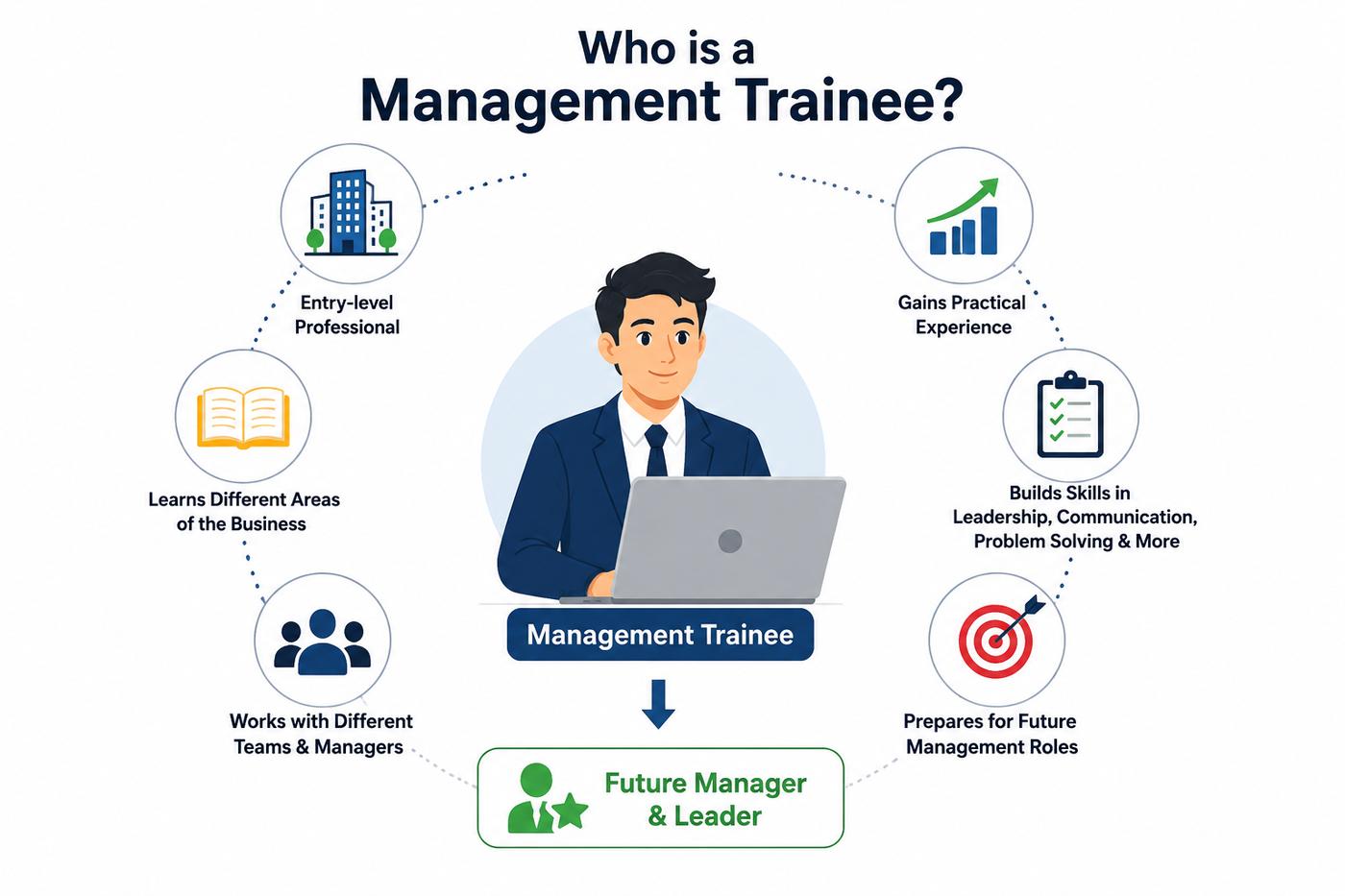
Management trainee, also called MT, is an entry-level job. In this role, you're hired to train across various parts of a business, so you can understand how it works before becoming a manager.
During the training you work with managers and senior leaders of different departments, and learn to make decisions, team management, and business processes.
In almost every industry, you will find the profile of a management trainee. The industry can include supply chain management, sales, HR, finance, marketing, and many more.
Also read: Management Trainee Job Description: Roles & Skills
Free Courses
A management trainee learns about different departments of an organization, this will help them in the future to make operations better. These trainees rotate within different departments to give them a better understanding of how the organization works.
Because good managers understand every aspect of a business to drive combined growth in the business. To progress through the program and step into a management role, management trainee roles and responsibilities are:
Also read: Top Business Management Courses Online in 2026
The management trainees are expected to build skills that solve real-life problems. They can learn these skills with hands-on-training, so below are some of the skills that you must learn:
Most of the management roles required a bachelor’s degree in the field of business, management, or something relevant. But some employers prefer those who have prior experience of handling business operations and teams.
Having an experience that shows your understanding of workplace dynamics and customer needs. Both are important for future leadership.
As management trainees work with different teams, they handle a wide range of responsibilities. In an organization, having strong time management skills must stay organized, and reduce stress.
These are some strategies to improve time management:
During training period, management trainees learn leadership such as how to handle teams, share the work, and handle tough situations. If they do regular practice and get guidance from senior leadership, trainees can become more comfortable in leading and taking different responsibilities.
For deliver work on time, a trainee needs to a good communicator. For explaining work, giving instructions, and clear confusion between team members. This also includes listening to others, giving feedback, learn how to handle disagreement, and share ideas clearly.
Management trainees also need to learn these skills based on the department they work in. This can include using business software, checking data, making reports, handling basic financial information, or working with different tools. Learning these skills during training helps them handle their work better.
Advance your leadership career with IIM Bangalore’s Certificate Programme in General Management for Young Leaders (YLP), designed to build practical management and leadership skills.
Getting into a management trainee program isn't quick. The process of hiring takes about two to three months or even more. In the hiring process there are multiples rounds, including assessment, case studies and group tasks. By doing this, you are showing that you know how to lead and solve problems on the spot.
Once you're in, the real program starts. This part can last anywhere from six months to three years, and honestly, it depends a lot on the company. A few things affect how long it drags on:
These programs are different from the others, like it’s not a classroom. You learn things happening in real on the job, this is also called On-the-Job training. First, you will see the work process of different departments, and then they will start giving you real tasks.
It is a good way to understand how a business runs instead of just reading about it.
This is also why these programs take so long. Because you can't learn all about a department in just two weeks. If a company rushes the rotation, trainees end up with a shallow understanding of how things work, and that defeats the whole point.
Also read: Project Coordinator: Skills, Roles & Duties
The management trainee program is like a slow build-up to becoming a manager one day. The hiring takes a while, then the actual training takes even longer, since you're moving through different departments and picking things up as you go.
You end up learning a mix of stuff, not just the technical side but also how to manage your time, lead people, and talk to a team without things falling apart. Most of it comes from just doing the work, not sitting through lectures.
It's not a fast process, and it's not always easy either. But if someone actually wants to understand how a business runs and build a real career out of it, this kind of program gets you there.
Books a consultation call with upGrad experts to know which management program is best for you.
Not always. Some companies keep you on after training, others just give a fixed contract for the program. Best to just ask during the interview, they'll usually tell you straight up.
Yes, actually most of these roles are made for freshers. Companies aren't really looking for years of experience here. They care more about your grades, whether you can think on your feet, and if you're actually willing to learn.
Usually not. You're learning by being around teams and watching how things work in person, so most companies want you physically there, or at least some days in office.
In most places, yes. You get hired, you get paid, same as any other employee. The benefits might look a bit different though, depends on the company.
A management trainee learns by moving between departments, picking up skills, and figuring out how things work before taking on real responsibility. A manager has already been through that. They make the decisions, own the outcomes, and are the one responsible for how their team does day to day.
Some companies let you switch if there's an opening and you're doing well. Others keep it fixed based on how the program is structured. It's not something you can count on everywhere.
Your education obviously, plus internships, projects, any leadership stuff you've done, certifications too. Basically anything that shows you can work with people or handle pressure.
Honestly it varies a lot. Could be something like improving a slow process, going through customer complaints, checking why sales dropped, or just helping a team work smarter.
Yes, you're an employee so you get paid. How much really comes down to the company, the industry, and sometimes where you're located.
New teams, new tasks, things changing all the time, it can get overwhelming. Switching departments means learning everything from scratch while still trying to keep up with your normal work.
It can happen, but nothing's guaranteed just by finishing the program. Comes down to how well you perform, what you've learned, and whether the right opportunity shows up at the right time.
1283 articles published
We are an online education platform providing industry-relevant programs for professionals, designed and delivered in collaboration with world-class faculty and businesses. Merging the latest technolo...
Get Free Consultation
By submitting, I accept the T&C and
Privacy Policy
Top Resources
Certification
3 Months
Certification
6 Months
O.P. Jindal Global University
Masters in International Accounting and Finance (Accredited by ACCA, UK)Master's Degree
12 Months