DBA Full Form: Doctor of Business Administration What It Really Means
By upGrad
Updated on Jun 19, 2026 | 4 min read | 2.95K+ views
Share:

All courses
Certifications
More
By upGrad
Updated on Jun 19, 2026 | 4 min read | 2.95K+ views
Share:
Table of Contents
DBA full form stands for Doctor of Business Administration. It is a doctoral-level degree designed for experienced professionals who want to deepen their business knowledge, solve real-world organizational problems, and move into senior leadership, consulting, or academic roles. It's the highest academic qualification you can earn in the field of business.
It’s built specifically for working professionals who want to apply research to real-world problems rather than pursue a purely academic career.
This blog covers what DBA means, how it compares to an MBA and a PhD, who it's meant for, what the coursework looks like, career options after completing it, and what it costs. If you're weighing this degree seriously, you'll find everything you need here to make an informed call.
Explore our Doctor of Business Administration programs and develop the advanced research, strategic thinking, and leadership skills needed for senior management and consulting roles.
Popular Management Programs
DBA full form sits at the doctoral level, which means it's equivalent in academic rank to a PhD. But if you are thinking about DBA vs PhD,then a DBA isn't just a PhD with a different name. The two degrees are designed with completely different goals in mind.
A PhD in Business focuses on producing original theoretical research. Most PhD graduates go on to teach at universities or work in research institutions.
A DBA, on the other hand, is designed for senior professionals already working in business, management, consulting, or leadership roles.
The DBA asks one core question: how can advanced research solve actual business problems?
You won't spend years studying theories, rather, you'll apply research frameworks to challenges that already exist in your own industry or organisation. That's the defining feature of this degree.
The degree bridges the gap between academic research and business practice. Instead of producing purely theoretical findings, DBA candidates work on research that addresses real organizational issues.
Feature |
Details |
| Degree Level | Doctoral |
| Focus | Applied business research |
| Target Audience | Experienced professionals |
| Duration | 3 to 5 years |
| Learning Format | Online, hybrid, or on-campus |
| Final Requirement | Doctoral thesis or applied research project |
Many institutions offer DBA programs with specialized tracks.
Common options include:
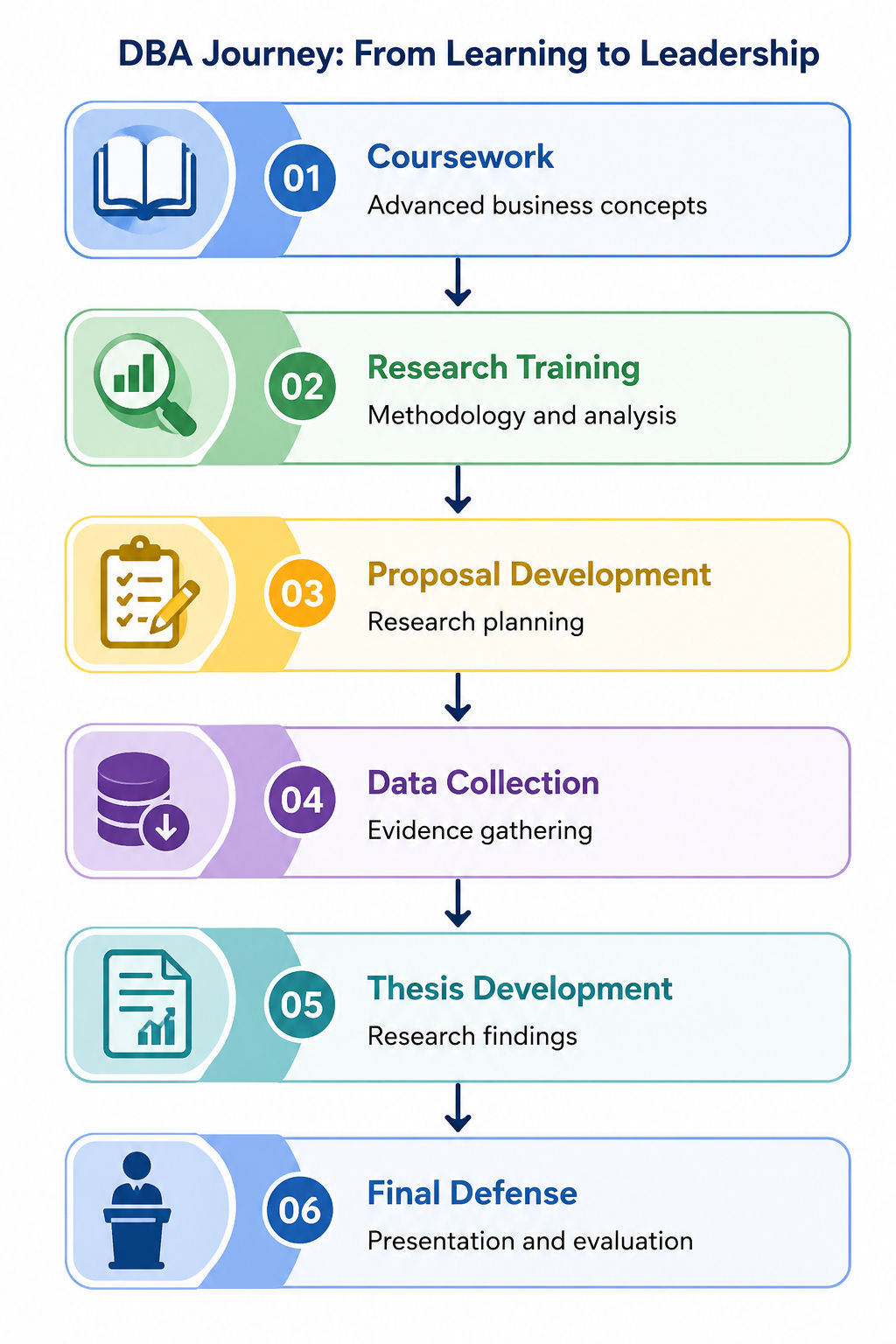
Typical DBA Journey
Free Courses
This degree is designed for a specific kind of professional. You're typically looking at someone with 10 or more years of work experience, already in a leadership or senior management role, who wants to conduct research that actually impacts their field.
Some people also pursue a DBA to earn the title of "Doctor" in a professional context. That's a valid reason, but it shouldn't be the only one.
It's not the right choice if you're early in your career. An MBA or a postgraduate diploma will give you more return at that stage. The DBA pays off when you already have experience to bring into the research process.
Must read: 2025 Salary Trends for DBA Graduates in India vs International
Management Courses to upskill
Explore Management Courses for Career Progression
IIIT-B & IIM, Udaipur
Chief Technology Officer & AI Leadership ProgrammeCompleting a DBA opens doors that most business qualifications don't reach.
The most common path is executive education. Many DBA graduates move into teaching roles at business schools, specifically in MBA and executive programmes where their industry experience is a direct asset.
Others stay in industry but move into advisory, consulting, or board-level roles. The doctoral credential carries weight in contexts where research credibility matters.
Salary expectations in India vary widely, depending on the role:
Role |
Approximate Annual Salary (INR) |
| Business School Faculty | ₹10 LPA – ₹30 LPA |
| Senior Management Consultant | ₹20 LPA – ₹45 LPA |
| C-Suite Executive | ₹40 LPA – ₹1 Crore+ |
| Independent Researcher / Advisor | Project-based / Variable |
Source: ambitionbox, glassdoor
Also read: Jobs after Doctor of Business Administration in India & Abroad
Both options are viable. The right choice depends on your goals, budget, and how you want to use the degree.
Indian universities are now offering DBA programmes, including through business schools affiliated with the University Grants Commission. These programmes are more affordable and allow you to stay connected to the Indian business context.
International DBA programmes from universities in the UK, USA, Australia, or Europe carry global recognition and often come with stronger research networks. They're also significantly more expensive, with fees ranging from 20 to 60 lakhs or more.
If your career is primarily in India, a well-accredited Indian DBA from a reputable institution may serve you just as well. If you're aiming for a global consulting or academic role, the international route may give you stronger positioning.
upGrad offers pathways into advanced management and doctoral-level education through its partnerships with global universities. If you're exploring this space, it's worth checking their programme offerings for Doctor of Business Administration options.
DBA full form is Doctor of Business Administration. It's a doctoral degree built for professionals who've already built careers and want to combine research with real-world impact.
It's not for everyone, and it's not meant to be. But for the right person, at the right stage of their career, it's one of the most credible and meaningful qualifications available in the business world.
If you're seriously considering it, do your research on accreditation, talk to alumni from your target programme, and go in with a clear idea of what you want to do with it.
Ready to start your journey? Book a free consultation with upGrad today to find the best path for your career.
Yes, a DBA is recognized in India when it is awarded by an accredited and legitimate institution. Recognition depends on the university's status and accreditation rather than the degree name itself. Before applying, verify whether the institution is recognized in its home country and whether the qualification aligns with your career goals in India.
In most countries, including India, DBA graduates are entitled to use the title "Dr." because the qualification is a doctoral degree. However, professional usage may vary across industries and organizations. It's always a good idea to understand local regulations and employer policies regarding doctoral titles.
The cost varies significantly depending on the institution and country. Indian DBA programs may range from ₹5 lakh to ₹20 lakh, while international programs can exceed ₹50 lakh. Tuition, research expenses, travel requirements, and residency components can all affect the total investment.
Many universities now offer online or hybrid DBA programs designed for working professionals. While coursework can often be completed remotely, some institutions require short residencies, workshops, or dissertation presentations. Always review the program structure before enrolling.
A DBA can be valuable for entrepreneurs who want to make better strategic decisions using research-backed insights. The degree helps develop analytical thinking, leadership capabilities, and problem-solving skills. Many entrepreneurs also use their research projects to explore challenges within their own businesses.
A DBA is generally more demanding than an MBA because it requires independent research over several years. MBA programs focus on learning established business concepts, while DBA candidates must investigate complex problems, analyze data, and produce original research that meets doctoral standards.
Yes, most DBA programs are specifically designed for working professionals. That said, balancing work, personal responsibilities, and doctoral research can be challenging. Many candidates spend 15 to 20 hours each week on coursework, reading, data collection, and dissertation writing.
The dissertation is a core requirement of the degree. Without successfully completing and defending it, you generally won't receive the DBA qualification. This is why choosing a realistic research topic and maintaining a consistent study schedule are critical from the start.
Employers often value a DBA when hiring for leadership, consulting, strategy, and advisory roles. The degree demonstrates advanced business knowledge, research capability, and commitment to professional development. Its impact is strongest when combined with significant industry experience.
Yes, many professionals pursue a DBA to enter higher education. Business schools often seek faculty members who combine academic knowledge with practical industry experience. A DBA can create opportunities in executive education, MBA teaching, corporate training, and guest lecturing.
Start by evaluating accreditation, faculty expertise, research support, program flexibility, and alumni outcomes. Consider whether the curriculum aligns with your career goals and research interests. Speaking with current students or graduates often provides insights that brochures and rankings don't reveal.
1008 articles published
We are an online education platform providing industry-relevant programs for professionals, designed and delivered in collaboration with world-class faculty and businesses. Merging the latest technolo...
Get Free Consultation
By submitting, I accept the T&C and
Privacy Policy
Top Resources
Certification
3 Months
Certification
6 Months
O.P. Jindal Global University
Masters in International Accounting and Finance (Accredited by ACCA, UK)Master's Degree
12 Months