Total Quality Management: Definition, Principles, Benefits, Tools, and Examples
By upGrad
Updated on Oct 16, 2026 | 133 views
Share:

All courses
Certifications
More
By upGrad
Updated on Oct 16, 2026 | 133 views
Share:
Table of Contents
Key Highlights
Explore upGrad’s online management programs to develop leadership, strategic planning, and problem-solving skills that can help you implement quality improvement strategies, optimise business processes, and enhance organisational performance.
Popular Management Programs
Total Quality Management is an organization-wide approach to improving products, services, processes, and customer satisfaction through continuous improvement. It involves everyone in the organization, from senior leaders to frontline employees.
A simple total quality management definition is that quality should not be the responsibility of one quality control department. Every person and every process can affect the final result.
For example, imagine a company that sells laptops. The quality of the laptop does not depend only on the manufacturing team. The purchasing team must source reliable components. The design team must create a dependable product. Employees on the production line must follow consistent processes. The customer service team must handle complaints properly. Management must provide the resources needed to maintain these standards.
If one part of this chain performs poorly, the customer's experience can suffer.
Also read: Expert in Lean Six Sigma Principles for Quality Management!
Free Courses
Total Quality Management works as a continuous cycle and the process can be understood in eight simple steps:
The process begins by identifying what customers consider good quality. This can include product reliability, service speed, safety, price, convenience, or support.
Organizations can use different sources to understand these expectations, such as:
Once customer expectations are clear, the organization converts them into measurable goals.
For example, an online retailer may set a target to reduce order-delivery complaints by 20% within six months. A hospital might aim to reduce patient waiting time, while a manufacturer may set a target for reducing production defects.
The organization then examines how work is currently being done. Teams look for delays, errors, waste, unnecessary steps, and other factors that can affect quality.
The goal is not simply to find who made a mistake. It is to understand why the process allowed the mistake to happen.
Employees who work directly with a process often understand its problems better than anyone else. TQM therefore encourages employees to share ideas, report issues, and participate in improvement activities.
For example, an employee working on a production line may notice that a machine regularly causes small defects. Sharing this observation can help the organization investigate the issue before it creates larger problems.
The organization tracks relevant quality indicators to understand how well the process is performing.
Depending on the business, these may include:
These measurements provide evidence of whether a process is meeting its quality objectives.
When performance falls below the desired level, teams investigate the underlying causes. Tools such as root cause analysis, Pareto charts, and fishbone diagrams can help.
The objective is to fix the source of the problem rather than repeatedly correcting the same symptoms.
After identifying the cause, the organization changes the relevant process. This could involve:
The improvement is then monitored to determine whether it produces the expected result.
TQM does not end after one successful improvement. The organization continues measuring performance and looking for new opportunities.
This creates a continuous cycle:
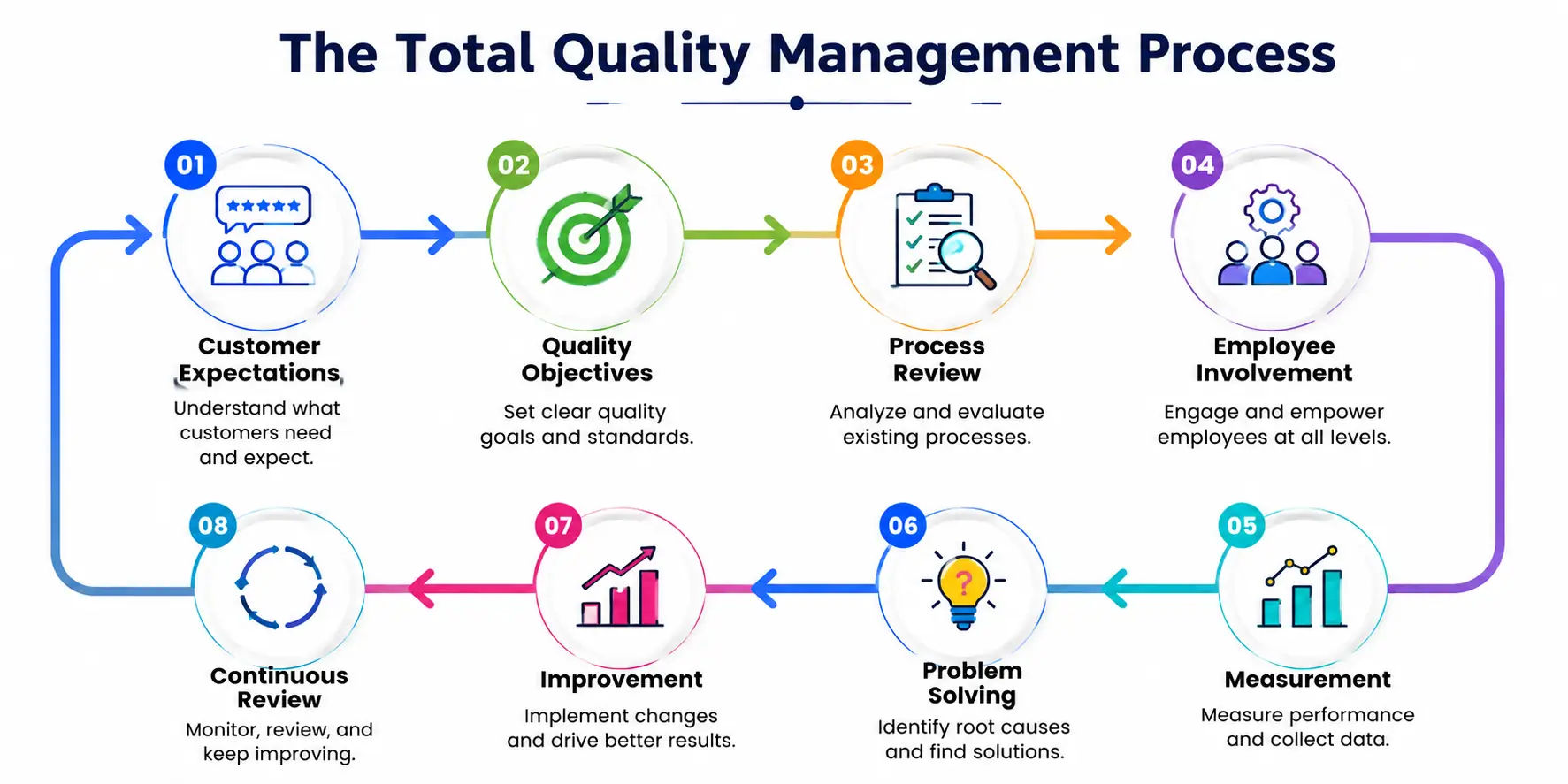
This cycle is central to total quality management theory. It shows why TQM is a long-term approach rather than a one-time quality project.
Management Courses to upskill
Explore Management Courses for Career Progression
IIIT-B & IIM, Udaipur
Chief Technology Officer & AI Leadership ProgrammeIIM Kozhikode
PCP in AI for Business ProfessionalsTQM tools help organizations collect data, understand problems, identify their causes, and monitor improvements. The total quality management tools list includes seven basic quality tools, along with techniques such as PDCA, Kaizen, and root cause analysis.
Seven Basic Quality Tools
| Tool | What It Helps With |
| Check Sheet | Collecting and organizing data |
| Histogram | Understanding data distribution |
| Pareto Chart | Identifying the most significant problems |
| Fishbone Diagram | Finding possible causes of a problem |
| Scatter Diagram | Examining relationships between variables |
| Control Chart | Monitoring process variation over time |
| Flowchart | Understanding and improving processes |
For example, a company receiving many customer complaints can use a check sheet to record complaint types. A Pareto chart can then show which issues occur most frequently. A fishbone diagram can help the team investigate their possible causes.
Also read: Project Quality Management: Cost of Quality Concept Explained | upGrad blog
Implementing TQM means making quality part of everyday operations. It requires leadership support, employee participation, clear objectives, and regular measurement.
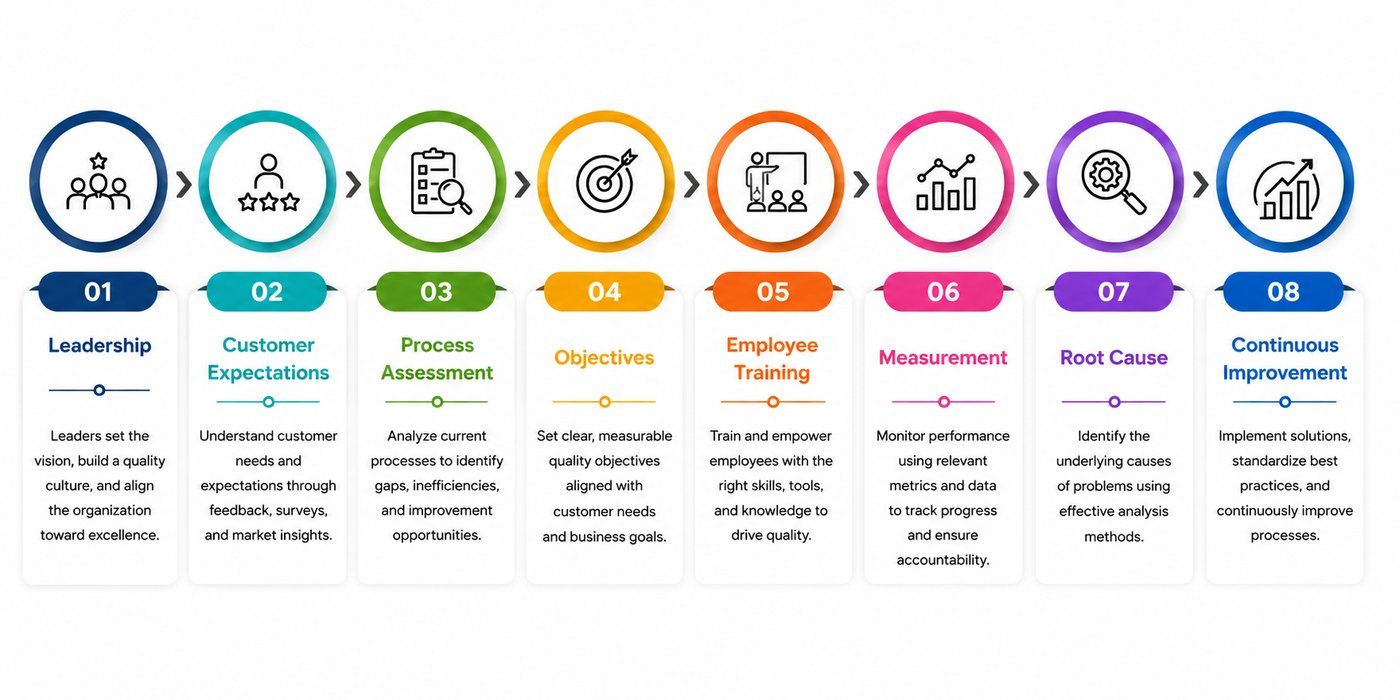
Senior management needs to communicate why quality matters and connect quality objectives with business goals.
Leaders also need to provide the resources required for improvement, including training, people, time, and technology.
The organization should understand what customers actually value. This may include:
Customer expectations should be based on feedback and data rather than assumptions.
Teams should first understand how their processes currently work.
They can map workflows, review performance data, speak with employees, and examine customer complaints. This helps establish a baseline and identify areas that need improvement.
Quality objectives should be specific and measurable.
For example, instead of setting a vague goal such as "improve customer service," a company could aim to reduce average complaint-resolution time from three days to one day.
Employees need to understand TQM and their role in quality improvement.
Training may cover quality tools, problem-solving methods, process standards, or data analysis. Employees should also have opportunities to suggest improvements because they often understand operational problems firsthand.
Organizations need relevant metrics to determine whether processes are performing as expected.
Common measures include:
The goal is not to measure everything. Organizations should focus on metrics that connect directly to their quality objectives.
When a problem occurs, teams should investigate why it happened.
For example, if a company experiences repeated billing errors, correcting individual invoices will not solve the underlying issue. The team needs to determine whether the cause is incorrect data, software problems, unclear procedures, or inadequate training.
TQM does not stop after reaching one quality target. Organizations should continue monitoring performance and identifying opportunities for improvement.
Successful changes can also become part of the standard process, helping the organization maintain improvements over time.
Understand how workplace behaviour influences organisational performance with the MA in Organizational Psychology from Golden Gate University. Develop expertise in employee motivation, team dynamics, and organisational development to foster a productive work environment and support continuous improvement.
A total quality management system connects quality goals, processes, people, measurements, and improvement activities.
A practical system should include:
For example, if customer complaints increase, the system should help the organization record the complaints, identify patterns, investigate the causes, take corrective action, and measure the outcome.
The system should support everyday work rather than exist only for documentation or audits. When quality objectives, employee responsibilities, process data, and improvement activities are connected, TQM becomes part of the organization's regular way of working.
Also read: A Comprehensive Guide to General Management: Roles, Skills, and Career Opportunities
Total Quality Management was not developed by one person. Its foundation was shaped by several quality-management experts who introduced ideas about process improvement, customer needs, management responsibility, and defect prevention.
The total quality management ideas were developed by the following people:
Deming emphasized continuous improvement, process variation, and the role of management in improving organizational systems.
He argued that many quality problems come from the processes and systems employees work within. This shifted attention from blaming individuals toward improving the overall system.
Juran focused on quality planning, quality control, and quality improvement. He emphasized understanding customer requirements and designing processes that can consistently meet them.
His work also highlighted the importance of management involvement in quality initiatives.
Crosby focused on preventing defects and became closely associated with the concept of "zero defects."
His approach encouraged organizations to build quality into processes instead of relying mainly on inspection to find mistakes after they occur.
Feigenbaum introduced the concept of total quality control. He argued that quality should involve every function of an organization, not just the production or inspection department.
This organization-wide view became an important foundation for TQM.
Ishikawa promoted employee participation in quality improvement and contributed practical tools for identifying problems.
He is particularly associated with the cause-and-effect diagram, also known as the fishbone diagram, which helps teams investigate possible causes of a problem.
Also read: What Is Case Management? Key Insights Into Its Process and Applications
The principles of TQM explain how an organization can turn quality from a department-level responsibility into an organization-wide practice. The total quality management principles list can be understood through nine key principles:
Customers are the starting point for quality improvement. Organizations need to understand their expectations and use feedback to determine whether products and services are meeting those expectations.
Customer feedback can come from:
Leaders set quality priorities and provide the resources needed to achieve them. They also create an environment where employees can report problems and suggest improvements.
Leadership matters because employees are more likely to take quality initiatives seriously when managers actively support them.
Employees should actively participate in quality improvement. Their experience with daily processes can help identify problems and practical solutions.
For example, a customer service employee may notice a recurring complaint before it becomes visible in the company's performance reports.
TQM looks at how work is performed from beginning to end. Instead of focusing only on the final output, organizations examine each stage that contributes to that output.
If customers receive orders late, for example, the company may examine inventory, order processing, packing, dispatch, and delivery rather than blaming only the delivery team.
Business functions are connected. Purchasing, production, marketing, distribution, finance, and customer service can all affect quality.
An integrated approach helps departments work toward shared quality objectives rather than optimizing their own activities separately.
Quality should be connected to the organization's wider business goals. Companies need clear objectives and a structured approach for achieving them.
For example, a business competing through premium service may focus on response time, reliability, employee training, and customer satisfaction.
Organizations should constantly look for ways to improve their processes, products, and services.
Improvement does not always require a major change. A small reduction in processing time or a simpler procedure can also improve quality when it is applied consistently.
Quality decisions should be supported by reliable information. Organizations can use data such as:
This helps teams identify problems and determine whether an improvement has actually worked.
Clear communication helps employees understand quality expectations and responsibilities. It also allows information about problems and improvement opportunities to move between teams and management.
These principles work together rather than operating independently. For example, customer feedback may identify a problem, employees may help investigate it, data may reveal its root cause, and leadership may provide the resources required to improve the process.
Also read: Techniques of Decision-Making: Top Tools & Methods for 2026
TQM can improve more than the quality of a product or service. When quality becomes part of everyday operations, organizations can make processes more reliable, reduce waste, and respond better to customer needs.
The following are the benefits of total quality management:
1. Improved Customer Satisfaction: TQM encourages organizations to understand customer expectations and use feedback to improve products and services. Consistent quality can strengthen customer trust and satisfaction.
2. Fewer Defects and Errors: By identifying problems within processes and addressing their causes, organizations can reduce defects, mistakes, and rework.
3. Reduced Costs and Waste: Better processes can reduce wasted materials, repeated work, delays, and unnecessary activities. Over time, this can lower operating costs.
4. Better Productivity: Removing inefficient steps and improving workflows allows employees to spend more time on productive activities. Standardized processes can also make work more consistent.
5. Greater Employee Engagement: Employees can participate in problem-solving and suggest improvements based on their practical experience. This can create greater ownership and involvement.
6. Improved Processes: Regular measurement and review help organizations identify weak areas and improve processes over time.
Also read: What is Six Sigma? 5 Steps of Six Sigma [Detailed Guide]
TQM can deliver long-term improvements, but organizations may face challenges while implementing it.
1. Resistance to Change: Employees may be reluctant to adopt new procedures, especially when they are comfortable with existing methods. Clear communication and employee involvement can make the transition easier.
2. Lack of Leadership Support: TQM requires continued management support. If leaders stop providing resources or attention, quality initiatives can lose momentum.
3. Training Requirements: Employees may need training in new processes, quality tools, data analysis, and problem-solving methods. This requires time and investment.
4. Resource Requirements: Organizations may need to invest in training, technology, data collection, or process improvements. The initial investment can be challenging for smaller organizations.
5. Difficulty Measuring Long-Term Results: Some outcomes, such as stronger employee involvement or customer loyalty, may take time to become measurable. Organizations need to track relevant indicators consistently rather than expecting immediate results.
Also read: Must-Have Skills for Leadership & Management Roles
TQM can be adapted to almost any industry because every organization has processes, customers, and quality expectations. The way it is applied depends on the problems an organization is trying to solve.
A manufacturer may notice a high number of defective products. Instead of simply increasing final inspections, the company can examine where defects are being introduced.
The team may:
This approach helps prevent recurring defects rather than repeatedly finding them at the end of production.
A hospital may discover that patients are waiting too long before receiving care. The team can examine the complete patient journey to identify where delays occur.
It may improve:
Waiting times and patient feedback can then be monitored to determine whether the changes improve service quality.
A bank receiving repeated complaints about slow loan processing can review the process from document submission to approval.
The organization may identify unnecessary steps, improve employee training, or use technology to reduce processing time. Turnaround time and customer complaints can then be used to evaluate the improvement.
A software company may notice that similar bugs appear after multiple releases. Instead of fixing each bug after customers report it, the team can examine where errors enter the development process.
Possible improvements include:
Bug rates and customer-reported issues can show whether these changes are effective.
Also read: Top 15 Business Management Careers in India for 2026
Total Quality Management is an organization-wide approach to achieving consistent quality and continuous improvement. It brings together customer focus, leadership, employee involvement, process management, measurement, and problem-solving.
TQM is not simply about finding defects after they occur. It encourages organizations to understand why problems happen and improve the processes that create them. Its tools can help teams analyze data, identify root causes, and monitor results. The real value of TQM comes from making quality part of everyday work.
Ready to take the next step in your career? Book a consultation call with upGrad to explore the right program for your professional goals.
Manufacturing has traditionally used TQM extensively, but it is also applicable to healthcare, banking, education, IT, hospitality, and other service industries. Any organization seeking better processes and customer experiences can adapt TQM to its specific needs.
Yes. Small businesses can begin with simple practices such as understanding customer expectations, standardizing important processes, tracking key metrics, and encouraging employees to suggest improvements. TQM does not require a complex system to deliver useful results.
There is no fixed timeline. Initial improvements can begin within weeks, while developing a strong quality culture may take months or years. The timeline depends on the organization's size, existing processes, employee readiness, and the scale of required changes.
Everyone has a role in TQM. Leadership provides direction and resources, managers establish expectations, and employees contribute through their daily work, problem-solving, and improvement suggestions.
Useful skills include problem-solving, data analysis, communication, teamwork, process management, and knowledge of quality tools. Employees should also understand their processes and how their work affects customers and other teams.
It can. TQM gives employees opportunities to share ideas, solve problems, and influence improvements. When employees see their suggestions being considered and implemented, they may develop a stronger sense of ownership and involvement.
Consistent quality can strengthen customer trust. When customers regularly receive reliable products or services and see their feedback being addressed, they are more likely to develop a positive relationship with the organization.
Common mistakes include treating TQM as a short-term project, focusing only on inspection, ignoring employee feedback, setting unclear objectives, collecting data without using it, and failing to maintain leadership support.
Yes. TQM is a management approach rather than a certification requirement. An organization can apply its principles without holding a specific quality certification. Standards such as ISO 9001 are separate frameworks with their own requirements.
The cost depends on the organization's size and improvement needs. Expenses may include training, technology, data systems, process changes, and consulting. Smaller organizations can begin with basic improvements using existing resources.
Organizations should identify what prevented the approach from working. Weak leadership support, poor communication, employee resistance, unclear objectives, and inadequate measurement are common causes. Addressing these issues can help the organization improve its approach.
1141 articles published
We are an online education platform providing industry-relevant programs for professionals, designed and delivered in collaboration with world-class faculty and businesses. Merging the latest technolo...
Get Free Consultation
By submitting, I accept the T&C and
Privacy Policy
Top Resources
Certification
3 Months
Certification
6 Months
O.P. Jindal Global University
Masters in International Accounting and Finance (Accredited by ACCA, UK)Master's Degree
12 Months