RMSE in Machine Learning: Formula, Calculation, and Real-World Use
By Rahul Singh
Updated on Jun 23, 2026 | 10 min read | 4.22K+ views
Share:

All courses
Certifications
More
By Rahul Singh
Updated on Jun 23, 2026 | 10 min read | 4.22K+ views
Share:
Table of Contents
RMSE (Root Mean Square Error) is one of the most commonly used metrics for evaluating regression models in machine learning. It measures the average difference between predicted values and actual values, helping you understand how accurately a model makes numerical predictions. Because RMSE squares each error before averaging, larger prediction mistakes have a greater impact on the final score.
In this blog, you will learn what is RMSE in machine learning, the exact formula behind it, how to calculate RMSE values step by step, when to use it, how it compares to other metrics, and where it actually shows up in real projects.
Master machine learning concepts with upGrad's Artificial Intelligence Courses. Learn model evaluation, predictive analytics, and real-world applications through hands-on projects and industry case studies.
Popular AI Programs
Think of it this way: if your model is predicting house prices and the actual price is Rs. 50 lakhs but your model predicts Rs. 47 lakhs, there is an error of Rs. 3 lakhs. RMSE takes all such errors across your dataset, squares them, averages them, and then takes the square root to give you one clean number.
Let's visualize the given example below to understand it better:
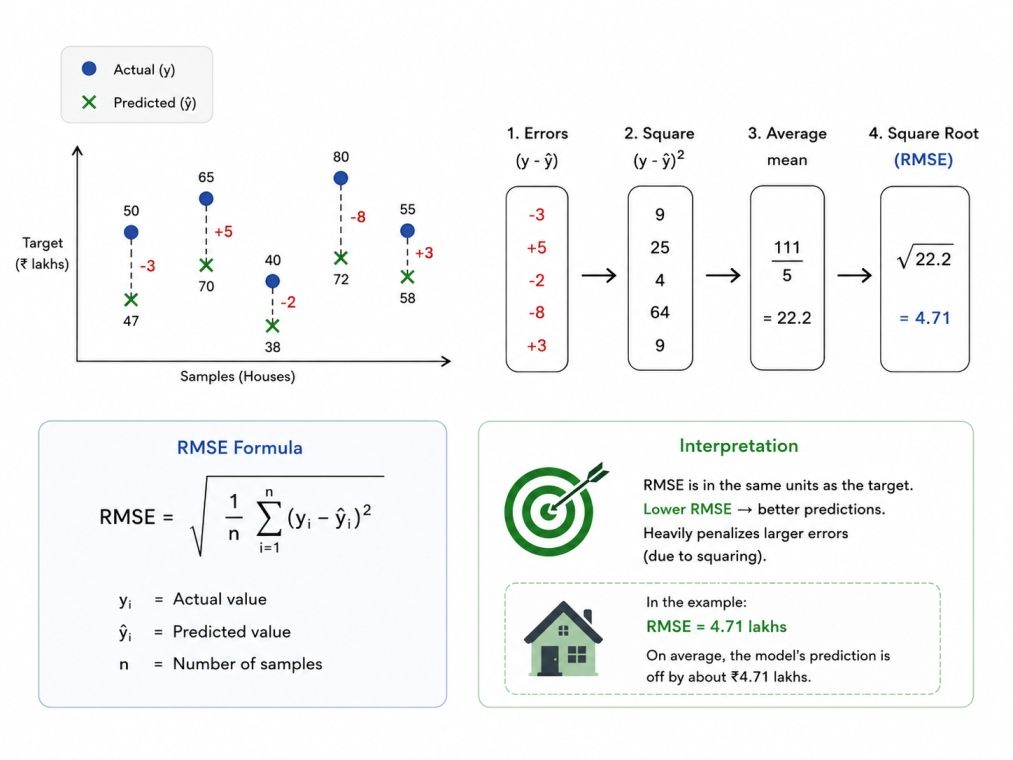
RMSE is popular because:
RMSE in machine learning is most commonly used in regression tasks. These include predicting prices, temperatures, sales figures, energy consumption, or any output that is a continuous number.
RMSE is sensitive to outliers. If your dataset has a few extreme values, those will inflate the RMSE significantly. In such cases, metrics like MAE (Mean Absolute Error) might give you a more balanced picture.
Scenario |
Recommended Metric |
| Large errors are costly | RMSE |
| Outliers are common | MAE |
| Need percentage error | MAPE |
| Comparing models on same scale | RMSE or MAE |
Free Courses
Understanding how to calculate RMSE values in machine learning requires breaking the formula into simple steps.
RMSE = sqrt( (1/n) * sum( (y_actual - y_predicted)^2 ) )
Where:
Let us say you have five actual and predicted values:
Data Point |
Actual (y) |
Predicted (y_hat) |
Error (y - y_hat) |
Squared Error |
| 1 | 10 | 12 | -2 | 4 |
| 2 | 20 | 18 | 2 | 4 |
| 3 | 30 | 28 | 2 | 4 |
| 4 | 40 | 45 | -5 | 25 |
| 5 | 50 | 48 | 2 | 4 |
Step 1: Calculate the error for each point (actual minus predicted).
Step 2: Square each error.
Step 3: Find the mean of the squared errors.
Mean Squared Error = (4 + 4 + 4 + 25 + 4) / 5 = 41 / 5 = 8.2
Step 4: Take the square root.
RMSE = sqrt(8.2) = approximately 2.86
So the model is off by about 2.86 units on average, with larger errors weighted more heavily.
Also Read: Evaluation Metrics in Machine Learning: Types and Examples
import numpy as np

actual = np.array([10, 20, 30, 40, 50])
predicted = np.array([12, 18, 28, 45, 48])

rmse = np.sqrt(np.mean((actual - predicted) ** 2))
print("RMSE:", rmse)
You can also use scikit-learn:
from sklearn.metrics import mean_squared_error
import numpy as np

rmse = np.sqrt(mean_squared_error(actual, predicted))
print("RMSE:", rmse)
Both approaches give the same result. Knowing how to calculate RMSE values in machine learning with code is an essential skill for any ML practitioner.
Also Read: Difference Between Anomaly Detection and Outlier Detection
AI Courses to upskill
Explore Artificial Intelligence Courses for Career Progression
Once you understand what is RMSE in machine learning, it helps to know how it compares to similar metrics. Each metric has its strengths, and knowing when to use which one separates a good practitioner from a great one.
MAE (Mean Absolute Error) averages the absolute differences between actual and predicted values without squaring them. This means MAE treats all errors equally regardless of size.
RMSE, on the other hand, penalizes larger errors more because of the squaring step. If your model makes a few very large mistakes, RMSE will highlight this much more than MAE will.
Feature |
RMSE |
MAE |
| Sensitivity to outliers | High | Low |
| Error unit | Same as target | Same as target |
| Penalizes large errors | Yes (squared) | No (absolute) |
| Easier to interpret | Moderate | High |
| Used in optimization | Common | Common |
MSE (Mean Squared Error) is simply the mean of the squared errors without taking the square root. RMSE is the square root of MSE.
The key advantage of RMSE over MSE is interpretability. MSE gives you a squared unit (for example, square rupees if you are predicting prices), which is hard to interpret. RMSE brings it back to the original unit of the target variable.
Also Read: Accuracy Formula in Machine Learning
R-squared (also called the coefficient of determination) tells you what proportion of the variance in the target variable your model explains. It is a relative measure, not an absolute one.
RMSE gives you the actual magnitude of error. A model can have a high R-squared but still have a large RMSE if the target values span a wide range. Using both together gives a fuller picture.
RMSE in machine learning is not just a theoretical concept. It shows up in almost every regression-based project across industries.
1. Finance and Stock Prediction
When models predict stock prices or asset returns, analysts use RMSE to check how far the predictions deviate from actual market values. A lower RMSE indicates more reliable predictions over time.
Also Read: Build a Stock Price Prediction Model Using ML Techniques
2. Weather Forecasting
Meteorological models predict temperature, rainfall, and wind speed. RMSE is used to benchmark these predictions against observed data. Weather agencies track RMSE across seasons to measure model improvement.
3. Demand Forecasting in Retail
Retail companies use machine learning to predict product demand. RMSE helps them understand how accurate their inventory predictions are. A high RMSE here can directly lead to overstocking or stockouts, both of which cost money.
4. Energy Consumption Prediction
Power grids use ML models to forecast energy demand across different hours and regions. RMSE is the standard metric for evaluating these models because even small prediction errors can cause operational challenges.
5. Healthcare and Medical Diagnosis
In clinical settings, models predicting things like blood sugar levels, patient recovery times, or disease progression rely on RMSE to measure accuracy. The stakes are high here, so understanding prediction error matters a great deal.
6. House Price Estimation
Real estate platforms that predict property values use RMSE to tune and evaluate their models. When RMSE is expressed in the same currency as the price, it becomes directly actionable for buyers, sellers, and agents.
Also Read: House Price Prediction Using Regression Algorithms
Even experienced practitioners make these mistakes. Knowing them helps you avoid them.
Common Mistake |
Issue |
Fix |
| Comparing RMSE Across Datasets | Scale-dependent metric | Compare within the same dataset |
| Ignoring Outliers | Inflates RMSE | Check outliers before evaluation |
| Using RMSE for Classification | Not meant for classification | Use Accuracy, F1-score, or AUC |
| Using RMSE Alone | Limited insight | Combine with MAE and R² |
RMSE in machine learning is a foundational metric that every data science practitioner should understand deeply. It measures the average magnitude of prediction error, with extra sensitivity to large mistakes. Learning how to calculate RMSE values in machine learning manually and in code helps you evaluate models with confidence.
Use RMSE when prediction accuracy matters and large errors carry real consequences. Pair it with MAE and R-squared for a complete view of model performance. Across finance, healthcare, retail, and more, RMSE remains one of the most trusted tools in the machine learning evaluation toolkit.
If you want to build strong ML foundations, upGrad's programs in data science and machine learning take you from concepts like RMSE all the way to deploying production-grade models.
Want personalized guidance on AI and upskilling? Speak with an expert for a free 1:1 counselling session today.
RMSE stands for Root Mean Squared Error. It measures how much a model's predictions deviate from the actual values on average. It is important because it gives you a direct, interpretable measure of model accuracy in the same unit as the target variable, making it easy to understand and act on.
A high RMSE means your model's predictions are far from the actual values. It suggests the model is not capturing the underlying patterns well. However, what counts as "high" depends on the scale of your target variable, so always interpret RMSE in context.
A low RMSE indicates that your model's predictions are close to the actual values. It generally means good model performance. But always pair RMSE with other metrics and domain knowledge to get the full picture.
MSE (Mean Squared Error) averages the squared errors without taking the square root. RMSE is simply the square root of MSE. The key advantage of RMSE is that it returns the error in the original unit of the target variable, which makes it more interpretable than MSE.
No. RMSE is a metric designed for regression problems where the target variable is continuous. For classification tasks, you should use metrics like accuracy, precision, recall, F1-score, or AUC-ROC depending on what your model needs to optimize for.
Outliers have a strong impact on RMSE because the squaring step amplifies large errors disproportionately. Even one extreme outlier can significantly inflate your RMSE. If outliers are a concern in your dataset, it is worth also checking MAE, which is more robust to extreme values.
There is no universal "good" RMSE value. It entirely depends on the scale of your target variable and the problem context. For example, an RMSE of 10 might be excellent when predicting temperatures but poor when predicting exam scores. Compare RMSE against the range and mean of your target variable to gauge quality.
To calculate RMSE, first find the difference between each actual and predicted value. Then square each difference. Next, calculate the average of all squared differences to get MSE. Finally, take the square root of MSE. The result is your RMSE, expressed in the same unit as the target variable.
Neither is universally better. RMSE is preferred when large errors are more costly because it penalizes them more. MAE is better when all errors should be treated equally or when outliers skew the evaluation. Using both together gives a more complete view of model performance.
In deep learning, RMSE is commonly used as a loss function for regression tasks. It is differentiable and works well with gradient descent optimization. Frameworks like TensorFlow and PyTorch support RMSE-based loss functions, and it is also used as an evaluation metric after training.
When a model overfits, it performs very well on training data but poorly on unseen test data. You can detect this by comparing RMSE on the training set versus the validation or test set. A large gap between training RMSE and test RMSE is a strong signal that the model has overfit to the training data.
98 articles published
Rahul Singh is an Associate Content Writer at upGrad, with a strong interest in Data Science, Machine Learning, and Artificial Intelligence. He combines technical development skills with data-driven s...
Speak with AI & ML expert
By submitting, I accept the T&C and
Privacy Policy
Top Resources
Master's Degree
18 Months
Executive Diploma
12 Months
IIIT Bangalore
Executive Programme in Generative AI & Agentic AI for LeadersIndia’s #1 Tech University
Dual Certification
5 Months