Model Selection Machine Learning: Methods, Process, and Best Practices
By Sriram
Updated on Aug 18, 2026 | 11 min read | 4.34K+ views
Share:

All courses
Certifications
More
By Sriram
Updated on Aug 18, 2026 | 11 min read | 4.34K+ views
Share:
Table of Contents
Key Highlights
Ready to build stronger AI skills beyond the basics? Explore upGrad’s Machine Learning Courses in India
Popular AI Programs
Picking a model isn't always straightforward. Different algorithms can perform differently on the same dataset, and a strong training score doesn't guarantee good results on new data.
Model selection machine learning means comparing suitable algorithms and choosing the one that fits the problem best. You should consider accuracy, generalization, complexity, speed, and interpretability.
For customer churn, you might compare logistic regression, decision trees, and random forests before making the final choice.
Free Courses
Model training teaches an algorithm to recognize patterns from available data. Model selection happens before the final model is chosen.
You might train five different algorithms. Each one receives training data and produces predictions, but you'll need a fair way to compare those predictions before deciding which model deserves deployment.
The distinction matters because a model isn't automatically good just because it learned the training data well. If it memorizes noise, its performance on new observations can drop sharply.
AI Courses to upskill
Explore Artificial Intelligence Courses for Career Progression
A poor choice can create problems later.You might get high training accuracy but weak production performance. Your model might also require too much computing power or produce results that stakeholders can't explain.
Good selection helps you balance several factors.
The best model isn't always the most complicated one. A simple model that performs consistently can be a better choice than a complex algorithm with a tiny performance advantage.
Different methods help you compare candidate models fairly. The method you choose depends on your dataset, target variable, available data, and evaluation goal.
You shouldn't rely on one training score. A model needs to prove itself on data it hasn't seen.
Holdout validation splits the available dataset into separate portions for training and evaluation. A common setup uses training data for learning and test data for final assessment.
For example, you might divide 80% of the data for training and reserve 20% for testing.
It's simple and fast. That's useful when the dataset is large enough to provide reliable samples in both sets.
The weakness is that one split can produce an unstable estimate. A different random split might give you a noticeably different result.
Cross-validation divides training data into multiple sections called folds. The model trains on some folds and validates against the remaining fold.This process repeats until every fold has been used for validation.
Cross-validation is especially useful when your dataset isn't huge. It gives you several performance measurements instead of relying on one validation split.
For classification, stratified cross-validation can help preserve the proportion of classes across folds.
Leave-one-out cross-validation uses one observation for validation while training on all remaining observations. The process repeats for every observation.It makes extensive use of limited data. However, it can become computationally expensive when the dataset contains many records.
Some workflows use repeated validation or bootstrap-based techniques to understand how model performance changes across different samples.The goal isn't to create a complicated evaluation process. It's to understand whether your result is stable enough to trust.
A clear process keeps model comparison fair. Without one, it's easy to choose a model because its score looks attractive rather than because it actually fits the problem.
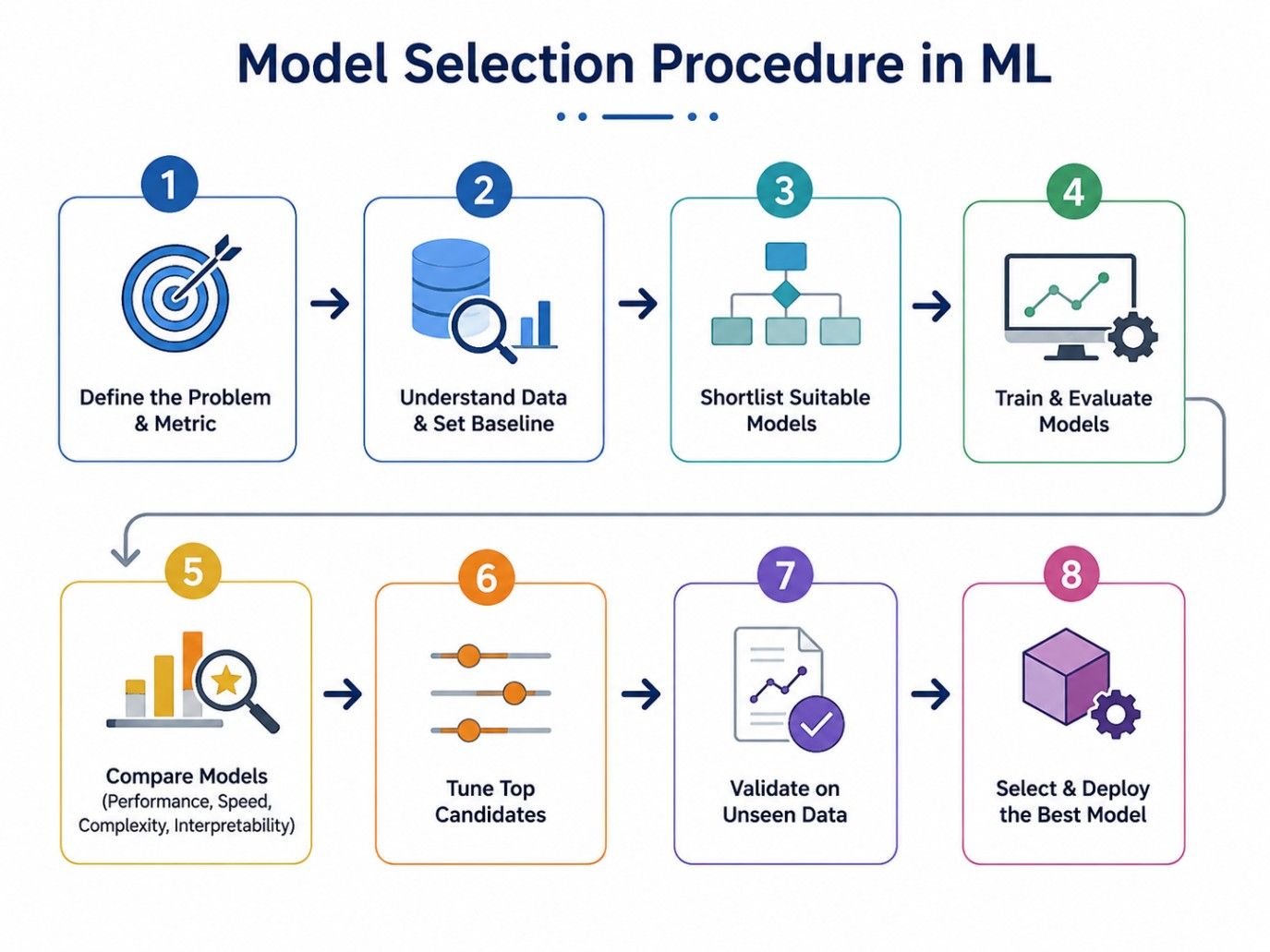
The model selection procedure in machine learning usually begins with defining the prediction task and ends with evaluating the final candidate on untouched test data.
There isn't one algorithm that wins every problem. If you're wondering how to select machine learning model options, start with the nature of the task rather than the popularity of the algorithm. A model should fit the data and the job.
The target variable gives you the first clue.
Problem type |
Models you might consider |
| Binary classification | Logistic regression, decision tree, random forest |
| Multiclass classification | Logistic regression, random forest, gradient boosting |
| Regression | Linear regression, random forest, gradient boosting |
| Clustering | K-means, hierarchical clustering, DBSCAN |
| Time series | ARIMA, exponential smoothing, machine learning models |
| Text classification | Naive Bayes, logistic regression, transformer-based models |
A small dataset with clear relationships might favor a simpler approach, while a larger dataset with complex interactions may justify a more flexible model.
Data size changes the practical choice.
Some algorithms work well with smaller datasets, while others benefit from larger amounts of training data. Feature count matters too.
If you've got thousands of features but only a few hundred observations, a highly flexible model could struggle with overfitting.
Ask yourself who needs to understand the predictions.A medical research team may need clear explanations for predictions. A recommendation system might place more emphasis on predictive performance and latency.
Interpretability isn't a technical afterthought. It's part of choosing the model.
Ready to move from machine learning concepts to building real AI solutions? Explore upGrad’s Building AI Products, Systems & Services EPGC by IIT KGP and develop practical skills to design, build, and deploy AI-powered products, systems, and services.
Performance is important, but it isn't the only factor. Strong model selection machine learning decisions consider several criteria together.
Imagine two models. Model A reaches 91% accuracy and takes seconds to predict. Model B reaches 92% but requires ten times more computing resources.
Choose metrics that reflect the actual problem. For classification, common measures include accuracy, precision, recall, F1 score, and ROC-AUC.For regression, you might use mean absolute error, mean squared error, root mean squared error, or R-squared.
A fraud detection model provides a good example. Missing fraudulent transactions may be more costly than reviewing a few extra legitimate transactions, so recall and precision deserve careful attention.
A model should perform well beyond its training data. That's why validation matters. If training accuracy is 98% but validation accuracy falls to 70%, something is wrong.
The gap can indicate overfitting.
Complex models can capture complicated patterns. They can also become harder to explain, tune, maintain, and monitor.If a simpler model delivers nearly the same performance, it may be the more sensible choice.
Think beyond the notebook.
Ask whether the model needs low-latency predictions, frequent retraining, limited memory, or straightforward deployment. You'll make a better decision when these constraints are considered before the final selection.
Also read: Supervised vs Unsupervised Learning: Key Differences
Cross-validation helps compare models more fairly by testing them across different subsets of the training data. It reduces the risk of choosing a model based on one lucky or misleading data split.
K-fold cross-validation divides the training data into several groups called folds.
For example, with 5-fold cross-validation, the model trains on four folds and validates on the fifth. This repeats five times, with each fold used for validation once.
You then calculate the average score across all folds. A model with stable scores across folds is usually more reliable than one with large performance swings.
Stratified cross-validation is useful for classification problems with imbalanced classes.
It keeps the class distribution similar across each fold. For example, if only 5% of transactions are fraudulent, stratification helps maintain a similar fraud ratio during validation.
Also Read: Ensemble Methods in Machine Learning: Types, Applications, and Best Practices
Cross-validation doesn't prevent data leakage by itself. Preprocessing, scaling, and feature engineering should be performed within each training fold when required.
Otherwise, information from the validation data can influence training and make the model appear better than it really is.
How Do You Compare Multiple Machine Learning Models?
Comparing models isn't about collecting the biggest score and stopping there. You need a consistent evaluation setup so that every candidate gets a fair test.
If you're asking how to select a model in machine learning, comparison should happen against the same data splits, metrics, and evaluation rules.
Create a Model Comparison Table
A simple table can make trade-offs easier to see.
Model |
Training Time |
Interpretability |
Complexity |
| Logistic Regression | Low | High | Low |
| Decision Tree | Low | High | Medium |
| Random Forest | Medium | Medium | Medium |
| Gradient Boosting | Medium | Low | High |
The highest score isn't automatically the final answer. If the difference between two models is tiny, simplicity might matter more.
A classification model might have high accuracy but poor recall.That's a problem if false negatives are expensive.
Look at the confusion matrix. Review precision and recall. Check the validation score and, where appropriate, examine calibration and threshold behavior.
Also read: Understanding Recurrent Neural Networks: Applications and Examples
Check Stability
A model that performs well on one split and poorly on another deserves scrutiny.
You want performance that remains reasonably consistent across validation samples.
That's one reason repeated cross-validation can be useful for sensitive projects.
How Does Hyperparameter Tuning Affect Model Selection?
Hyperparameters control how an algorithm behaves before or during training. Examples include tree depth, learning rate, number of estimators, and regularization strength.
Hyperparameter tuning and model selection are related, but they aren't the same thing.
Model selection chooses among different algorithm families or candidate approaches. Hyperparameter tuning searches for better settings within a chosen model.
A Simple Example
Suppose a random forest performs better than logistic regression.The forest might improve when you adjust the number of trees, maximum depth, or minimum samples required for a split.
But excessive tuning can create another problem. If you keep optimizing against the same validation data, you can gradually overfit to that validation set.
That's why your evaluation design matters.
Grid Search and Random Search
Grid search tests predefined combinations of hyperparameters.Random search samples combinations from specified ranges.
Grid search can work well when the search space is small. Random search becomes attractive when many parameters are involved and only some have a strong effect on performance.
The best approach depends on the model and computational budget.
Also read: Regularization in Machine Learning: How to Avoid Overfitting?
A model with high bias is usually too simple to capture the patterns in the data. A model with high variance is too sensitive to the training sample.You need a reasonable balance.
A linear model might underfit a complex relationship. A deep decision tree could memorize training observations and perform poorly on new data.That tension is central to model selection.
Underfitting happens when the model can't capture enough structure.
Training performance is poor. Validation performance is also poor.
You might respond by adding useful features, increasing model flexibility, or selecting an algorithm that can represent more complex relationships.
Read: A Day in the Life of a Machine Learning Engineer: What do they do?
Overfitting looks different.Training performance is strong, but validation performance is much weaker. A model may have learned noise or highly specific patterns from the training data.
Regularization, pruning, better validation, more data, or a simpler model can help.You shouldn't assume that increasing complexity will solve every performance problem.Sometimes the opposite works better.
Also Read: Top 14 Most Common Data Mining Algorithms You Should Know
Real-world problems make model choice clearer. The same algorithm may work well for one task but not another.
For customer churn, you could start with logistic regression, then compare it with a decision tree or random forest. Cross-validation and metrics like precision and recall can help identify the better option.
Image classification is different. Neural networks are often better suited to complex visual patterns than traditional machine learning models. The type of data shapes the choice.
Example Comparison
Scenario |
Possible Starting Model |
Main Consideration |
| Customer churn | Logistic regression | Interpretability |
| Credit risk | Logistic regression or tree-based model | Explainability and error costs |
| Fraud detection | Tree-based models | Class imbalance |
| House price prediction | Linear regression or boosting | Prediction error |
| Customer segmentation | K-means | Cluster structure |
| Image recognition | Convolutional or transformer model | Representation learning |
It's to develop a selection habit. Start with the problem, inspect the data, establish a baseline, compare reasonable candidates, and validate the result.
Read: Linear Regression: Step by Step Guide
Model selection can go wrong even when the process looks correct. Small evaluation mistakes can affect results and lead you to choose the wrong model.
Choosing a model becomes easier when you follow a clear process. You don't need to test every algorithm, just the ones that fit your data and goal.
This approach makes the model selection procedure in machine learning more practical and evidence-based.
Good model selection machine learning practice starts with the problem, not the algorithm.
Define the objective. Understand the data. Build a baseline. Compare suitable candidates using consistent validation and meaningful metrics.Don't chase a tiny score improvement without considering complexity, interpretability, speed, and maintenance.
If you're learning how to select a model in machine learning, remember the core principle. The right model is the one that performs reliably on unseen data while fitting the real requirements of the problem.That makes the final decision easier to defend, test, and improve.
Ready to start your journey? Book a free consultation with upGrad today to find the best path for your career
Neither is universally better. Scikit-learn is well suited to traditional machine learning, including classification, regression, clustering, preprocessing, and model evaluation. PyTorch is designed around deep learning and tensor-based computation, making it a stronger fit for neural networks, computer vision, NLP, and generative AI workloads.
model_selection is a scikit-learn module containing tools for evaluating and tuning machine learning models. It includes cross-validation utilities, train-test splitting, parameter searches, and related methods that help compare models and estimate how well they generalize to unseen data.
Yes, scikit-learn is a strong starting point for beginners because it provides consistent APIs for common machine learning tasks. You can learn preprocessing, classification, regression, clustering, cross-validation, and tuning without first building neural networks or managing complex deep learning workflows.
The difficulty depends on your programming background and learning goals. Both frameworks require understanding tensors, model architecture, training, and optimization. PyTorch's Python-focused workflow can feel natural to many developers, while TensorFlow offers high-level APIs through Keras that simplify common neural network development.
They solve different problems, so a direct winner doesn't make much sense. Scikit-learn is convenient for traditional machine learning algorithms and evaluation workflows, while TensorFlow is an end-to-end platform for building, training, and deploying machine learning models, particularly neural networks and deep learning systems.
For someone starting with machine learning fundamentals, learning scikit-learn first can be useful because it exposes core ideas such as features, targets, training, evaluation, preprocessing, and cross-validation. Once those concepts are clear, moving into PyTorch becomes easier when you need neural networks or deep learning workflows.
Start with the data and problem rather than the framework. Structured tabular data often provides a good starting point for traditional machine learning, while large image, audio, or text problems may benefit from deep learning. Available data, computing resources, latency, and interpretability should also influence the decision.
When several algorithms are suitable, model selection means comparing their performance under the same evaluation conditions and choosing the option that best fits the project's requirements. The decision can include predictive performance, training time, interpretability, complexity, and generalization rather than relying on one score alone.
Scikit-learn can support some neural-network models through its own estimators, but it isn't primarily a deep learning framework. For larger or more specialized neural networks, PyTorch or TensorFlow provides deeper control over tensors, automatic differentiation, model architecture, training, and hardware acceleration.
Model selection usually means deciding which algorithm or modeling approach to use, while tuning focuses on finding suitable hyperparameter values for that choice. For example, choosing random forest over logistic regression is selection, while adjusting tree depth or the number of trees is tuning.
Choose PyTorch when your project needs flexible neural-network architectures, GPU-based tensor computation, or deep learning workflows such as computer vision, natural language processing, and generative AI. For conventional tabular classification, regression, clustering, and many evaluation tasks, scikit-learn may provide a simpler development path.
730 articles published
Sriram K is a Senior SEO Executive with a B.Tech in Information Technology from Dr. M.G.R. Educational and Research Institute, Chennai. With over a decade of experience in digital marketing, he specia...
Speak with AI & ML expert
By submitting, I accept the T&C and
Privacy Policy
Top Resources
Master's Degree
18 Months
Executive Diploma
12 Months
IIIT Bangalore
Executive Programme in Generative AI & Agentic AI for LeadersIndia’s #1 Tech University
Dual Certification
5 Months