Independent Component Analysis in Machine Learning
By Rahul Singh
Updated on Jun 10, 2026 | 9 min read | 4.13K+ views
Share:

All courses
Certifications
More
By Rahul Singh
Updated on Jun 10, 2026 | 9 min read | 4.13K+ views
Share:
Table of Contents
Independent component analysis (ICA) is a machine learning and signal processing technique used to separate a collection of mixed signals into their original independent components. It works by identifying hidden source signals within observed data and recovering them based on the assumption that the original sources are statistically independent of one another.
A key principle behind ICA is that the underlying source signals are non-Gaussian, meaning they do not follow a normal distribution. By leveraging both independence and non-Gaussianity, ICA can uncover meaningful patterns that may be hidden within complex datasets, making it useful for tasks such as signal separation, feature extraction, noise reduction, and biomedical data analysis.
This blog covers everything you need to know about independent component analysis in machine learning.
Popular AI Programs
The classic example used to explain independent component analysis (ICA) is called the cocktail party problem. Imagine three microphones placed in a room where three people are speaking simultaneously. Each microphone records a different mix of all three voices. ICA takes those three mixed recordings and outputs the three original voice signals, cleanly separated.
ICA works by finding a transformation that makes the output components as statistically independent as possible. Unlike methods that just reduce correlation between variables, ICA goes a step further and minimizes statistical dependence altogether.
Here is a simple way to think about it:
Element |
Description |
| Input | Mixed signals (you only observe these) |
| Goal | Find the hidden independent sources |
| Output | Separated, independent components |
Also Read: What Is Machine Learning and Why It’s the Future of Technology
You do not need to be a mathematician to understand the basics. ICA assumes your observed data X is a linear mixture of independent components S:
X = A x S
Where:
ICA tries to find the unmixing matrix W (the inverse of A) so that:
S = W x X
The algorithm achieves this by maximizing the non-Gaussianity of the output components, because the central limit theorem tells us that a mixture of signals becomes more Gaussian than the originals. So when you reverse that and maximize non-Gaussianity, you are getting closer to the original independent signals.
Also Read: Top 5 Machine Learning Models Explained For Beginners
Assumption |
Why It Matters |
| Statistical independence of sources | Core requirement for the math to work |
| Non-Gaussian source distributions | Allows ICA to separate signals |
| Linear mixing | The signals combine in a straightforward additive way |
| Number of sources = Number of observed signals | Needed for a unique solution |
Free Courses
Understanding the process helps you apply ICA correctly in real projects. Here is a walkthrough of how the algorithm runs.
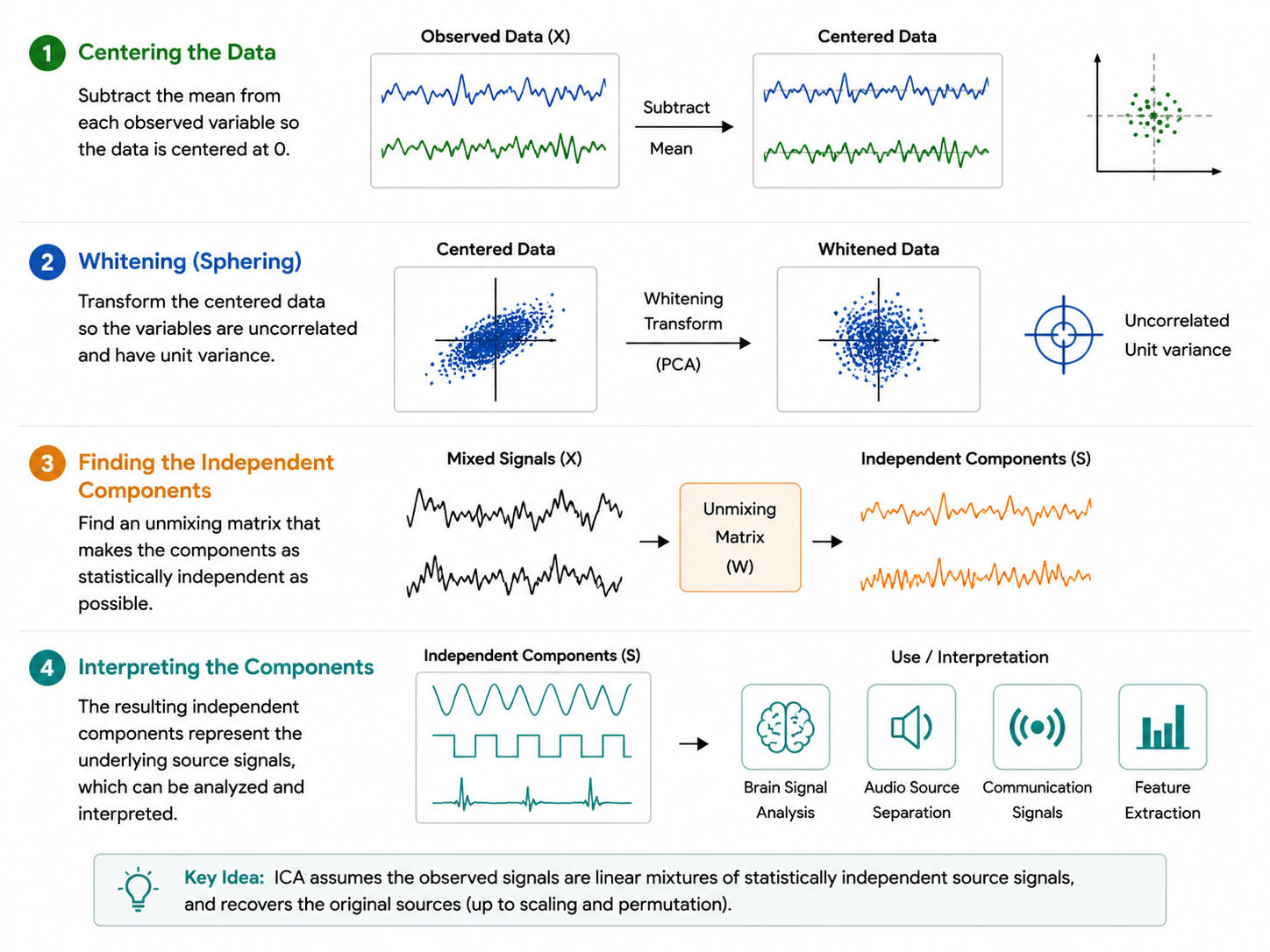
The first step is to subtract the mean from each observed signal. This centers the data around zero and simplifies the calculations that follow.
Before ICA can separate signals, it transforms the data so that the components are uncorrelated and have unit variance. This step is called whitening or sphering.
After whitening:
Whitening is often done using Principal Component Analysis (PCA) as a preprocessing step. However, PCA alone is not enough to find independent components. ICA goes further.
This is the main step. The algorithm iteratively adjusts the unmixing matrix W to maximize the statistical independence of the output components.
The two most popular ICA algorithms are:
FastICA
Infomax ICA
Also Read: 15 Dimensionality Reduction in Machine Learning Techniques
Once ICA finishes, you get a set of independent components. The tricky part is that ICA does not label them for you. You need to interpret what each component represents based on domain knowledge.
For example, in brain signal analysis, one component might represent eye blink artifacts, another might be muscle movement, and a third might be actual brain activity.
AI Courses to upskill
Explore Artificial Intelligence Courses for Career Progression
ICA has found a home in many real-world applications. Here are the most common use cases.
The cocktail party problem is the most famous example. ICA is used to separate audio sources, remove noise from recordings, and improve speech recognition systems.
Also Read: Top 48 Machine Learning Projects [2026 Edition] with Source Code
This is one of the most active areas of ICA research. Electroencephalography (EEG) data captures brain activity, but it also picks up noise from eye blinks, muscle movements, and heartbeats.
ICA separates:
Without ICA, researchers would struggle to isolate real brain signals from noise.
ICA can decompose images into independent features. Researchers have used it to:
Also Read: Top 29 Image Processing Projects in 2026 For All Levels + Source Code
Financial analysts use ICA to find hidden factors driving stock market movements. Unlike PCA which finds correlated factors, ICA finds statistically independent ones, which can reveal more meaningful underlying drivers in the market.
ICA helps with separating signals that interfere with each other in wireless communication systems, improving signal quality and reducing cross-talk between channels.
Many people confuse ICA with PCA because both are dimensionality reduction and signal decomposition methods. They are related but serve different purposes.
Feature |
PCA |
ICA |
| Goal | Maximize variance, reduce dimensions | Find statistically independent components |
| Assumption | Gaussian data | Non-Gaussian data |
| Output | Orthogonal components | Independent components |
| Interpretability | Low (abstract) | Higher (meaningful sources) |
| Use case | Dimensionality reduction, compression | Source separation, artifact removal |
| Order of components | By variance (largest first) | No natural order |
| Speed | Fast | Slower (iterative) |
Also Read: Image Recognition Machine Learning: Brief Introduction
A common workflow is to use PCA first for whitening and dimensionality reduction, then apply ICA to find independent components. Many libraries including scikit-learn follow this approach internally.
Here is a practical example to get you started. This uses the FastICA implementation available in scikit-learn.
pip install scikit-learn numpy matplotlibfrom sklearn.decomposition import FastICA
import numpy as np
import matplotlib.pyplot as plt
# Simulate two independent source signals
np.random.seed(42)
n_samples = 2000
time = np.linspace(0, 8, n_samples)
# Source 1: Sine wave
s1 = np.sin(2 * time)
# Source 2: Sawtooth wave
s2 = np.sign(np.sin(3 * time))
# Stack sources
S = np.c_[s1, s2]
# Mixing matrix
A = np.array([[1, 1], [0.5, 2]])
# Create mixed signals
X = S @ A.T
# Apply FastICA
ica = FastICA(n_components=2, random_state=42)
S_estimated = ica.fit_transform(X)
print("Original sources shape:", S.shape)
print("Mixed signals shape:", X.shape)
print("Recovered sources shape:", S_estimated.shape)Parameter |
What It Does |
Default |
| n_components | Number of independent components to extract | None (all) |
| algorithm | Deflation or parallel | parallel |
| max_iter | Maximum iterations | 200 |
| tol | Convergence tolerance | 0.0001 |
| fun | Non-linearity function (logcosh, exp, cube) | logcosh |
Also Read: Scikit Learn Library in Python: Features and Applications
Subscribe to upGrad's Newsletter
Join thousands of learners who receive useful tips
ICA is powerful but it is not a perfect solution for every problem. Knowing the limitations helps you use it wisely.
ICA does not tell you which component comes first. The algorithm outputs components in no particular meaningful order. You have to figure out the order yourself based on domain expertise.
ICA can return a component that is the negative (flipped) version of the real source. For many applications this does not matter, but in some cases you need to account for it.
Also Read: Types of Algorithms in Machine Learning: Uses and Examples
If your source signals follow a Gaussian (normal) distribution, ICA cannot separate them. This is a fundamental mathematical constraint. For Gaussian data, PCA is the better choice.
You need at least as many observed signals as there are independent sources. If you have three sources but only two microphones, ICA will struggle or fail.
ICA assumes the mixing is linear. Real-world mixing can be nonlinear (for example, echo in audio). Standard ICA does not handle nonlinear mixing well, though extensions exist.
Outliers in data can distort the estimated independent components. Preprocessing to remove extreme values is often necessary before applying ICA.
Also Read: Math for Machine Learning: Essential Concepts You Must Know
Independent component analysis in machine learning is a genuinely useful tool for anyone working with mixed signals or complex multivariate data. It goes beyond correlation and finds statistically independent hidden sources, which is something PCA simply cannot do.
You have now seen what ICA is, the math behind it in simple terms, where it is applied across industries, how it compares to PCA, and how to implement it in Python. You have also learned where it falls short so you can make better decisions about when to use it.
Want personalized guidance on AI and upskilling? Speak with an expert for a free 1:1 counselling session today.
Independent component analysis in machine learning is a technique that separates a set of mixed signals into their original independent parts. It is like identifying individual instruments in a piece of music when you only have a single recording of the whole band playing together.
PCA finds components that explain maximum variance and assumes Gaussian data. ICA goes further by finding components that are statistically independent, not just uncorrelated. ICA works best on non-Gaussian data and is better suited for signal separation tasks than dimensionality reduction.
The cocktail party problem is the classic illustration for ICA. Multiple microphones in a room capture mixed speech from several speakers. ICA recovers each speaker's voice separately from those mixed recordings, even though none of the microphones captured any single voice cleanly.
No. ICA cannot separate signals that follow a Gaussian (normal) distribution. This is a known mathematical limitation. When your data is Gaussian, PCA or other methods are more appropriate choices for your analysis.
FastICA is an efficient algorithm for performing independent component analysis. It uses a fixed-point iteration method and converges much faster than earlier ICA algorithms. It is available in scikit-learn and is the go-to implementation for most machine learning practitioners.
Yes, ICA can reduce dimensionality by extracting a smaller number of meaningful independent components from high-dimensional data. However, it is primarily designed for source separation, and PCA or autoencoders are usually preferred when the main goal is dimensionality reduction.
ICA is widely used in EEG and brain signal analysis to remove artifacts, in audio processing to separate speech or music sources, in finance to identify hidden market factors, in image processing for feature extraction, and in telecommunications to reduce signal interference.
A common approach is to first use PCA to identify how many meaningful dimensions your data has, and then extract that many independent components. There is no single right answer because it depends on your data and the specific problem you are solving.
ICA is an unsupervised learning method. It does not require labeled data. It learns the structure of the data purely from the observed signals without any external guidance or target labels provided during training.
The most accessible option is scikit-learn, which provides FastICA through sklearn.decomposition.FastICA. For neuroscience applications, MNE-Python offers ICA tailored for EEG and MEG data. Both are well-documented and beginner-friendly.
If there are more independent sources than observed signals, standard ICA cannot find a unique solution. The problem becomes underdetermined. In such cases, you either need more sensors or you need to use variants like sparse ICA or other blind source separation methods designed for underdetermined systems.
98 articles published
Rahul Singh is an Associate Content Writer at upGrad, with a strong interest in Data Science, Machine Learning, and Artificial Intelligence. He combines technical development skills with data-driven s...
Speak with AI & ML expert
By submitting, I accept the T&C and
Privacy Policy
Top Resources
Master's Degree
18 Months
Executive Diploma
12 Months
IIIT Bangalore
Executive Programme in Generative AI & Agentic AI for LeadersIndia’s #1 Tech University
Dual Certification
5 Months