A Comprehensive Guide to Entity in DBMS: Types, Entity Sets, and Practical Applications in 2026
Updated on Dec 05, 2025 | 12 min read | 49.99K+ views
Share:

All courses
Certifications
More
Updated on Dec 05, 2025 | 12 min read | 49.99K+ views
Share:
Table of Contents
Did You Know? An entity in dbms is more than just data, it's a real-world object like a user, product, or order that brings meaning and structure to your database!
A Database Management System (DBMS) is essential software that enables efficient storage, organization, and management of data. It ensures data consistency, reduces redundancy, and supports multi-user access, making it a critical tool in domains like data science, machine learning, and business intelligence.
A fundamental concept in DBMS is the entity. An entity in DBMS represents real-world objects such as people, products, or events that are stored as data in a structured format. Understanding entities and entity sets in DBMS is crucial for designing scalable databases that support data-driven applications and decision-making across industries.
This guide will help you define entity in DBMS, explore its types, understand entity sets in DBMS, and see their practical applications in real-world scenarios.
Unleash the power of data! Choose from a variety of Data Science programs and get ready to lead in the age of analytics.

An entity in DBMS is a fundamental building block representing any object, person, concept, or event significant to the system. It’s the foundation of how data is organized and understood.
Advance your career with globally recognized Data Science and AI courses from top institutes like IIIT-B and Liverpool John Moores University. Enroll now and lead the future of data-driven innovation.
Think of a university’s database. Entities might include "Students," "Courses," and "Professors." Each of these has specific types of attributes in DBMS. For instance:
These entities in dbms and their attributes enable the system to track and manage vast data seamlessly. Though entities aren’t just data containers, they act as anchors to structure database relationships.
For example:
Without defining entities, it would be impossible to establish these logical connections. There are different ways to visualize this entity in DBMS. Read ahead!
Step into the future of analytics and AI! Join our free Data Science courses and learn the fundamentals of this high-demand field.
One of the most effective ways to understand entities is through Entity-Relationship Diagrams (ERDs). These diagrams use shapes (like rectangles for entities and ovals for attributes) to represent how data is structured and related.
For instance, in an e-commerce system:
Using ERDs lets you visualize how entities interact, laying a clear roadmap for database design.
Let’s get into the types of entity in DBMS!
Free Courses
When you think about organizing data in a database, have you ever wondered how real-world objects and abstract ideas are represented? In a DBMS, everything boils down to entity in dbms, and these entities can be broadly classified into two types: tangible and intangible.
Let’s break this down so you can see how both forms of entities work and why they’re crucial for any database.
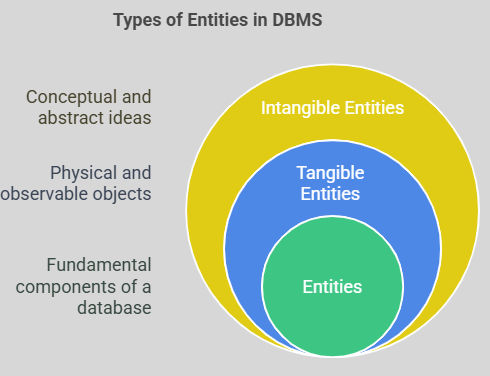
Imagine the things you interact with daily — a laptop, a book, or even a person. These are examples of tangible entities that can be directly observed and measured.
Tangible Entities in DBMS are important because:
How They’re Represented in a DBMS:
Picture a table labeled "Products." Each row represents a tangible entity — a single product. The attributes (columns) might include ProductID, Name, Price, and Stock.
Now, let’s think bigger. What about things you can’t touch but still deal with regularly — like a bank transaction, a loan, or a university course enrollment? These are intangible entities.
They’re just as important as the tangible ones because:
How They’re Represented in a DBMS:
Take "Transaction" as an example. It doesn’t exist physically but is essential for tracking financial activity. Attributes could include TransactionID, Amount, Date, and Linked Account.
So, the next time you encounter terms like entity in DBMS, think of tangible and intangible entities working together to bring data to life.
Also Read: DBMS vs. RDBMS: Understanding the Key Differences, Features, and Career Opportunities
Next, let's understand what is an entity set in DBMS!
If you’ve ever worked with databases, you know how critical it is to group similar entities together. That’s precisely what an entity set in DBMS does — a collection of entities that share the same properties.
It allows you to manage data more efficiently by grouping entities with the same structure. This is essential for database applications that involve large volumes of related data.
For example:
Thus, to define an entity set effectively, you need three key elements:
By grouping entities into sets, you create a structured database design that is easier to query, update, and maintain.
To explore more about database design, go for upGrad’s Introduction to Database Design with MySQL course for a start!
Let’s dive into the specific terms you need to understand entity sets fully!
When working with entity set in DBMS, you’ll encounter several key terms that describe how they function. Let’s break these down:
| Term | Definition | Example |
| Attributes | Traits or properties that define an entity in the set. | For "Student": Name, Roll Number, Department |
| Entity Instance | A specific occurrence or record of an entity. | John Doe in the "Students" entity set |
| Entity Type | The category or class of entities sharing the same attributes. | "Student" or "Product" |
| Primary Key | A unique identifier for each entity instance within the set. | Roll Number for "Student" |
Understanding these will help you recognize how data flows and connects within your system.
Now, let’s uncover the types of entity set in DBMS!
The entity set in DBMS is categorized into two main types: strong and weak entity in DBMS. Understanding these concepts is crucial for designing efficient databases that manage data and relationships effectively.
Here’s how strong and weak entity in DBMS differ, how they work, and why they play a vital role in building a robust data structure.
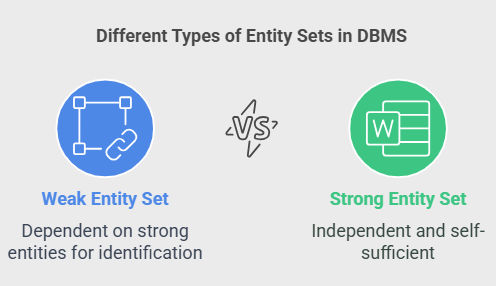
A weak entity set is a collection of entities that cannot exist independently without being linked to a "stronger" entity. It lacks a primary key and relies on a foreign key to uniquely identify its records.
For an example, consider a database for a school:
This linkage ensures that data in a weak entity set remains meaningful and connected.
A strong entity set is self-sufficient and doesn’t rely on other entities to be uniquely identified. Each record in this set has a primary key distinguishing it from all other records.
For example, in the same school database:
As you can see, both entities together create a network of interconnected data that reflects real-world scenarios.
Also Read: Understanding Types of Data: Why is Data Important, its 4 Types, Job Prospects, and More
Now, let's compare entity and entity set side by side!
When you dive into databases, it’s essential to differentiate between an entity and an entity set. Think of it as the difference between a single student in a school and an entire class.
Let’s break this down further with a comparison:
| Aspect | Entity in DBMS | Entity Set in DBMS |
| Definition | A single, uniquely identifiable object or concept. | A collection of entities with the same attributes. |
| Example | A specific student: "John Doe" with Roll Number 101. | All students in a class, represented by attributes like Roll Number, Name, and Department. |
| Scope | Refers to a specific instance of data. | Groups together multiple similar entities for easier management. |
| Attributes | Describes the characteristics of one entity (e.g., name, roll number, department). | Shared attributes apply to all entities within the set (e.g., all students share "roll number" as an attribute). |
| Usage in DBMS | Represents an individual data point in a database. | Forms the foundation for organizing and structuring data relationships in tables. |
Understanding this distinction helps you see how entity in DBMS functions, allowing databases to manage vast amounts of data efficiently and enabling you to design cleaner, more organized database structures.
Also Read: Database vs Data Warehouse: Difference Between Database vs Data Warehouse [2024]
Now, let’s see what ERD is, why it matters, and how you can create one step by step!
Subscribe to upGrad's Newsletter
Join thousands of learners who receive useful tips
Imagine trying to understand a database just by reading tables and columns; it’s like solving a puzzle without a picture to guide you. This is where the Entity Relationship Diagram (ERD) comes in.
ERDs are graphical representations that show how entities and their relationships are structured in a DBMS. One crucial element in ERDs is cardinality, which defines the number of associations between entities.
Here’s a quick overview of cardinality types and how they apply to real-world scenarios:
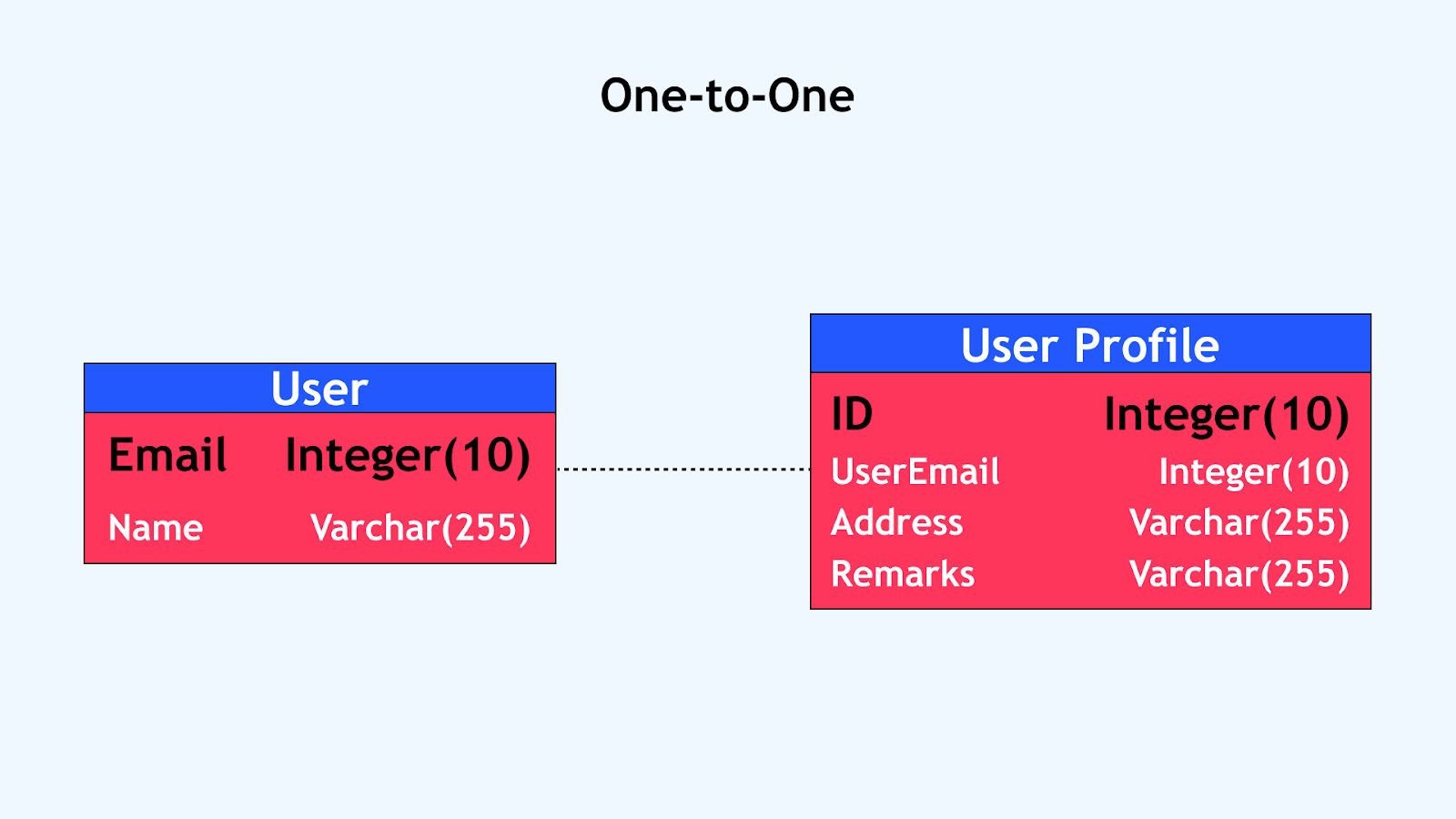
In the One-to-One type, each entity in Set A relates to exactly one entity in Set B, and vice versa.
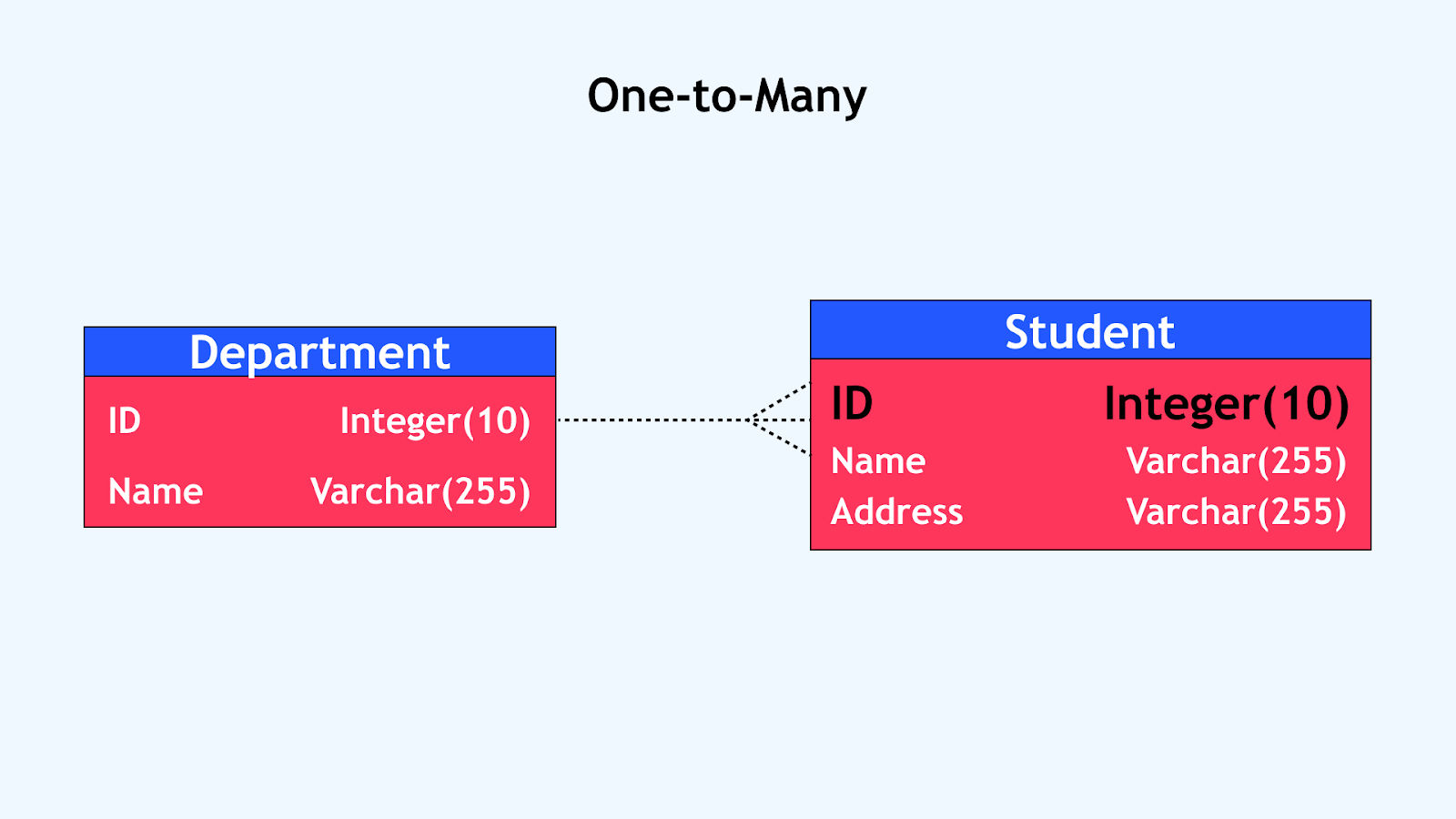
In the One-to-Many type, one entity in Set A relates to many entities in Set B.
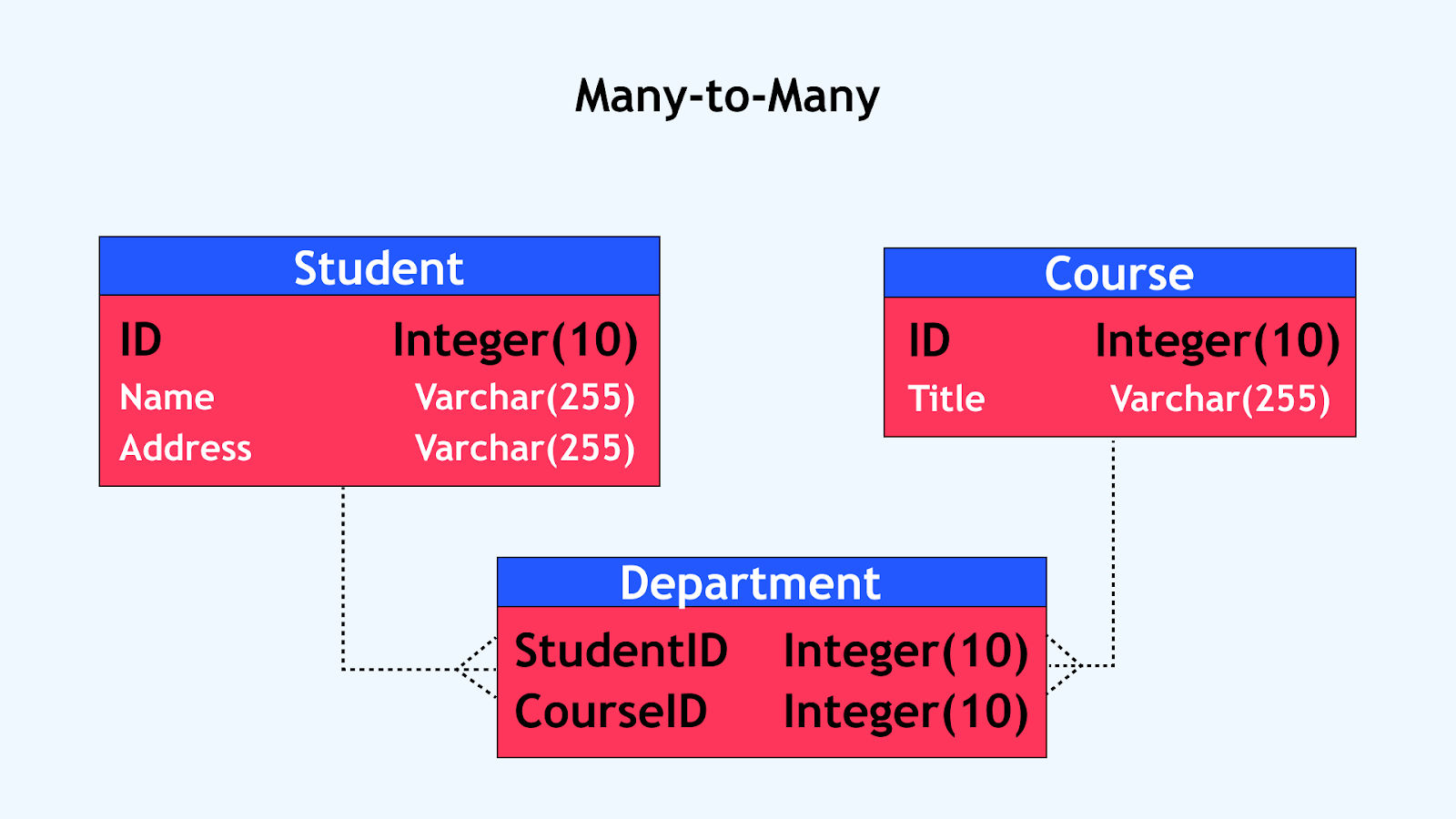
In the Many-to-Many type, entities in Set A relate to multiple entities in Set B, and vice versa.
Now, let us get to ERD symbols!
To decode an ERD effectively, you must understand its symbols. Each symbol has a unique purpose, making the diagram intuitive and informative. Below are the common ER diagram symbols:
Understanding these symbols ensures you can not only create ERDs but also interpret them with ease.
Also Read: Mastering DBMS: Exploring the 7 Types of Keys in DBMS and Their Roles
Let’s move ahead and discover how this entity in DBMS is practically applied!
Entities and entity set in DBMS aren’t just theoretical concepts — they’re integral to how modern systems manage and organize vast amounts of data.
Here’s a look at how entities and entity sets are applied in key industries:
| Application | Entities | Example of Data Structure and Relationships |
| E-commerce and Customer Management | Customers, Orders, Products | A customer places multiple orders; each order contains multiple products. |
| Inventory and Supply Chain Management | Products, Suppliers, Stock Levels | Multiple suppliers supply products; stock levels are monitored for each product across locations. |
| Healthcare Systems | Patients, Doctors, Appointments | A patient books multiple appointments; each appointment is associated with one doctor. |
You see, entity in DBMS empower businesses and systems to handle data efficiently, creating better experiences for both users and administrators.
Also Read: 25+ Innovative DBMS Project Ideas for Beginners in 2026: Source Code, Benefits, and More

Doesn't it sound fascinating to imagine yourself analyzing complex data sets or designing databases that power global organizations? To excel in such roles, understanding entity in DBMS and knowing what is entity in DBMS is essential.
This is where upGrad, India’s leading online learning platform, becomes your partner in success. Its comprehensive programs and learner-focused approach equip you with the skills and confidence to master DBMS concepts and apply them effectively in real-world scenarios.
Some of the top relevant courses include:
Want help figuring out where to start? Book a free career counseling session with upGrad experts and explore how the right program can transform your career. For more details, visit our offline centers.
Take control of your career with upGrad — the platform for achievers like you
Boost your career with our popular Software Engineering courses, offering hands-on training and expert guidance to turn you into a skilled software developer.
Master in-demand Software Development skills like coding, system design, DevOps, and agile methodologies to excel in today’s competitive tech industry.
Stay informed with our widely-read Software Development articles, covering everything from coding techniques to the latest advancements in software engineering.
An entity in entity in database management system is a real-world object, person, or concept that can be distinctly identified and stored in a database, such as a customer or a product.
An entity set groups entities with similar attributes, making it easier to manage, query, and maintain related data in a database.
An entity refers to a single data object, while an entity set is a collection of similar entities, like all students in a school database.
Strong entity sets have their primary key and exist independently, while weak entity sets rely on a strong entity and use a foreign key for identification.
Attributes are properties or characteristics of an entity, such as a student’s name, roll number, or department.
ERDs visually map entities and their relationships, simplifying database design and ensuring logical organization.
Cardinality defines the number of relationships between entities, such as one-to-one, one-to-many, or many-to-many connections.
In an e-commerce platform, an entity set like “Customers” includes individual entities (customers) with attributes such as name and email.
A primary key uniquely identifies each entity within an entity set, ensuring no two records are identical.
Popular tools include Microsoft Visio, Lucidchart, and online platforms like draw.io, which provide user-friendly interfaces for ERD creation.
It equips you with essential database management skills, enabling you to design efficient systems for data analytics, software development, and IT management roles.
Relationships define how two or more entities interact in a database. Understanding relationships is essential to connect entity in DBMS correctly and design efficient database structures.
No. Every entity in DBMS must have attributes that describe its properties. Without attributes, you cannot uniquely identify or define the entity within a database.
A strong entity has a primary key and can exist independently, whereas a weak entity depends on a strong entity. Learning this distinction helps define entity in DBMS clearly.
Foreign keys link entities in different tables and maintain referential integrity. Proper use of foreign keys ensures relationships among entities in DBMS are accurately represented.
A derived entity’s value is computed from other entities. For instance, a “Total Purchase” entity in a sales database can be calculated from the entity in DBMS like “Orders” and “Products.”
Normalization organizes attributes of an entity in database to reduce redundancy and dependency, making queries faster and data storage more efficient.
Composite attributes combine multiple properties into a single attribute. For example, a “Full Name” attribute may include “First Name” and “Last Name” within an entity in DBMS.
Yes, an entity set can have multiple relationships. For example, a “Student” entity in database may relate to “Courses” and “Clubs,” reflecting real-world interactions.
Knowing what is entity in DBMS helps designers model real-world systems accurately, optimize queries, and ensure data integrity, which is critical for IT, software, and analytics roles.
Reference Link:
https://www.anvayasolutions.com/90-of-the-worlds-data-was-created-in-two-years/
911 articles published
Pavan Vadapalli is the Director of Engineering , bringing over 18 years of experience in software engineering, technology leadership, and startup innovation. Holding a B.Tech and an MBA from the India...
Get Free Consultation
By submitting, I accept the T&C and
Privacy Policy
Top Resources
Classroom
6 Months
Microsoft
Generative AI Mastery Certificate for Software DevelopmentLearn to use GitHub copilot, Azure & more
Certification
2 months
3 Months