15 Best Employee Management System in India (2026)
By upGrad
Updated on Aug 24, 2026 | 8 min read | 5.51K+ views
Share:

All courses
Certifications
More
By upGrad
Updated on Aug 24, 2026 | 8 min read | 5.51K+ views
Share:
Table of Contents
Key Highlights
Advance your career with management degree courses that combine business fundamentals, leadership skills, and practical industry knowledge.
Popular Management Programs
Every business has different HR priorities. Some need robust payroll and compliance features, while others focus on talent management, employee engagement, or workforce analytics. The platforms below cater to a wide range of business sizes and industries, making it easier to find one that aligns with your requirements.
Keka is one of the most popular employee management systems for Indian businesses, offering a complete HR solution without overwhelming users with unnecessary complexity. Combines payroll, attendance, leave management, performance reviews, expense claims, and employee records in one platform, making daily HR operations much more efficient.
Its payroll engine is one of its biggest strengths. Keka automates salary calculations, tax deductions, PF, ESI, and other statutory requirements, helping businesses reduce manual work and stay compliant with Indian regulations.
Employees can independently access payslips, apply for leave, update personal information, and submit reimbursement requests through the self-service portal.
Best For: Startups, SMEs, and growing businesses looking for an all-in-one HR platform.
Businesses that already rely on Zoho's ecosystem often prefer Zoho People because it integrates seamlessly with applications like Zoho Payroll, Zoho Recruit, and Zoho CRM. Instead of managing employee information across multiple tools, HR teams can centralize records, attendance, onboarding, and performance management within one system.
Organizations can customize workflows, approval processes, forms, and attendance policies based on their internal requirements rather than adapting to predefined settings. Its mobile app also makes it easy for employees to mark attendance, submit leave requests, and access HR documents while working remotely.
Best For: Businesses looking for a flexible and customizable HR platform.
Managing a large workforce requires more than payroll software, and Darwinbox is designed with that challenge in mind. It supports the complete employee lifecycle, covering recruitment, onboarding, learning, engagement, performance management, and workforce planning through a single cloud platform.
Its AI-powered analytics give HR leaders deeper visibility into workforce trends, helping them identify skill gaps, monitor employee performance, and plan hiring more effectively. The platform is also highly scalable, making it a preferred choice for enterprises expanding across multiple offices or countries.
Best For: Large organizations and enterprises managing distributed teams.
If payroll processing and statutory compliance take up most of your HR team's time, greytHR is worth considering. The software simplifies salary processing while helping businesses comply with regulations such as PF, ESI, TDS, and professional tax.
Apart from payroll, greytHR covers attendance, leave management, employee records, and document management. Employees can download payslips, check leave balances, and access tax documents on their own, reducing routine HR queries and improving operational efficiency.
Best For: Businesses focused on payroll accuracy and statutory compliance.
BambooHR is designed for organizations that want a clean, user-friendly HR platform without sacrificing essential functionality. It manages employee records, hiring, onboarding, time-off requests, and performance reviews through an interface that is easy for both HR teams and employees to navigate.
The software places a strong emphasis on employee experience. Digital onboarding, self-service tools, and performance tracking help businesses create a smoother journey from hiring to career development. Reporting tools also provide useful insights into workforce trends and employee turnover.
Best For: Small and medium-sized businesses looking for an intuitive HR platform.
Rippling stands out because it combines HR, IT, and finance into a single platform. Beyond managing employee records and payroll, it can automatically create email accounts, assign company laptops, provide software access, and manage employee benefits during onboarding.
This connected approach reduces manual work and helps businesses onboard or offboard employees much faster. It's particularly useful for organizations with remote teams, where HR and IT need to work together throughout the employee lifecycle.
Why Rippling Stands Apart
Unlike traditional HR software, Rippling also manages employee devices and software permissions, making it a practical solution for technology-driven businesses.
Best For: Companies that want to manage HR and IT operations together.
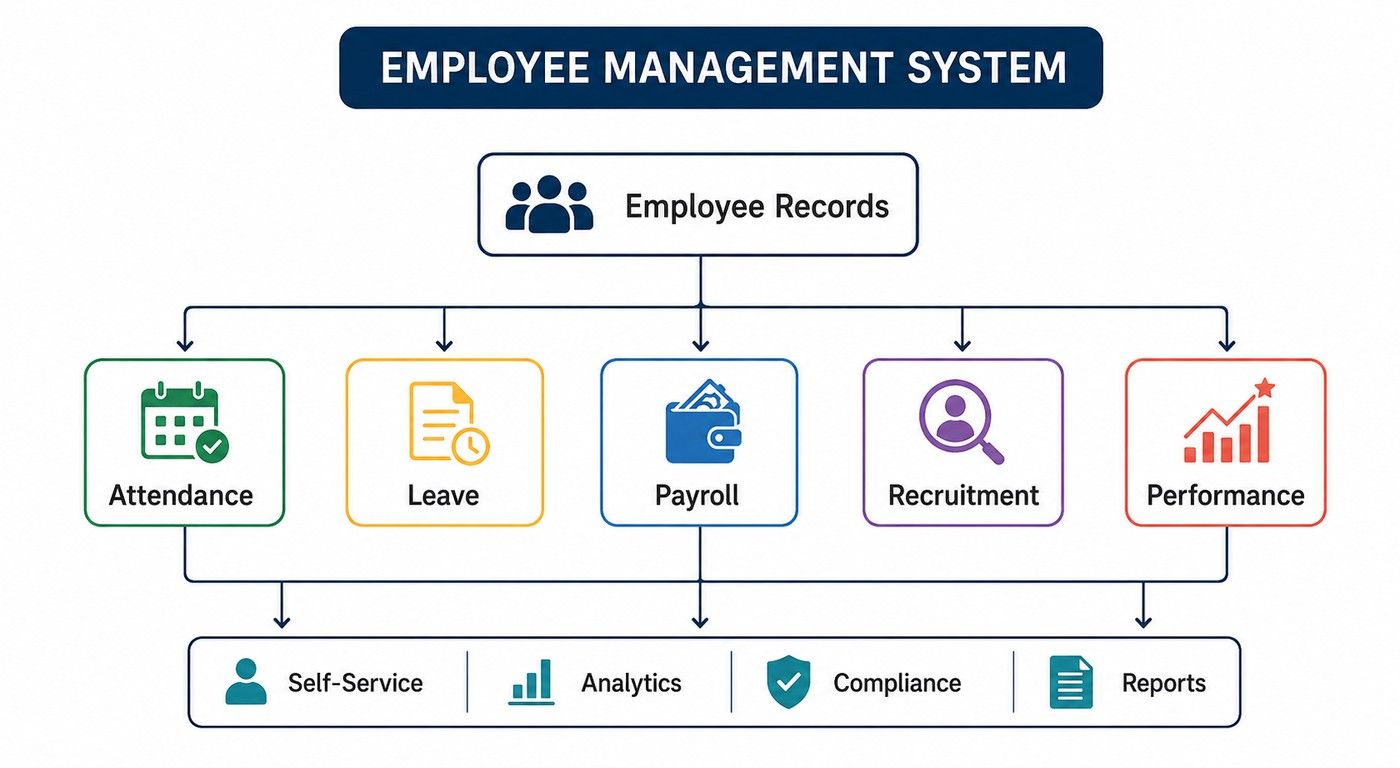
What Does an Employee Management System Manage?
Large enterprises often need more than operational HR software. Workday helps organizations manage workforce planning, talent management, compensation, and employee data while providing real-time insights for strategic decision-making.
Its analytics capabilities are a major differentiator. HR leaders can forecast hiring needs, monitor workforce costs, identify skills gaps, and evaluate employee performance using interactive dashboards. Workday also integrates with enterprise systems, making it suitable for organizations operating across multiple regions.
Best For: Large enterprises requiring advanced workforce planning and analytics.
Also read: 12 Essential Time Management Tips for Employees
SAP SuccessFactors is a comprehensive employee management suite that supports every stage of the employee lifecycle, from recruitment and onboarding to learning, performance management, and succession planning. Businesses can implement individual modules or adopt the full suite based on their HR requirements.
The platform is especially valuable for multinational organizations managing employees across different countries. Its learning and talent management capabilities help companies develop future leaders while improving employee engagement through continuous feedback and career development.
Best For: Large enterprises and multinational organizations with global HR needs.
For organizations managing employees across multiple countries, Oracle Fusion HCM offers much more than basic HR management. It brings together core HR, payroll, talent management, workforce planning, and employee experience into a single cloud platform. Large enterprises often choose it because it can handle complex organizational structures while supporting local compliance requirements.
One of Oracle Fusion HCM's biggest advantages is its AI-powered workforce intelligence. HR leaders can identify skill gaps, predict workforce requirements, recommend career paths, and improve hiring decisions using real-time insights.
Best For: Large enterprises and multinational organizations.
factoHR is an Indian employee management system designed for businesses that want to digitize HR operations without investing in complex enterprise software. It covers payroll, attendance, leave management, employee records, recruitment, and performance management through a user-friendly interface.
The platform is particularly useful for organizations with field staff or multiple office locations. Its mobile-first approach allows employees to mark attendance, apply for leave, submit expense claims, and access HR documents directly from their smartphones.
Best For: Small and medium-sized businesses with office, remote, or field employees.
Pocket HRMS combines traditional HR functions with AI-powered automation, making routine HR processes faster and more convenient. Along with payroll, attendance, leave management, and recruitment, it includes an AI chatbot that assists employees with common HR queries.
Instead of contacting HR for basic information, employees can ask the chatbot about leave balances, salary details, attendance records, or company policies. This improves employee experience while reducing repetitive work for HR teams.
Best For: Businesses looking for AI-enabled HR automation.
HRMantra is an end-to-end HRMS that supports organizations throughout the employee lifecycle. From recruitment and onboarding to payroll, compliance, learning, and performance management, it provides a broad set of HR capabilities suitable for growing organizations.
The platform is highly configurable, allowing businesses to customize workflows, approval hierarchies, and HR policies according to their operational requirements. This flexibility makes it useful across industries with different workforce structures.
Best For: Medium and large businesses needing customizable HR workflows.
HROne focuses on improving HR productivity by automating repetitive administrative tasks while providing employees with an easy-to-use self-service platform. It brings together attendance, payroll, recruitment, employee engagement, and performance management within a single dashboard.
The software also offers AI-driven insights that help HR teams understand workforce trends, monitor employee performance, and identify areas that need attention. Its modern interface makes adoption easier for organizations moving away from manual HR processes.
Best For: Organizations seeking an easy-to-use HR management platform.
Also read: Difference Between Training and Development: Key Concepts Explained
Qandle is a modular employee management system that allows businesses to choose only the HR features they need. Instead of purchasing a complete HR suite, organizations can start with modules such as attendance, payroll, or recruitment and add more capabilities as they grow.
This flexibility makes it particularly attractive for startups and expanding businesses that want to control costs while building a scalable HR system. The software also includes employee engagement and learning modules for long-term workforce development.
Best For: Startups and growing businesses that prefer modular HR software.
Zimyo combines HR automation with employee engagement tools, making it more than just a payroll or attendance management solution. It helps businesses manage recruitment, onboarding, payroll, leave, performance, and learning while creating a better workplace experience.
The platform includes features like employee rewards, recognition programs, surveys, and feedback collection, helping organizations improve engagement and employee retention alongside everyday HR operations.
Best For: Businesses looking to combine HR management with employee engagement.
Free Courses
Choosing the right employee management system becomes easier when you compare the most important factors side by side.
| Software | Pricing | Best For | Deployment | Free Trial | AI Capabilities |
| Keka | Custom pricing | Startups, SMEs | Cloud | ✔ Yes | HR insights and workflow automation |
| Zoho People | Starts with affordable per-user plans | Growing businesses | Cloud | ✔ Yes | Workflow automation and analytics |
| Darwinbox | Custom pricing | Large enterprises | Cloud | Demo | AI-powered workforce analytics |
| greytHR | Custom pricing | Payroll-focused businesses | Cloud | ✔ Yes | HR reports and analytics |
| BambooHR | Custom pricing | SMBs | Cloud | Demo | Employee insights and reporting |
| Rippling | Custom pricing | HR + IT management | Cloud | Demo | Automated workflows |
| Workday | Custom pricing | Global enterprises | Cloud | Demo | Predictive workforce analytics |
| SAP SuccessFactors | Custom pricing | Multinational companies | Cloud | Demo | Talent intelligence and workforce insights |
| Oracle Fusion HCM | Custom pricing | Large enterprises | Cloud | Demo | AI-powered workforce planning |
| factoHR | Custom pricing | SMEs and field teams | Cloud | ✔ Yes | Attendance analytics |
| Pocket HRMS | Custom pricing | AI-driven HR operations | Cloud | Demo | AI HR chatbot |
| HRMantra | Custom pricing | Medium & large businesses | Cloud | Demo | HR analytics |
| HROne | Custom pricing | Growing organizations | Cloud | Demo | AI-powered dashboards |
| Qandle | Custom pricing | Startups & SMEs | Cloud | ✔ Yes | Smart workflow automation |
| Zimyo | Custom pricing | Employee engagement | Cloud | Demo | AI-powered HR insights |
Looking to build strong business and leadership skills? The Certificate Programme in General Management for Young Leaders (YLP) from IIM Bangalore can help you develop the expertise needed to excel in today's dynamic workplace.
Management Courses to upskill
Explore Management Courses for Career Progression
IIIT-B & IIM, Udaipur
Chief Technology Officer & AI Leadership ProgrammeIIM Kozhikode
PCP in AI for Business ProfessionalsChoosing the right platform involves more than comparing prices. The software should align with your HR workflows, support future business growth, and provide a smooth experience for both HR teams and employees.
While every platform offers a different mix of capabilities, these are the features every business should prioritize.
An attendance management system records employee working hours, shifts, overtime, and holidays without relying on manual registers or spreadsheets. It also helps managers monitor attendance patterns and generate reports whenever needed.
Look for features like:
Managing leave manually often leads to approval delays and inaccurate leave balances. A digital leave management system automates requests, approvals, and leave calculations while giving employees complete visibility into their available leave.
Key capabilities include:
Payroll software ensures employees receive accurate salaries while helping businesses stay compliant with tax and labor regulations. It minimizes manual calculations and reduces payroll processing time.
An effective payroll module should offer:
Employee learning should continue long after onboarding. A built-in learning management system helps organizations assign training, track progress, and improve employee skills without using separate learning platforms.
Useful features include:
Performance management enables managers and employees to track goals, measure progress, and identify development opportunities throughout the year. Regular feedback also helps improve engagement and career growth.
Look for capabilities such as:
A self-service portal allows employees to complete routine HR tasks without contacting the HR team. This saves time for both employees and administrators while improving the overall employee experience.
Employees should be able to:
Also read: How to Create an Effective Employee Development Plan
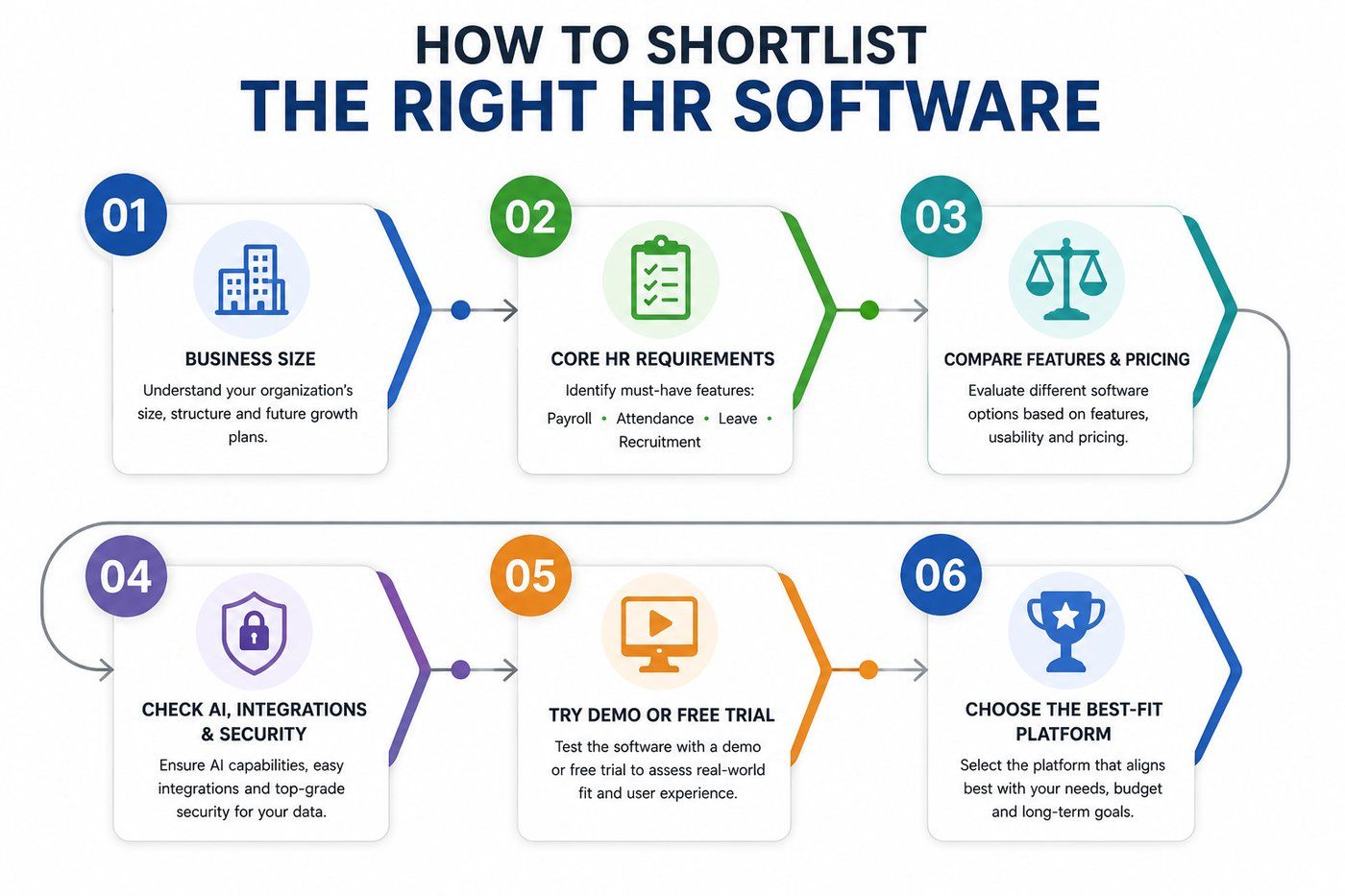
The best employee management system isn't necessarily the one with the most features. It should fit your organization's current needs while supporting future growth.
1. Business Size: Choose software that fits your current workforce while supporting future growth. Small businesses often need core HR features, while larger organizations benefit from advanced workforce management and analytics.
2. Budget: Consider implementation fees, training expenses, additional modules, customer support plans, and future upgrade costs to understand the total investment.
3. Scalability: Supports additional employees, departments, office locations, and new HR modules without requiring a complete system replacement.
4. Integrations: Your employee management system should connect with the tools your business already uses. Seamless integrations reduce duplicate work and improve data accuracy across departments.
5. Data Security: Employee records contain sensitive information, making security a critical consideration. Choose software that protects data while giving administrators control over who can access specific information.
6. Customer Support: Reliable customer support becomes especially important during implementation and when resolving technical issues. Fast assistance reduces downtime and helps teams use the platform effectively.
Also read: 4 Inspiring Ways You Can Improve Your Employee Development Methods
An employee management system is designed to simplify HR operations while improving workforce efficiency. Beyond reducing paperwork, it helps businesses build consistent HR processes and make informed decisions.
Managing payroll, attendance, leave, recruitment, and employee records through separate tools often leads to duplicate work and errors. An employee management system centralizes these activities, improving collaboration between HR teams, managers, and employees while saving valuable time.
When managers have access to real-time employee data, they can make quicker and more informed decisions. Better visibility into attendance, workloads, and performance also helps identify productivity gaps before they affect business outcomes.
This leads to:
Routine administrative work consumes a significant amount of HR time. Automating everyday processes reduces manual effort, minimizes errors, and allows HR professionals to focus on employee development and business growth.
Common tasks that can be automated include:
Employees expect quick access to HR services without waiting for manual approvals. Self-service portals, digital onboarding, and transparent communication make everyday interactions faster and more convenient, contributing to a better workplace experience.
Compliance becomes easier when employee records, payroll calculations, and statutory reports are managed from a single platform. Automated processes help businesses stay aligned with labor laws while reducing the risk of reporting errors and missed deadlines.
Also read: Employee Attrition Prediction Using a Classification Algorithm
An employee management system has evolved from being a payroll tool to becoming the central hub for managing the entire employee lifecycle. Whether you need a simple solution for attendance and leave management or an enterprise platform with AI-powered workforce analytics, selecting software that aligns with your business goals is essential.
For startups and SMEs, platforms like Keka, Zoho People, and greytHR offer an excellent balance of functionality and affordability. Larger organizations with complex workforce requirements may benefit from enterprise solutions such as Darwinbox, Workday, SAP SuccessFactors, or Oracle Fusion HCM. Evaluate your business needs, compare features carefully, and take advantage of free trials or product demos before making a final decision.
Take the first step toward leadership. Book a free consultation with upGrad today.
An employee management system focuses on managing day-to-day employee operations like attendance, payroll, leave, and performance. An HRMS usually includes broader HR capabilities such as recruitment, workforce planning, learning, compliance, analytics, and strategic talent management within a single platform.
Yes. Even small teams benefit from automating HR tasks early. A centralized system helps organize employee records, standardize onboarding, reduce administrative work, and build HR processes that can scale as the company hires more employees.
Most modern employee management systems include features designed for hybrid and remote work environments. Employees can mark attendance, access HR documents, submit requests, and communicate with managers using web portals or mobile applications from any location.
Implementation timelines vary depending on company size, data migration, and customization needs. Small businesses can often get started within a few days, while larger enterprises may require several weeks for configuration, testing, integrations, and employee training.
Yes. Most leading platforms offer Android and iOS applications that allow employees to complete routine HR tasks, receive notifications, approve requests, and stay connected without needing access to a desktop computer.
Employee management software automates repetitive administrative tasks, but HR professionals still play a vital role in hiring, employee relations, leadership development, conflict resolution, and strategic workforce planning. The software improves efficiency rather than replacing HR teams.
Many employee management platforms support multiple branches, departments, and business units. They allow organizations to configure different attendance policies, holidays, shifts, and reporting structures while managing all employees from a centralized dashboard.
These platforms are widely used across IT, healthcare, manufacturing, retail, education, banking, logistics, hospitality, consulting, and professional services. Any organization that manages employees can benefit from automating HR processes regardless of industry.
Prepare a checklist of your HR requirements, such as payroll, attendance, performance management, integrations, reporting, and compliance. During the demo, evaluate ease of use, customization options, implementation support, and whether the platform matches your existing workflows.
Yes. Features like continuous feedback, performance tracking, learning opportunities, recognition programs, and transparent communication create a better employee experience. When combined with strong HR practices, these tools can contribute to higher engagement and improved retention.
Review your HR software whenever your workforce grows significantly, business processes become more complex, or existing tools no longer meet operational needs. Regular evaluations help ensure the platform continues to support changing business goals and employee expectations.
1277 articles published
We are an online education platform providing industry-relevant programs for professionals, designed and delivered in collaboration with world-class faculty and businesses. Merging the latest technolo...
Get Free Consultation
By submitting, I accept the T&C and
Privacy Policy
Top Resources
Certification
3 Months
Certification
6 Months
O.P. Jindal Global University
Masters in International Accounting and Finance (Accredited by ACCA, UK)Master's Degree
12 Months