Top 20 Snowflake Interview Questions and Answers to Land Your Next Role
By Rahul Singh
Updated on Apr 13, 2026 | 11 min read | 3.48K+ views
Share:

All courses
Certifications
More
By Rahul Singh
Updated on Apr 13, 2026 | 11 min read | 3.48K+ views
Share:
Table of Contents
Snowflake interviews focus on core areas like architecture, where storage and compute work independently, along with performance tuning using micro-partitions and caching. You also need to understand data protection features like Time Travel and Fail-safe, which help in recovery and data reliability.
You should be comfortable with tools and concepts like Snowpipe for data ingestion, zero-copy cloning, and secure data sharing. Strong SQL skills and the ability to optimize queries for columnar storage are also important for handling real-world data scenarios.
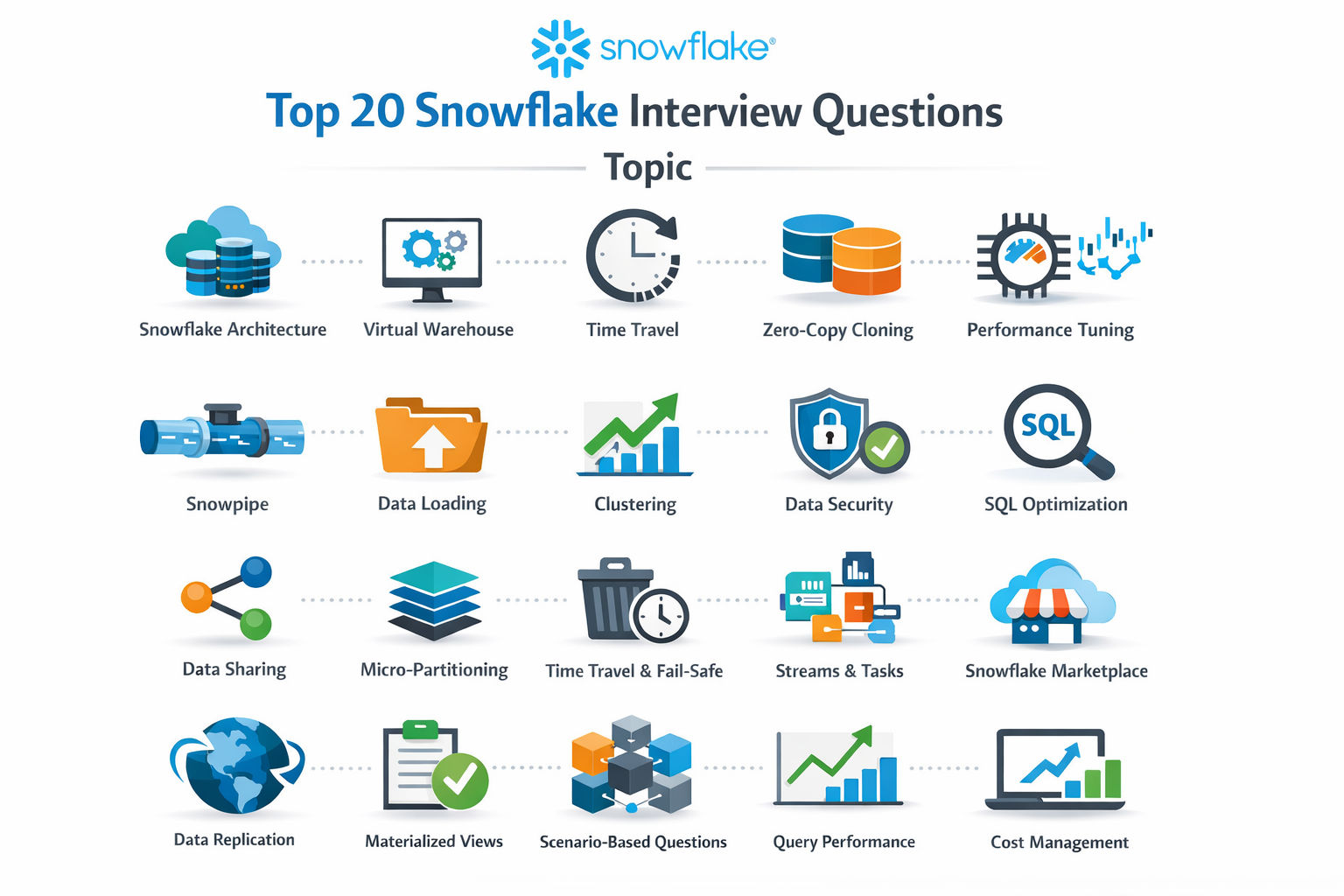
In this blog, you will find 20 carefully selected snowflake interview questions divided into beginner, intermediate, and advanced levels.
Strengthen your Snowflake and data engineering skills to unlock opportunities in cloud data and analytics roles. Explore our Online Data Science Courses and start building your career in data-driven systems today.
Popular upGrad Programs
This section covers the foundational concepts of the platform. You must be comfortable with its unique architecture and basic features before moving to complex scenarios.
How to answer:
Sample Answer:
Snowflake uses a unique multi-cluster shared data architecture. It completely separates storage and compute resources, which is a major advantage over a legacy DBMS. The three layers are:
How to answer:
Sample Answer:
| Cache Type | Location | Lifespan | Primary Benefit |
|---|---|---|---|
| Result Cache | Cloud Services Layer | 24 hours | Instantly returns results for identical SQL queries. |
| Local Disk Cache | Virtual Warehouse | Until warehouse suspends | Speeds up queries using recently accessed data blocks. |
| Remote Disk | Storage Layer | Permanent | The source of truth for all data, used when other caches miss. |
How to answer:
Sample Answer:
For standard accounts, the limit is 1 day. For Enterprise, it is up to 90 days.
Here is how you query a table as it existed exactly 20 minutes ago:
SELECT * FROM customer_data AT(OFFSET => -60 * 20);Also Read: Top 25+ DBMS Project Ideas for Students in 2026 [With Source Code]
How to answer:
Sample Answer:
How to answer:
Sample Answer:
Data sharing allows organizations to securely share objects like tables and views with other Snowflake accounts in real-time. Because of the centralized storage layer, data is not copied or transferred. Instead, the provider grants access to the live data, and the consumer uses their own compute resources to query it. This eliminates data silos and reduces storage costs.
Also Read: Best SQL Free Online Course with Certification [2026 Guide]
How to answer:
Sample Answer:
| Stage Type | Description | Best Use Case |
|---|---|---|
| Internal Stage | Storage hosted directly within the Snowflake environment. | Small, temporary files or internal user uploads. |
| External Stage | Storage located in a separate cloud environment like AWS S3, Google Cloud Storage, or Azure Blob. | Large-scale data lakes or files managed by external data pipelines. |
How to answer:
Sample Answer:
SQL
CREATE TABLE testing_table CLONE production_table;
Also Read: AWS Architecture Explained: Function, Components, Deployment Models & Advantages
Free Courses
These questions focus on data loading, performance tuning concepts, and specific database objects. Interviewers expect you to know how to move data efficiently.
How to answer:
Sample Answer:
| Feature | COPY INTO | Snowpipe |
|---|---|---|
| Execution | Manual or scheduled via external orchestration tools. | Automated and event-driven (e.g., a file lands in S3). |
| Compute Used | Uses a user-managed Virtual Warehouse. | Uses serverless compute managed by Snowflake. |
| Best For | Bulk loading large batches of data daily or weekly. | Continuous, near real-time data ingestion. |
How to answer:
Sample Answer:
SQL
SELECT
    raw_data:customer_name::STRING AS name,
    raw_data:address.city::STRING AS city
FROM json_staging_table;
Also Read: Detailed SQL Syllabus Structure for Data Science Certification
How to answer:
Sample Answer:
How to answer:
Sample Answer:
Also Read: Top 10 Real-Time SQL Project Ideas: For Beginners & Advanced
How to answer:
Sample Answer:
SQL
ALTER TABLE large_sales_data
CLUSTER BY (transaction_date, region_id);How to answer:
Sample Answer:
| Command | Action | Can be recovered? |
|---|---|---|
| TRUNCATE | Removes all rows from a table but leaves the table structure and metadata intact. | Yes, using Time Travel if configured. |
| DROP | Completely removes the table structure, metadata, and all its data from the DBMS. | Yes, using the UNDROP command within the Time Travel window. |
How to answer:
Sample Answer:
Snowflake secures data using a strict RBAC model. Privileges are never assigned directly to users. Instead, privileges are granted to roles, and roles are assigned to users. Roles can also be granted to other roles to create a security hierarchy. Standard system roles include SYSADMIN for creating objects, SECURITYADMIN for managing users, and ACCOUNTADMIN, which encapsulates all permissions.
Recommended Courses to upskill
Explore Our Popular Courses for Career Progression
IIIT Bangalore
Executive Diploma in Machine Learning and AI360° Career Support
O.P.Jindal Global University
MBA from O.P.Jindal Global UniversityLive Case Studies and Projects
Advanced questions test your ability to handle massive scale, optimize costs, and build complex, automated data pipelines.
How to answer:
Sample Answer:
How to answer:
Sample Answer:
SQL
-- Create a stream
CREATE STREAM sales_stream ON TABLE raw_sales;

-- Create a task that runs every hour to process new stream data
CREATE TASK process_sales
  WAREHOUSE = my_wh
  SCHEDULE = '60 MINUTE'
WHEN
  SYSTEM$STREAM_HAS_DATA('sales_stream')
AS
  INSERT INTO transformed_sales SELECT * FROM sales_stream;
Also Read: SQL Vs NoSQL: Key Differences Explained
How to answer:
Sample Answer:
| Strategy | Implementation | Impact on Cost |
|---|---|---|
| Auto-Suspend | Set warehouses to suspend after 1-2 minutes of inactivity. | Prevents paying for idle compute time. |
| Resource Monitors | Create alerts or hard stops when credit quotas are reached. | Prevents runaway queries and unexpected billing surprises. |
| Right-Sizing | Use a smaller warehouse for simple queries and only scale up for heavy workloads. | Ensures you only pay for the compute power actually required. |
How to answer:
Sample Answer:
SQL
CREATE EXTERNAL TABLE data_lake_sales (
  id INT AS (VALUE:id::INT),
  amount NUMBER AS (VALUE:amount::NUMBER)
)
LOCATION = @my_s3_stage/sales_data/
FILE_FORMAT = (TYPE = JSON);
Also Read: Relational Database vs Non-Relational Databases
How to answer:
Sample Answer:
When a standard Virtual Warehouse receives more SQL queries than it can process, it places the excess queries in a queue, causing delays. To solve this, you can configure a multi-cluster warehouse. When concurrency increases, the system automatically spins up additional identical clusters to handle the load. Once the query volume drops, it spins the clusters back down, ensuring high performance during peak hours without wasting credits during off-peak times.
How to answer:
Sample Answer:
SQL
CREATE MASKING POLICY email_mask AS (val string) RETURNS string ->
  CASE
    WHEN CURRENT_ROLE() IN ('HR_ADMIN') THEN val
    ELSE '***@***.com'
  END;

-- Apply the policy to the table
ALTER TABLE employees MODIFY COLUMN email SET MASKING POLICY email_mask;
Also Read: Overcoming the Top 10 Common Challenges of NoSQL Databases
Mastering these Snowflake interview questions will give you a massive advantage in your job search. Focus on understanding the unique separation of storage and compute, practice writing SQL for specific features like Time Travel, and understand how to optimize your queries. By breaking down your answers into clear explanations and providing practical examples, you will prove your expertise and ace your technical interview.
Want personalized guidance on DBMS? Speak with an expert for a free 1:1 counselling session today.
Common questions focus on architecture, virtual warehouses, Snowpipe, Time Travel, and performance tuning. Interviewers check if you understand core concepts and real-world usage. Most interviews also include SQL-based questions and practical scenarios to test your understanding.
Beginner-level questions usually cover definitions like Snowflake architecture, stages, and caching. Answers should be simple, clear, and structured. You should explain concepts with examples to show understanding instead of just giving definitions.
Experienced-level questions focus on system design, performance tuning, and optimization. You may be asked about clustering, query tuning, and scaling strategies. Interviewers expect you to explain real-world use cases and decisions rather than basic definitions.
For 5 years experience, questions focus on data pipelines, ETL processes, and query optimization. You should be ready to explain how you handled large datasets, improved performance, and managed data workflows in real projects.
Snowflake interview questions test your understanding of architecture, SQL skills, and problem-solving ability. Interviewers also check how you design scalable systems, optimize queries, and handle real-world data challenges in production environments.
For senior roles, questions focus on architecture design, cost optimization, and governance. You may be asked to design enterprise-level systems, handle multi-cluster workloads, and explain trade-offs in large-scale data warehouse implementations.
Scenario-based questions test how you solve real problems. You may be asked to design a data pipeline, optimize slow queries, or handle data ingestion at scale. These questions check your practical thinking and decision-making skills.
Snowflake interview questions help you understand what companies expect. They guide your preparation by highlighting key topics like architecture, security, and performance. Practicing them improves your confidence and helps you answer questions clearly during interviews.
Interviewers often ask about joins, window functions, query optimization, and data transformations. You should also know how to handle large datasets and write efficient queries to improve performance in Snowflake environments.
Snowflake interview questions vary by role. Data engineers get questions on pipelines and performance, analysts focus on SQL and reporting, and architects handle system design and scalability. Each role requires a different level of depth and practical knowledge.
Start with core concepts like architecture and warehouses. Practice SQL queries and work on real projects. Focus on performance tuning and data pipelines. Understanding practical use cases helps you answer both theoretical and scenario-based questions.
You may be asked about tools like Airflow, dbt, and BI tools. Interviewers check if you know how Snowflake integrates into modern data pipelines and analytics workflows used in real-world projects.
Avoid giving only theoretical answers. Interviewers expect real examples and clear explanations. Not understanding performance tuning or data pipelines can also impact your chances in technical rounds.
The difficulty depends on your preparation and experience. Beginners face easier conceptual questions, while experienced roles involve complex scenarios and system design problems. Practicing real-world cases makes the process easier.
Focus on architecture, Snowpipe, performance tuning, and security. New topics like Snowpark and data governance are also becoming important. Staying updated with recent trends helps you answer modern interview questions confidently.
98 articles published
Rahul Singh is an Associate Content Writer at upGrad, with a strong interest in Data Science, Machine Learning, and Artificial Intelligence. He combines technical development skills with data-driven s...
Get Free Consultation
By submitting, I accept the T&C and
Privacy Policy
Top Resources
Certification
3 Months
Certification
6 Months
O.P. Jindal Global University
Masters in International Accounting and Finance (Accredited by ACCA, UK)Master's Degree
12 Months