Leadership Skills for Managers: What Actually Makes a Good Leader
By upGrad
Updated on May 07, 2026 | 9 min read | 2.13K+ views
Share:

All courses
Certifications
More
By upGrad
Updated on May 07, 2026 | 9 min read | 2.13K+ views
Share:
Table of Contents
Leadership skills for managers involve guiding teams effectively while keeping daily operations aligned with business goals. These skills include clear communication, confident decision-making, team management, and resolving workplace conflicts professionally. Strong managers build trust, support employee growth, and create a positive work environment while balancing immediate priorities with long-term business objectives.
This blog breaks down the most important leadership skills for managers, why they matter, and how managers can build them in daily work. You'll also learn practical habits, mistakes to avoid, and the leadership skills that companies now expect from modern managers.
Want to go beyond theory and learn how to develop leadership skills that create real impact? Explore upGrad’s MBA, Management and Leadership programs to build practical skills for any professional environment.
Popular Management Programs
According to workplace studies from firms like ‘Gallup’ and ‘McKinsey & Company’, Managers shape up to 70% of employee engagement and influence employee engagement more than almost any other workplace factor. Companies with better leadership often report higher productivity, lower turnover, and stronger collaboration across departments.
Your behavior as a manager directly shapes how your team performs. Leadership Skills for managers are the abilities that help you guide a team, make good decisions, and get results without burning people out.
Most people assume leadership is about authority but it isn't. It's about influence. A manager with strong leadership skills gets people moving not because they have to, but because they want to.
Here's what effective leadership changes inside a team:
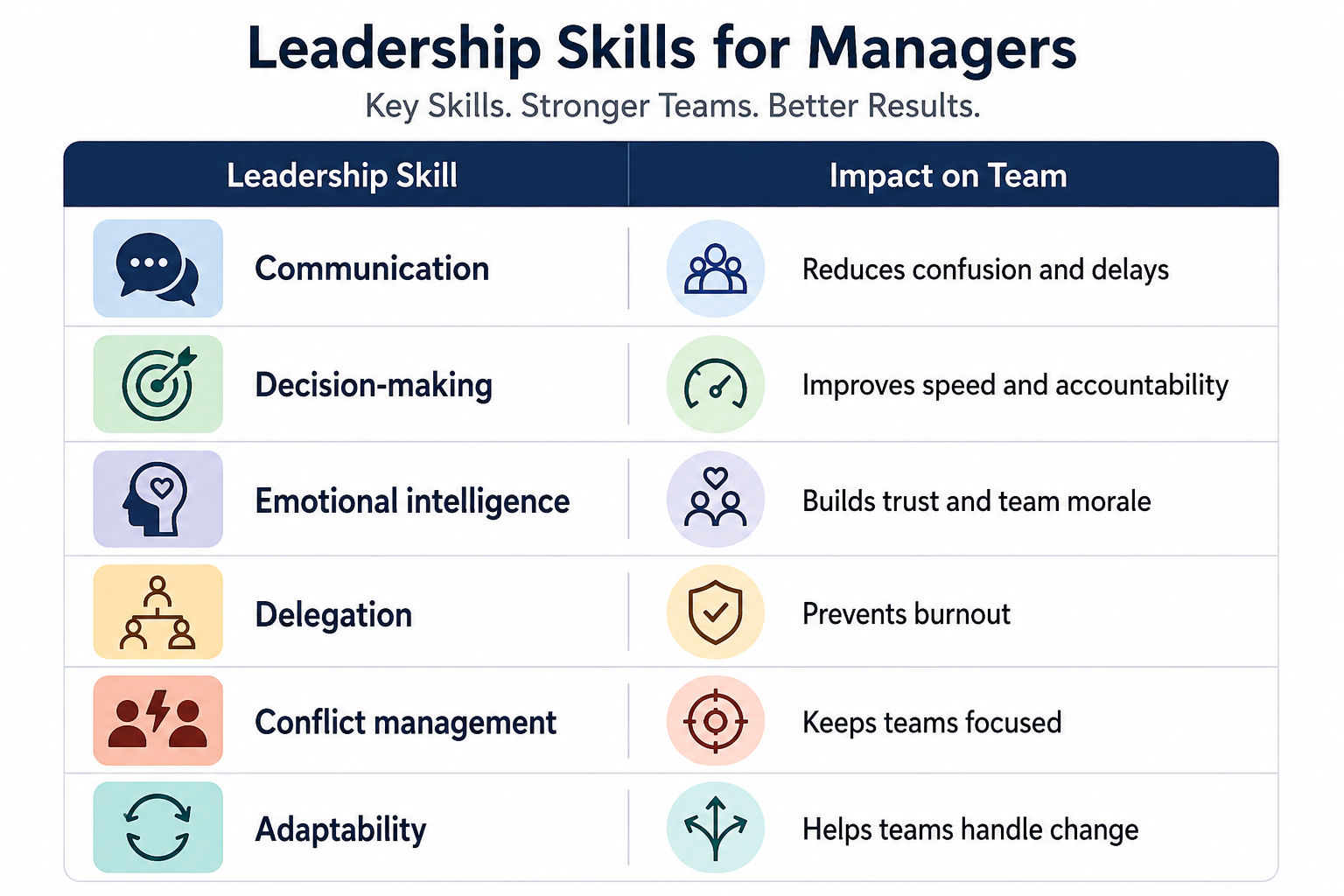
A manager might be technically skilled, organised, and experienced. Still, if they can't guide people, solve problems calmly, or handle difficult conversations, the team suffers. Employees notice weak leadership quickly. Deadlines start slipping and ownership disappears. Meetings become longer and less useful.
Whereas a strong manager creates direction even during stressful projects, shifting targets, or limited resources. Their team knows what matters, what to prioritize, and where to focus attention. That confidence spreads across the workplace.
Good leadership is visible in small daily actions like:
Also Read: Top Skills Required for Leadership & Management in 2025
Free Courses
Managers often focus heavily on reporting, planning, or operations. Those are important. Still, leadership comes down to how well you handle people, pressure, and decisions when things don't go smoothly.
Below are the top leadership skills for managers that consistently improve team performance and workplace culture.
Poor communication creates expensive problems. Teams miss deadlines. Employees misunderstand priorities. Small issues turn into larger conflicts because nobody clarified expectations early enough. Strong managers communicate clearly and directly.
That includes:
Great communication isn't about talking more. It's about making things easier to understand.
Managers also need to adjust communication styles based on the situation. A quick update during a crisis sounds different from a one-on-one performance discussion.
This skill separates average managers from trusted leaders. Emotional intelligence means understanding emotions without letting them control decisions. Managers with emotional intelligence recognize frustration, stress, conflict, and burnout early.
They don't react impulsively. Instead, they pause, assess the situation, and respond with clarity. That approach helps teams feel respected, especially during stressful periods where emotions run high and communication breaks down faster than usual.
Managers with emotional intelligence usually:
People remember how managers make them feel. Always.
Indecisive managers slow teams down. Every workplace involves uncertainty. Managers constantly face incomplete information, changing priorities, and tight deadlines. Strong leadership means making decisions without waiting forever for perfect conditions.
That doesn't mean rushing blindly. Good managers collect relevant information, weigh risks, and move forward confidently. They also take accountability when decisions don't work out as planned.
Employees trust managers who can make clear decision-making skill during uncertain situations. Teams lose confidence when leadership hesitates repeatedly. Fast isn't always smart. Frozen is worse.
New managers often struggle by doing everything themselves. Instead, it creates bottlenecks, exhaustion, and frustrated employees who never get ownership opportunities. Delegation isn't dumping tasks randomly.
Effective delegation means assigning responsibility based on employee strengths, explaining expectations clearly, and trusting people to complete work without constant interference. Micromanagement kills momentum quickly.
Strong delegation helps managers:
Conflict appears in every team. What matters is how managers respond when disagreements happen. Ignoring tension rarely solves anything. It usually makes problems worse.
Strong managers address conflict early. They listen to both sides, focus on facts instead of assumptions, and guide conversations toward practical solutions. They also avoid taking sides emotionally before understanding the full situation.
Good conflict management creates healthier teams because employees feel heard rather than dismissed.
Workplaces are constantly evolving, priorities shift, technology advances, and team structures change. Managers who resist change create friction and slow progress across the organization.
Adaptable managers stay flexible without losing direction. They adjust plans when needed, communicate changes quickly, and help teams navigate uncertainty without panic. That stability becomes extremely valuable during periods of rapid business change.
The best leaders aren't rigid. They're responsive.
Must read: Top 5 Types of Leadership in Management
Management Courses to upskill
Explore Management Courses for Career Progression
IIIT-B & IIM, Udaipur
Chief Technology Officer & AI Leadership ProgrammeLeadership develops through daily habits, experience, feedback, and self-awareness. Most strong leaders weren't naturally great communicators or decision-makers when they started managing teams. They improved over time through practice, reflection, and consistent effort. Leadership skills for managers grow faster when managers stay open to learning, identify weak areas early, and actively work on improving how they communicate, solve problems, and guide teams under pressure.
Here are some practical ways managers can strengthen their leadership skills:
Must Read: 6 Key Elements which will Make YOU a Better Leader than You Are!
Even experienced managers make leadership mistakes. The difference is that strong leaders recognize problems early and adjust quickly. Weak leadership patterns usually start small, then spread across the team quietly until morale, productivity, and trust begin dropping at the same time.
Managers who constantly monitor every task create frustration and dependency. Employees stop taking initiative because they expect every decision to be questioned or corrected anyway. Good leadership requires trust. Managers should guide employees, clarify expectations, and stay available for support without controlling every detail.
People perform better when they feel ownership over their work. Micromanagement usually comes from anxiety, not strength.
Some managers blame teams whenever results fall short. Strong managers take responsibility for failures instead of shifting blame downward. They address problems honestly, identify what went wrong, and focus on improving systems rather than protecting personal image.
Accountability builds credibility. Without it, trust disappears.
When businesses restructure teams, change goals, or shift priorities, employees immediately look toward managers for clarity. If communication becomes inconsistent or vague, uncertainty spreads across the workplace.
Good managers communicate early. Even when they don't have every answer yet, they still explain what’s changing, what remains stable, and what employees should focus on next.
Clear communication reduces anxiety significantly during uncertain situations.
Some managers focus only on short-term output which creates long-term problems. Employees want growth opportunities, skill development, and career direction. Managers who ignore employee development often struggle with low engagement and higher turnover because people feel stuck professionally.
Strong leaders help employees improve through:
Teams grow faster when managers invest in them consistently.
Leadership doesn't improve without feedback. Managers who become defensive whenever employees raise concerns create unhealthy work environments quickly. Open communication fades. Issues go unaddressed for longer. Frustration quietly builds beneath a surface of politeness.
Great managers stay curious. They listen carefully, ask follow-up questions, and look for patterns in feedback instead of reacting emotionally to isolated comments. That openness strengthens team trust over time.
Do Read: 10 Best Leadership Courses of 2026
Becoming a manager shifts your focus from personal work to team performance. New managers often struggle with delegation, authority, and communication. Avoid extremes: don’t try to be everyone’s friend or overly controlling. Focus early on trust, communication, and consistency
Also Read: Transformational Leadership in Diversity and Inclusion
Leadership isn't about controlling people or managing every small detail. It's about helping teams stay focused, motivated, and confident during both smooth and difficult situations. That's why leadership skills for managers matter far beyond job titles. Managers who communicate clearly, resolve conflicts early, and support employee growth create stronger teams and better business results over time. The most effective leadership skills for managers are often the simplest ones practiced consistently every day. Clear communication, fair decision-making, honest feedback, accountability, and trust are what teams value most in a leader.
The most important leadership skills for managers include communication, decision-making, emotional intelligence, delegation, and the ability to give useful feedback. These five cover the majority of what you'll deal with day to day, and they compound over time. Strong skills in these areas directly improve team performance and retention.
There's no fixed timeline. Most managers see meaningful improvement in 6 to 12 months if they're deliberate about it. The key is consistent practice and honest feedback. Waiting for a training program isn't enough. You have to apply what you learn in real situations, reflect on what happened, and adjust.
Leadership skills for new managers should start with delegation and communication. These two affect everything else. If you can't communicate clearly and let go of work you used to do yourself, every other skill becomes harder to develop. Master these two first before adding complexity.
They can absolutely be learned. Some people have an easier start because of their background or personality, but the research is clear that leadership skills develop through practice, feedback, and reflection. No one is born knowing how to delegate or run a difficult conversation well.
Management skills are about process, planning, and output. Leadership skills are about people, direction, and influence. Both matter. A manager who can only manage tasks but can't motivate people will hit a ceiling. A leader who inspires but can't execute will frustrate their team. You need both.
Be consistent from day one. Do what you say you'll do. Listen before you try to change things. Be honest about what you don't know. Trust isn't built through grand gestures. It's built through small, repeated moments where you show up reliably. Give it 60 to 90 days of consistent behavior.
Common signs include high team turnover, constant firefighting, low morale, unclear priorities, and decisions that get reversed often. These aren't always the manager's fault, but they're good indicators that leadership development is needed. Honest 360-degree feedback is one of the best ways to surface blind spots early.
It affects almost everything. Managers with low emotional intelligence react poorly under pressure, miss early signs of team struggle, and create environments where people don't feel safe raising problems. High EQ managers build more trust, handle conflict more effectively, and retain their people longer.
Practice making decisions with less information than you'd like and then track outcomes. Most managers improve by reviewing their decisions regularly: what they decided, why, and what actually happened. Getting comfortable with uncertainty is a skill. It doesn't come from reading about it. It comes from doing it.
Focus on specific behavior, not character. Be timely. Have the conversation in private. Make it a dialogue, not a lecture. People respond well to feedback when they feel respected and when they understand the impact of their actions. The goal is always improvement, not correction.
Yes, and formal learning works best when it's paired with on-the-job practice. Look for programs that use real case studies, peer learning, and structured reflection. upGrad's management programs are designed for working professionals and cover leadership frameworks, people management, and strategic thinking in a format that fits around your career.
1038 articles published
We are an online education platform providing industry-relevant programs for professionals, designed and delivered in collaboration with world-class faculty and businesses. Merging the latest technolo...
Get Free Consultation
By submitting, I accept the T&C and
Privacy Policy
Top Resources
Certification
3 Months
Certification
6 Months
O.P. Jindal Global University
Masters in International Accounting and Finance (Accredited by ACCA, UK)Master's Degree
12 Months