Generative AI vs Agentic AI vs Predictive AI: Detailed Comparison
By upGrad
Updated on Sep 23, 2026 | 9 min read | 2.37K+ views
Share:

All courses
Certifications
More
By upGrad
Updated on Sep 23, 2026 | 9 min read | 2.37K+ views
Share:
Table of Contents
Key Highlights
Curious how generative AI creates content and how agentic AI takes it further, planning, using tools, and following through on tasks end to end? Explore our Generative AI and Agentic AI courses in India and learn to build both kinds of systems yourself.
Agentic AI Courses to upskill
Explore Agentic AI Courses for Career Progression
IIIT Bangalore
Executive Diploma in Machine Learning and AI360° Career Support
Below are some of the key differences between generative AI vs agentic AI vs predictive AI:
Aspect |
Predictive AI |
Generative AI |
Agentic AI |
| Core function | Forecasts future outcomes | Creates new content | Plans and takes autonomous action |
| Primary question it answers | What is likely to happen? | Can you create this for me? | Can you get this done for me? |
| Output | Probabilities, scores, forecasts | Text, images, audio, code | Completed multi-step tasks |
| Data dependency | Trained on historical, labeled data | Trained on large unlabeled/text-image datasets | Uses other models and tools as needed during execution |
| Level of autonomy | Low, produces a single prediction | Low to medium, responds per prompt | High, plans, acts, and adapts with minimal supervision |
| Human involvement | Human interprets and acts on the prediction | Human prompts and reviews the output | Human sets the goal; AI handles most of the execution |
| Example tools | Fraud detection, demand forecasting, churn models | ChatGPT, Claude, Midjourney, GitHub Copilot | AI agents that research, execute, and adjust workflows |
| Example use case | Predicting which customers will churn | Drafting a marketing email | Running an entire retention campaign end to end |
| Explainability | Generally high, easier to validate | Lower, harder to trace exact reasoning | Lowest, involves chained decisions across steps |
Also Read: Agentic AI vs Generative AI: What Sets Them Apart
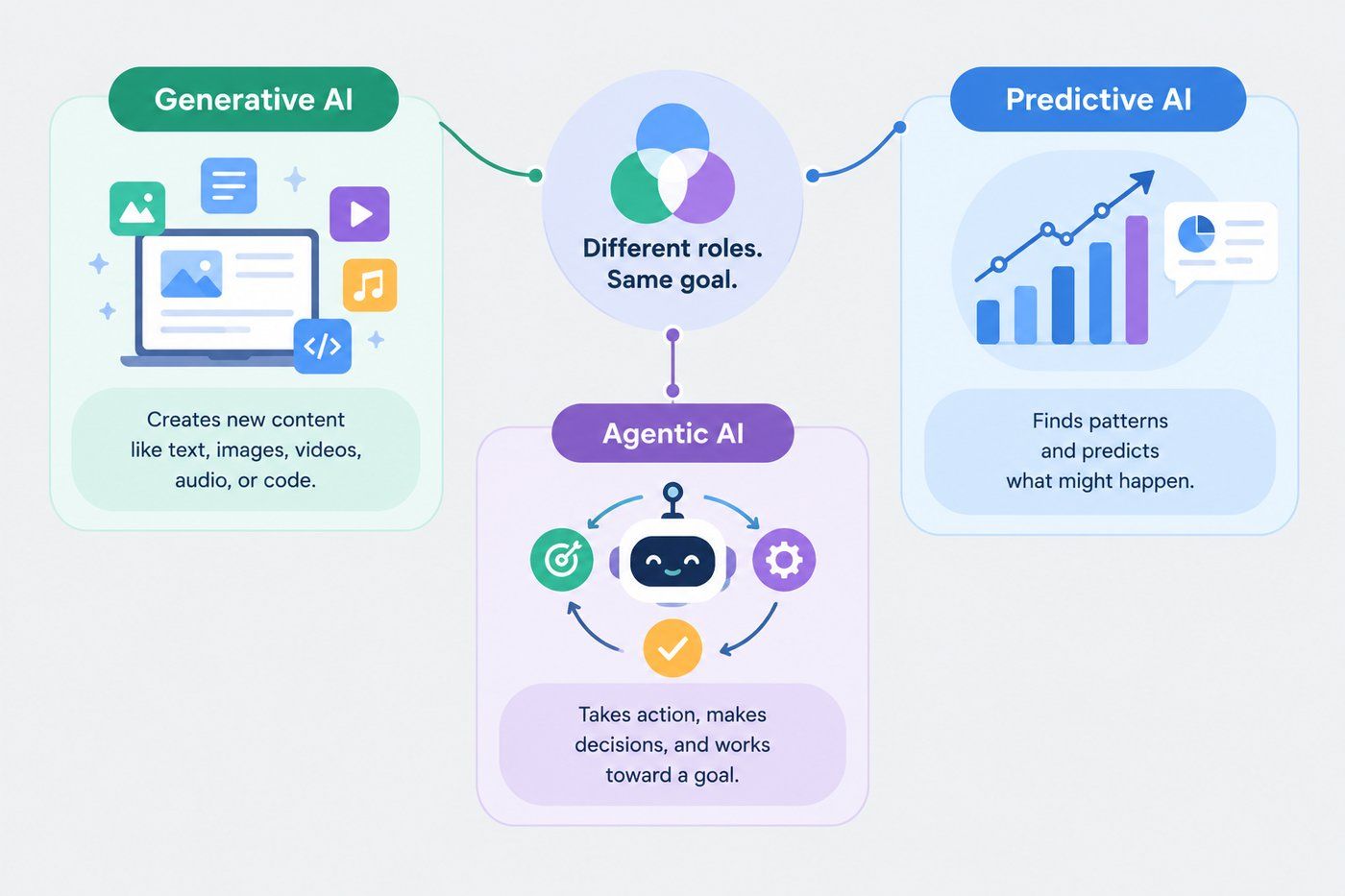
Majority of tools use generative AI like ChatGPT, Claude, Midjourney, GitHub Copilot, and more. It creates original content by analyzing the existing data and finding patterns in it.
Machine learning is used in this to produce text, images, video, audio, code, or synthetic data. It is clear that generative AI saves time but its output still needs to be checked. That’s why in the end of AI responses, it is mentioned “The tool is an AI and can make mistakes. Please double-check responses.”
Key Features of Generative AI
Deep learning is an underlying technology that allows generative AI to process huge datasets and produce content. Tools that are based on generative AI usually follow a specific architecture called a transformer. GPT, the model behind ChatGPT. It gets its name from this Generative Pre-trained Transformer.
The model is trained on enormous amounts of data pulled from books, websites, and other sources. These sources can be:
Based on this data, it learns to predict its next move. However, as generative AI relies completely on probability, it has two major limitations, hallucination and static knowledge.
Also Read: How Does Generative AI Work? Key Insights, Practical Uses, and More
Agentic AI can take things a step further than regular AI tools, so instead of just answering a prompt, it can plan a goal, break it into steps, even without someone checking in at every step.
For example, you ask it to organize a marketing campaign. A generative tool would just write you an email if you asked for one. An agentic system does more, it might research the audience, draft several versions, schedule them, track how they perform, and adjust the campaign based on the results, all as one ongoing task.
Tools built on this idea are still fairly new, but they're showing up in customer support, coding assistants that can run and fix their own code, and research assistants that can search the web and pull together a report on their own.
Key Features of Agentic AI
An AI agent runs on a four-part framework: brain, memory, tools, and action.
Also Read: Generative AI vs Traditional AI: Which One Is Right for You?
The main job of predictive AI is to do forecasting, it means predicting what is likely to happen next based on historical data. It does not create anything, also it cannot take action on its own. It just answers questions like "how likely is this customer to cancel" or "what will demand look like next month."
Key Features of Predictive AI
Below is a process, how predictive AI goes from raw data to an actual prediction:
Ready to move beyond individual tools and master AI at a strategic level? Explore the Executive Post Graduate Programme in Applied AI and Agentic AI and build the expertise to lead AI-driven transformation in your organization.
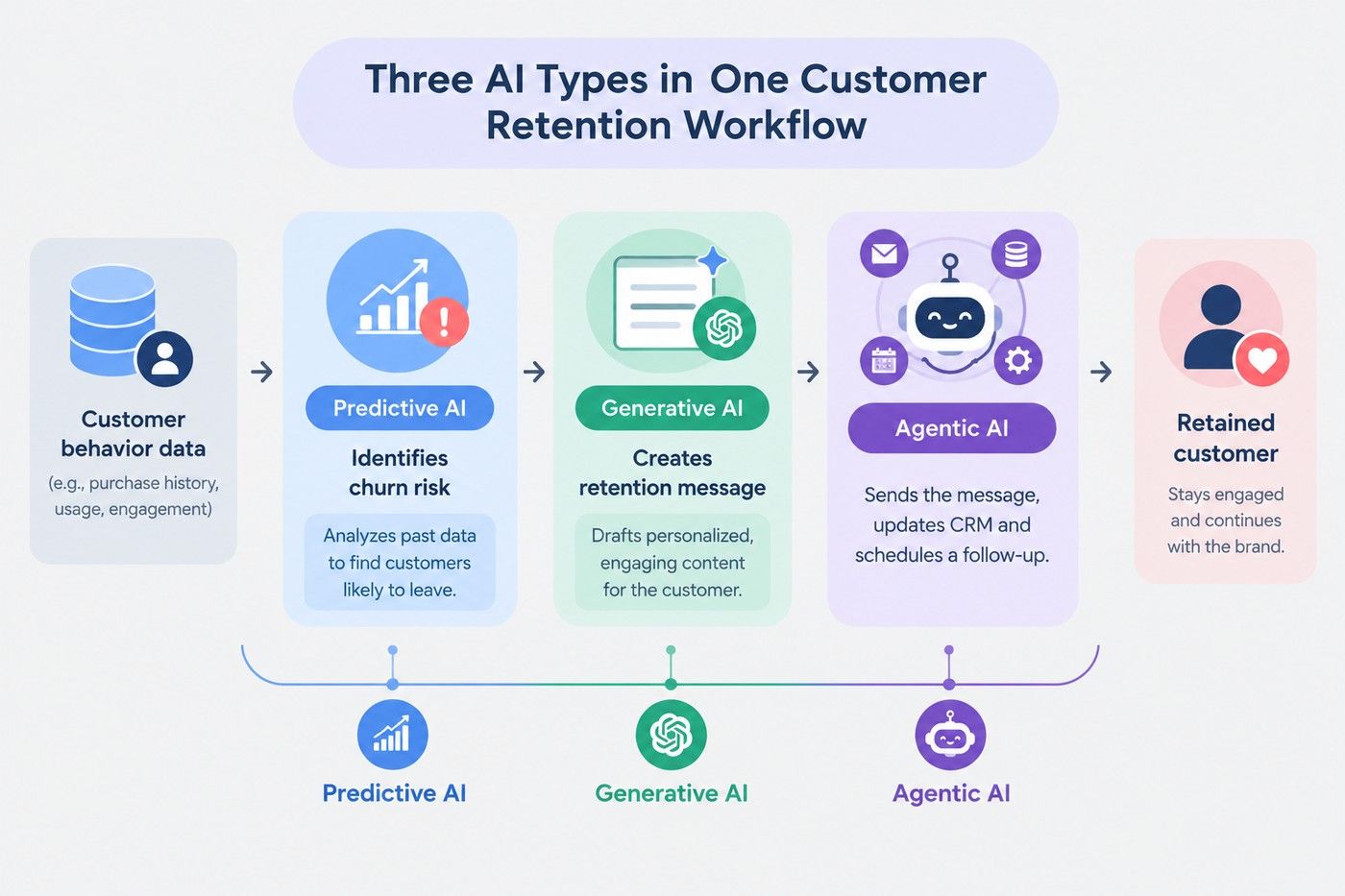
Predictive AI spots the problem or the opportunity. Generative AI creates the content or solution for it. Agentic AI takes the action and follows through.
Here's what that looks like in an actual workflow:
None of these steps needs a human in between. Predictive AI hands off the insight, generative AI hands off the content, and agentic AI takes it from there to the finish line.
That's really the shift happening right now. AI used to stop at giving answers. Now it can go from spotting a pattern, to creating something useful, to actually getting the task done.
Also Read: Difference Between Generative AI and Predictive AI: Full Comparison
Test yourself with these five quick questions on generative AI vs agentic AI vs predictive AI.
1. Which type of AI is best suited for forecasting whether a customer is likely to cancel their subscription?
a) Generative AI
b) Predictive AI
c) Agentic AI
d) All three equally
Answer: b) Predictive AI. It's built to forecast outcomes based on historical data, exactly the kind of task churn prediction is.
2. What does generative AI actually produce?
a) A probability or score
b) A completed multi-step task
c) New content like text, images, or code
d) A forecast of future trends
Answer: c) New content like text, images, or code. Generative AI creates original content based on patterns it learned during training.
3. What makes agentic AI different from generative AI?
a) It only works with images, not text
b) It can plan, use tools, and complete multi-step tasks on its own
c) It requires a prompt for every single step
d) It cannot use external tools or APIs
Answer: b) It can plan, use tools, and complete multi-step tasks on its own. Agentic AI plans a goal, breaks it into steps, and carries out the task with minimal human input, unlike generative AI, which waits for a prompt each time.
4. In an AI agent's four-part framework, what role does "memory" play?
a) It generates the final response
b) It tracks the current task and recalls past interactions
c) It connects the agent to external APIs
d) It executes the final action
Answer: b) It tracks the current task and recalls past interactions. Short-term memory keeps track of the current task, while long-term memory lets the agent recall past interactions and preferences.
5. In a workflow that combines all three AI types, what role does predictive AI usually play?
a) It sends the final email or message
b) It spots the problem or opportunity first
c) It writes the content
d) It updates the CRM after the task is done
Answer: b) It spots the problem or opportunity first. Predictive AI usually kicks off the workflow, before generative AI creates content and agentic AI takes action.
Also Read: Automation vs AI: Key Differences and How They're Shaping the Future
Conclusion
Predictive AI, generative AI, and agentic AI are not three separate technologies competing for attention. They are three different layers, each doing a specific job. Predictive AI looks at the past and tells you what is likely to happen. Generative AI takes that insight and creates something with it, an email, a report, an image. Agentic AI goes further and actually gets the task done, start to finish, with minimal human input.
Most businesses won't pick just one. The real value shows up when these three work together, predictive AI spotting the opportunity, generative AI producing the content, and agentic AI carrying out the action. That's already happening in customer retention campaigns, IT support, supply chain management, and more.
Not sure which course fits your goals? Book a free consultation and get personalized guidance on choosing between Generative AI and Agentic AI.
ChatGPT is generative AI at its core. It responds to prompts and creates text, but newer versions with browsing, code execution, or plugin access start to show agentic behavior, since they can take a few actions on their own to complete a task.
Yes. Many platforms already do this, a predictive model flags a risk or opportunity, and a generative model turns that into a message, report, or recommendation a person can act on.
Mostly, yes. "AI agent" usually refers to the actual system or tool, while "agentic AI" refers to the broader approach or capability. In practice, people use the terms interchangeably.
Agentic AI carries the most risk, since it takes real actions across systems on its own. A mistake doesn't just produce bad text, it can send a wrong email, make a wrong purchase, or update the wrong record.
Not necessarily. If your workflow is mostly about creating content, drafts, images, reports, generative AI on its own is usually enough. Agentic AI makes sense when you need multi-step tasks completed without constant prompting.
Predictive AI is built on real machine learning techniques, but it's true that it overlaps a lot with traditional statistics and data science. The line is more about how it's applied, forecasting outcomes at scale, than the underlying math being fundamentally different.
Technically yes, but most modern agentic systems use an LLM as their "brain" for reasoning and decision-making. Without some language model driving it, the agent would need a completely different way to interpret goals and plan steps.
Customer support, software development, and IT operations are ahead of the curve right now, since these areas involve repetitive, multi-step tasks that agents can handle with tools like APIs, ticketing systems, and code environments.
Unlikely. Predictive AI is still the most accurate and explainable option for forecasting tasks, and businesses that need reliable, auditable predictions, like risk scoring or fraud detection, will likely keep relying on it.
It varies by task and by how much trust a company puts in the system. Most businesses today still keep a human in the loop for high-stakes actions, like financial transactions or customer-facing decisions, even if the agent handles everything else on its own.
All three are accessible to smaller businesses now. Predictive AI tools are built into many CRMs and analytics platforms, generative AI is available through tools like ChatGPT or Claude, and agentic AI features are increasingly showing up in everyday software, not just custom enterprise builds.
1000 articles published
We are an online education platform providing industry-relevant programs for professionals, designed and delivered in collaboration with world-class faculty and businesses. Merging the latest technolo...
Speak with AI & ML expert
By submitting, I accept the T&C and
Privacy Policy