30 Best Cyber Security Projects Ideas in 2026
By Rohan Vats
Updated on Aug 18, 2026 | 28 min read | 179.63K+ views
Share:

All courses
Certifications
More
By Rohan Vats
Updated on Aug 18, 2026 | 28 min read | 179.63K+ views
Share:
Table of Contents
Leading cybersecurity project ideas for 2026 include AI-driven intrusion detection systems, ransomware detection solutions, and blockchain-based data integrity platforms. Other in-demand projects focus on IoT security, phishing simulation tools, and secure passwordless biometric authentication, leveraging machine learning and automation to tackle modern cyber threats effectively.
Foundational cybersecurity projects such as penetration testing frameworks, malware scanners, SIEM solutions, and network monitoring tools remain highly valuable in 2026. These projects help you develop practical skills in threat detection, vulnerability assessment, incident response, and security operations.
This guide covers top cybersecurity project ideas for 2026, from beginner to expert levels. These hands-on projects help build practical skills, strengthen your portfolio, and prepare you for a successful cybersecurity career.
To master these indispensable skills, we will see these Cyber security projects in detail in this guide, along with expert-curated Data Science Courses that can advance your career.
Popular Data Science Programs
This section presents a diverse range of 30 hands-on cybersecurity project ideas, categorized by difficulty, to help you build practical skills and elevate your security expertise.
Key Highlights:
Project Difficulty |
Project Title |
Top 3 Tools Required |
Beginner Level Security Projects |
Keylogging | Python/C++, Keylog libs, OS input |
| Caesar Cipher Encryption/Decryption | Python/Java, Basic GUI (opt), Editor | |
| Integrity Checker | Python, hashlib, CLI | |
| Web Vulnerability Scanner | Python/JS, ZAP, Burp Suite | |
| Lost Data Retrieval | Python, TestDisk, Disk tools | |
| Hashed Password Cracker | Python, hashlib, Wordlist | |
| File Type Identification | Python, File sig libs, Detection APIs | |
| Non-hashed Password Cracker | Python, crypt lib, Brute/dict tools | |
| DoS Detection | Python, Wireshark, Packet sniffer | |
| Bug Bounties & Hackathons | Burp Suite, ZAP, Manual tools |
Recommended for You: Java Projects With Source Code | Raspberry Pi Projects for Students and Beginners
Let’s further discuss these beginner-friendly projects in detail:
Keylogging involves the creation of a tool that tracks and records keystrokes typed on a device's keyboard. This tool helps monitor user activity and can be used to capture sensitive information such as passwords, email content, or personal notes. It’s a basic to1.ol for understanding how unauthorized access can occur in an operating system.
Also Read: Reasons Why Python Is So Popular With Developers in 2026
The Caesar Cipher is one of the simplest forms of encryption where each letter in a message is replaced by a letter some fixed number of positions down the alphabet. This project provides an introduction to cryptographic algorithms and is useful in understanding the basics of data protection through simple encryption techniques.
Also Read: Public Key Cryptography Beginner’s Guide: How Does it Work?
An Integrity Checker is a tool designed to monitor the integrity of files by comparing their hash values to known safe values. If the hash value of a file changes, the integrity checker can alert the user to potential tampering or corruption, making it an essential tool for security auditing and ensuring file system consistency.
Here’s your chance to earn a Free Certificate in Python with upGrad and upskill now.
A Simple Web Vulnerability Scanner is a tool that scans websites for vulnerabilities such as SQL injection, Cross-Site Scripting (XSS), and outdated software. The tool provides a basic vulnerability assessment of a web application and generates a report to help website administrators identify and mitigate security risks, essential for maintaining web application security.
Lost Data Retrieval involves creating a tool that can retrieve lost or deleted data from storage devices such as hard drives, USB drives, or memory cards. This tool helps in recovering accidentally deleted files or files lost due to corruption, providing insights into file system structures and data recovery methods.
Also Read: Machine Learning Tutorial: Basics, Algorithms, and Examples Explained
A Hashed Password Cracker attempts to break hashed passwords using methods like brute-force or dictionary-based attacks. The tool tests the strength of password hashes generated by algorithms such as MD5, SHA256, or bcrypt, allowing users to assess how secure their password storage practices are.
The File Type Identification project is focused on creating a tool that can identify a file’s true type based on its content, rather than relying solely on its extension. This project helps in detecting malicious files that may attempt to disguise themselves by altering their file extensions.
The Non-hashed Password Cracker is a tool designed to break plaintext passwords by using brute-force or dictionary-based attacks. This project introduces learners to the basic principles of password cracking and demonstrates the weaknesses of using simple, unprotected passwords.
Also Read: Top 10 JavaScript Libraries to Learn
DoS Detection focuses on creating a tool that detects Denial of Service (DoS) attacks by monitoring abnormal network traffic. DoS attacks aim to overwhelm a target system with traffic, rendering it unavailable. This project teaches how to identify such attacks and respond accordingly to protect network resources.
Bug bounties and hackathons provide opportunities to find and report vulnerabilities in live systems. In bug bounty programs, individuals are rewarded for discovering and reporting security flaws. This project helps participants practice ethical hacking, find real vulnerabilities, and contribute to improving system security.
Also Read: Python vs Java: Mastering the Best Language For Your Career
In this section you will get 10+ best cyber security projects for final year students. These projects will helps you to test your basic skill you have learnt.
Project Difficulty |
Project Title |
Top Tools Required |
Intermediate-Level Cyber security Projects |
Penetration Testing Framework | Kali Linux, Metasploit, Nmap |
| Malware Scanner using Yara | Yara, Python, Malware DB | |
| Network Anomalies Detection | Wireshark, Python, Scikit-learn | |
| SQL Injection | SQLMap, Burp Suite, DVWA | |
| Cloud Access Security Broker (CASB) | Cloud APIs, Python, IAM tools | |
| Network Packet Capturing Tool | Wireshark, tcpdump, Python | |
| Exploit Development | Metasploit, GDB, C/Python | |
| Optimized Password Cracker | Hashcat, John the Ripper, Scripts | |
| Simple Vulnerability Matcher | Python, CVE/NVD DBs, Scanner scripts | |
| Web-Based Facial Authentication | OpenCV, Dlib, HTML/JS |
Let’s dive further into these projects
A Penetration Testing Framework is a set of tools and methodologies that simulate real-world cyberattacks to evaluate the security of networks, applications, and systems. This project involves creating or using an existing framework to identify vulnerabilities and assess security by exploiting potential weaknesses in a controlled environment. It mimics hacker techniques to find vulnerabilities before they can be exploited by actual attackers.
This is one of the most sought-after cyber security final year project ideas, offering practical insights into ethical hacking and penetration testing.
Also Read: Python Vs Ruby: Complete Side-by-Side Comparison
Yara is a tool designed to help detect and classify malware by creating custom rules based on file patterns, strings, or behaviors. This project involves developing a simple malware scanner that uses Yara rules to identify known malware in files or network traffic. By analyzing files for signature patterns, the tool can alert security teams to malicious software before it infects a system.
Network Anomalies Detection involves developing a system that can monitor network traffic in real time to identify unusual patterns indicative of security threats such as data exfiltration, Distributed Denial-of-Service (DDoS) attacks, or malware infections. This project often uses machine learning or statistical methods to spot outliers in traffic patterns, offering early warnings before a malicious attack can cause damage.
Also Read: What is Hyperinflation? How does it Works? Causes, Effects [With Real World Examples]
SQL Injection is a type of vulnerability that allows attackers to interfere with the queries an application makes to its database. This project involves testing a web application for SQL injection flaws and creating scripts to exploit these vulnerabilities. By understanding how attackers can manipulate queries to extract, modify, or delete data, this project helps reinforce the importance of secure coding practices, especially input validation.
Are you looking to upskill yourself in SQL? Here’s your chance!! Enroll yourself in a Free Advance SQL Course from upGrad and take your career to newer heights.
A Cloud Access Security Broker (CASB) is a security tool that sits between cloud service users and cloud providers to monitor and control access to cloud-based services. This project involves creating a CASB solution to ensure that sensitive data and applications stored in the cloud are protected by enforcing security policies and detecting potential threats in real time.
An advanced Network Packet Capturing Tool allows you to capture, analyze, and inspect network packets to monitor communication between devices on a network. This project helps you understand how data flows through the network and how attackers might use network traffic to exploit vulnerabilities. By creating a tool that captures packets, you can identify suspicious traffic patterns, such as potential cyberattacks or data breaches.
Also Read: Relation Between Transport Layer And Network Layer
Exploit Development involves crafting code that takes advantage of vulnerabilities in systems, applications, or services. This project is crucial for understanding how attackers leverage security flaws to gain unauthorized access or cause damage. By learning exploit development, you can also develop countermeasures to defend against such attacks.
A password cracker is a tool used to recover passwords from their hashed values using different cracking techniques. This project involves creating an optimized version of a password cracker, utilizing methods like brute force, dictionary attacks, and rainbow tables, but with enhancements to speed and accuracy. The focus is on cracking hashed passwords faster and more efficiently, emphasizing the importance of strong password security practices.
Also Read: Cyber Security in Banking: Challenges and Security Strategies
A Simple Vulnerability Matcher is a tool that scans software, network, or application systems for known vulnerabilities based on predefined security databases like CVE (Common Vulnerabilities and Exposures). This project involves developing a tool that matches vulnerabilities found in the system to a list of known threats and reports them for remediation.
A web-based facial authentication system uses facial recognition technology to verify a user's identity by analyzing unique features of their face. This project involves creating a secure login system that replaces traditional methods (like passwords) with facial recognition. It demonstrates how biometric authentication enhances security, making it harder for unauthorized users to gain access.
These projects offer a perfect blend of hands-on experience and theoretical knowledge, making them some of the best cybersecurity final-year project ideas for aspiring professionals.
Also Read: 25+ TensorFlow Projects for Beginners to Explore Across Various Domains
Key Highlights
Project Difficulty |
Project Title |
Top Tools Required |
Expert-Level Cyber security Projects |
Security Information and Event Management (SIEM) | Splunk, ELK Stack, Python |
| Wazuh Open Source SIEM | Wazuh, Elastic Stack, Logstash | |
| Advanced Malware Analysis and Reverse Engineering | Ghidra, IDA Pro, Cuckoo Sandbox | |
| Blockchain Security Auditing | MythX, OpenZeppelin, Solidity | |
| Cloud Security Posture Management (CSPM) | AWS Config, Azure Security Center, Prisma Cloud | |
| Packet Sniffing | Wireshark, tcpdump, Python | |
| Advanced Network Scanner | Nmap, Masscan, Python | |
| Optimized Denial of Service (DoS) Attack Prevention | Fail2Ban, Cloudflare, Nginx | |
| Zero Trust Architecture Implementation | Okta, Azure AD, VMware NSX | |
| Advanced Exploit Development | Metasploit, GDB, IDA Pro |
Let’s dive deeper into these advanced cybersecurity project ideas:
Security Information and Event Management (SIEM) is a extensive solution for real-time monitoring, detection, and analysis of security events across an organization’s network. This project involves setting up and configuring a SIEM system to collect logs from various security devices and software, analyze data to detect potential threats, and provide real-time alerts for security incidents. It provides organizations with centralized visibility of their IT infrastructure’s security status.
Learn everything about SIEM with this Free SIEM Tutorial by upGrad and enhance your knowledge base.
Wazuh is an open-source SIEM that helps organizations detect intrusions, monitor security events, and respond to incidents. It can be used for log data analysis, file integrity monitoring, and vulnerability detection. This project involves deploying Wazuh as a centralized monitoring solution for security events, configuring rules to detect various threats, and generating alerts to help security teams act swiftly.
Also Read: Cybersecurity Challenges: Top Issues and Effective Solutions
Advanced Malware Analysis and Reverse Engineering involves dissecting malware to understand its behavior, code structure, and intent. This project requires expertise in disassembling malicious code, understanding its functionality, and identifying its vulnerabilities. By reverse-engineering malware, cybersecurity professionals can develop better detection methods and countermeasures to defend against evolving threats.
Blockchain Security Auditing focuses on reviewing the security of blockchain systems, smart contracts, and decentralized applications (DApps). This project involves creating an auditing tool or framework that analyzes the security of blockchain transactions, smart contract code, and network configurations to identify vulnerabilities, such as reentrancy attacks or issues with transaction privacy.
Cloud Security Posture Management (CSPM) is a toolset for ensuring that an organization’s cloud infrastructure is securely configured and compliant with security policies. This project involves creating a system to assess the security posture of cloud environments, identify misconfigurations, and recommend security measures to enhance the protection of cloud-based assets and data.
Also Read: Blockchain Free Online Course with Certification
Packet sniffing is a technique used to intercept and analyze network packets to monitor and capture network traffic. This project involves creating a packet sniffing tool that captures network packets, analyzes them for suspicious activity, and displays relevant information. Packet sniffing can help security teams identify unauthorized network access, data exfiltration, or attacks like DDoS.
An Advanced Network Scanner tool scans networks to identify connected devices, open ports, and vulnerabilities that can be exploited. This project involves developing a complex network scanner capable of scanning large networks, identifying hidden or rogue devices, and assessing the security of each device by checking for open ports and known vulnerabilities.
A Denial of Service (DoS) attack aims to overwhelm a server, service, or network by flooding it with traffic. This project involves developing a system to detect, prevent, and mitigate DoS attacks by optimizing existing defense mechanisms such as rate limiting, IP filtering, or traffic analysis to reduce the effectiveness of these attacks.
Also Read: What is CIA Cybersecurity: Key Components, Importance, and Use Cases
Zero Trust Architecture (ZTA) is a security model that requires strict verification for every user, device, and network request, regardless of whether they are inside or outside the corporate network. This project involves implementing Zero Trust principles, such as least-privilege access, identity verification, and continuous monitoring, to improve an organization’s security posture.
Advanced Exploit Development involves coding that takes advantage of unpatched security vulnerabilities in software, often with the aim of gaining unauthorized access or executing arbitrary commands. This project involves techniques like buffer overflows, heap spraying, and return-oriented programming (ROP) to create exploits that bypass security mechanisms.
Also Read: Different Types of Cyber Security & Threats Explained
Free Courses
Choosing the right cybersecurity project depends on your current skill level and career goals. Start with beginner-friendly projects to understand core security concepts, then gradually move to advanced projects involving threat detection, cloud security, and enterprise security systems.
Beginner
    ↓
Caesar Cipher Encryption/Decryption
    ↓
Integrity Checker
    ↓
File Type Identification
    ↓
Web Vulnerability Scanner
    ↓
DoS Detection
    ↓
Malware Scanner Using Yara
    ↓
Network Anomalies Detection
    ↓
Penetration Testing Framework
    ↓
SIEM Implementation
    ↓
Cloud Security Posture Management
    ↓
Zero Trust Architecture Implementation
Following this progression helps you build strong fundamentals in cryptography, network security, vulnerability assessment, threat monitoring, and modern cybersecurity practices.
Data Science Courses to upskill
Explore Data Science Courses for Career Progression
IIIT Bangalore
Executive Post Graduate Certificate in Data Science & AIPlacement Assistance
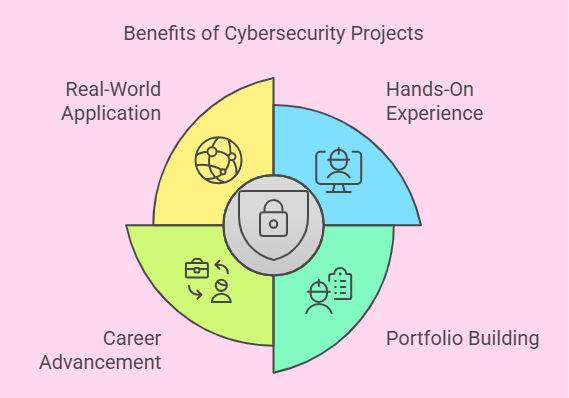
Cybersecurity projects offer invaluable benefits, helping learners and professionals develop practical skills while boosting their career prospects. Below are the key advantages of engaging in cyber security projects:
1. Hands-On Experience
Working on cybersecurity projects provides practical exposure to real-world scenarios. It helps build technical skills like threat detection, vulnerability assessment, and encryption, enhancing problem-solving abilities critical for success in cybersecurity roles.
2. Portfolio Building
Cybersecurity projects create a portfolio showcasing your expertise to potential employers. Demonstrating achievements, such as building a vulnerability scanner or implementing SIEM, makes you stand out in the competitive job market.
3. Career Advancement
These projects help acquire industry-relevant skills and stay updated with emerging trends. Gaining experience with advanced tools and techniques boosts your employability and prepares you for higher-level roles in cybersecurity.
4. Real-World Application
Cybersecurity projects address pressing security challenges affecting businesses and governments. By solving genuine problems, you contribute to creating safer digital environments while refining your knowledge of security protocols and methodologies.
Also Read: Top 6 Critical Challenges of Cloud Computing [Everything You Need to Know]
Cybersecurity is one of the fastest-growing fields in the digital age, offering unparalleled career prospects. Here's why a career in cybersecurity is highly rewarding:
Click on the link to read more about the Scope of Cybersecurity in the current industry and learn about the opportunities in this field.
Cybersecurity projects address critical challenges and provide innovative solutions across different domains. Here are some key use cases:
Also Read: What Is Ethical Hacking? The Legal Way to Hack Systems!
Subscribe to upGrad's Newsletter
Join thousands of learners who receive useful tips
A career in cyber security is highly rewarding, offering opportunities to work in critical areas like ethical hacking, threat intelligence, and cloud security. If you're aspiring to build expertise in this field, upGrad can provide the right platform to get started.
upGrad, a leading online education provider, offers comprehensive cyber security courses in collaboration with renowned universities. These programs are designed to equip you with industry-relevant skills and hands-on experience through practical projects and case studies.
If you’re looking for Free Courses to upskill yourself or want a Free Career Counselling Session for a better understanding of the career pathways, here’s your chance to get some expert insights on what’s the best next move for you.
Similar Reads:
Cyber security projects are hands-on tasks where learners build tools, test systems, detect vulnerabilities, or simulate attacks. These projects help you understand security concepts through practical work and prepare you for roles related to network security, ethical hacking, and system protection.
They help you apply theory to real problems, understand attack patterns, and learn defensive strategies. Practical work improves confidence, strengthens your portfolio, and shows employers your ability to solve security challenges through structured planning and testing.
Cybersecurity projects for beginners include password strength checkers, basic port scanners, simple keyloggers, firewall rule setups, and Wi-Fi security audits. These projects introduce essential tools and methods without requiring advanced coding or complex security frameworks.
Basic networking, Linux commands, Python fundamentals, and understanding of encryption and authentication. These skills allow beginners to explore simple tools, automate tasks, and run small security tests safely.
Cybersecurity projects for students include vulnerability scanning, web application testing, malware analysis basics, and network monitoring dashboards. These projects help students understand real threats and practice applying security measures across systems.
Projects like intrusion detection systems, phishing detection models, SIEM dashboards, automated scanners, and secure login modules demonstrate hands-on expertise. These projects show that you can use real security tools and analyse threats effectively.
Cybersecurity projects for final year students include anomaly detection models, blockchain-based identity management, advanced penetration testing frameworks, and secure file transfer systems. These projects show deeper technical understanding and are suitable for research or industry-level evaluation.
Pick a project based on your skill level, interest area, and available tools. Beginners can start with simple analysis tasks, while advanced learners can explore penetration testing, monitoring systems, or automation-based security solutions.
Common tools include Wireshark, Nmap, Burp Suite, Metasploit, Splunk, Snort, and Python libraries. These tools help with scanning, testing, monitoring, and analysing networks or applications in real scenarios.
Yes. Many projects, such as network mapping, vulnerability scanning, documentation-based audits, and configuration tasks, do not require coding. However, coding knowledge helps you automate tasks and build more advanced solutions.
Python is most common due to its security-focused libraries. Other useful languages include Bash, PowerShell, JavaScript, and C. These help you create scripts, analyse data, test vulnerabilities, and automate security checks.
Completing three to five cybersecurity projects for beginners is enough to build confidence. A small but diverse project set shows your understanding of scanning, testing, scripting, and documentation.
Examples include network packet analysis, intrusion detection rules, firewall configurations, honeypot setups, and traffic monitoring dashboards. These projects strengthen your understanding of network behaviour and common attack patterns.
You can build SQL injection testing tools, cross-site scripting detectors, secure login forms, or vulnerability scanning scripts. These projects help you practise securing web applications and understanding common web attacks.
Complex options include malware detection using machine learning, cloud security policy automation, zero-trust access models, and endpoint protection tools. These require deeper knowledge in networking, scripting, and analysis.
Projects show employers your practical skills, familiarity with tools, and ability to solve real issues. They act as proof of work and help you discuss security tasks confidently during interviews.
Yes. Many cybersecurity projects for students use open-source tools like Nmap, Wireshark, Metasploit, OpenVAS, and Security Onion. These tools let you explore real concepts without high setup costs.
Yes, if done in secure environments like virtual machines, isolated networks, or sandbox systems. Avoid testing on live systems you don’t own. Safe setups protect you from accidental security risks.
Both are possible. Beginners often start alone with simple tools, while group projects help students tackle advanced systems like SIEM dashboards, monitoring tools, or penetration testing frameworks.
Cybersecurity projects for final year show deeper analytical skills, system-level knowledge, and ability to design complete solutions. Recruiters value strong project reports, tool usage, and real testing outcomes as indicators of job readiness.
Source Code Links:
418 articles published
Rohan Vats is a Senior Engineering Manager with over a decade of experience in building scalable frontend architectures and leading high-performing engineering teams. Holding a B.Tech in Computer Scie...
Speak with Data Science Expert
By submitting, I accept the T&C and
Privacy Policy
Start Your Career in Data Science Today
Top Resources
Executive Diploma
12 Months
Master's Degree
18 Months
Bootcamp
6 Months